
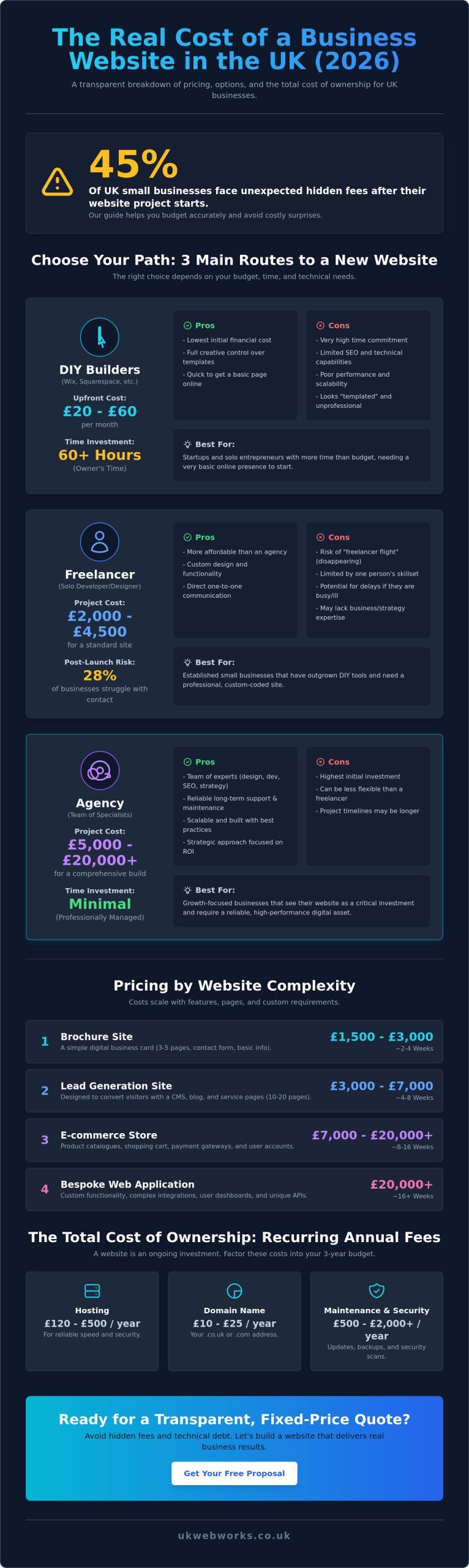
Why does one agency quote you £2,000 for a new site while another demands £20,000 for what looks like the same brief? It’s a common frustration for UK business owners who just want a straight answer. You likely feel that getting a clear picture of the average cost of a new business website uk 2026 is harder than it should be. Recent industry surveys from 2024 suggest that 45% of small business owners encounter unexpected hidden fees after a project starts. It’s exhausting to deal with these surprises or the constant worry that a budget template will fail you as you scale. We know you need a reliable tool for growth, not a technical headache.
We believe in digital craftsmanship and total honesty. This guide gives you a transparent, jargon-free breakdown of UK website pricing to ensure you don’t overpay for features you don’t need. We’ll explain the three distinct price tiers available in 2026 and provide a logical framework to help you justify the investment to your stakeholders. You’ll finish this article with a clear roadmap to avoid technical debt and build a site that actually works for your bottom line.
Key Takeaways
- Understand how inflation and rising UK tech salaries have shifted website pricing from static pages to dynamic business tools.
- Compare the average cost of a new business website uk 2026 across DIY, freelancer, and agency routes to find the right balance between time and investment.
- Learn the realistic price brackets for everything from simple brochure sites to complex bespoke ecommerce shops.
- Identify the “hidden” recurring fees and maintenance costs to accurately project your digital spend over a three-year horizon.
- Spot red flags in design proposals and learn how to write a brief that secures a transparent, fixed-price quote.
Understanding Website Pricing in 2026: Why Ranges Vary So Widely
Pricing a website in 2026 feels more complex than it did a few years ago. You aren’t just buying a digital flyer anymore. You’re investing in a 24/7 sales representative that needs to handle payments, book appointments, and rank on search engines. The average cost of a new business website uk 2026 reflects this shift from static pages to dynamic business tools. Today, a website must be fast, secure, and accessible to everyone, or it simply won’t perform.
Economic factors have also played a role. Since early 2024, UK tech salaries have risen by approximately 5.2 percent. Because agencies need to retain top-tier talent to handle modern security threats and complex integrations, these overheads naturally influence project rates. When you see a wide range in quotes, you’re often looking at the difference between a solo freelancer and a full-service team. A larger agency carries higher overheads but provides a safety net of multiple specialists, whereas a smaller shop offers lower costs but higher individual dependency.
The “Black Box” of pricing usually comes down to what happens under the hood. A cheap quote often ignores long-term health. Choosing the lowest price frequently leads to technical debt, where your site requires expensive rebuilds within 18 months because it was built on shaky, outdated foundations. We focus on digital craftsmanship to ensure your investment lasts.
The Impact of AI and Automation on Build Costs
AI tools have flooded the market in 2026, making it easier to generate code and content quickly. This has lowered the entry barrier for basic sites, but it has increased the need for expert human oversight. AI-generated “cookie-cutter” sites often lack the nuance required for high-level SEO and user experience. While we use automation to streamline repetitive tasks, we believe bespoke craftsmanship remains the gold standard. Following established Web design principles ensures your site is actually built for your specific UK audience, rather than being a generic template that fails to convert visitors into customers.
Fixed-Price vs. Hourly Rate Models
Budgeting for the average cost of a new business website uk 2026 requires a clear understanding of how you’ll be billed. Hourly rates often lead to “budget creep,” where a project that started at £2,000 ends up costing £4,000 because of “unforeseen” tweaks. Fixed-price models are generally better for small to medium businesses because they offer certainty. You know exactly what you’re paying before the first line of code is written. Many owners find that clearly defined Fixed-Price Website Build Fees provide the necessary transparency for budgeting. At UK Web Works, we lean into transparent, jargon-free fixed pricing. It removes the stress of watching the clock and keeps the focus on delivering a high-quality result that helps your business grow.
Comparing the Three Main Routes: DIY, Freelancers, and Agencies
Choosing the right path for your online presence depends on a direct trade-off between your time and your budget. For most UK business owners, time is the most expensive resource. While you might save money upfront by doing the work yourself, the long-term impact on your growth can be significant. The average cost of a new business website uk 2026 varies wildly across these three routes, but the value you receive is rarely just about the price tag.
DIY Builders: Low Upfront Cost, High Time Commitment
Platforms like Wix, Squarespace, and Shopify are popular for startups with more time than capital. In 2026, expect to pay between £20 and £60 per month for a professional-tier subscription that removes third-party branding. However, the “DIY Trap” is real. Business owners often spend upwards of 60 hours trying to get a template to look right. This breakdown of website costs confirms that while entry fees are low, you often lose out on custom functionality and specialized SEO. If your site doesn’t rank on Google because of technical limitations, the “cheap” option becomes very expensive in lost leads. If you want to avoid this time-consuming trap, you can discover more about 24-Hour Website Builder to get a professional site launched in just one day.
The Freelance Middle Ground
Hiring a freelancer is a common step for businesses that have outgrown DIY tools. Average UK freelance rates for a standard WordPress build in 2026 typically sit between £2,000 and £4,500. It’s important to distinguish between a designer, who focuses on visuals, and a developer, who handles the code and security. A common challenge here is “freelancer flight.” Industry data suggests that 28% of small businesses struggle to contact solo contractors for urgent updates after the initial launch. Before hiring, always ask who will maintain the site if they are on holiday or move to a full-time role elsewhere.
Professional Agencies: The Strategic Investment
Agencies charge more because they provide a multi-disciplinary team. When you work with an agency, you aren’t just paying for a person to move pixels around. You’re paying for project management, quality assurance testing, and strategic marketing. The average cost of a new business website uk 2026 for an agency build starts around £5,000 but offers much higher stability.
We believe the real value lies in bespoke website development. Unlike templates, a bespoke site is built specifically for your brand authority and conversion goals. These builds are optimized for speed and scalability from day one, ensuring your site grows as your business does. If you want a partner who takes a no-nonsense approach to your growth, you can view our straightforward services to see how we help local businesses succeed.
- DIY: Best for side hustles and testing very small ideas.
- Freelancers: Good for limited budgets with specific, simple requirements.
- Agencies: Best for established businesses where reliability and ROI are the priorities.
Pricing by Website Complexity: From Brochure Sites to Bespoke Ecommerce
The average cost of a new business website uk 2026 depends heavily on what you need the site to do for your customers. We see many business owners struggle because they compare a simple five page site to a complex portal. It’s like comparing a garden shed to a three bedroom semi; both have a roof, but the engineering involved is worlds apart. Your budget should reflect the level of functionality required to meet your specific business goals.
Standard Brochure Websites (£2,500 to £7,500)
A brochure site acts as your digital storefront. For an investment between £2,500 and £7,500, you should receive a high quality, responsive design with 5 to 10 pages and basic SEO. By 2026, standards for speed and accessibility have tightened. A site that takes longer than 2.5 seconds to load or fails to meet WCAG 2.2 accessibility guidelines will simply disappear from search results. We find WordPress remains the most cost-effective CMS for this bracket. It gives you a professional platform without the high monthly fees of proprietary builders. As the Federation of Small Businesses (FSB) often points out, a credible online presence is the most important asset for any UK firm looking to compete locally.
Ecommerce and Online Shops (£5,000 to £25,000+)
Selling products online adds layers of technical complexity that “simple” sites don’t have. You aren’t just paying for a design; you’re paying for secure payment gateways, automated shipping logic, and inventory synchronization. Shopify is a popular choice for quick launches, but those monthly app fees can quickly eat into your margins. WooCommerce offers more control but requires more technical oversight. Because the stakes are higher with financial transactions, choosing the right ecommerce company is the difference between a site that converts and one that crashes during a sale. A well-built shop should pay for itself through increased conversion rates, which often rise by 20% when moving from a template to a professional build.
Complex Bespoke Web Applications (£15,000+)
When your business needs go beyond standard pages, you enter the territory of bespoke web applications. This includes membership portals, custom booking systems, or sites that need to talk to your CRM and ERP software via APIs. These projects require a dedicated technical specification phase before a single line of code is written. While the upfront average cost of a new business website uk 2026 is higher for these builds, the long-term ROI is often superior. You own the intellectual property and you don’t get trapped in “per-user” subscription models. These systems are crafted to match your exact internal workflows, saving your team hours of manual data entry every week.
The Total Cost of Ownership: Recurring Fees and “Hidden” Extras
Viewing a website as a one-time purchase is a common trap for business owners. The launch price is just the beginning of your investment. To get an accurate view of the average cost of a new business website uk 2026, you need to project your spending over a three-year horizon. This approach prevents nasty surprises and ensures your digital presence stays functional and secure. A website is a living asset; it needs regular attention to remain a tool rather than a liability.
Hosting, Domains, and Security
Your website needs a reliable home and a clear address. In 2026, UK hosting prices vary based on the performance and traffic you expect. Basic shared hosting remains affordable at roughly £12 to £25 per month. Managed cloud hosting is the superior choice for growing brands, typically starting around £45 per month. You should also budget for these essentials:
- Domain Renewals: Expect to pay £15 to £30 per year for .co.uk or .com addresses.
- Professional Email: Business-grade email through platforms like Microsoft 365 costs about £6 to £15 per user, per month.
Ongoing Maintenance and Support Plans
Software doesn’t stay static. Plugins, themes, and core systems require regular updates to fix bugs and close security loopholes. The 2024 Cyber Security Breaches Survey reported that 50% of UK businesses identified a cyber attack in the previous 12 months. Neglecting updates makes your business an easy target. Most UK agencies offer monthly maintenance retainers starting from £100. These plans cover automated daily backups, security monitoring, and small technical tweaks. Having a developer on call saves you from the panic of a site crash during a peak sales period.
Marketing and Content: The Fuel for Your Website
A beautiful website without traffic is like a high-end showroom on a deserted island. You need a strategy to attract visitors. While initial SEO setup is often part of the build, ongoing monthly optimisation is what drives long-term growth. When calculating the average cost of a new business website uk 2026, don’t forget the cost of professional assets. A local commercial photographer might charge £400 for a basic shoot, and professional copywriting ensures your site actually converts visitors into customers. Distinguishing between “needs” like security and “wants” like complex animations helps you allocate your budget where it delivers the most value.
Want a clear breakdown of your long-term website costs? Talk to our team for a transparent, jargon-free consultation.
How to Choose the Right Partner and Secure a Fixed-Price Quote
Finding a partner who understands your vision is just as vital as the budget itself. While understanding the average cost of a new business website uk 2026 helps you set expectations, a quote is only as good as the agency behind it. You should be wary of red flags during the proposal stage. If a developer provides a vague “estimate” rather than a fixed price, or if their proposal is buried under layers of technical jargon, take it as a warning sign. Transparency in pricing is the ultimate trust signal. It shows that the agency has a proven process and understands the work required to deliver your project.
To get an accurate, no-nonsense quote, you need to provide a clear brief. List your specific business goals, the essential features you need, and examples of sites you admire. This prevents “scope creep” later in the project. Always prioritize UK-based support and communication. Being able to pick up the phone and speak to someone who understands the local market makes a massive difference in how quickly issues are resolved and how well your brand is represented online.
Vetting Your Potential Agency
When you review portfolios, look beyond “pretty” pictures. Test the functionality of their previous work. Use tools like Google PageSpeed Insights to see if their sites actually perform well. We suggest looking for long-term client relationships. An agency that has supported the same business for three or more years is a clear sign of reliability and consistent quality. Your initial consultation should be jargon-free. If a consultant can’t explain a strategy without using confusing buzzwords, they likely don’t have your best interests at heart.
Securing Your Investment
You must ensure you own your website outright. Some agencies use proprietary systems that make it impossible to move your site elsewhere. Always check that you own the intellectual property and the code once the final invoice is paid. This protects your business long-term. Structure your project with clear payment milestones. A typical reliable structure involves a deposit, a mid-point payment after design approval, and a final sign-off payment once you are 100% satisfied.
At UK Web Works, we deliver bespoke quality with fixed-price certainty. We know that the average cost of a new business website uk 2026 can be a significant investment for a small company, so we eliminate the guesswork. Our approach is grounded in digital craftsmanship and direct communication. We don’t use high-pressure tactics or hidden fees. Instead, we focus on building a high-performing site that serves as a reliable tool for your business growth, backed by a team that’s always ready to help.
Future-Proof Your Business with a Clear Digital Strategy
Budgeting for your online presence shouldn’t be a game of chance. While the average cost of a new business website uk 2026 is influenced by rising technical standards and the need for deeper integration, your focus should remain on long-term value. You now understand that the right route depends on your complexity, from simple brochure sites to bespoke ecommerce solutions. Since 2014, our UK-based team has delivered reliable digital craftsmanship with a strictly jargon-free, no-nonsense attitude. We’ve spent over a decade demystifying the web for local business owners, ensuring every pound spent contributes to real growth.
Choosing a partner who offers transparency over technical fluff is the smartest way to protect your investment. Don’t settle for vague estimates or hidden fees that balloon your budget later. We’re ready to provide the honest, expert guidance you need to succeed in a competitive market. It’s time to build a website that works as hard as you do.
Get a transparent, fixed-price quote for your 2026 website project
Your journey toward a professional, high-performing website starts with a single, straightforward conversation.
Frequently Asked Questions
How much does a basic 5-page business website cost in the UK in 2026?
In 2026, you can expect to pay between £1,000 and £2,500 for a professionally designed 5-page website in the UK. This price range typically covers a bespoke design, mobile responsiveness, and a secure contact form. We focus on providing clear, fixed pricing so you aren’t hit with unexpected bills halfway through your project. Costs vary based on whether you choose a freelancer or a small agency, but this remains a standard benchmark for quality work.
Is it cheaper to use a website builder or hire a professional?
A website builder like Wix or Squarespace is cheaper initially, with monthly costs ranging from £15 to £45. However, hiring a professional is often more cost-effective in the long run because the site is built to convert visitors into customers. Data from 2024 suggests that 70% of DIY websites fail to rank on the first page of search results. A professional build saves you hours of frustration and delivers a tool that actually grows your business.
Why is there such a huge price difference between web design quotes?
The price difference usually comes down to the level of strategy, customisation, and ongoing support included in the quote. A £500 quote often uses a basic template with no SEO or security features, while a higher quote from a reputable UK agency covers deep market research and custom coding. You aren’t just paying for a layout; you’re paying for a specialist team that understands the local market. We provide a transparent breakdown so you know exactly where your investment goes.
How much should I budget for monthly website maintenance?
You should budget between £50 and £150 per month for reliable website maintenance in 2026. This monthly fee covers essential services like secure hosting, software updates, and regular off-site backups. Skipping these updates leaves 60% of small business websites vulnerable to security breaches within their first year. Investing in a maintenance plan means a professional keeps your site running smoothly while you focus on running your daily operations.
Does the cost of a website include SEO and content writing?
Standard web design quotes usually exclude professional copywriting and advanced SEO as these are specialist services. While we ensure every site has a solid technical foundation, high-quality copy often requires a separate investment. It’s vital to clarify these details early to ensure the average cost of a new business website uk 2026 fits your total marketing budget. Always ask your provider if they include keyword research or if you need to provide the text yourself.
Can I get a fixed-price quote for a bespoke website build?
You can definitely get a fixed-price quote for a bespoke build if the agency provides a clear scope of work. We believe in being refreshingly direct about costs, so we provide a set price upfront to avoid any surprise charges later. This approach ensures you know your total investment before any design work starts. A fixed-price agreement protects your budget and holds the agency accountable for delivering the project as promised.
What are the hidden costs of building a new website?
Common hidden costs include annual domain renewals at £15 to £30 and premium plugin licenses which can reach £200 annually. You might also need to pay for professional stock photography if you don’t have high-quality images of your own. We aim to be honest about these extras from day one so your budget remains realistic. Understanding these 2026 market rates helps you plan for the entire lifecycle of your digital presence without any nasty surprises.
How long does a professional website build typically take?
A professional website build typically takes between 4 and 12 weeks from the initial consultation to the launch date. A simple 5-page site usually sits at the 4-week mark, while more complex projects with custom features require the full 12 weeks. This timeline allows for design revisions, technical testing, and making sure the site is fully responsive on all devices. We follow a logical, step-by-step process to ensure your project stays on track and meets your deadline.