What if the most beautiful website you’ve ever seen is actually costing your business money every single day? A 2024 study by the Federation of Small Businesses found that nearly 70% of small firms feel their digital presence isn’t working hard enough to drive growth. It’s a common frustration. You want a professional online presence, but you’re likely tired of being blinded by technical jargon or worried about hidden hosting fees that suddenly appear in your inbox. Finding a reliable website designer shouldn’t feel like a gamble, especially when your business growth depends on it.
We agree that you deserve better than a “disappearing” freelancer or a flashy agency that doesn’t understand the local UK market. This guide promises a clear, honest, and jargon-free path to choosing a partner who builds for performance, not just for show. We’ll show you exactly how to interview candidates, what a fair maintenance contract looks like, and how to ensure your site generates real leads in 2026. From bespoke layouts to transparent pricing, we’ve broken down the essential steps to help you secure a website that actually works.
Key Takeaways
- Shift your focus from aesthetics to results by understanding how professional design bridges the gap between your business goals and customer experience.
- Use our 2026 checklist to ensure your chosen website designer prioritizes strategic business growth and technical performance over mere visual appeal.
- Learn how to look beyond portfolio screenshots to evaluate real-world site speed, ease of use, and whether a provider offers truly bespoke work.
- Protect your investment by asking five critical questions about fixed pricing and ensuring you retain full ownership of your domain and content.
- Discover the value of a jargon-free partnership that offers transparent, honest communication without the high-pressure tactics of traditional agencies.
Defining the Role: What Does a Professional Website Designer Actually Do?
Hiring a website designer in 2026 isn’t just about picking someone who can make a page look “pretty.” While aesthetics matter, a professional’s true job is to create a functional asset that turns visitors into paying customers. They act as the bridge between your specific business goals and the digital experience your customers expect. If your goal is to increase enquiries by 20%, the design must lead the user toward that goal with zero friction.
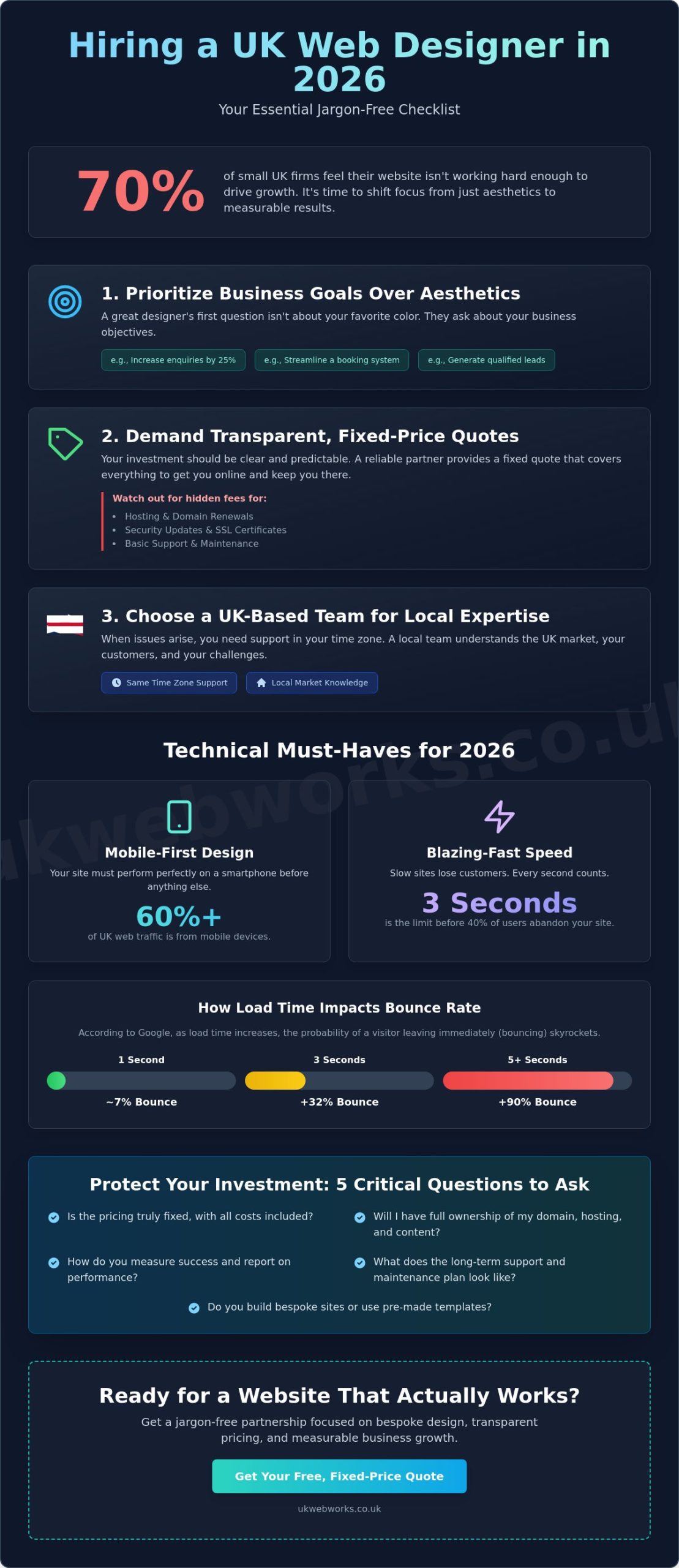
You might think a site is just pictures and text, but there is a lot going on under the hood. A pro manages critical technical foundations like site speed and mobile responsiveness. According to data from Google, as page load time goes from one second to three seconds, the probability of a bounce increases by 32%. A designer ensures your site works perfectly on every device, from a smartphone in a rural part of the UK to a high-end desktop in a London office.
To understand the full scope of the field, it helps to look at What Does a Professional Website Designer Actually Do? beyond just the visual layer. It involves user interface (UI) design, user experience (UX) research, and ensuring the layout supports your search engine visibility. It’s a blend of psychology, art, and technical engineering.
When you start your search, you’ll find three main paths. DIY tools are cheap but often leave you with a site that looks like everyone else’s. Freelancers offer flexibility but can sometimes lack the breadth of skills needed for complex projects. A full-service UK web agency provides a dedicated team of specialists. This approach ensures your site is a bespoke business tool built with local market knowledge and long-term support in mind.
Designer vs. Developer: Understanding the Difference
Designers focus on the user journey and visual layout. They decide where buttons go, which colours represent your brand, and how the information flows. Developers build the engine and technical functionality, writing the code that makes those buttons work. Hiring a team that handles both ensures a seamless project. It prevents the common “handover” issues where a beautiful design is too heavy or complex to actually function in a real browser.
The Business Impact of Professional Web Design
Conversion rate optimization is the process of making it as easy as possible for a visitor to take a specific action, such as filling out a contact form or buying a product. Professional branding builds immediate trust; research suggests users take only 0.05 seconds to form an opinion about your website. A bespoke site offers a long-term ROI that restrictive templates cannot match. It gives you the freedom to scale your business without being held back by “off-the-shelf” limitations.
If you are looking for inspiration on how technical craftsmanship can support business growth, you can discover 創意數位科技 and their specialized approach to web development.
The Essential Checklist for Hiring a Website Designer in 2026
Finding the right website designer shouldn’t feel like a gamble. You need a partner who understands that your site is a sales tool, not just a digital art project. A professional designer asks about your business goals before they ever mention colour palettes or font styles. They’ll want to know if you’re aiming for a 25% increase in lead generation or if you need to streamline a booking system to save five hours of admin every week. If their first question is about your favourite shade of blue, they aren’t thinking strategically about your growth.
Transparency is another non-negotiable factor. You should receive a clear breakdown of costs upfront. Watch out for hidden “extras” for hosting, security updates, or basic support. A reliable agency provides a fixed quote that covers everything you need to get live and stay online. It’s also vital to choose a UK-based team. When you have an urgent question or something goes wrong, you don’t want to wait eight hours for a different time zone to wake up. Local support means you can pick up the phone and speak to someone who understands the UK market and your specific challenges.
Technical Must-Haves for Modern Websites
Mobile-first design is the standard in 2026. With over 60% of UK web traffic now coming from mobile devices, your site must look and perform perfectly on a smartphone before anything else. You should verify that your chosen responsive web design company prioritises page speed. Research shows that 40% of users abandon a site if it takes longer than three seconds to load. Your designer must also implement an SEO-friendly structure from the start. This includes clean code, proper header tags, and fast-loading images so that Google can easily find and rank your business.
Communication and Jargon-Free Reporting
Avoid designers who hide behind technical “smoke and mirrors.” If they use words like “back-end architecture” or “API integration” without explaining the benefit to you, they’re likely trying to justify a higher price tag. You deserve a partner who explains the process in plain English. Test their responsiveness during the enquiry phase. If they take three days to reply to a simple email now, they’ll likely be even slower once the project is underway. A dedicated project manager ensures you’re never left wondering about the status of your build. If you’re looking for a straightforward approach to your next project, you can view our simple process here to see how we work.
- Strategic focus: Do they prioritise your business ROI?
- Clear pricing: Are there any hidden monthly fees?
- UK support: Can you reach them during your working hours?
- Plain English: Do they demystify the tech or use it to confuse you?
Portfolio Analysis: How to Spot a Designer Who Delivers Results
A portfolio is more than a gallery of pretty pictures; it’s a record of performance. When you evaluate a potential website designer, don’t just scroll through their home page images. Open the actual links. A screenshot won’t tell you if a button works or if the page takes five seconds to load. In 2026, speed is non-negotiable for both user retention and search engine rankings. If a live site in their portfolio feels sluggish, yours likely will too.
Look for variety in their work. If every project follows the same layout, you aren’t getting a bespoke solution; you’re getting a template. Your business has unique goals, and your site should reflect that. Check if they’ve handled complex builds, particularly if you need a specialist ecommerce web design company. Selling online requires a specific set of skills, from secure checkout integrations to inventory management. A designer who has solved these problems for others will save you from expensive mistakes later.
Read the case studies carefully. Look for the “why” behind the design choices. A good case study identifies a specific hurdle, such as a high bounce rate or a confusing checkout process, and explains how the designer fixed it. This shows they think about your bottom line, not just the aesthetics. Evidence of digital craftsmanship usually lies in these details.
Testing User Experience (UX) on Live Sites
Grab your mobile phone and visit three sites from their portfolio. This is the quickest way to see if a website designer prioritises modern users. Over 60% of UK web traffic now happens on mobile devices, so a desktop-only focus is a red flag. Check for clear Calls to Action (CTAs). Can you find the contact button or the “Buy Now” link within three seconds? If the navigation feels like a maze, your customers will leave before they’ve even seen your offer. Understanding what separates a high-performing mobile experience from a frustrating one is exactly what a responsive web design company should be able to demonstrate across every site in their portfolio.
Verifying Client Testimonials and Reviews
Authentic feedback is the bedrock of trust. While quotes on a designer’s own website are helpful, they’re often curated to show only the best bits. Search for the agency on Google or Trustpilot instead. Look for specific mentions of reliability, honesty, and post-launch support. A project doesn’t end on the day the site goes live; you need to know they’ll be there if something breaks. Be wary of reviews that sound too polished or identical. Genuine clients often mention a specific challenge they faced or the direct, no-nonsense attitude of the team during the build process.
Contract Clarity: 5 Essential Questions to Ask Your Potential Designer
Before you sign any paperwork, you need to know exactly what you are paying for. A professional website designer should provide a clear, jargon-free contract that leaves no room for hidden extras. This protects your investment and ensures the final product meets your expectations without a budget blowout. Here are five questions to ask before the work begins.
- Is the price fixed or will it change? You need to know if the quote covers the entire project or if you’ll be billed hourly if the project evolves. Clarity here prevents awkward conversations later.
- Who owns the website, the domain, and the content? You should have full legal ownership of your digital assets once the final invoice is paid.
- What happens if I need a small change six months after launch? Minor tweaks shouldn’t be a headache. Ask if they offer a set hourly rate for small updates.
- Do you provide managed hosting and security updates? A website isn’t a “set and forget” asset. It needs a secure environment to live in.
- Can you help me grow the site? Your site is a tool for lead generation. Ask if they can integrate digital marketing agency hull strategies like SEO to ensure people actually find you.
Ownership and Intellectual Property Rights
We’ve seen too many business owners trapped by “proprietary” systems. These are website builders owned entirely by the agency. If you decide to move, you can’t take the site with you. You must insist on full admin access to your own Content Management System (CMS). You must own your domain name registration personally or through your limited company to ensure you retain control over your brand’s digital identity.
Post-Launch Maintenance and Technical Support
Building the site is only the first step. Standard hosting is just the “rent” you pay for space on a server, but “managed support” is what keeps your business online and safe. Security updates are non-negotiable for WordPress and Shopify sites. Industry data from 2024 showed that nearly 94% of successful cyberattacks on small business websites targeted outdated plugins or themes. Your contract should clearly state who is responsible for these vital patches.
A reliable website designer acts as a partner, not just a one-time service provider. They should be transparent about what is included and what costs extra. This honest approach is how we build long-term relationships with our clients across the UK. It’s about craftsmanship and accountability, ensuring your site remains a high-performing asset for years to come.
Don’t get tied into a contract that limits your growth. Talk to us today for a straightforward, no-nonsense quote.
The UK Web Works Approach: Bespoke Design Without the Jargon
Choosing a website designer shouldn’t feel like a test of your technical knowledge. At UK Web Works, we’ve built our reputation on a foundation of honesty and direct communication. We don’t use complex terminology to hide high costs or mask a lack of progress. Instead, we provide transparent pricing and clear timelines so you’re always in control of your budget. Our team treats your project with the same care we’d give our own business, focusing on digital craftsmanship that produces real results for UK small and medium enterprises.
We’re more than a one-time service provider. We act as your long-term digital partner. This means our support continues long after your site goes live. Whether you need a new logo design that captures your brand identity or advanced SEO strategies to climb the search rankings, we handle the heavy lifting. By integrating these services, we ensure your online presence is cohesive and professional. Our goal is to demystify the digital world, providing a reliable point of contact for all your technical needs.
Bespoke Design vs. The Template Trap
Many agencies rely on “off-the-shelf” templates to cut corners. While these might seem cheaper initially, they often come with hidden costs. Generic themes are frequently bloated with unnecessary code, which slows down your site. Research from Google shows that 53% of mobile visits are abandoned if a page takes longer than three seconds to load. Our bespoke approach eliminates this bloat, resulting in faster load times and better security. We build every site specifically for your target audience, ensuring the user journey is optimised for conversions.
A bespoke site also scales with your business growth. If you decide to add an e-commerce shop or a complex booking system in 2027, a custom-built foundation can handle it. Templates often break when you try to push them beyond their original limits. By investing in a tailored solution, you’re protecting your business from the technical debt that comes with generic software. According to Stanford University, 75% of users judge a company’s credibility based on its website design. A unique, professional site ensures that first impression is a positive one.
Ready to Start Your Project?
We invite you to reach out for a grounded, honest conversation about your goals. Our discovery process is straightforward. We start by listening to your challenges and identifying what your business actually needs to succeed online. There’s no high-pressure sales talk or “limited time” offers. You’ll speak directly with our UK-based team, ensuring your project benefits from local market expertise and cultural understanding.
Every step of our process is designed to give you peace of mind. From the initial wireframes to the final launch, we maintain a steady, logical flow of information. You’ll receive regular updates in plain English, keeping you informed without the headache of technical fluff. If you’re looking for a website designer who values integrity and hard work as much as you do, we’re ready to get started. Let’s build something that works for your business.
Build a Site That Works as Hard as You Do
Choosing a professional website designer in 2026 doesn’t have to be a complicated or stressful process. By focusing on portfolio performance and insisting on total contract clarity, you’ve already taken the most important steps toward a successful project. A great site is always a balance of bespoke craftsmanship and a deep understanding of the UK market. Since 2014, we’ve focused on providing honest advice and jargon-free support to help local businesses grow without the usual agency headache. We don’t hide behind complex tech talk or hit you with unexpected costs. Instead, we provide fixed-price quotes and a direct, collaborative approach that puts your business goals first. You deserve a partner who values your investment and understands the local landscape. Let’s get to work on a digital presence that reflects your brand’s quality and drives the growth you’re looking for.
Talk to a straight-talking website designer today
Your business has a unique story to tell, and we’re ready to help you share it with the right audience.
Frequently Asked Questions
What is the difference between a website designer and a web developer?
A website designer focuses on the visual layout and user experience, while a web developer builds the functional structure using code. Think of the designer as an architect who creates the blueprints and the developer as the builder who follows those plans. Our team combines both skills to ensure your site looks professional and works perfectly on every level.
How much should I expect to pay a professional website designer in 2026?
You should expect to invest between £2,500 and £7,500 for a bespoke business website in 2026, based on current UK industry standards. Basic brochure sites may start around £1,500, while complex e-commerce platforms often exceed £12,000. We provide fixed quotes to prevent the budget creep that impacts 45% of IT projects, ensuring you stay in control of your costs. For a detailed breakdown of what drives these figures, our guide to website design prices UK explains exactly where your money goes and how to calculate the real ROI of your investment.
If you are looking for a high-quality entry-level option with a much faster turnaround, you can find out more about The £199 Website Package which provides a professional, mobile-responsive site in under 24 hours.
How long does it typically take to design and launch a bespoke website?
A bespoke project usually takes between 8 and 12 weeks from the initial meeting to the final launch. This timeline allows for two weeks of planning, four weeks of design iterations, and four weeks of development and testing. While some basic sites can be ready in 6 weeks, quality craftsmanship requires a methodical approach to ensure everything is right the first time.
Will I be able to update the website content myself after it is built?
You’ll have full control to update text, images, and blog posts through a simple Content Management System. We don’t believe in locking you out of your own site or charging for minor changes. Every project includes a 60 minute training session to show you how to manage your content without needing any technical knowledge or coding skills.
Do I need to provide all the images and text for my new website?
You’re the expert on your business, so you’ll usually provide the core information, but we can help with professional copywriting and photography. Roughly 60% of project delays occur because clients struggle to produce content. If you’re stuck, we’ll step in to refine your message and source high quality imagery that fits your brand perfectly.
Why should I hire a UK-based agency instead of using a cheap offshore freelancer?
Hiring a UK agency gives you legal protection under UK contract law and ensures your website designer understands the local market. You won’t have to deal with awkward time zones or language barriers that lead to mistakes. We offer a reliable, face to face partnership that offshore freelancers simply can’t match, which saves you time and frustration in the long run.
What is responsive design and why is it mandatory for my business?
Responsive design means your site automatically reshapes itself to look great on smartphones, tablets, and desktops. Since over 55% of UK web traffic now comes from mobile devices, a site that’s hard to use on a phone will lose you money. Google also uses mobile-first indexing, so a non-responsive site will struggle to appear in search results at all.
Can a website designer help me get to the first page of Google?
A website designer builds the technical foundation for SEO, but reaching the first page requires a long term strategy and quality content. We ensure your site is fast, secure, and follows Google’s Core Web Vitals, which are essential ranking factors. While nobody can honestly guarantee a number one spot, a well-built site gives you the best possible start in a competitive market.