
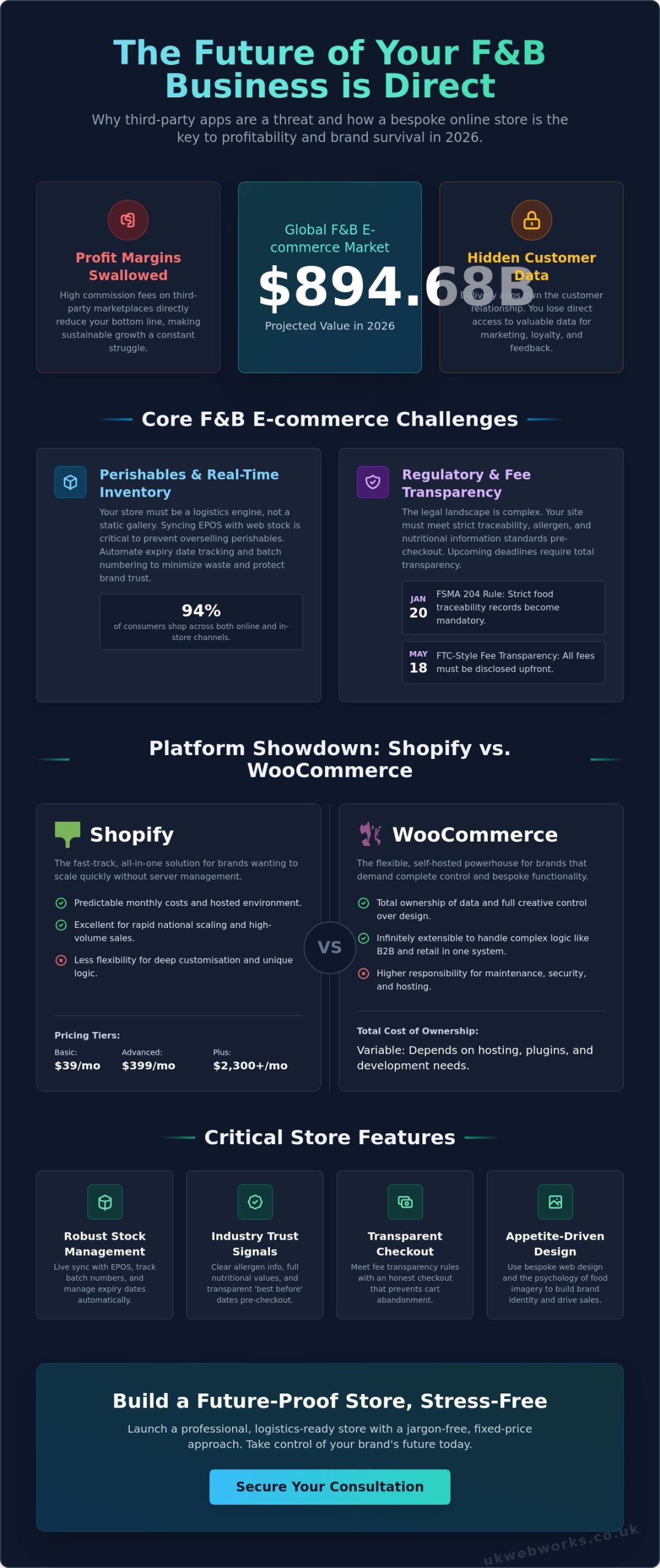
What if the third-party delivery apps you rely on are actually the biggest threat to your brand’s survival in 2026? While these platforms offer reach, they often swallow your margins and hide your customer data. Building a bespoke online store for food and beverage business is no longer a luxury for local producers or restaurants. It’s a necessary shift to protect your bottom line. With global F&B e-commerce projected to hit $894.68 billion this year, the real challenge is moving from a simple website to a logistics engine that works as hard as your kitchen does.
We understand that managing perishables and syncing EPOS systems with web inventory feels like a technical minefield. You want to focus on quality, not troubleshooting code or worrying about the May 18, 2026, FTC deadline for fee transparency. This article will show you how to build a high-performing, logistics-ready store that streamlines your operations and secures your data. We’ll explore everything from meeting the January 2026 FSMA 204 traceability rules to choosing between a $39 Shopify Basic plan or a flexible WooCommerce setup to ensure your brand remains profitable and professional.
Key Takeaways
- Learn why moving your online store for food and beverage business away from third-party marketplaces is the only way to fully own your customer data and protect your profit margins.
- Compare the total cost of ownership between Shopify and WooCommerce to find the right balance of flexibility and ease of use for your specific brand.
- Discover the essential technical features, from robust stock management to industry-specific trust signals, that prevent cart abandonment in the F&B sector.
- Understand how to use the psychology of food imagery and bespoke web design to build a brand identity that reflects your heritage and drives sales.
- See how a jargon-free, fixed-price approach to web development can help you launch a professional, future-proof store without the stress of hidden costs.
The Unique Challenges of Running an Online Store for Food and Beverage Business
Running an online store for food and beverage business is fundamentally different from selling shelf-stable goods like electronics or clothing. You aren’t just moving boxes; you’re managing life cycles. The traditional “buy-it-now” model often collapses if your digital stock isn’t perfectly synced with your physical pantry. If a customer orders a specific artisan cheese or a fresh batch of sourdough that sold out in-store twenty minutes ago, the brand trust you’ve built vanishes instantly. In 2026, approximately 94% of consumers shop across both online and in-store channels, which means your inventory must be a single, unified source of truth.
Many F&B brands are now reclaiming their independence from third-party marketplaces. While these aggregators provided a lifeline in previous years, the high commission fees and lack of customer data have become unsustainable hurdles. By moving to a direct-to-consumer (D2C) model, you gain full ownership of your margins and your audience. Understanding the history and business models of online food ordering helps clarify why owning your platform is the most reliable path to long-term growth. This shift allows you to handle retail orders alongside wholesale (B2B) accounts on a single platform, streamlining your entire operation without the need for multiple, disconnected systems.
Managing Perishables and Real-Time Inventory
Your CMS needs to be more than a product gallery; it must act as a live logistics engine. We focus on integrating your web store directly with your physical warehouse or shop stock to prevent the nightmare of overselling. Automating “out of stock” triggers is vital when dealing with perishables that have limited shelf lives. If your system knows a specific batch expires within 48 hours, it can automatically trigger a discount or delist the item to protect your reputation. Handling batch numbers and expiry dates through a bespoke CMS ensures that you’re always shipping the freshest products while minimizing waste.
UK Regulatory Compliance and Online Labelling
The legal landscape for an online store for food and beverage business became significantly more complex in early 2026. Following the compliance deadline for the FDA’s FSMA 204 rule on January 20, 2026, UK businesses have also faced stricter traceability requirements. Your website must provide clear, digital allergen information and full nutritional values before the customer reaches the checkout. This isn’t just a recommendation; it’s a core component of 2026 UK consumer protection standards. We ensure your checkout process is transparent about “best before” dates and packaging waste diversion, helping you meet the May 18, 2026, FTC-style fee transparency rules that consumers now expect as standard.
Shopify vs WooCommerce: Which Platform Wins for Food Brands in 2026?
Deciding on the right platform for your online store for food and beverage business is a pivotal moment for your brand. It’s not just about the monthly subscription; it’s about how the system responds when your order volume spikes. To make an informed choice, you need to look at current food and beverage market trends, which show a massive 16.9% CAGR growth for 2026. This growth means your store needs to be more than just a digital brochure. It must be a scalable engine that handles everything from tax obligations to complex delivery windows without breaking.
The total cost of ownership varies significantly between the two main players. Shopify offers a predictable, hosted environment, while WooCommerce provides a flexible, self-hosted foundation. Both platforms have evolved to handle the specific needs of food retailers, but they cater to different business styles. Whether you value a “hands-off” technical approach or complete creative control, your choice will dictate how easily your non-technical staff can manage daily orders and inventory changes.
Shopify: The Fast-Track to National Food Retail
Shopify is often the go-to for brands looking to scale quickly without worrying about server maintenance. The Basic plan starts at $39 per month, while the Advanced plan reaches $399. For massive operations, Shopify Plus begins at $2,300 per month. It’s a robust solution where security and hosting are managed for you. This is ideal if you’re running high-volume flash sales or limited edition product drops that might crash a standard server. It’s built for speed and reliability, making it a strong contender for standard D2C food brands that want to focus on the product rather than the plumbing.
WooCommerce: Bespoke Flexibility for Complex Menus
If your business model involves complex product configurations, WooCommerce is often the better fit. It allows for a truly bespoke website design that can handle weight-based pricing, bulk discounts, and specific wholesale tiers. While the plugin is free, you’ll need to budget for managed hosting, which typically ranges from $30 to $200 per month for a busy store. Essential extensions like WooCommerce Subscriptions cost around $279 per year. The real value here is ownership. You aren’t renting a space; you own the entire shop floor, from the checkout flow to every bit of customer data. Finding the right balance between these two can be tricky, but choosing a bespoke ecommerce solution ensures your tech stack never limits your growth.
Critical Features Your Food and Beverage Store Cannot Ignore
A standard checkout process is often the point where a promising online store for food and beverage business loses its momentum. In 2026, customers don’t just want to buy a product; they want to know exactly how and when it will arrive at their door. Generic ecommerce templates rarely account for the logistical gymnastics required to ship fresh or fragile items. To reduce cart abandonment, which still hovers around 70% across the industry, you must integrate trust signals that go beyond a simple SSL certificate. This includes displaying live food hygiene ratings, clear “packed on” dates, and transparent sourcing information right where the customer makes their final decision.
Local Delivery Zones and Click-and-Collect Logic
Precision is everything when you’re dealing with chilled or short-dated goods. Your store needs robust postcode validation to ensure you only accept orders you can actually fulfill. We implement delivery rules that allow you to set specific zones, such as offering local van delivery within a 10-mile radius while using national couriers for shelf-stable items. Click-and-collect is equally vital. By implementing specific pick-up slots, you can manage the flow of your kitchen or warehouse, preventing a “logjam” of customers arriving all at once. This keeps your staff organized and ensures every order is fresh and ready exactly when it should be.
Age Verification and Legal Compliance
If your online store for food and beverage business sells alcohol or restricted items, legal compliance is your top priority. You can’t rely on a simple “I am over 18” tick box anymore. Modern standards require robust digital verification at the point of sale to meet Challenge 25 requirements. We integrate secure, third-party age verification tools that check customer details against official records in seconds. This protects your license and ensures you’re operating within the law. We also ensure that all customer identification data is handled with the highest level of privacy and security, building the long-term trust that defines a successful British food brand.
Designing for Appetite: UX and SEO for the F&B Sector
Designing an online store for food and beverage business requires a shift from purely functional lists to sensory experiences. While wholesale platforms often focus on utilitarian grids for bulk ordering, a successful D2C brand must trigger an immediate appetite response. High-quality imagery is your most powerful sales tool. It bridges the gap between the digital screen and the kitchen table. When you invest in a bespoke website, you aren’t just buying a template; you’re building a digital storefront that reflects your specific brand heritage and craftsmanship. This visual storytelling is essential because approximately 70% of consumers in 2026 prefer brands that demonstrate clear environmental and ethical commitments through their online presence.
Trust in food safety is built through total transparency. Integrating user-generated content and verified reviews allows your customers to vouch for the freshness and quality of your produce. Beyond the visuals, your site must be discoverable. Optimising for “near me” searches and specific product queries is the most effective way to capture local intent. If someone in your area searches for “artisan bakery delivery,” your store needs to be the first name they see. To ensure your brand stands out in a crowded market, you can start with our bespoke web design services to create a site that looks as good as your food tastes.
High-Conversion Product Pages for Foodies
A great product page does more than list a price; it provides a complete sensory profile. In 2026, shoppers expect a deep dive into what they’re eating before they buy. Your pages should include full ingredient lists, clear nutritional breakdowns, and prominent dietary labels like Vegan, Gluten-Free, or Keto. We also recommend using short, high-resolution video clips to show the texture of the product. Adding “best with” suggestions can also encourage cross-selling and larger basket sizes, helping you maximise every visit to your store.
Driving Traffic with F&B-Specific SEO Strategies
Building a Future-Proof Store with UK Web Works
Building an online store for food and beverage business involves more than just a “buy” button. It requires a partner who understands that your inventory is alive and your delivery windows are non-negotiable. At UK Web Works, we strip away the technical fluff. We don’t talk in circles about “digital transformation” or “synergy.” Instead, we focus on the practical craftsmanship of your site. Our team is entirely UK-based. This means you can pick up the phone and talk to the person actually building your shop. We know that over 81% of food business owners feel confident about their future in 2026, and we’re here to ensure that confidence is backed by a reliable, high-performing platform.
Budgeting for a new build shouldn’t feel like a gamble. We operate on a fixed-price basis for our projects. This transparency is essential for SME budget planning, especially when you’re balancing the rising costs of ingredients and logistics. Once your store is live, the work doesn’t stop. We offer comprehensive website maintenance packages to keep your site secure and fast. This ensures your shop stays online 24/7, protecting the 25.5% share of total grocery spending that is expected to happen online by 2028. We treat your digital storefront with the same care you give your recipes.
Our Process: From Concept to First Order
We start with a thorough discovery phase and a logistical audit. We don’t just look at colours; we look at how your stock moves from the kitchen to the customer’s door. The second step is a bespoke design that captures your brand’s unique flavour and heritage. Finally, we move to rigorous testing. We push your delivery and payment logic to its limits. This ensures that when your first customer hits “order,” the transaction is seamless and the logistics are ready to fire.
Beyond the Launch: Marketing and Support
Your store needs to be ready for the busiest days of the year. Our managed hosting is designed to scale automatically during seasonal peaks like Christmas or Valentine’s Day. We don’t leave you in the dark after launch. We provide transparent reporting on your sales performance and SEO growth, so you know exactly where your investment is going. If you’re ready to take full ownership of your customer data and protect your margins, Get a no-nonsense quote for your F&B store today. We’ll help you build an online store for food and beverage business that is built to last.
Take Control of Your Digital Storefront Today
Building a successful online store for food and beverage business in 2026 is about more than just a checkout page. It’s about protecting your profit margins and owning your customer relationships directly. You’ve seen how a logistics-first approach helps you handle the latest UK regulatory compliance and delivery challenges. Whether you need the rapid scale of Shopify or the deep flexibility of WooCommerce, your technology should support your growth, not hinder it. Reclaiming your data from third-party platforms is the first step toward long-term stability.
Our team has over 10 years of ecommerce experience. We provide a grounded, jargon-free service that focuses on what actually works for your brand. With fixed-price project fees and a dedicated UK-based expert team, you’ll always know where you stand. We don’t believe in hidden costs or complex technical talk. If you’re ready to reclaim your independence from third-party platforms, Let’s build your bespoke F&B store—get a jargon-free quote today. We’re here to help you turn your passion into a high-performing digital engine that’s built to last.
Frequently Asked Questions
Is Shopify or WooCommerce better for a small food business?
Shopify is the better choice for speed, with its Basic plan starting at $39 per month in 2026. WooCommerce is better for brands that need complete control over their checkout flow. While the plugin is free, you’ll need managed hosting which can range from $30 to $200 per month. We’ll help you decide based on your technical comfort and your business’s unique growth plans.
How do I handle refrigerated delivery in my online store?
You handle refrigerated delivery by setting postcode-restricted shipping zones and using specialized cold-chain couriers. Your website must also allow customers to choose specific delivery dates to ensure someone is home to receive the goods. This prevents fresh items from sitting in a transit hub. Setting clear cutoff times for same-day dispatch is also vital for managing your daily production and kitchen workflow.
Can I integrate my physical shop EPOS with my online store?
Yes, you can sync most modern EPOS systems directly with your online store for food and beverage business. This ensures that your stock levels are always accurate, whether you sell an item in-person or through your website. It’s a simple way to stop overselling and saves your team from the headache of manual inventory updates. We focus on making these integrations seamless and jargon-free for your staff.
What are the legal requirements for selling alcohol online in the UK?
You need both a Personal Licence and a Premises Licence issued by your local council to sell alcohol online. Your store must also implement robust age verification at the checkout stage to meet Challenge 25 standards. This isn’t just a tick-box; it’s a legal requirement to ensure you aren’t selling to minors. We use secure, third-party tools to verify customer details against official records in seconds.
How much does it cost to build a bespoke online store for food?
The cost varies depending on whether you choose a hosted platform like Shopify or a bespoke WooCommerce build. Shopify’s monthly fees are fixed, such as the $399 Advanced plan, but the design and setup are separate. We provide fixed-price quotes for all our development work so you aren’t hit with unexpected bills. This transparency is essential for SMEs who need to manage their cash flow while building a professional brand.
Do I need a special license to sell food online in the UK?
Yes, you must register as a food business with your local authority at least 28 days before you start trading. You also need to comply with the FSMA 204 traceability rule which took effect on January 20, 2026. This requires you to keep detailed records of certain foods to facilitate fast identification during a recall. Following these steps ensures your business stays compliant and protects your customers’ health.
How can I manage “Click and Collect” through my website?
You can manage “Click and Collect” by adding a dedicated shipping method that allows customers to choose a pick-up time at checkout. This helps you stagger customer arrivals and prevents your shop or kitchen from becoming overcrowded. It’s an excellent way to avoid delivery fees and encourages local customers to visit your physical location. We’ll set up the logic so you can easily manage these orders alongside your deliveries.
What is the best way to handle food allergens on a product page?
You should list all 14 major allergens in bold directly on the product page. This is a legal requirement in the UK and helps you meet 2026 consumer protection standards. Don’t rely on a general disclaimer; shoppers with allergies need specific data before they add an item to their cart. Providing this information clearly builds immediate trust and ensures that your online store is accessible and safe for every customer.