
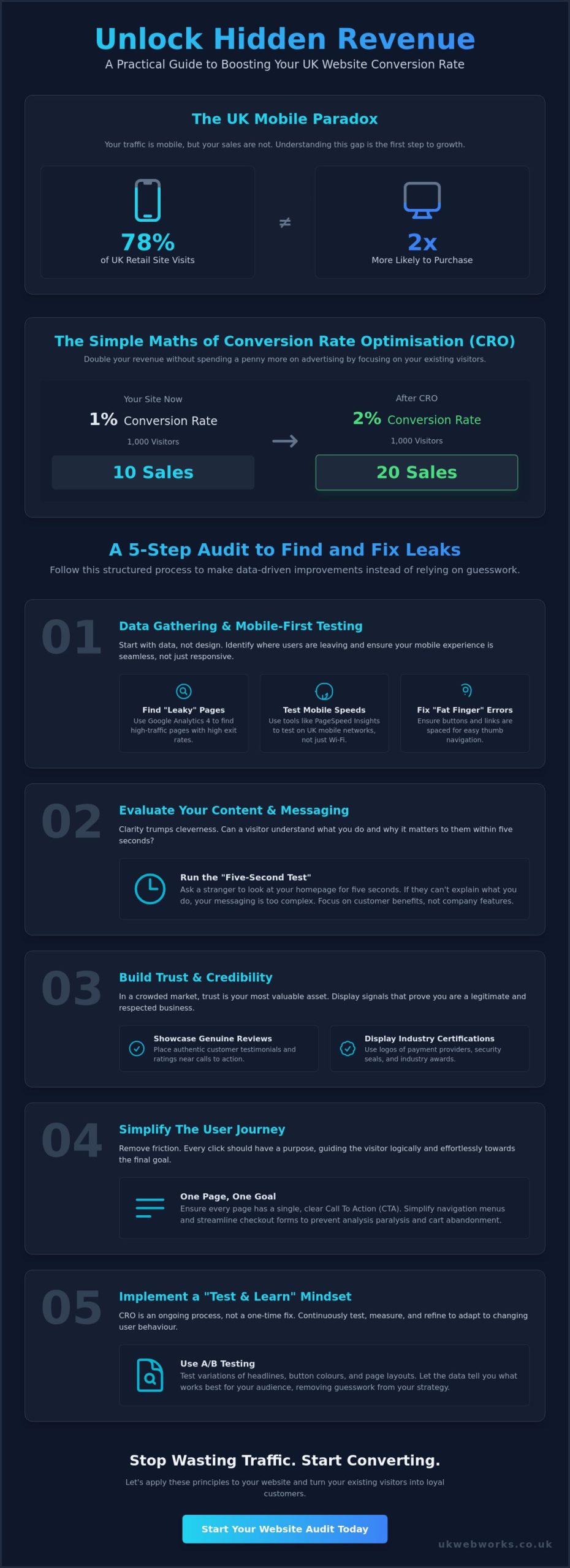
With 78% of UK retail site visits now happening on mobile devices, why are desktop users still nearly twice as likely to complete a purchase? You’ve likely noticed that while your traffic grows, your sales don’t always follow suit. It’s frustrating to watch expensive PPC traffic land on your site only to bounce away seconds later. You aren’t alone. The average UK ecommerce conversion rate sits between 2.6% and 4.1%, meaning the vast majority of visitors leave empty-handed. If you want to know how to improve website conversion rates uk, the answer isn’t just about getting more people through the door. It’s about refining the journey they take once they arrive.
We’ve put together this practical guide to help you turn more of your existing visitors into paying customers without spending an extra penny on advertising. We’ll strip away the confusing jargon around CRO and UX to focus on what actually works in 2026. From navigating the latest Data (Use and Access) Act cookie regulations to optimizing for a mobile-first world, you’ll get a clear action plan to boost your sales. We’ll show you which metrics truly matter for your business. You’ll also learn how a straightforward approach to design and development can transform your results.
Key Takeaways
- Learn why focusing on your conversion rate is the most efficient way to grow your business without spending more on advertising.
- Discover how to use Google Analytics 4 to identify “leaky” pages and learn how to improve website conversion rates uk through a mobile-first audit.
- Guide your visitors toward a purchase by simplifying your navigation and using a single, clear call to action on every page.
- Build immediate trust with your audience by placing genuine reviews and industry certifications where they have the most impact.
- Shift to a “test and learn” mindset that uses A/B testing to make practical, data-driven improvements instead of relying on guesswork.
What is Website Conversion Rate and Why Does It Matter?
At its simplest, your conversion rate is the percentage of total visitors who complete a specific action you’ve asked them to take. If you’re looking for how to improve website conversion rates uk, you first need to understand that this metric is the pulse of your digital presence. It tells you exactly how effective your website is at turning interest into action. Think of these actions in two distinct categories: macro and micro.
A macro-conversion is your primary goal, like a completed sale or a lead form submission. A micro-conversion is a smaller step that shows interest, such as signing up for an email newsletter or downloading a guide. Both matter because they move a visitor closer to becoming a customer. There’s a common belief that low sales always require more traffic. Many business owners spend more on PPC or social ads, only to find the same percentage of people leaving without buying. This is an expensive way to grow. In 2026, focusing on your conversion rate is the most cost-effective strategy because you’re making better use of the people who’ve already found you. Understanding What is Conversion Rate Optimization? helps you see that it’s about logic and user experience, not just marketing tricks.
The Simple Maths of CRO
Let’s look at the numbers. Imagine you have 1,000 visitors and a 1% conversion rate. That’s 10 sales. If you improve that rate to 2%, you get 20 sales from the same 1,000 visitors. You’ve doubled your revenue without spending an extra penny on advertising. By doing this, you effectively halve your customer acquisition cost. We define CRO as the process of removing friction from the user journey. It’s about making the path to purchase as smooth as possible.
Common Barriers to Conversion in 2026
Three main issues typically kill conversions for UK sites: slow loading speeds, confusing navigation, and a lack of trust. These are the “Three Big Killers” of online sales. UK consumers have very little patience, especially when browsing on mobile devices. If your site feels clunky or takes more than a few seconds to load, they’ll go elsewhere immediately. Your site’s technical health is directly tied to its ability to convert. If the foundation is weak, even the best marketing will struggle to deliver results. Learning how to improve website conversion rates uk starts with identifying and fixing these fundamental barriers to ensure your visitors feel confident and guided at every step.
A 5-Step Guide to Auditing Your Website Performance
Before you change a single button colour or rewrite a headline, you need to understand where your website is currently failing your visitors. Improving your sales isn’t about following trends; it’s about a repeatable, logical audit process. Many business owners make the mistake of changing elements based on gut feeling, but this often leads to wasted effort. If you want to know how to improve website conversion rates uk, you must start with cold, hard data. This guide provides a structured way to identify the exact points where you’re losing money.
Step 1 & 2: Data Gathering and Mobile Testing
Your first task is to open Google Analytics 4 and look for your “leaky” pages. Focus specifically on the “exit rate” of your high-traffic landing pages. If a page has a high number of visitors but a disproportionate number of people leaving immediately, that’s where your audit begins. It’s often a sign that the content doesn’t match the promise made in your search listing or ad.
Next, move to mobile testing. With 78% of UK retail site visits now occurring on mobile devices, simply having a “responsive” site is no longer enough. You need to check for “fat finger” errors. This happens when buttons or links are placed too close together, making it difficult for users to navigate with their thumbs. Use free tools like PageSpeed Insights to check your site speed specifically on UK mobile networks. A site that loads quickly on office Wi-Fi might struggle on a 4G connection in a rural area, causing frustrated users to bounce.
Step 3, 4 & 5: Content and Technical Flow
Once the data and mobile basics are covered, you must evaluate your messaging. Use the “five-second test” on your homepage. Ask a stranger to look at your site for five seconds and then tell you exactly what you do. If they can’t, your headlines are likely focusing on features rather than benefits. Your copy should clearly explain how you solve a customer’s problem. When building these paths, we often look to the GOV.UK Service Standard as a benchmark for clarity and user-focused design.
The fourth step is the “Friction Audit.” Literally count the number of clicks it takes to get from your landing page to a completed conversion. Every extra click is an opportunity for a customer to change their mind. We often help clients through bespoke website design to streamline these journeys and remove unnecessary form fields. Finally, perform a technical health check. Ensure every form, checkout button, and navigation link works perfectly across different browsers like Safari, Chrome, and Edge. A single broken button on an older version of a browser can quietly kill your conversion rate for weeks. This methodical approach is the most reliable way to understand how to improve website conversion rates uk without relying on guesswork.
Optimising the User Journey: Designing for Action
Once you’ve identified where visitors are leaving, the next step is to redesign those paths for clarity. A common mistake is overwhelming users with too many options. This is known as choice paralysis. If you want to know how to improve website conversion rates uk, you must understand that less is often more. Every page should have one primary job and one clear call to action (CTA). When you give a visitor three different buttons to click, they often end up clicking none of them.
Visual hierarchy plays a vital role here. You want to guide the user’s eye toward the most important information using size, colour, and weight. For example, your main headline should be the boldest element, followed by a supporting sub-headline and a high-contrast button. We also recommend moving away from generic stock photography. High-quality, bespoke imagery of your actual team, office, or products builds immediate rapport. It shows a level of craftsmanship and integrity that a stock photo of a smiling call centre worker simply cannot match. It proves you’re a real UK business that values quality.
Refining Your Calls to Action
The label on your button can make or break a sale. “Submit” is a poor choice because it’s vague and slightly demanding. Instead, use active, benefit-driven language like “Get My Free Quote” or “Download My Guide.” Your button should tell the user exactly what happens next after they click it. Placement is just as important as the wording. Ensure your primary CTA is visible “above the fold” so users don’t have to scroll to find it. Use a colour that stands out from the rest of your brand palette to make the action impossible to miss. This simple change is one of the fastest ways to see how to improve website conversion rates uk.
Streamlining Navigation and Forms
Can your visitors find what they need in three clicks or less? If not, your navigation is too complex. We often find that bespoke website design is the best solution for this. Unlike off-the-shelf templates that force you into a rigid structure, a custom build allows you to create an intuitive flow tailored to your specific audience. You should also look at your contact or checkout forms. Every extra field you ask a user to fill in reduces the chance of them finishing the process. If you don’t absolutely need their phone number or job title right now, don’t ask for it. Keep it simple and keep the momentum moving forward. This practical, no-nonsense approach respects your visitor’s time and leads directly to more sales.
Building Trust: Essential Credibility Signals
Even with a perfect user journey and a fast site, a visitor won’t buy if they don’t trust you. Trust is the invisible barrier that often prevents a conversion at the very last second. UK consumers are naturally skeptical, especially with the rise of AI-generated content and faceless stores. If you want to know how to improve website conversion rates uk, you must demonstrate that you are a reliable, established professional. This isn’t about bragging. It’s about providing the “peace of mind” signals that reduce the perceived risk of a transaction.
Technical trust is your foundation. This includes having a valid SSL certificate, which is now a standard expectation rather than a feature. You should also display secure payment icons, such as Visa, Mastercard, or PayPal logos, near your checkout buttons. These small visual cues reassure users that their financial data is safe. Beyond the technical side, transparency is key. Be upfront about your pricing, delivery times, and returns policy. Hiding these details until the final stage of the checkout is a guaranteed way to increase your bounce rate and lose potential customers.
Leveraging Social Proof Correct
Social proof is most effective when it is specific and visible. Many businesses make the mistake of burying their testimonials on a dedicated “Reviews” page that nobody visits. Instead, you should place your best feedback right next to your contact forms or “Buy Now” buttons. This provides a final nudge of confidence exactly when the user is deciding whether to act. Video testimonials or detailed case studies carry far more weight than anonymous text snippets. Seeing a real person talk about their positive experience makes your business feel tangible and honest. You can also use “Trusted By” or “As Seen In” strips to show that other reputable organisations have already vetted your services.
The “Real Business” Indicators
Small details often make the biggest difference in building credibility. For instance, displaying a physical UK address and a landline phone number signals that you are an established entity with a permanent presence. It suggests that if something goes wrong, the customer can actually reach you. We’ve found that a bespoke brand identity is another powerful trust signal. A generic, off-the-shelf logo can make your business look like a temporary venture. In contrast, a custom-designed identity shows a commitment to quality and longevity. This level of professionalism tells the visitor that you take your business seriously, which makes them more likely to trust you with theirs.
If you’re ready to build a more credible online presence, we can help you create a site that reflects the true quality of your work. You can explore our bespoke website design services to see how we help UK businesses stand out with integrity.
Implementing a Long-Term Conversion Strategy
Improving your sales is a marathon, not a sprint. Once you’ve addressed the technical errors and trust signals mentioned earlier, you enter the “test and learn” phase. This mindset is what separates successful UK businesses from those that eventually stagnate. You don’t have to get everything perfect on day one. Instead, you focus on continuous, incremental improvements. This is the real secret to how to improve website conversion rates uk over the long term. It requires a move away from gut feelings toward a strategy rooted in objective evidence.
A/B testing is one of the most effective tools in this process. It’s a straightforward method where you show two different versions of a page to your visitors to see which one performs better. Perhaps you test a benefit-led headline against a direct one, or you trial a different placement for your primary button. The data tells you exactly which version makes people buy or get in touch. It’s a logical, low-risk way to make decisions that actually impact your bottom line. By removing the guesswork, you ensure that every change you make is a step in the right direction.
You must also protect the progress you’ve made. Performance decay is a common issue for many sites. As web standards evolve and browsers update, an unmanaged website will naturally slow down or develop small technical glitches. Regular website maintenance ensures your site remains fast, secure, and fully functional. If your site speed drops or a form stops working on a specific browser, your conversion rate will surely follow. Keeping your digital foundation solid is essential for long-term growth.
Small Gains, Big Results
We often talk about the concept of marginal gains. A 0.5% improvement here and a 1% improvement there might seem small, but they eventually add up to a significant increase in total revenue. We suggest focusing your efforts on your highest-traffic pages first. These are the areas where even the smallest tweaks can have the biggest immediate impact on your results. Sometimes, you’re simply too close to your own business to see the obvious hurdles. A fresh set of expert eyes, such as the specialist automotive team at Kee, can often identify blind spots in your user journey that you’ve stopped noticing.
Moving Forward with UK Web Works
We take a refreshingly direct approach to helping UK businesses cut through the digital noise. We don’t hide behind complex jargon or make grand, unsupported claims. Instead, we act as a practical digital marketing partner who understands the national landscape and the specific challenges of growing an online presence. Our goal is to build long-term relationships based on honesty, craftsmanship, and hard work. We’re here to help you understand how to improve website conversion rates uk through clear, actionable steps. If you’re ready to stop guessing and start turning more visitors into customers, contact UK Web Works for a jargon-free website review today.
Take Control of Your Digital Growth
Improving your website’s performance doesn’t require a massive advertising budget or complex technical jargon. By focusing on a logical audit process and refining your user journey, you can make better use of the traffic you already have. Building trust through clear credibility signals and maintaining a mobile-first approach are essential for success in the 2026 UK market. Understanding how to improve website conversion rates uk is a continuous process of testing and learning that leads to sustainable results.
If you’re looking for a reliable partner to help identify your site’s blind spots, we’re here to help. At UK Web Works, we’ve been helping businesses grow online since 2014. We focus on bespoke, craftsmanship-led design and offer fixed-price project development so you always know where you stand. We don’t use high-pressure tactics or confusing industry speak. You can Get a Jargon-Free Website Review from UK Web Works today to see exactly how we can help you turn more visitors into paying customers. It’s time to build a website that truly works for your business.
Frequently Asked Questions
How long does it take to see results from conversion rate optimisation?
You can often see changes in user behaviour immediately, but reaching statistical significance typically takes between two and four weeks. This timeline depends heavily on your current traffic volume. If you fix a major technical barrier, such as a broken checkout button or a slow-loading mobile page, the positive impact on your sales can be visible within days.
What is a good conversion rate for a UK ecommerce website?
A good conversion rate for a UK business usually falls between 2.6% and 4.1% based on 2026 benchmarks. If you’re using Shopify, a rate of 3.2% or higher puts you in the top 20% of stores. While these averages provide helpful context, you should focus on improving your own baseline through consistent testing rather than just comparing yourself to national data.
Do I need to redesign my whole website to improve conversions?
You don’t always need a complete overhaul to see a better return on your investment. Many businesses find success by making incremental changes to their highest-traffic landing pages. If your site’s underlying technology is sound, we often recommend focusing on specific friction points, such as simplifying your navigation or improving your call-to-action placement, before considering a full redesign. To see how professional design can transform your site’s effectiveness, you can read more about bespoke website solutions.
How much does it cost to hire a CRO agency in the UK?
Professional fees vary depending on the complexity of your site and the depth of the audit required. Instead of focusing on the lowest price, look for a partner who offers fixed-price project development and transparent maintenance plans. This approach ensures you receive high-quality work without the risk of open-ended hourly billing or unexpected costs as the project progresses.
Can SEO improve my website conversion rates?
Search engine optimisation helps your conversion rate by ensuring you attract visitors with the right intent. When you target specific keywords that match what your customers are actually searching for, you bring in a more qualified audience. Combining this high-quality traffic with a smooth user journey is a proven way to understand how to improve website conversion rates uk for your brand.
What are the most common mistakes that kill conversion rates?
The biggest killers are slow page speeds, confusing navigation, and a lack of clear trust signals. UK consumers have very little patience for sites that don’t load quickly on mobile devices. Another frequent error is using too many form fields or having multiple competing calls to action on a single page, which leads to user frustration and high bounce rates.
How do I track my conversion rate accurately?
You should use Google Analytics 4 to set up specific conversion events for your primary business goals. This allows you to track exactly where visitors are dropping out of your sales funnel. By monitoring these metrics closely, you can identify which pages need the most attention and ensure your decisions are based on objective data rather than guesswork.
Will adding more content to my pages help or hurt conversions?
Quality always beats quantity. Helpful, benefit-driven copy that answers a customer’s questions will usually support your conversion goals. However, adding large blocks of text just to fill space can distract users from your primary call to action. The key is to provide enough information to build trust and authority without overwhelming the visitor or making the page difficult to navigate.