
Why does one person quote you £500 while another asks for £5,000 for the exact same project? It’s a frustrating position to be in, especially if you’ve been burned by unreliable freelancers or stung by “ongoing” fees that weren’t mentioned in the original handshake. You want a site that works, not a technical headache, and understanding what actually drives a professional web page price is the first step to avoiding a bottomless money pit. We know that opaque pricing and jargon can make it feel like you’re guessing rather than investing in your future.
We believe you deserve a partner who is as direct about costs as they are about results. This guide is here to give you total clarity on how website costs are calculated and how to ensure your investment generates actual leads for your business. We’ll explore current UK market trends for 2026, identify the hidden costs that often catch growing businesses off guard, and provide a practical framework to help you choose a team that values integrity and craftsmanship. You’ll finish this article with the confidence to evaluate any quote and the knowledge to build a digital presence that truly pays for itself.
Key Takeaways
- Identify the specific factors that influence UK market rates so you can spot the difference between a basic template and a high-performing site.
- Discover how professional strategy and user experience design work together to guide your visitors toward a purchase or enquiry.
- Evaluate the long-term trade-offs between DIY builders and professional teams to choose the path that supports your business growth.
- Learn how to calculate the potential return on your web page price by focusing on the lifetime value of the customers your site acquires.
- See how a transparent, fixed-price approach eliminates the fear of hidden fees and keeps your project on track and within budget.
What Determines a Web Page Price? The Reality of UK Costs
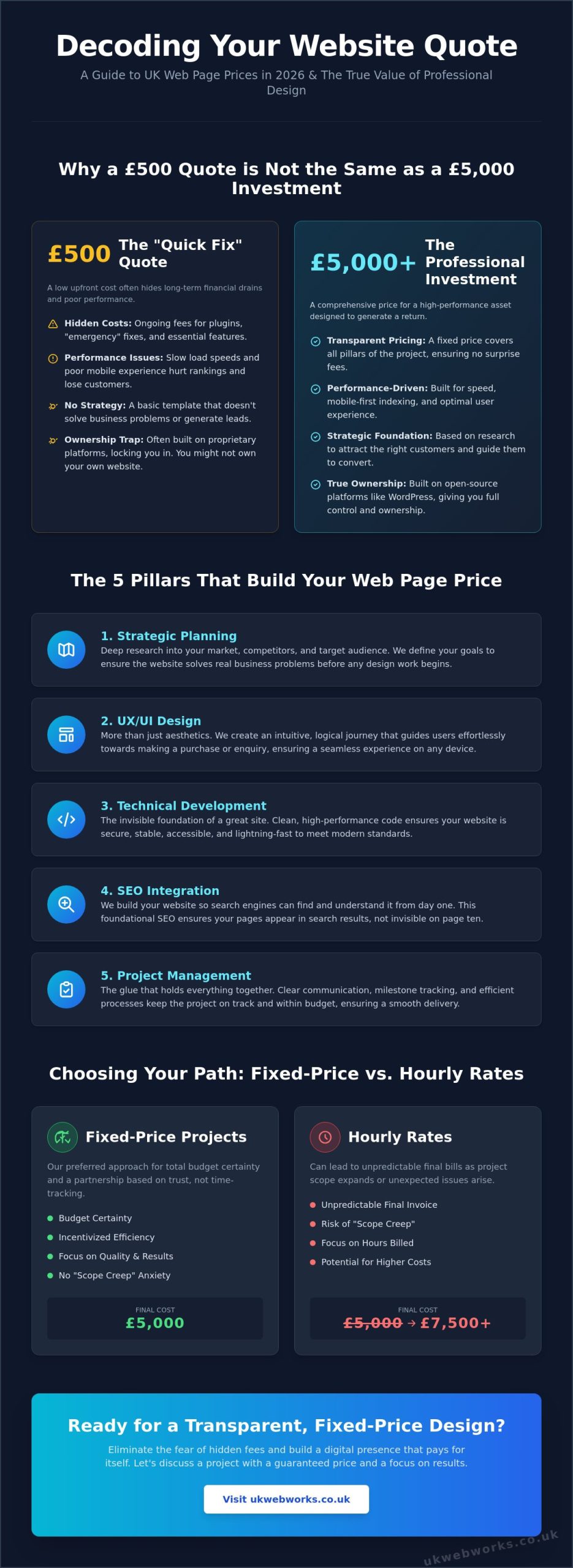
A web page price isn’t a single sticker value. It’s a calculation of time, expertise, and the specific goals of your business. In 2026, a website isn’t just an online business card; it’s a dynamic tool built to capture leads and process data. If you’re comparing a basic template to a bespoke build, you aren’t looking at the same product. You’re comparing a static image to a high-performance engine. A professional page is designed to solve a problem, whether that’s reducing the time your team spends on admin or increasing the number of enquiries you receive every week.
Setting realistic expectations for your initial investment is vital. A high-performing page requires a blend of technical skill and strategic thinking. It’s about more than just how things look on a screen. To build a site that truly performs, a team must master the core disciplines of web design, including user interface (UI) design, search engine optimization, and responsive development. When you pay for a professional page, you’re paying for a result, not just a layout.
Fixed-Price vs. Hourly Rates
Many agencies bill by the hour, but this often leads to “scope creep” where the final invoice is much higher than the initial estimate. We prefer a different route. Fixed-price project fees give you budget certainty from day one. You know exactly what you’re paying for, and we’re incentivized to work efficiently to get it right the first time. It removes the anxiety of watching a clock and lets us focus on the quality of the build. This transparent approach ensures that our partnership is based on trust rather than unpredictable billing cycles.
The “Hidden” Costs of Cheap Web Design
A low upfront cost often hides a long-term financial drain. Cheap sites frequently suffer from slow load speeds and poor mobile responsiveness. These technical flaws directly hurt your search engine rankings and drive potential customers away. If a site doesn’t convert visitors into leads, it’s expensive at any price. You might also find yourself paying for premium plugins or “emergency” fixes that should have been handled during the initial build.
Ownership is another critical factor. Some budget platforms lock you into their proprietary ecosystem. If you want to move your site or change providers, you might find you don’t actually own your assets. We believe in openness and integrity. Using open-source solutions like WordPress or WooCommerce ensures you own your site outright. You aren’t held hostage by a specific builder or a recurring software fee that keeps rising every year.
The 5 Pillars That Build Your Web Page Price
When you review a quote, it’s tempting to focus only on what you can see on the screen. However, the true value of a professional build lies in the “invisible work” that ensures your site actually works for your business. While many sources list average website costs for small businesses, these numbers often skip the technical depth required for success. A professional web page price is built on five essential pillars that transform a simple layout into a lead-generating asset.
- Strategic Planning: We conduct deep research into your market and competitors before we move a single pixel. We need to know who your customers are and what they need to see to trust you.
- UX/UI Design: This is about more than aesthetics. It’s about creating a logical journey that guides users toward a conversion or enquiry.
- Technical Development: High-performance code is the foundation. Clean development ensures your site is secure, stable, and lightning-fast.
- SEO Integration: We build the site so search engines can read it easily. This ensures your page actually appears in search results rather than sitting invisible on page ten.
- Project Management: This is the glue that keeps everything together. It involves clear communication and milestone tracking to keep the build on track and on budget.
Each of these pillars requires specific expertise. When these elements are ignored, you might get a lower initial quote, but you’ll likely pay more later to fix the mistakes. If you want to see how these pillars come together in practice, you can view our bespoke design services to see how we handle the details.
Responsive Design and Accessibility
In 2026, responsive web design is a mandatory standard. It’s no longer an optional extra. Your site must work perfectly on every device, from a small smartphone to a large desktop monitor. This level of compatibility requires extensive testing and refined code work. Beyond device types, accessibility compliance is now a critical business requirement. Ensuring your site is usable for everyone, regardless of their physical abilities, protects your business from legal risks and shows that you value every visitor. This technical rigor is a significant part of the total web page price because it ensures your site is future-proof and inclusive.
Content Architecture and SEO
There’s a massive difference between simply filling a page with text and creating strategic content that sells. We look at how information is structured to ensure it answers your customers’ questions and builds authority. When SEO agency services are baked into the price of a professional build, your site is designed to be found by search engines from the moment it goes live. Professional SEO integration during the build phase saves thousands in future marketing costs. By getting the architecture right at the start, you avoid the need for expensive structural changes later on.
DIY vs. Freelancer vs. Agency: Comparing the Value
Choosing who builds your site is a decision that impacts your business for years. It’s easy to get distracted by the lowest web page price, but the delivery method matters just as much as the cost. You essentially have three paths: doing it yourself, hiring a solo freelancer, or partnering with a professional agency. Your choice shouldn’t just reflect your current bank balance; it should align with where you want your business to be in twelve months. For a broader look at the market, you can check out this comprehensive guide to website costs in 2026, which mirrors many of the trends we see in the UK.
- DIY Builders: These platforms offer a low barrier to entry and minimal upfront costs. However, they demand a significant time investment from you. You’re often limited by templates, and scaling the site as you grow can be difficult or impossible.
- Freelancers: Solo developers usually offer mid-range pricing. They can be great for specific tasks, but they often lack the “full-stack” expertise of a team. If they’re a great designer, they might struggle with complex SEO or technical security.
- Professional Agencies: While the initial price is higher, an agency provides a comprehensive, secure, and scalable solution. You aren’t just hiring one person; you’re hiring a team of specialists who ensure every part of the site works together, much like the integrated approach offered by vinken-design.de.
The Risk Assessment of Your Choice
What happens if your site breaks on a Saturday morning? If you used a DIY platform, you’re often stuck in a long support queue. If your freelancer has moved on to a new project or changed careers, you might be left in the dark. This is where a website maintenance package becomes invaluable. It provides long-term peace of mind by ensuring someone is always watching over your digital assets. To help you vet your options properly, we’ve put together a website designer selection checklist to ensure you’re asking the right questions before you sign a contract.
Scale and Complexity
Simple brochure pages are relatively straightforward, but requirements skyrocket as soon as you move into ecommerce web design. Bespoke WordPress or Shopify builds aren’t just about “adding a shop”. They require specialist technical hours to integrate third-party tools like CRMs, complex payment gateways, and automated booking systems. These integrations ensure your site isn’t just a pretty face but a functional part of your business operations. The total web page price for these projects reflects the technical rigor needed to keep your customer data safe and your transactions smooth.
How to Calculate the ROI of Your Web Page Price
It’s time to stop looking at your website as a static bill and start seeing it as a vital member of your sales team. When you evaluate a web page price, the most important question isn’t “what does it cost?”, but rather “what will it earn?”. To get a true sense of value, you need to calculate the lifetime value of a customer acquired through that page. For a coaching business like life by design, where a single new client brings significant revenue over time, a professional site only needs to attract a few extra leads a year to pay for itself. A simple 1% increase in your conversion rate can often cover the entire cost of the build within a few months.
The build is only half of the story. To see a real return, you need a solid strategy for digital marketing to drive the right people to your new investment. Without traffic, even the best site sits idle. By combining a high-performance build with targeted outreach, you turn a digital asset into a reliable lead-generation machine. If you’re ready to start building a site that actually contributes to your bottom line, get a transparent quote from our team.
Performance Metrics That Matter
Professional design and fast load speeds do more than just look good. They reduce bounce rates, which is the percentage of people who leave your site after viewing only one page. Every person who leaves because your site was slow or confusing is a lost lead. This is why a “cheap” site that fails to convert visitors is actually the most expensive option you can choose. We use integrated analytics and conversion tracking to show you exactly where your leads are coming from. Tracking these metrics helps you understand if your web page price is delivering the value you expected. This data lets you make informed decisions based on facts rather than guesswork.
Future-Proofing Your Investment
A modular, bespoke build is much cheaper to update than a template is to replace. As your business grows, your website should grow with you. If you start with a rigid, low-cost template, you’ll often find that adding new features requires a complete rebuild from scratch. A professional approach allows us to add functionality over time without disrupting your existing setup. Managed web hosting and domain name management also play a role here. They protect your brand equity by ensuring your site is always online, secure, and under your control. This long-term thinking saves you money and stress as your digital presence expands.
The UK Web Works Approach: Transparent, Fixed-Price Design
At UK Web Works, we don’t believe in hiding behind technical jargon or complex billing structures. We know that the most frustrating part of searching for a professional web page price is the lack of clarity. Many providers give you a low estimate only to add “essential” extras later. Our approach is different. We provide straightforward, fixed-price quotes that cover everything you need to succeed online. We focus on bespoke builds because your business isn’t a carbon copy of your competitors; your website shouldn’t be one either. We build tools that are tailored to your specific objectives, whether that’s increasing local enquiries or scaling an online shop.
Our “No-Nonsense” promise is built on total integrity. You own your site, your data, and your domain name. We don’t believe in proprietary lock-ins that make it difficult for you to move or update your assets. This openness is a cornerstone of our brand identity. We act as your consultant and partner, ensuring you understand every step of the process. If you want to see exactly how we move from an initial idea to a live, high-performing site, our bespoke web design guide explains our full methodology in plain English.
What is Included in Our Fixed-Price Quotes?
We don’t just hand over a layout and call it finished. Every quote we provide is comprehensive. It starts with initial discovery sessions where we learn about your market and ends with rigorous final technical testing. We include integrated SEO foundations and mobile-first responsiveness as standard features, not optional add-ons. We also offer ongoing support through our maintenance plans to keep your site performing at its peak. This ensures your web page price covers a complete, professional solution that is ready to work for you from day one. You won’t find any hidden fees for things that should have been included at the start.
Get a Professional Perspective on Your Project
Generic price lists rarely work for real businesses because every project has unique requirements. We prefer to start with a conversation. This helps us understand your challenges and allows us to simplify complex digital concepts so you can make informed decisions. We value hard work and long-term relationships, which is why we’re honest about what you need and what you don’t. We’re a dedicated team of specialists genuinely invested in your success, not a distant corporate entity. Ready for a straight-talking quote? Contact UK Web Works today to discuss your project with a professional who speaks your language.
Start Building Your High-Performing Digital Future
Investing in your digital presence shouldn’t feel like a gamble. We’ve explored how a professional build is defined by more than just aesthetics. It’s about the technical foundations, strategic planning, and user experience that turn casual visitors into loyal customers. By shifting your focus from the initial cost to the potential return on investment, you can build a site that contributes to your growth rather than just sitting as a static expense on a balance sheet. You deserve a digital platform that is as hardworking as your business.
At UK Web Works, we’ve been providing direct, honest advice since 2014. Our UK-based team of experts specializes in bespoke WordPress and Shopify development, ensuring your site is secure, fast, and ready to scale. We don’t use jargon or hidden fees to justify a web page price; we use craftsmanship and results. If you’re ready for a partner who values integrity and long-term relationships, we’re here to help you take the next step with complete confidence.
Get a Jargon-Free Fixed-Price Quote
Frequently Asked Questions
How much does a 5-page website cost in the UK in 2026?
A professional 5-page website designed by a regional agency typically falls within the £3,000 to £6,000 range. This investment covers the strategic planning, bespoke design, and technical development required for a high-performing site. While you might find lower quotes from solo freelancers, this agency-level pricing ensures a team-based approach and a site built to generate leads.
Why is there such a big difference in web page prices between agencies?
The variation in a web page price usually reflects the depth of the technical work and strategy included in the project. Some providers use pre-made templates that are quick to set up but difficult to scale. Others build bespoke solutions that include deep market research, custom coding, and advanced speed optimization. You’re paying for the expertise that ensures your site actually converts visitors into customers.
Are there ongoing costs after I pay for the initial web design?
Yes, you should budget for domain name management and managed web hosting to keep your site online. Typical .co.uk domain renewals range from £12 to over £27, and standard hosting can cost between £60 and £600 per year. Many businesses also opt for a maintenance plan to handle software updates and security patches, ensuring the site stays stable and secure over time.
Can I reduce the price by providing my own content and images?
Supplying your own text and high-quality photography can reduce the total billable hours for your project. It’s a practical way to lower the web page price if you have the internal resources to produce professional-grade material. However, keep in mind that strategic copywriting is vital for search engine rankings, so your content needs to be as polished as the design itself.
How long does it take to build a professional web page?
A professional build usually takes between 4 and 12 weeks from the initial discovery session to the final launch. This timeline allows for a methodical process that includes planning, design iterations, development, and rigorous testing across all devices. Rushing this schedule often leads to technical oversights that can hurt your site’s performance and long-term reliability.
Is a bespoke website worth the higher price compared to a template?
Bespoke sites are a better investment for growing businesses because they’re built without the unnecessary code “bloat” found in templates. They offer superior speed, better security, and the flexibility to add custom features as your needs evolve. While templates have a lower entry cost, they often limit your search engine visibility and can be difficult to scale as your business expands.
Do I need to pay for SEO separately from the web page price?
Technical SEO foundation work should be included in any professional build, but ongoing marketing is a separate service. The initial price covers the structure, speed optimization, and meta tags that search engines require. If you want to actively climb the rankings for competitive keywords, you’ll likely need a dedicated monthly SEO strategy to drive consistent traffic to your site.
What happens if I want to update my website later—will it cost more?
If your site is built on a user-friendly platform like WordPress, you can update text and images yourself at no extra cost. We ensure our clients have the training to handle basic content changes independently. However, if you want to add complex new features or change the core layout in the future, those structural updates will be quoted as a separate project.