
What if the most feature-rich software is actually the biggest threat to your shop’s profit margins this year? You probably feel that finding the best ecommerce platform for uk small business is a minefield of hidden transaction fees and complicated VAT settings. It’s exhausting to worry about whether a platform will lock you in or if your shipping integrations will actually work with UK couriers when you’re just trying to grow.
I’ve built this no-nonsense guide to help you choose a platform based on your actual business goals and technical capacity rather than just a flashy sales pitch. We’ll look at the real-world costs of Shopify, WooCommerce, and BigCommerce for 2026, including how to manage the £90,000 VAT threshold and standard Stripe fees of 1.5% plus 20p. You’ll learn how to build a professional store that earns trust and ensures you keep full ownership of your customer data for long-term marketing success.
Key Takeaways
- Learn why owning your digital store offers more security and better profit margins than relying solely on third-party marketplaces.
- Compare the features and costs of top providers to find the best ecommerce platform for uk small business that fits your specific scaling needs.
- Discover how to automate essential UK operations like VAT compliance and shipping with couriers like Royal Mail, DPD, and Evri.
- Understand the long-term SEO benefits of professional bespoke design over generic templates to help your shop outrank competitors.
- Identify the technical requirements for a mobile-first shopping experience that builds immediate trust and encourages repeat customers.
The UK Ecommerce Landscape in 2026: Why Platform Choice Matters
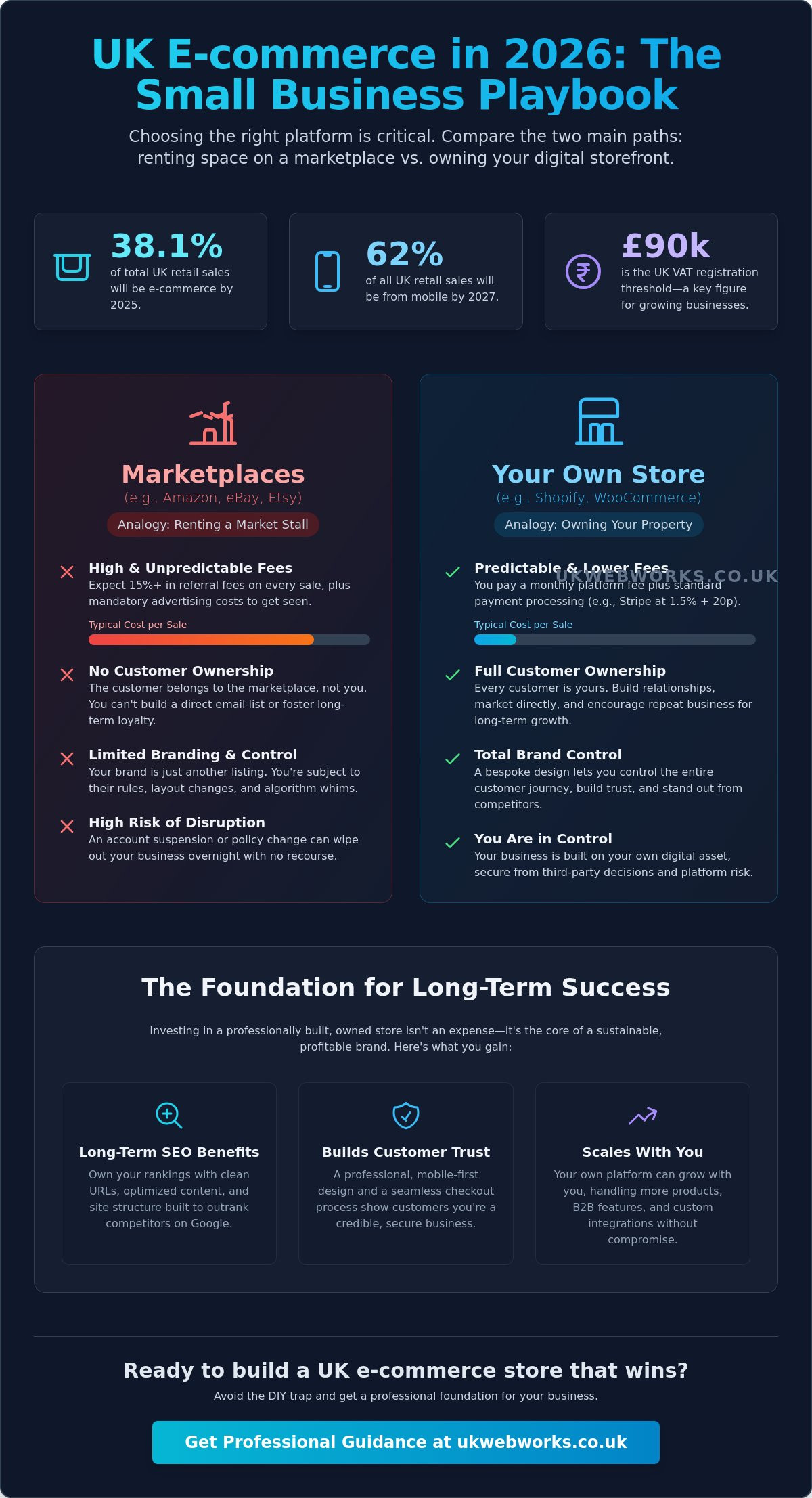
The concept of e-commerce has moved far beyond simply listing products on a page. In 2026, British shoppers expect a seamless digital journey that feels as polished as a high-street boutique. In 2025, it was predicted that retail ecommerce sales would account for 38.1% of the UK’s total retail sales, according to the International Trade Administration. This means the market is more crowded than ever. If your site is slow or looks like a dated template, you’re losing money before the customer even sees your prices. Choosing the best ecommerce platform for uk small business is about more than just checking boxes. It’s about building a foundation that won’t crumble as you grow. Migration is expensive and risky. Getting it right the first time saves you from the headache of moving data and losing SEO rankings later.
Mobile-first shopping isn’t a suggestion anymore. With mobile commerce expected to account for 62% of all UK retail sales by 2027, according to Forbes Advisor UK, your store must be responsive and lightning-fast. A generic builder often carries heavy, unnecessary code that slows down load times. This leads to high bounce rates. If a page takes more than three seconds to load, most users will head back to Google. To win in this environment, you need a store that prioritises the user experience over basic functionality.
Defining Your Business Goals
You need to be honest about your scale. A shop selling ten handmade items has very different needs than a wholesaler managing 10,000 SKUs. Inventory size dictates which software will work for you. For those managing community-led services or educational programs, you can explore Course and Workshop Enrollment Fees to see how Wyld Work Projects handles their nature-based intake. We often see businesses struggle because they chose a platform that couldn’t handle their growth or their need for B2B trade accounts. Think about whether you need bulk pricing or password-protected areas for trade clients. Your budget should also account for more than just the monthly subscription, including transaction fees, professional web development costs, and ongoing maintenance.
The 2026 Consumer Trust Factor
Trust is the most valuable currency in the UK market. Savvy consumers look for professional web design and familiar payment icons as signs of credibility. If your checkout process feels clunky, shoppers will abandon their carts. Your choice of platform also dictates your SEO potential. Some builders make it difficult to edit meta tags or create clean URL structures. This can bury your store on page five of the search results. Investing in a professional Shopify ecommerce store or a WooCommerce online shop avoids the common DIY trap where you spend months building a site that nobody can find.
Marketplace vs. Owned Store: Renting vs. Owning Your Success
Renting a stall in a busy market is an easy way to start selling. It’s fast, the crowds are already there, and you don’t need to worry about the plumbing. However, you’re always subject to the market owner’s rules. If they raise the rent or change the layout, your business suffers. This is exactly what happens when you rely solely on marketplaces like Amazon, eBay, or Etsy. While the UK eCommerce market offers massive reach, these platforms often treat your brand as just another commodity in their database. You’re effectively renting your success on borrowed land.
The search for the best ecommerce platform for uk small business usually begins when a founder realises they’re paying 15% or more in referral fees on every sale. Transitioning to an owned store model doesn’t mean you have to abandon marketplaces entirely. Many successful brands use a hybrid approach. They use Amazon as a funnel to reach new buyers but encourage repeat business through their own bespoke website. This strategy protects your margins and ensures that if a marketplace account is ever suspended, your business doesn’t disappear overnight.
The Hidden Cost of Marketplaces
Marketplaces are built on a “pay-to-play” model. To get any real visibility, you often have to pay for internal advertising on top of your standard referral fees. Perhaps the biggest loss is customer ownership. When someone buys from you on Amazon, they aren’t your customer; they are Amazon’s. You can’t send them a follow-up email or build a relationship that leads to repeat sales. This makes it incredibly difficult to scale a brand that people actually remember and trust.
The Freedom of an Owned Ecommerce Site
Building your own store gives you total control over the customer experience. You decide how your products are presented, how the checkout flows, and exactly how you handle data. This ownership is the foundation of a sustainable business. By working with an experienced ecommerce web design company, you can create a unique brand identity that stands out from the generic listings found on massive marketplaces. Direct-to-consumer (DTC) models offer higher margins because you aren’t splitting your profit with a middleman. If you want to build a resilient brand, we can help you develop Shopify ecommerce stores or WooCommerce shops that put you back in the driver’s seat.
Comparing the Top 3 Platforms for UK Small Businesses
Choosing the best ecommerce platform for uk small business isn’t about finding the one with the most features. It’s about matching the software to your daily capacity. If you choose a system that’s too complex, you’ll spend your evenings fixing bugs instead of packing orders. Conversely, picking a platform that’s too simple might save you time now but will cost you a fortune in migration fees when you outgrow it. According to e-commerce statistics for 2026, the UK market is increasingly driven by mobile sales, meaning whichever path you take must offer a flawless mobile experience.
For most of our clients, the choice comes down to three main contenders. Shopify offers a managed, “hands-off” approach where the technical heavy lifting is done for you. WooCommerce provides an open-source framework that gives you total ownership of your site. Then there are drag-and-drop builders like Wix or Squarespace, which work well for very small, creative-led shops but often struggle with advanced SEO or complex shipping rules. Here is how the top two professional options compare in the current market.
Shopify: The “Hands-Off” Technical Solution
Shopify is currently the most popular all-in-one hosted giant. In 2026, its Basic plan costs £19 per month when billed annually, or £25 on a monthly basis. It’s incredibly fast to set up and includes secure hosting as standard. You don’t have to worry about server updates or security patches. However, there are trade-offs. You’re limited in how much you can customise the checkout experience, and monthly app fees can quickly spiral if you need extra functionality. It’s the right choice for businesses that want to focus entirely on marketing and sales.
WooCommerce: The “No-Limits” Growth Platform
WooCommerce is a flexible, open-source plugin for WordPress. There’s no monthly subscription fee for the software itself, which makes it highly cost-efficient in the long run. It offers infinite customisation and is widely regarded as the superior choice for SEO. Because you own the code, you aren’t restricted by a corporate roadmap. The catch is that you’re responsible for your own security and updates. To keep a WooCommerce online shop running smoothly, most serious businesses invest in website maintenance packages to prevent downtime and protect customer data.
When comparing costs, remember that Shopify’s card processing rates for the Basic plan are 2% plus 25p. If you use WooCommerce with a standard Stripe integration, you’re looking at 1.5% plus 20p for UK cards. While 0.5% sounds small, it adds up to hundreds of pounds as your turnover increases. We help our clients weigh these operational costs against their technical comfort levels to ensure they land on the right foundation.
Operational Essentials: UK Shipping, Tax, and Payments
Most business owners focus on how their storefront looks, but your back-end operations determine whether you actually make a profit. Getting the “plumbing” right is what separates a hobby from a professional enterprise. In 2026, the best ecommerce platform for uk small business must do more than just display products. It needs to handle complex UK tax rules and integrate seamlessly with the couriers your customers trust. If these systems don’t talk to each other, you’ll spend your weekends manually typing addresses into courier portals instead of growing your brand.
Payment processing is your first major hurdle. For standard UK cards, Stripe currently charges 1.5% plus 20p per transaction. PayPal is more expensive at 2.9% plus 30p for domestic sales. While these percentages seem small, they eat into your margins quickly. You should also consider “Buy Now Pay Later” providers like Klarna or Clearpay. These are no longer just “nice-to-have” features; they’re expected by savvy British shoppers who want flexibility. Ensuring your site is PCI compliant is also vital to protect customer data and maintain your reputation.
Fulfilment and Logistics Strategy
Shipping is often the most expensive part of the journey. Integrating your store directly with Royal Mail, DPD, or Evri allows you to automate label printing and tracking updates. This saves hours of admin time. You need to decide if you’ll offer flat-rate shipping or real-time rates based on UK zones. Click-and-collect has also become a standard requirement for local retailers in 2026. It bridges the gap between your physical location and your digital shop. If you sell across multiple channels, your platform must sync inventory in real-time to prevent the frustration of overselling an out-of-stock item.
The Legalities of UK Online Selling
Staying legally watertight is non-negotiable. The UK VAT registration threshold for the 2026/27 period is £90,000. If your taxable turnover for the previous 12 months exceeds this, you must register and ensure your platform calculates tax correctly for every order. You also need to comply with the UK Consumer Rights Act. This requires clear, jargon-free Terms and Conditions and a straightforward refund policy. Don’t forget GDPR and cookie consent; your site must be transparent about how you handle data to build long-term trust with your audience.
Setting up these technical integrations can be daunting if you’re doing it alone. We specialise in building WooCommerce online shops and Shopify stores that come pre-configured with the essential UK operational tools you need to succeed from day one.
The DIY Trap: Why Professional Setup Wins in the Long Run
Many founders start with a DIY builder because the initial price tag looks appealing. It’s a sensible way to test an idea without a large upfront investment. However, you’ll likely find that “cheap” becomes expensive very quickly as you scale. The true cost of a DIY site is often hidden in lost sales, high bounce rates, and hundreds of hours spent on technical frustration. Finding the best ecommerce platform for uk small business isn’t just about picking a software tool; it’s about how that tool is implemented to serve your specific customers.
One of the biggest issues we see with DIY builds is “plugin bloat.” When you try to add features like advanced UK shipping rules or custom loyalty programmes without professional guidance, you end up stacking dozens of third-party apps on top of each other. This clogs your site’s performance and creates security vulnerabilities. It slows down your page load speeds, which we’ve already identified as a primary reason why British shoppers abandon their carts. A professional setup ensures your site remains lean, secure, and fast.
Bespoke Design vs. Off-the-Shelf Templates
A generic template might get you online, but it won’t help you stand out in a saturated market. Most basic Shopify or WooCommerce themes are designed to be “one-size-fits-all,” which often means they don’t fit anyone perfectly. With bespoke website design, every element of the user journey is tailored to your specific customer persona. Custom code is cleaner and more efficient than a template, which directly improves your mobile performance and helps you outrank competitors in Google Search. You avoid the “same-as-everyone-else” look and build a brand identity that commands higher prices and greater loyalty.
Building for 2027 and Beyond
Your platform needs to be a foundation, not a ceiling. If your store is built correctly from day one, you won’t have to worry about a painful migration when your turnover doubles. Future-proofing your business means choosing a technical stack that can grow with you. It also means having a reliable partner on hand for technical support when you want to launch new features or enter new markets. We don’t just build websites; we create long-term digital assets. Whether you need Shopify ecommerce stores or WooCommerce online shops, the first step is moving away from the DIY struggle and toward a professional, scalable solution that lets you focus on what you do best: running your business.
Ready to Build Your Digital Foundation?
Choosing the best ecommerce platform for uk small business is a decision that shapes your growth for years to come. We’ve explored how the right setup protects your profit margins from high transaction fees and ensures you stay compliant with the £90,000 UK VAT threshold. Whether you opt for Shopify’s streamlined approach or the total control of WooCommerce, the priority remains owning your data and building a brand that shoppers trust. Avoiding the DIY trap early on saves you from expensive migrations and technical debt later.
Since 2014, our team has delivered bespoke ecommerce solutions that help businesses scale without the headache. We offer fixed-price project fees with no hidden surprises, giving you direct access to UK-based technical specialists who understand your market. You deserve a partner who values your hard work as much as you do. Get a jargon-free quote for your bespoke ecommerce store and let’s start building a shop that actually works for you. You have a great product; it’s time your website reflected that quality.
Frequently Asked Questions
Which ecommerce platform is cheapest for a UK startup?
WooCommerce is often the most budget-friendly starting point because the software itself is free. You only pay for your domain name and managed web hosting. Shopify is a solid alternative if you prefer a predictable monthly cost, with plans starting at £19 per month when billed annually in 2026. Both are strong contenders for the best ecommerce platform for uk small business depending on whether you value lower upfront costs or technical simplicity.
Do I need a business bank account to start an online shop in the UK?
You should definitely set up a dedicated business bank account before you start selling. Most payment providers, including Stripe and PayPal, require one to verify your identity and process your payouts. It also makes your life much easier when it’s time to report your earnings to HMRC. Keeping your personal and business finances separate is essential for professional bookkeeping and long-term tax compliance.
Can I move my products from Etsy to my own website later?
You can absolutely migrate your products from Etsy to a dedicated store whenever you’re ready. Most professional platforms allow you to export your Etsy listings as a CSV file and import them directly into your new site. This saves you from manually re-entering every product description and price. It’s a common step for growing brands that want to move away from high marketplace fees and own their customer data.
What is the best platform for SEO in 2026?
WooCommerce is widely considered the superior choice for SEO because it offers deeper technical control over your site’s structure. You can fine-tune every meta tag, URL, and schema markup to help your shop rank higher on Google. Shopify is also very effective for most retailers, but it has some rigid limitations on URL structures. Your choice depends on how much you plan to rely on organic search traffic for your growth.
How much does it cost to have a professional ecommerce site built in the UK?
The investment for a professional ecommerce site depends entirely on your specific requirements. Factors like your total product count, bespoke design needs, and complex courier integrations will influence the final project fee. Instead of looking for a generic price, it’s better to request a fixed-price quote from a specialist who can assess your goals. This ensures you get a high-quality production without any hidden surprises or budget creep.
Is Shopify or WooCommerce better for UK VAT compliance?
Both platforms handle UK VAT well, including the 2026 threshold of £90,000. Shopify has a simplified, built-in tax engine that handles most calculations automatically at checkout. WooCommerce offers more flexibility through dedicated plugins that sync directly with your accounting software. Whichever you choose, you must ensure your platform is configured to distinguish between UK and international tax rules to keep your business legally watertight.
Do I need to be a tech expert to manage a WooCommerce store?
You don’t need to be a developer to manage a WooCommerce store on a daily basis. The interface is very user-friendly for adding new products and processing customer orders. However, the technical side, like security patches and software updates, does require regular attention. Many owners choose a maintenance plan to handle these tasks, allowing them to focus on marketing rather than troubleshooting server issues or plugin conflicts.
How long does it take to launch a professional online shop?
A professional online shop typically takes between 8 and 12 weeks to launch from the initial design phase. This timeline allows for bespoke website design, responsive development, and thorough testing of your payment and shipping integrations. While you can find “quick-fix” solutions that launch in a few days, a properly structured store is worth the wait to ensure a smooth, trustworthy experience for your shoppers.