
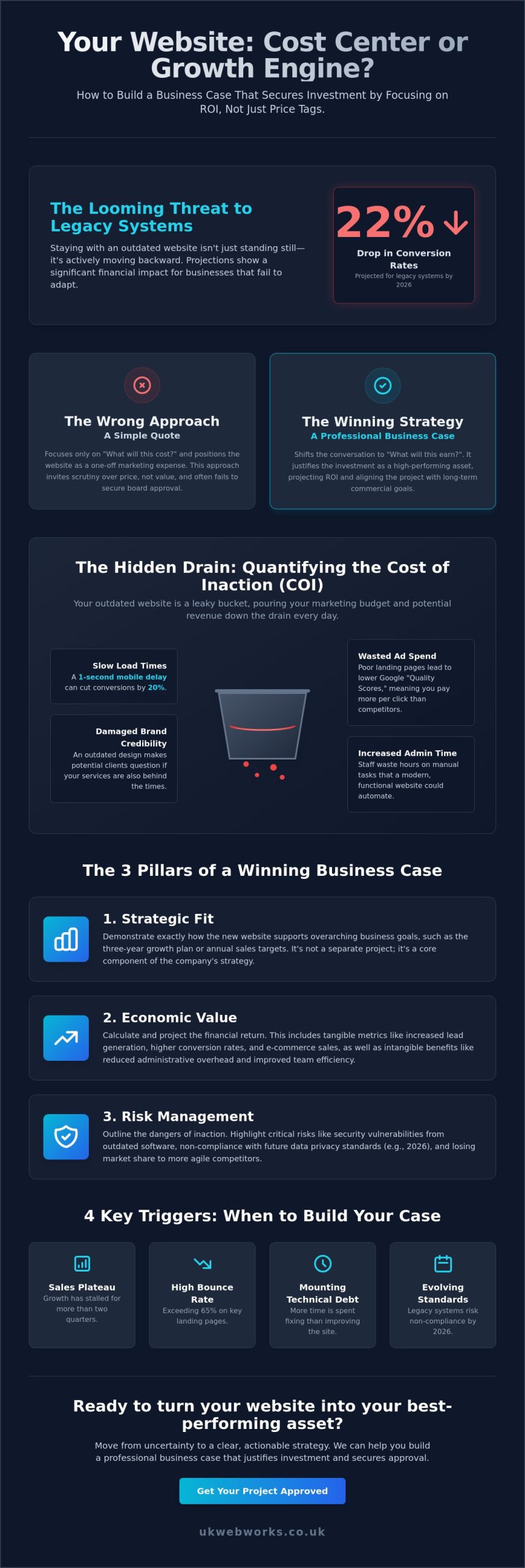
Your MD doesn’t care about “cleaner layouts” or “modern aesthetics” as much as they care about the 22% drop in conversion rates that legacy systems are projected to suffer by 2026. It’s a hard truth, but a website is a financial instrument, not just a digital brochure. We understand the frustration of seeing technical flaws hold your growth back while you struggle to build a business case for a new website that non-technical stakeholders actually value. It’s often difficult to predict a specific return on investment when you’re worried about hidden costs or project overruns.
This guide shows you how to structure a professional proposal that justifies the investment and secures the approval you need. You’ll learn how to translate technical requirements into business value and calculate a realistic ROI that stands up to scrutiny. We’re providing a clear template and a roadmap for the procurement process so you can present your plan to your leadership team with total confidence and zero jargon. Our goal is to help you move from a position of uncertainty to a clear, actionable strategy that gets your project off the ground.
Key Takeaways
- Discover why a simple quote isn’t enough and how to use the ‘Cost of Inaction’ to show the board exactly what the status quo is costing your business in lost revenue.
- Learn how to structure a professional business case for a new website that projects both tangible and intangible ROI over a clear three-year growth framework.
- Master the art of the 30-second executive summary to grab stakeholder attention and frame your current site as a barrier to growth rather than just a marketing cost.
- Get a straightforward guide to navigating objections from the CEO and CFO by speaking their language of risk, reliability, and long-term value.
- Access a jargon-free methodology designed for UK business owners to turn complex technical requirements into a clear, persuasive roadmap for project sign-off.
What is a Business Case for a New Website?
Think of a Business case as the bridge between a technical requirement and a financial reality. It is a strategic document designed to justify an investment in your digital infrastructure. For most UK small to medium businesses, a simple quote from a web agency is no longer enough to satisfy a board of directors or a finance manager. They don’t want to see a price tag; they want to see a plan for growth.
A strong business case for a new website moves the conversation away from “what will this cost?” toward “what will this earn?”. It functions as an internal roadmap that ensures every pound spent aligns with your wider commercial goals. To be effective, your case must stand on three specific pillars:
- Strategic Fit: How the new site supports your current three-year plan or annual targets.
- Economic Value: The projected ROI, including lead generation and reduced admin time.
- Risk Management: Identifying the dangers of inaction, such as security vulnerabilities or losing market share to faster competitors.
The ultimate goal is to secure the necessary budget by proving that a new website is a high-performing asset rather than an overhead expense. You are demonstrating that the digital status quo is costing the company more than the investment itself.
The Difference Between a Proposal and a Business Case
It’s easy to confuse these two documents. A proposal is an external document from an agency detailing the “what” and the “how” of the build. In contrast, the business case is an internal document that explains the “why” and the “how much.” Even if you work with a partner like us to gather data, the final case belongs to you. It stays within your business as the benchmark to measure success 12 or 24 months after the site goes live.
When is the Right Time to Build Your Case?
You shouldn’t wait for your site to crash before acting. Common triggers include a sales plateau that has lasted more than two quarters or bounce rates exceeding 65% on key landing pages. UK businesses also need to consider the 2026 digital standards regarding data privacy and accessibility. Legacy systems often struggle to meet these evolving requirements, creating a liability for the company.
This forward-looking approach is especially critical for impact-driven organisations. For instance, The Ethical Agency outlines how essential sustainability reporting elements are set to become a pillar of digital strategy by 2026, requiring businesses to adapt their platforms now.
One of the biggest drivers for a new business case for a new website is the accumulation of technical debt. Technical debt is the mounting cost and complexity caused by using outdated software or “quick-fix” patches that eventually make your website too fragile to update safely. If you spend more time fixing your site than using it to sell, the time to build your case is now.
Step 1: Quantifying the Need and the Cost of Inaction (COI)
When you’re building a business case for a new website, you need to look beyond the initial investment. We often talk about Return on Investment (ROI), but the Cost of Inaction (COI) is just as vital. It’s the tangible loss your business suffers every day you keep an underperforming site online. It isn’t just a theoretical concept; it’s a drain on your actual bank balance.
Think of your website as a digital bucket. If it’s full of holes like slow page loads or broken links, you’re pouring marketing budget into a vessel that can’t hold water. Research into Building a Business Case shows that even a one-second delay in mobile load times can impact conversion rates by up to 20%. For a UK business turning over £500,000 online, that’s £100,000 in lost potential annually. An outdated site also damages your brand. If your digital presence looks like it belongs in 2015, potential clients will wonder if your services are equally behind the times.
Identifying Your Current Digital Bottlenecks
Common issues like sluggish performance and poor mobile responsiveness don’t just frustrate users. They create extra work for your team. If your sales staff spend hours manually explaining things because the website doesn’t, that’s wasted salary. We suggest using Google Analytics 4 (GA4) to find these leaks. Check your “Key Events” and “Path Exploration” reports. If users are dropping off on the final checkout or contact page, you’ve found a bottleneck that’s costing you money right now.
The Financial Impact of Doing Nothing
Sticking with a site that’s “good enough” is an expensive mistake. If your current conversion rate is 1% while the UK industry average for your sector is 3%, you’re effectively losing two-thirds of your potential leads. This inefficiency also hits your advertising spend. Google Ads assigns a “Quality Score” to your landing pages. A poor site means you pay more per click than your competitors for the exact same traffic.
Beyond ads, consider the internal drain on your resources. We’ve seen business owners spend five hours a week wrestling with a clunky, non-responsive CMS just to update a single blog post. Based on average UK management salaries, that’s over £8,000 a year in lost productivity alone. If you’re unsure where your site stands, we can help you audit your current performance to find these hidden costs and stop the leakage.
Step 2: Calculating ROI and Projecting Growth
Building a solid business case for a new website requires more than just a list of technical features. You need to show stakeholders exactly how the investment will pay for itself over time. We recommend a 36-month framework for these projections. The first 12 months usually focus on recouping the initial investment and stabilizing the new platform. By months 24 and 36, the focus shifts to compounding growth as the site matures and organic rankings improve. This long-term view helps move the conversation away from “cost” and toward “value.”
It’s helpful to distinguish between tangible and intangible ROI. Tangible ROI covers the hard numbers like sales, lead generation, and reduced bounce rates. Intangible ROI includes brand authority and customer trust. If your site looks dated, you’re losing credibility before a visitor even reads your first paragraph. We also suggest using a fixed-price development model. This gives your finance team total budget certainty, removing the fear of hidden costs or “scope creep” halfway through the build.
Choosing Bespoke Web Design is a strategic move for long-term savings. While templates might seem cheaper on day one, they often require expensive workarounds as your business grows. A bespoke site is built to scale. This means you won’t need a total rebuild in two years because the foundation was built specifically for your unique requirements.
Projecting Revenue from Improved Conversion Rates
You can project growth using a simple formula: Current Monthly Traffic x Target Conversion Rate x Average Order Value. For example, if you have 10,000 visitors a month with a 1% conversion rate and a £100 average order, you’re generating £10,000. Improving that conversion rate to just 2% through better UX design doubles your monthly revenue to £20,000. This 1% shift can completely transform your bottom line without needing to increase your marketing spend. Over time, effective SEO works to lower your customer acquisition costs, making every lead more profitable than the last.
Efficiency Gains and Operational Savings
A modern Ecommerce Web Design Company focuses on more than just the front end. They look at how to automate manual tasks like inventory management and order processing. If your new site reduces customer service enquiries by 25% through better self-service features, your team can focus on high-value tasks instead of answering basic questions. Additionally, a user-friendly CMS allows your staff to make updates in-house. This removes the need to pay external developers for minor text or image changes, saving you hundreds of pounds in maintenance fees every year.
Beyond digital automation, creating a physical environment that fosters productivity is equally important for operational savings. Businesses can look to modular solution providers like Workpod for inspiration on how to create adaptable, quiet spaces that allow teams to focus on high-value tasks.
Step 3: Structuring Your Website Business Case Document
You’ve gathered your data; now you need to present it in a way that resonates with decision-makers. A strong business case for a new website acts as a bridge between technical necessity and commercial growth. It shouldn’t read like a manual. Instead, it should be a logical, transparent proposal that proves you understand the company’s bottom line. Use a clean structure that moves from the current struggle to the future reward.
Writing a Jargon-Free Executive Summary
The executive summary is your most vital page. Most stakeholders spend less than 30 seconds here, so you must get straight to the point. Avoid mentioning CSS, APIs, or back-end frameworks. Focus entirely on business outcomes like lead volume, profit margins, and market share. Your summary needs to answer three questions: What do we need? What will it cost in GBP (£)? And what is the specific benefit to the company?
A good tip is to write this section last. You can’t accurately summarise the project until you’ve finalised the data and risk assessments. Keep it punchy. If you can’t explain the value of the project in three paragraphs, the scope might be too vague. Focus on the fact that a site with a 70% mobile bounce rate is actively costing the business money every single day.
Outlining the Project Scope and Timeline
Scope creep is the quickest way to lose the trust of your finance team. You must clearly define your “must-haves” versus your “nice-to-haves.” This prevents the budget from spiralling out of control. For complex e-commerce builds or bespoke systems, we recommend a phased approach. Launching a high-performing “Phase One” allows you to start seeing an ROI sooner while you refine secondary features for a later date.
- The Problem Statement: Frame the current site as a barrier to growth. If the site isn’t responsive, you’re likely losing the 50% of UK users who browse on mobile.
- The Proposed Solution: Explain why a bespoke design is better than a cheap template. Bespoke builds offer better long-term value because they’re tailored to your specific sales funnel.
- The Financial Case: Present the investment and the projected ROI clearly. Use a 12 to 24-month timeline to show when the project will pay for itself.
- Risk Assessment: Identify pitfalls like data migration issues. Show you have a plan to mitigate these, which proves you’re thinking like a partner, not just a technician.
Setting realistic expectations regarding the launch date is essential. A professional, bespoke website typically takes 12 to 16 weeks to build properly. Don’t promise a four-week turnaround just to get the sign-off; honesty at this stage builds a much stronger long-term relationship with your stakeholders.
Navigating Stakeholder Objections and Securing Sign-off
Presenting your business case for a new website often feels like a balancing act. You aren’t just asking for a budget; you’re asking for trust. The CEO needs to see how this project drives the company vision. The CFO wants to know how quickly the initial investment pays for itself. Meanwhile, the CTO is looking for reassurance that the new platform won’t become a security liability within six months. Each stakeholder has a different definition of success.
We suggest framing this project as a collaborative investment rather than a simple marketing expense. A modern website is a digital asset that works 24 hours a day. It’s your most hardworking employee. By choosing a partner that prioritises “No-Nonsense” transparency, you remove the fear of hidden costs or technical “black boxes.” When stakeholders see a clear roadmap from the first deposit to the final launch, the path to approval becomes much smoother. The next steps involve moving from the final sign-off directly into a structured kick-off meeting where roles and milestones are clearly defined.
Answering the “Why Now?” Question
The most common hurdle is the “can it wait?” objection. To beat this, use a cold look at the competition. If your main rival launched a lightning-fast, mobile-first site three months ago, they’re already siphoning away your leads. By 2026, the digital market will punish “Technical Obsolescence” even more severely. Old systems won’t just look dated; they’ll stop functioning with modern browsers and payment gateways. Waiting another year doesn’t save money. It increases the cost of catching up later.
Choosing the Right Development Partner
Risk management is a huge part of your business case for a new website. Working with a UK-based agency provides a level of accountability that offshore teams cannot match. You get local support, shared time zones, and a partner who understands British business culture. It’s about building a long-term relationship, not just a one-off transaction. We don’t hide behind jargon; we focus on what helps you grow.
Protecting your investment is just as vital as the build itself. We recommend including Website Maintenance Packages in your proposal. This ensures the site remains secure, fast, and functional long after the first kick-off meeting. It turns a one-time project into a sustainable, high-performing tool for your business.
Ready to move from planning to action? Contact UK Web Works for a jargon-free consultation. We’ll help you refine your numbers and provide the clarity you need to secure that final sign-off.
Secure Your Digital Competitive Advantage
Securing approval for your digital budget requires a shift from viewing a site as an expense to seeing it as a growth engine. You now have the framework to quantify the cost of inaction and project the ROI that stakeholders demand. By focusing on a structured business case for a new website, you move beyond aesthetic choices and focus on the commercial outcomes that matter most for your bottom line.
Since 2014, we’ve delivered bespoke, UK-based development that prioritises clarity over complexity. We don’t hide behind technical fluff or surprise you with escalating costs. Instead, we offer fixed-price project fees to ensure total budget certainty from day one. Our no-nonsense approach is designed to help you navigate the 2026 market with confidence and a reliable partner by your side.
Book a jargon-free consultation to help build your business case
We’re ready to help you turn these strategies into a high-performing reality for your business.
Frequently Asked Questions
What is the most important part of a website business case?
The most important part is the clear alignment between the project and your commercial objectives. If you can’t show how a new site increases revenue or cuts costs, the project won’t get off the ground. Focus on measurable outcomes like a 15% increase in lead generation or reducing customer support calls by 10% through better self-service features. We find that stakeholders respond best to logic and hard numbers rather than aesthetic preferences.
How much detail should I include about technical specifications?
Keep technical details to a minimum and focus on the business impact of technology instead. Mentioning that the site needs to load in under 2 seconds or pass Google’s Core Web Vitals is useful because it affects SEO and sales. Don’t get bogged down in server architecture or specific coding languages unless your IT department specifically asks for it. Your goal is to explain what the site will do for the business, not how the code is written.
How do I calculate the ROI of a new website if we don’t sell products online?
You calculate ROI by assigning a monetary value to your key conversions. If your average contract is worth £5,000 and you close 1 in 10 leads, every website enquiry is worth £500. By increasing your monthly enquiries from 20 to 30, you’ve added £5,000 in monthly value. This simple calculation makes your business case for a new website much more persuasive to stakeholders who care about the bottom line.
Should I include competitor websites in my business case?
Yes, including 3 to 5 local competitors is essential for benchmarking. Show where their sites are faster, easier to use on mobile, or rank higher in UK search results. This isn’t about copying what they do. It’s about identifying the standard your customers expect and demonstrating where your current site falls short of the market average. It provides a reality check that often highlights the cost of doing nothing.
How do I handle the objection that the current site works fine?
Address this by highlighting the opportunity cost of staying still. Use data to show that while the site “works,” it might be losing 40% of mobile users who find it difficult to navigate. Contrast “working fine” with “performing well.” A site that isn’t actively growing your business is a liability, especially when 81% of consumers research online before making a purchase. Stagnation is a risk to your market share.
Do I need to have a specific agency chosen before I write the business case?
No, you don’t need a specific agency yet. It’s better to secure your budget and define your requirements first. Having a clear business case for a new website helps you find a partner who fits your goals. Once the budget is approved, you can approach UK-based specialists with a firm brief. This ensures you get a transparent quote without any guesswork or hidden costs later in the process.
What are the biggest risks to mention in a website business case?
The biggest risks are scope creep and the loss of existing SEO rankings. Be honest about these challenges. Explain that you’ll mitigate SEO risks by using proper 301 redirects to protect your Google positions. Mentioning these risks early builds trust with your board. It shows you’ve planned for a smooth, professional transition rather than just a cosmetic update. Honesty about risks actually makes your case stronger.
How long should a business case for a new website be?
Aim for a document that’s between 2 and 4 pages long. Busy directors won’t read a 20 page manifesto. Use a one-page executive summary to highlight the return you expect. Keep the rest of the document focused on logic and evidence. It’s about being efficient and direct, which is exactly how your new website should function too. If it’s too long, the main message gets lost in the fluff.