
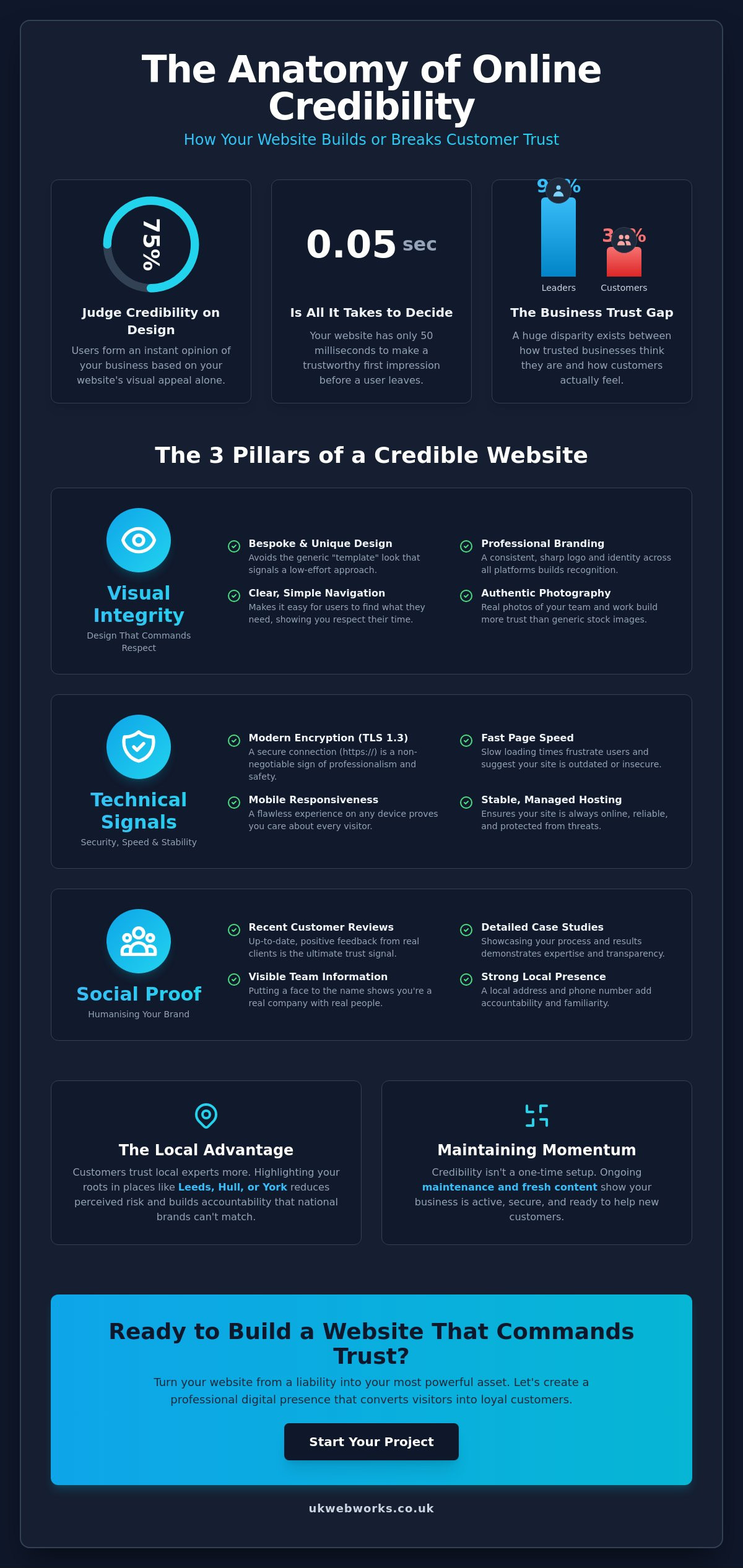
Did you know that 75% of people judge your company’s entire reputation based on your website design alone? It feels a bit unfair when you know your service is top-tier, but in 2026, an amateur look is the fastest way to lose a lead. You’ve likely felt the frustration of watching potential customers visit your site only to leave without a word. If you’re asking how to make my business look credible online, you’re facing a common challenge. While 90% of business leaders think they’re trusted, only 30% of customers actually feel that way.
We know it’s exhausting to keep up with technical shifts like TLS 1.3 encryption or new state privacy laws while trying to run your daily operations. You deserve a professional digital presence that reflects your real-world expertise and actually converts your marketing spend into enquiries. This guide gives you a clear, practical roadmap to bridge that trust gap. We will walk through the visual, technical, and human elements you need to transform your brand from a question mark into a trusted industry leader.
Key Takeaways
- Learn why bespoke design and authentic photography are essential for making a professional first impression in under a second.
- Identify the critical technical signals, from encryption to page speed, that keep visitors on your site instead of hitting the back button.
- Discover how to make my business look credible online by using recent reviews and local case studies to demonstrate your proven track record.
- Understand the importance of ongoing maintenance and fresh content to show your business is active, secure, and ready to help.
The Foundation: Why Online Credibility is Your Business’s Digital Handshake
Credibility isn’t about one single feature. It’s the combined weight of every visual, technical, and social cue on your site. Think of it as a digital handshake. If it’s firm and clear, people stay. If it’s weak or confusing, they leave. Research shows users form an opinion about your site in just 0.05 seconds. That’s 50 milliseconds to prove you aren’t a risk. This quick judgment is rooted in Source credibility theory, which suggests that expertise and trustworthiness are the bedrock of any persuasive communication. If you fail this initial test, no amount of clever copy will save the sale.
When a visitor doubts you, you pay the “Cost of Doubt.” This shows up as a high bounce rate. You might be spending money on SEO or PPC advertising, but if your landing page doesn’t feel right, that investment is wasted. To fix this, we look at three pillars. First is Visual Integrity, which covers your Logo and Brand Identity Design. Second is Technical Reliability, involving your Managed Web Hosting and security protocols. Third is Human Transparency, shown through your reviews and team stories. Understanding how to make my business look credible online starts with accepting that trust is earned through consistency across these areas.
The Psychology of Trust in 2026
By 2026, everyone has become “scam-aware.” We’ve all seen too many deepfakes and AI-generated fluff. Modern customers aren’t looking for a “corporate” facade anymore. They want professional clarity. Flashy animations and complex layouts are out. Simple, fast, and easy-to-use interfaces are in. If a customer has to hunt for your contact details or wait for a heavy video to load, they’ll assume you’re hiding something. They want to see that you value their time and security above all else. Professionalism today is about making the user’s journey as frictionless as possible.
The Local Advantage for Yorkshire Businesses
If you are based in Leeds, Hull, or York, you have a massive advantage. People trust local experts more than faceless national brands. Being a grounded, local partner reduces the perceived risk for your customer. They know you’re just down the road, which adds a layer of accountability that a distant corporation can’t match. Highlighting your regional roots is one of the most effective ways to answer the question of how to make my business look credible online. It proves you’re a real team with real-world skin in the game. We see this every day; a local address and a familiar dialling code often do more for trust than a million-pound marketing budget.
Visual Integrity: Designing a Website That Commands Respect
Visuals are the first thing your visitor processes. If your site looks like a carbon copy of five other businesses in your industry, you’ve already lost their interest. When people ask how to make my business look credible online, we always start with the visual cues that suggest quality and effort. A professional appearance isn’t about being “funky” or using the latest trends. It’s about clarity and consistency. If your Logo and Brand Identity Design looks sharp on your homepage but pixelated on your social media, you’re sending a signal of inconsistency. People notice these small details, even if only subconsciously.
Navigation plays a huge role in this. We often see sites where the contact button is buried or the menu is too clever for its own good. If you make your customers work to find your phone number, they’ll assume your service is equally difficult to deal with. A clean, logical structure shows you’re organised and ready to help. This is a core part of Responsive Web Development; ensuring the site works perfectly and looks professional on every device. When a site adapts seamlessly to a mobile screen, it proves you value the user’s experience.
The Death of the “Template” Look
Generic WordPress templates are everywhere. While they’re cheap, savvy customers can “feel” a theme that hasn’t been tailored to a specific business. It signals a low-effort approach to your digital presence. Investing in bespoke web design allows you to position your brand uniquely. You can use white space effectively to create a premium feel. This isn’t about being empty. It’s about giving your content room to breathe, which makes you look more confident and established.
Photography and Brand Identity
A professional brand identity goes far beyond just having a nice logo. It includes the imagery you choose. The “Stock Photo Trap” is a real problem. We’ve all seen the same photo of three people smiling at a laptop. It feels fake. Replacing these with real photos of your team or your workshop in Yorkshire builds immediate rapport. High-quality icons and graphics can also help explain your complex services without overwhelming the reader. This is a simple way to figure out how to make my business look credible online without needing a massive budget. Authentic photos show you’re a real business with real people.
If your current site feels a bit dated or generic, it might be time to review your digital brand identity with a specialist who understands the local market.
The Technical Trust Signals: Security, Speed, and Stability
While a good design gets you through the door, technical reliability keeps the room from falling down. If your site triggers a “Not Secure” warning, 65% of consumers will immediately lose trust in your brand following a data breach or security scare. In 2026, security isn’t just an option; it’s a requirement. Most browsers now flag any site without a valid TLS 1.3 certificate. This isn’t just about encryption; it’s about showing you care about your customer’s data. Using the current standard for web traffic encryption proves you’re keeping up with modern safety needs.
Speed is the next hurdle. If your site takes longer than three seconds to load, you’ve likely lost the visitor. We live in a world of instant results, and a slow site suggests a neglected business. Your site must also be fully responsive. Whether a customer is browsing on a smartphone in Hull city centre or a tablet in a home office, the experience must be flawless. Similarly, your email address says a lot about your operation. Using a generic Gmail or Outlook address for your business can feel amateur. A professional address linked to your Domain Name Management shows you’ve invested in your brand’s infrastructure.
Invisible Credibility: Performance and Security
Google uses Core Web Vitals as a literal stamp of quality. These technical metrics measure how fast your page becomes interactive and how stable the layout is as it loads. Achieving high scores here is a major part of Search Engine Optimization (SEO). To keep these scores high, you need a robust foundation. Choosing managed web hosting ensures your site stays online and performs at its best. It prevents the dreaded downtime that makes a business look like it’s closed its doors.
Technical Contact Points
Practical details often provide the strongest trust signals. Including a physical address and a local phone number, such as an 01482 Hull or 0113 Leeds prefix, grounds your digital presence in the real world. It proves you aren’t just a faceless entity. Adding an interactive map helps customers find you in East Yorkshire or beyond. Finally, make sure your contact forms actually work. A broken form is a silent killer of enquiries. Testing your technical contact points regularly is a simple answer to how to make my business look credible online. It ensures that when a customer is ready to reach out, your technology doesn’t get in the way.
Humanising Your Brand: Using Social Proof and Local Presence
People buy from people, not from servers or code. After you’ve sorted your technical signals, the next step in how to make my business look credible online is to show the human faces behind the brand. Social proof acts as a shortcut for the brain. If others have had a good experience, the risk of buying feels lower. Interestingly, a perfect 5.0-star rating can sometimes look suspicious to modern shoppers. A 4.8-star rating often feels more authentic because it shows you’re a real business that deals with real-world challenges. It’s the difference between looking “too good to be true” and looking like a reliable expert.
Seeing a name and a face makes a huge difference. Case studies that highlight your work in Leeds or Doncaster prove you understand the local market and have successfully delivered results nearby. If you can, use video testimonials. Seeing a real person talk about how you solved their problem is the ultimate trust builder. It’s much harder to fake a video than a written quote. You should also display logos from industry bodies like the FSB or Checkatrade. These accreditations act as a third-party seal of approval, confirming that you meet specific professional standards and are part of a wider community of specialists.
Mastering Your Google Business Profile
Your Google profile is often the first thing people see before they even reach your site. To improve your SEO in Hull, you must keep this profile active. Post regular updates and photos of your recent projects to show you are open and busy. Statistics show that 89% of consumers are highly likely to use a business that responds to all of its reviews. This includes the negative ones. Responding professionally to a complaint shows you’re accountable and care about your reputation. It turns a potential negative into a demonstration of your integrity.
Transparency as a Sales Tool
Transparency is a powerful way to build rapport. Many businesses hide their prices, but saying “prices starting from” creates an immediate sense of honesty. It sets expectations early and qualifies your leads. Your “Meet the Team” page shouldn’t just be job titles; it should show the people who will actually pick up the phone. Sharing a step-by-step guide of your process also helps. When a client knows exactly what happens after they sign a contract, they feel more in control. It removes the mystery and replaces it with confidence. This openness is a cornerstone of how to make my business look credible online.
If you want to start building a more transparent and trusted brand, you can speak with our team today about your digital strategy.
Maintaining Momentum: Why Credibility is Never “Finished”
Building trust is a great start, but keeping it requires ongoing effort. Many owners think that once the site is live, the job is done. In reality, a digital presence is like a physical storefront; it needs regular cleaning and updates. If a potential customer lands on your blog and sees the last post was written in 2021, they’ll wonder if you’re still trading. This “Ghost Town” effect is a silent killer of trust. It’s often better to have a small, focused site that’s current than a large one that feels abandoned. Understanding how to make my business look credible online means committing to a cycle of regular refreshes.
Refreshing your portfolio every quarter is a simple way to show you’re active and successful. It proves you’re still delivering results for clients in the local area. For busy business owners, digital marketing retainers act as a credibility insurance policy. They ensure your content stays fresh and your marketing remains relevant without you having to manage every single detail yourself. It’s about maintaining the professional standards you’ve worked hard to establish.
The Maintenance Trap
Technology moves fast. Behind the scenes, your site relies on various plugins and software. When these aren’t updated, features start to break. A broken contact form or a layout that suddenly looks “off” on a new smartphone model erodes customer trust instantly. They’ll assume that if you’re neglectful with your own site, you might be neglectful with their project too. A professional maintenance package keeps things sharp. It allows you to monitor site health and fix issues before a customer ever sees them.
Continuous Improvement
Credibility also comes from showing you’re always getting better. Use your analytics to see where people are dropping off. If visitors consistently leave on the same page, there’s likely a trust gap there that needs fixing. You can test different headlines to find the exact words that resonate with your local audience. Finally, conduct an annual digital audit. Review your entire presence against the latest 2026 standards to ensure you haven’t slipped behind. This proactive approach is the ultimate answer to how to make my business look credible online. It shows you’re a modern, reliable partner that’s here for the long term.
Take Command of Your Digital Reputation
Credibility is never a happy accident. It’s the result of deliberate choices across your visuals, technical security, and human transparency. By focusing on bespoke design and maintaining a fast, secure site, you move from being a “question mark” to a trusted professional brand. We’ve walked through the exact steps for how to make my business look credible online, from the 0.05-second first impression to the importance of recent reviews. This isn’t just about looking good; it’s about building a digital presence that works as hard as you do.
If you’re tired of feeling like your website is holding you back, we’re here to help. As local experts based in Hull since 2014, we specialise in clear, practical solutions. We provide fixed-price, jargon-free quotes so you always know where you stand. You can get a no-nonsense audit of your online credibility from UK Web Works to identify exactly what needs to change. You’ve built a great business in the real world. It’s time your online presence reflected that same level of quality and expertise.
Frequently Asked Questions
Does a small business really need a bespoke website for credibility?
A bespoke website isn’t just a luxury; it’s a way to prove you’re an established professional. While templates are common, savvy customers can feel when a site hasn’t been tailored to a specific business. Bespoke design ensures your site matches your unique workflow and brand values perfectly. It shows you’ve invested in your own reputation, which makes customers more comfortable investing in your services. It’s a clear signal of quality and long-term intent.
How many Google reviews do I need before I look trustworthy?
Quality and recency are more important than a massive volume of reviews. Over 91% of customers consult online reviews before making a purchase, but 73% only trust feedback from the last month. Focus on maintaining a steady stream of recent, detailed testimonials rather than a high number from years ago. Responding to every review, both good and bad, is also vital. It shows you’re active and accountable to your clients.
Why does my website speed affect my business credibility?
Speed is a silent trust signal. If your site takes longer than three seconds to load, visitors often assume your business is either struggling or neglected. A fast site proves you value your customer’s time and have a modern, reliable infrastructure. In 2026, technical stability is a baseline requirement for any professional operation. If you can’t manage your own site’s performance, customers may doubt your ability to manage their projects.
Is social media more important than a website for trust?
Social media is excellent for showing your daily activity, but your website remains your digital home base. You own your website, whereas you’re only renting space on social platforms. A professional site provides the depth and technical security signals that social media cannot match. Use social platforms to build a human connection and drive traffic back to a site that proves you’re a legitimate, grounded business with real-world expertise.
What are the most common “red flags” that make a website look dodgy?
The biggest red flags are “Not Secure” browser warnings and broken links. These suggest a lack of basic maintenance and security. Using overused stock photos of generic handshakes also makes you look like a faceless entity. To understand how to make my business look credible online, start by removing these barriers. Always include a physical address and a local phone number to ground your digital presence in the real world and reduce perceived risk.
Should I put my prices on my website to look more credible?
Transparency is a major credibility booster. While you don’t need to list every tiny cost, providing “starting from” prices or typical project ranges shows honesty. It removes the fear of “hidden costs” and helps qualify your leads before they even call you. Customers appreciate businesses that are open about their value. It positions you as a confident expert rather than someone hiding behind a vague “call for quote” button.
How often should I update my website content?
You should aim to refresh your core content, like your portfolio and service descriptions, at least every quarter. This prevents the “Ghost Town” effect where a site looks like it stopped trading years ago. Regular updates show you’re active, successful, and keeping up with industry changes. If you’re wondering how to make my business look credible online, keeping your project list current is one of the simplest wins you can achieve today.
Can a bad logo really ruin my online reputation?
Your logo is the face of your brand. If it looks pixelated, dated, or like it was made in five minutes, it sets a low bar for your entire business. A professional logo signals quality and attention to detail. It’s often the first thing people notice in that critical 0.05-second window. Investing in proper brand identity design ensures you make a strong, professional first impression that builds rapport across all your platforms.