
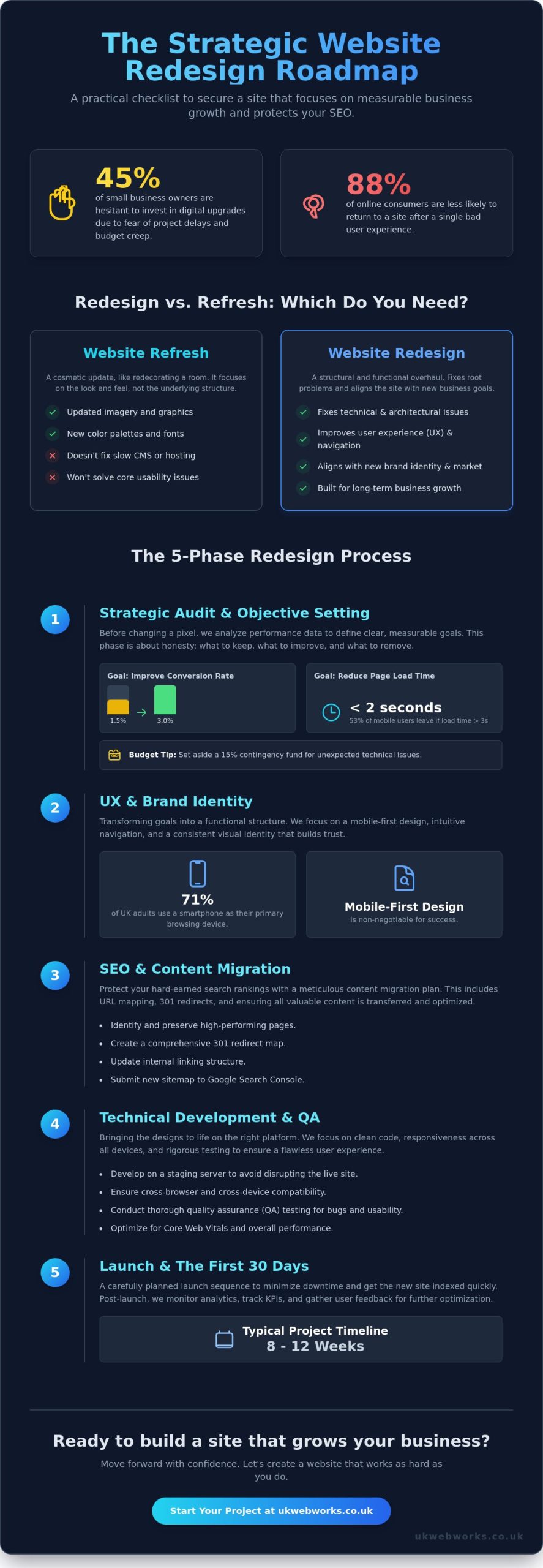
A 2024 survey by the UK’s Federation of Small Businesses found that 45% of owners are hesitant to invest in digital upgrades due to previous project delays and budget creep. It’s a valid concern. You likely feel that your current site is dated and underperforming, but the fear of losing your hard-earned Google rankings or getting stuck with an opaque agency makes you pause. We understand that hesitation. That’s why we’ve created this practical website redesign strategy checklist to help you secure a site that works as hard as you do.
We’ll show you how to build a roadmap that focuses on measurable business growth rather than just pretty pictures. You’ll learn how to keep your 2026 project on track, protect your existing SEO, and ensure the final result is easy for your team to manage internally. Industry data from 2023 suggests that 88% of online consumers are less likely to return to a site after a bad experience, so we’ve focused this guide on creating a seamless journey for your customers. This guide provides the clarity you need to move forward with confidence.
Key Takeaways
- Learn how to distinguish between a simple cosmetic refresh and a bespoke redesign that focuses on measurable business growth.
- Protect your hard-earned search rankings by following our jargon-free website redesign strategy checklist for a seamless content migration.
- Get a straightforward guide to choosing the right platform and ensuring your site remains responsive and fast on every device.
- Master the launch process with a step-by-step sequence designed to minimise downtime and get your new site indexed quickly.
- Discover how to create a clear, intuitive user experience that reflects your brand’s integrity and helps convert more visitors into customers.
Phase 1: The Strategic Audit and Objective Setting
Before you change a single pixel, you need a clear plan. This website redesign strategy checklist starts with a hard look at where your business stands right now and where you want it to go. We’ve seen many UK businesses rush into a design because they’re bored of their current look, only to find that the underlying technical issues remain. You shouldn’t spend your budget on a new coat of paint if the foundations are crumbling—a principle of design integrity that firms like ArchEvolve champion in the physical world before any construction begins.
A successful audit identifies what works and what doesn’t. We look at your data to see which pages keep people reading and which ones send them packing. You might find that your blog is driving 40% of your traffic, but your contact page hasn’t been updated since 2019. This phase is about being honest with your performance metrics so you can decide what to keep and what to kill.
Redesign vs. Refresh: Which do you actually need?
A website refresh is like redecorating a room; it involves new colours, fonts, and updated imagery. However, a website redesign is a structural and functional overhaul. If your current CMS is sluggish or your hosting environment feels like it’s stuck in 2015, a refresh won’t save you. You need to assess your technical debt. If your site isn’t meeting the fundamental principles of web design, such as accessibility and intuitive navigation, a full redesign is the only way to fix the root problems. We recommend a full overhaul if your brand identity no longer speaks to your 2024 target market.
Setting Measurable KPIs for Success
We don’t believe in “looks better” as a goal. Success must be measurable. You should aim for specific targets, such as increasing your conversion rate from 1.5% to 3% or reducing page load times to under 2 seconds. Right now, 53% of mobile users will leave a site if it takes longer than 3 seconds to load, so benchmarking your current speed is vital. We also look at user journeys to find where people drop off. If 70% of your visitors leave at the checkout stage, that’s a functional problem we need to solve. Your budget should reflect these goals. We always suggest setting aside a 15% contingency fund for technical surprises that often appear during the migration of old data.
- Identify goals: Are you looking for more leads, direct sales, or better brand authority? For a perspective on visibility and reputation, explore Wir verkaufen keine Artikel. Wir verkaufen Sichtbarkeit, Reputation und Leads.
- Audit content: High-performing pages stay; outdated or thin content gets deleted.
- Check mobile usability: Ensure your site works perfectly on smartphones, as this accounts for over 60% of UK web traffic.
- Set a timeline: A bespoke redesign usually takes 8 to 12 weeks, depending on complexity.
Phase 2: User Experience (UX) and Brand Identity
Once your objectives are set, you need to turn those goals into a functional structure. This stage is where your website redesign strategy checklist moves from abstract ideas to tangible layouts. We focus on how a visitor feels when they land on your page and how easily they can find what they need. A site that looks beautiful but feels clunky will always lose customers to a simpler, faster competitor.
Mobile-first design is no longer a secondary thought for UK businesses. With Ofcom reporting that roughly 71% of UK adults use smartphones as their primary device for browsing, your site must work perfectly on a small screen first. We build a content hierarchy that guides users naturally toward your call-to-action, ensuring the most important information is always within reach. This isn’t about cluttering the screen; it’s about clear, logical paths that respect the user’s time.
The Blueprint: Sitemap and Wireframing
We start by organising your pages to reduce the number of clicks required for a conversion. If a customer has to click four times to find your contact form, you’ve likely already lost them. A logical sitemap also plans for the future. It ensures your site can handle new services or products as your business grows without needing another total overhaul in twelve months. Most importantly, your bespoke website design should prioritise user intent over flashy animations that serve no practical purpose.
Modern Branding and Visual Consistency
Visual identity is about more than just a new logo. It involves selecting typography and colour palettes that remain consistent across every digital touchpoint. Using professional photography and custom iconography helps build immediate trust with your audience. Stock photos often feel cold and generic, whereas real images of your team or your work in the UK create a genuine connection.
Balancing aesthetic appeal with performance is a delicate task. While a high-impact “wow factor” is great for first impressions, it shouldn’t come at the cost of loading speeds. Research shows that a one-second delay in page load time can lead to a 7% reduction in conversions. When refreshing your look, checking an ultimate guide to website redesign can provide extra perspective on how professional branding impacts your bottom line. We believe in digital craftsmanship that looks modern while remaining incredibly fast. If you’re unsure how your current brand translates to a new site, chat with our team for a straightforward assessment.
Phase 3: The SEO and Content Migration Strategy
Before you touch a single line of code, you need to know what’s already working. We start with a full content audit to catalog every page on your current site. Data from a 2023 Ahrefs study shows that 90.63% of content gets no traffic from Google. You don’t want to waste time migrating dead weight. We identify your “evergreen” pages; these are the high-performers that consistently bring in leads and traffic. This step is a vital part of your website redesign strategy checklist because it ensures you carry over your most valuable digital assets while pruning the rest.
Technical SEO foundations must be baked into the new site structure from the beginning. It’s much harder to “add SEO” later than it is to build it into the architecture. We focus on four key areas:
- Identifying top-performing URLs to preserve search equity.
- Mapping out a new, logical site hierarchy.
- Optimising page load speeds for the UK market.
- Ensuring mobile responsiveness is flawless across all devices.
Protecting Your Rankings During the Move
Moving a website without a 301 redirect map is like moving house and not telling the post office. You’ll lose your hard-earned search rankings overnight. A 301 redirect tells search engines that a page has moved permanently to a new address. This process preserves the authority you’ve built up over the years. You also need to migrate your metadata and image alt-text carefully to maintain visibility. For deeper technical insights into site structure, this comprehensive guide to web design explains how architecture impacts long-term performance. A redirect map prevents the dreaded 404 error for returning visitors, ensuring they find exactly what they’re looking for.
Content Strategy: Quality Over Quantity
Your new site needs a fresh, direct voice. Use this opportunity to rewrite outdated messaging so it aligns with your current brand persona. We focus on integrating keywords naturally into the text. The old-fashioned tactic of “keyword stuffing” will only get you penalised by modern algorithms. Instead, we look at the specific questions your customers are asking. A well-planned internal linking structure is also essential. It helps search engines understand the relationship between your pages and boosts authority across the entire site. By following this website redesign strategy checklist, you’ll ensure your content is written for human readers first while remaining visible to search engine crawlers. This isn’t about fluff; it’s about making sure your UK business remains competitive and easy to find.
Phase 4: Technical Development and Quality Assurance
The development phase is where your visual concepts turn into a functional business tool. It’s the engine room of the project. Choosing the right platform is your first major decision. We typically guide clients toward WordPress for its vast flexibility or Shopify for robust retail requirements. Every choice here should be a line item on your website redesign strategy checklist to ensure the technology supports your commercial goals. Your site must perform flawlessly on an iPhone 15 just as it does on a 27-inch desktop monitor. This requires rigorous responsive testing across Chrome, Safari, and Edge to ensure no user is left behind.
Selecting Your Content Management System (CMS)
Your CMS choice dictates how your team will interact with the site daily. If your staff cannot update a simple blog post or change a price without technical help, the platform is a hurdle rather than a tool. Security remains a top priority; for example, a single plugin vulnerability led to the compromise of over 13,000 sites in one 2023 cyberattack. When choosing the right ecommerce web design company, you should prioritise partners who offer bespoke configurations that strip away unnecessary code. This lean approach improves site speed and reduces the “attack surface” for hackers.
The QA Testing Checklist
Quality Assurance (QA) is the safety net that prevents launch-day disasters. We perform all testing in a private staging environment so the public never sees a broken link or a half-finished page. Statistics from BigCommerce suggest that a 1-second delay in page response can result in a 7% reduction in conversions. This makes load testing essential. We use specific benchmarks to ensure your site stays fast even during high traffic periods. Our standard website redesign strategy checklist for QA includes:
- Functional testing: We click every button, fill out every form, and trigger every automation to ensure they work as intended.
- Accessibility compliance: We follow WCAG 2.2 guidelines to ensure the 16 million people in the UK living with a disability can navigate your content easily.
- Broken link checks: Using automated crawlers to identify and fix any 404 errors before they impact your SEO.
- Proofreading: A final manual sweep to catch typos that automated spellcheckers often miss.
Technical excellence isn’t about using the flashiest gadgets; it’s about building a reliable foundation that works for everyone. If you need a technical partner who values craftsmanship over jargon, speak with our UK-based specialists today.
Phase 5: Launch Day and the First 30 Days
Launching your site is a significant milestone, but it isn’t the finish line. It’s the moment your vision meets the real world. To ensure your investment pays off, you need a disciplined approach to the final hours and the weeks that follow. This final stage of your website redesign strategy checklist focuses on technical stability, data collection, and long-term performance. We don’t just “flick a switch” and walk away; we ensure the transition is smooth and your site is ready to work for you.
The Launch Day Sequence
We aim for a seamless transition that keeps downtime to a minimum. Most modern launches happen in seconds, ensuring your customers don’t encounter a “maintenance” page. Our first priority is verifying that your SSL certificate is active and your hosting connection is secure. A “Not Secure” warning on day one can damage your brand’s reputation instantly. We also confirm that every tracking code, from Google Analytics 4 to Meta Pixels, is firing correctly. Without this data, you can’t measure your success or track your return on investment.
Once the technical checks are complete, we recommend following these steps to build momentum:
- Verify secure connections: Double-check that all internal links are redirecting to the HTTPS version of your site.
- Test all forms: Ensure that contact forms and checkout processes are delivering notifications to the right email addresses.
- Announce the change: Send a dedicated update to your email list and share the news across your social media channels to drive immediate traffic.
Post-Launch Monitoring and Growth
The work continues well after the site is live. Within the first 24 hours, we submit your new XML sitemap to Google Search Console. This prompts Google to re-index your pages and helps protect your hard-earned SEO rankings. Over the first 30 days, we monitor your data against your original KPIs. If your goal was to increase enquiries by 15% or reduce page load times to under two seconds, we look at the actual performance figures to see if we’ve hit those marks.
We use heatmaps and analytics to identify any “snags” or friction points that emerge. If users are struggling with a specific form or leaving a page too quickly, we make the necessary adjustments. A website is a living tool, not a static brochure. To prevent technical decay and keep your site running at peak performance, it’s wise to set up a website maintenance package. This ensures your software remains secure and your site stays fast, providing a reliable foundation for your business growth. Following this website redesign strategy checklist ensures your new site remains an asset rather than a liability.
Take Control of Your Digital Future
A successful website overhaul isn’t just about a fresh coat of paint. It requires a firm balance between technical SEO and intuitive user experience. By following this website redesign strategy checklist, you protect your hard-earned search rankings and ensure your brand identity remains consistent across all five phases of development. Research indicates that 88% of online consumers won’t return to a site after a poor experience, so getting the UX right is vital. Planning for the first 30 days after launch is just as important as the initial design phase.
Our UK-based expert team has spent over 10 years perfecting our digital craftsmanship to help businesses grow. We focus on delivering clear results without the confusing technical talk. We believe in total transparency; that’s why we offer fixed-price project fees so you’re never surprised by hidden costs. It’s time to stop worrying about an outdated site and start building a platform that truly works for your business. Book a jargon-free website redesign consultation with UK Web Works today. We’re ready to help you navigate the 2026 digital landscape with confidence.
Frequently Asked Questions
How long does a typical website redesign take from start to finish?
A professional website redesign usually takes between 12 and 16 weeks to complete. This timeline covers everything from the initial discovery sessions to the final technical testing. Smaller projects might be finished in 8 weeks, while complex e-commerce builds often require 6 months of development. We work methodically to ensure your new site is launched without any technical hitches.
Will a website redesign hurt my current Google SEO rankings?
A redesign won’t damage your rankings if you follow a comprehensive website redesign strategy checklist to manage your site’s structure. The main risk involves changing URLs without setting up proper 301 redirects. We map every old page to its new location so you don’t lose the “link juice” you’ve built up over the years. Most businesses actually see a ranking boost after 3 months due to improved mobile performance.
What is the average cost of a professional website redesign in the UK?
Professional website redesigns in the UK typically range from £3,000 to £15,000 for small to medium businesses. These figures are based on 2024 market rates for bespoke agency work rather than basic template builds. A custom project ensures your site is built specifically for your goals. We provide transparent, fixed quotes so you can manage your budget without worrying about hidden costs or jargon-filled invoices.
Should I redesign my site myself or hire a professional agency?
You should hire a professional agency if you want a bespoke site that functions as a reliable sales tool. DIY builders are fine for basic hobby sites, but they often lack the technical flexibility needed for advanced SEO or custom integrations. Choosing an expert team gives you access to specialists who understand the UK market. We handle the complex coding so you can focus on running your business.
How often should a business redesign its website?
Most businesses should consider a full redesign every 3 to 5 years to stay competitive. Technology moves fast; a site built in 2020 likely struggles with today’s mobile standards and security requirements. Regular updates ensure your brand looks modern and your site remains compatible with the latest browser versions. If your current site feels slow or looks dated compared to local rivals, it’s probably time for a change.
What is the most common mistake made during a website redesign?
The biggest mistake is prioritising visual design over the actual user experience. It’s easy to get caught up in choosing colours, but if the navigation is confusing, your visitors will leave. We’ve seen many businesses spend their entire budget on “fluff” while ignoring the checkout process or contact forms. We focus on a “user-first” approach to ensure your new site actually converts visitors into paying customers.
What technical elements are most important in a redesign checklist?
Your website redesign strategy checklist must include 301 redirect mapping, SSL certificate installation, and mobile responsiveness. These elements are the foundation of a healthy site. We also prioritise page load speeds, as 40% of visitors will abandon a page that takes more than 3 seconds to load. Getting these technical details right from the start prevents expensive fixes later and keeps your site visible in search results.
How do I know if my website needs a full redesign or just a refresh?
You need a full redesign if your site’s core structure is broken or it isn’t mobile-friendly. A refresh is better if your current layout works well but the images and text simply need updating. If your bounce rate has climbed above 70%, it’s usually a sign that the underlying technology or navigation needs a complete overhaul. We can help you decide which path is most cost-effective for your specific situation.