
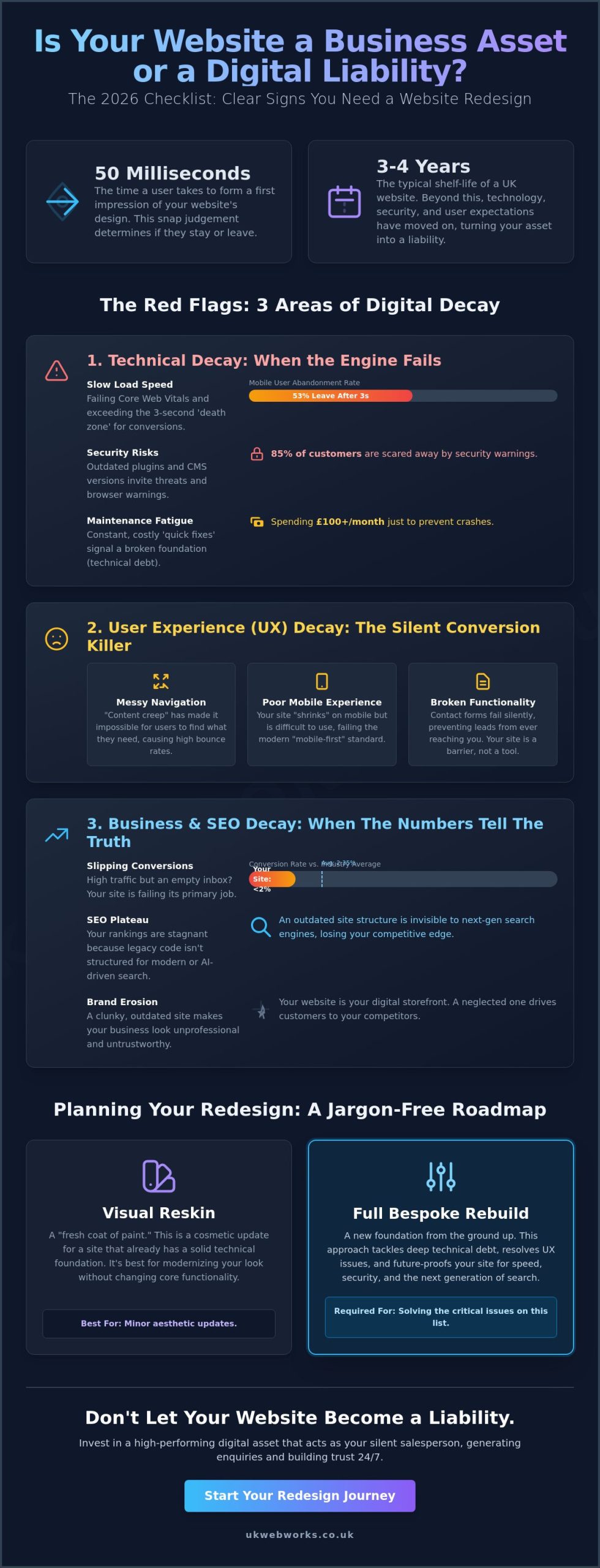
According to a 2024 study by the Nielsen Norman Group, users form an opinion about your website’s aesthetics in just 50 milliseconds. If you feel a pang of dread when a prospect asks for your URL, or you’ve noticed your conversion rate has slipped below the 2.35% industry average, you’re likely seeing the clear signs you need a website redesign. Your digital presence shouldn’t be a source of embarrassment or a technical headache that’s impossible to manage on a daily basis.
We know it’s frustrating when traffic is high but your inbox stays empty. You need a site that acts as a silent salesperson, not a barrier to your growth. This article provides a jargon-free checklist to help you make a firm “Yes” or “No” decision about your digital future in 2026. We’ll show you how to measure the potential return on investment and provide a clear, honest roadmap to get your business back on track without the usual agency fluff.
Key Takeaways
- Learn why the typical 3-4 year shelf life of UK websites means your current site may have shifted from a business asset to a digital liability.
- Identify the technical red flags and hidden “technical debt” that serve as clear signs you need a website redesign before patching becomes more expensive than a fresh start.
- Discover how “content creep” and messy navigation ruin the user journey, and how to fix the underlying causes of high bounce rates.
- Move beyond vanity metrics to understand why your rankings have hit an “SEO plateau” and how a strategic overhaul restores your competitive edge.
- Follow a jargon-free roadmap to determine whether your business requires a simple visual reskin or a full, bespoke technical rebuild based on real data.
Is Your Website a Business Asset or a Digital Liability?
Your website is often the first point of contact for a potential customer in the UK. If it was built more than three or four years ago, it likely functions as a passive brochure rather than an active sales engine. In the fast-moving digital market of 2026, a website that simply “exists” is a liability. We see many business owners mistake a superficial layout change for a genuine redesign. A true strategic overhaul goes much deeper than a fresh coat of paint; it involves a complete rethink of your site structure, underlying code, and the entire web design process to meet modern standards.
The typical shelf life for a professional website in Britain is now 36 to 48 months. Beyond this window, security patches become harder to manage, and user expectations move forward. Identifying the signs you need a website redesign early prevents your brand from looking stagnant. We advocate for digital craftsmanship, which is the practice of building bespoke, high-performing sites that avoid the bloat of generic templates. This approach ensures your platform remains a genuine business asset that generates enquiries while you sleep.
The High Cost of Doing Nothing
Sticking with an outdated site creates a “leaky bucket” effect for your marketing budget. If you spend £1,000 on monthly PPC or social media advertising, but your site takes five seconds to load, you are essentially throwing money away. This leads to brand erosion, as customers associate a clunky interface with a lack of professionalism. Opportunity cost in the context of web performance is the measurable value of the leads and sales lost to a competitor because your digital interface failed to convert a visitor.
- Wasted advertising spend on high-bounce pages.
- Loss of trust from local UK customers who expect seamless mobile browsing.
- Increasing technical debt as old plugins and themes stop receiving updates.
Why 2026 Demands a New Approach
The digital environment has shifted significantly. We are moving away from traditional lists of search results toward AI-generated answers that require structured, clean data to interpret your content correctly. Legacy codebases from 2021 or 2022 often struggle to support the advanced tracking and CRM integrations required for modern business. Choosing bespoke website development over a template provides the security and longevity needed to stay relevant. A tailored build ensures your site is fast, secure, and ready for the next generation of search technology.
Technical Signs: When the Engine Starts to Fail
Think of your website as a company vehicle. If it spends more time in the garage than on the road, it’s costing you money rather than making it. Just as you might invest in professional vehicle graphics Walsall to keep your physical fleet looking its best, your digital presence requires regular maintenance and updates. Technical debt occurs when you keep patching an old system until those very patches start to fail. We often see business owners trapped in a cycle of “quick fixes” that never actually solve the underlying rot. These are clear signs you need a website redesign before your digital presence breaks down entirely.
Watch out for these technical red flags during your weekly site check:
- Broken contact forms that prevent enquiries from reaching your inbox.
- Security warnings in browsers like Chrome or Safari that scare away 85% of potential customers.
- Plugins that no longer update because the developer has abandoned them.
- A backend that feels sluggish or “clunky” when you try to update a simple blog post.
Core Web Vitals and Speed Benchmarks
Google uses a set of metrics called Core Web Vitals to judge if your site provides a good experience. You don’t need a computer science degree to check this. Simply put your URL into Google PageSpeed Insights. It gives you a score out of 100; if you are seeing red numbers, your SEO is suffering. In 2026, a 3-second load time is the “death zone” for conversions. Data shows that 53% of mobile users abandon a site if it takes longer than that to appear. Modern bespoke website development solves this by removing the “bloat” found in off-the-shelf templates, ensuring your site is lean and lightning-fast.
The Maintenance Fatigue Cycle
If you are spending £100 or more every month just to keep your site from crashing, you are experiencing maintenance fatigue. This usually happens with older WordPress sites where dozens of conflicting plugins create a “house of cards” effect. You update one thing, and three other things break. This ultimate guide to website redesign highlights that security is a major driver for a fresh start. Running an outdated CMS version is like leaving your shop front unlocked at night. A clean, modern build reduces these long-term costs because the code is structured correctly from day one.
The reality of 2026 is mobile-first, not just mobile-responsive. If your site just “shrinks” to fit a phone screen but the buttons are too small to click, you’re failing your users. Google now ranks your business based almost entirely on how the mobile version performs. If you feel like you are fighting against your own technology, it is one of the most reliable signs you need a website redesign to stay competitive. We can help you move away from the “patchwork” approach with a clean, high-performance build that actually supports your growth.
User Experience (UX) Decay and the Messy Site Dilemma
Websites aren’t static objects; they grow and change as your business evolves. Over a three-year period, many UK businesses fall victim to “Content Creep”. This happens when you add new services, blog posts, and team members without a clear structural plan. The result is a digital labyrinth where your best content is buried under layers of outdated information. If your navigation feels like a puzzle, it’s one of the clearest signs you need a website redesign to restore order.
Spotting the Symptoms of Content Creep
A messy site directly impacts your bottom line. Research indicates that 88% of online consumers are less likely to return to a site after a bad user experience. You can test your site’s health using these simple markers:
- The Three-Click Rule: Every vital piece of information, from your phone number to your primary service, should be accessible within three clicks from the homepage.
- Identifying Zombies: These are pages that haven’t seen a visitor in 12 months. They clutter your sitemap and confuse search engine bots.
- Hierarchy Collapse: When your “Services” menu has 15 items, users experience choice paralysis and leave.
A professional update simplifies this structure. By following a structured website redesign checklist, we can strip away the fluff and focus on a journey that converts visitors into leads.
Accessibility: Moving Beyond the Basics
In 2026, accessibility is no longer a “nice to have” feature. It’s a legal requirement under the UK Equality Act 2010. There are 16 million people in the UK living with a disability; ignoring their needs means turning away a huge portion of the market. Common accessibility failures include low color contrast that makes text unreadable and links that don’t describe where they lead. These issues are clear signs you need a website redesign to stay compliant. A bespoke ecommerce web design company ensures your shop is inclusive by implementing keyboard navigation and screen-reader compatibility from the start.
Finally, consider the “Embarrassment Factor”. If you hesitate to show your website to a high-value prospect, your site is failing you. Your digital presence should be your hardest-working salesperson, not something you apologise for during a meeting. When you feel the need to say “ignore the website, it’s being updated,” it’s time to actually do it. A clean, honest design builds the trust you need to close the deal and proves you value quality craftsmanship.
Conversion and SEO: When Your Numbers Tell the Truth
Your Google Analytics might show a steady stream of visitors, but if your bank balance does not reflect that growth, you are looking at vanity metrics. Traffic is a vanity metric; conversions are a value metric. One of the clearest signs you need a website redesign is the “SEO Plateau”. This happens when your keyword rankings stall for six months or more despite you publishing regular blog posts. It usually indicates that your site’s underlying architecture is too clunky for modern search algorithms to crawl effectively.
We often meet business owners who are frustrated because they rank for services they stopped offering in 2023. These misaligned keywords happen when an old site structure clings to outdated content while failing to promote your current focus. It wastes your marketing budget and confuses potential clients. In 2026, search engines prioritise “Generative Engine Optimisation” (GEO). If your site is not built to feed clear, structured data to AI search tools, you will simply vanish from the results.
The Conversion Gap
High traffic paired with low enquiries is the ultimate signal that your design is failing you. Modern users decide to stay or leave within 0.05 seconds. If your Call to Action (CTA) buttons are poorly placed or your layout feels cluttered, you will lose the 88% of online consumers who rarely return after a bad experience. A redesign allows us to implement modern psychology in your layout, making it easier to run A/B tests and refine your Conversion Rate Optimisation (CRO) over time.
Preparing for the AI Search Era
AI-driven search engines require a specific “secret language” called schema markup. Old, “thin” content structures from five years ago get ignored by these systems because they lack the technical depth required for AI to parse them. By moving to a cleaner, more focused content architecture, you position your brand as a genuine authority. This involves more than just changing colours; it requires a bespoke technical foundation that proves your expertise to both humans and bots.
- Vanity vs. Value: Focus on lead quality rather than just total hits.
- Structural Health: Fix the “SEO Plateau” by modernising your site’s backend.
- Future Proofing: Use structured data to stay visible in AI-generated search results.
If your website’s performance has hit a wall, we can help you audit your current SEO and conversion rates to find and fix the leaks.
Planning Your Redesign: A Jargon-Free Roadmap
Starting a project based on a hunch is a recipe for a wasted budget. We always recommend an “Audit First” approach. Instead of guessing what your customers want, use the hard data from your existing Google Analytics 4 reports and heatmaps to see where users actually drop off. If 68% of your mobile traffic leaves your checkout page before completing a purchase, you’ve found a concrete problem to solve. Data removes the emotion from design decisions and ensures every pound you spend has a clear purpose.
You’ll need to decide between a “Reskin” and a “Full Rebuild.” A reskin is purely cosmetic, like applying a fresh coat of paint and new signage to a shop front. It updates your fonts, colours, and images but keeps the old technical engine running. A full rebuild replaces the underlying code from the ground up. If you’ve spotted several signs you need a website redesign, such as slow loading speeds or a difficult content management system, a cosmetic reskin won’t fix those structural cracks. In 2026, your technical foundation is just as important as your visual appeal.
Setting Realistic Goals for 2026
Your new site needs clear targets to be successful. Don’t just aim for “better.” Set specific KPIs like reducing page load times to under 2.5 seconds or increasing your monthly lead volume by 20% within the first six months. We advocate for a fixed-price model because it protects SME budgets from “scope creep” and hidden fees. You’ll know exactly what the investment is from day one. This no-nonsense approach ensures the focus remains on delivering a high-quality build, not on counting billable hours.
Choosing the Right Development Partner
Choosing a partner is about more than just finding the lowest quote. You need to ask three vital questions before signing any contract. First, will you own the code and the intellectual property? Second, is the build bespoke or just a tweaked off-the-shelf template? Third, what is the specific plan for SEO migration to protect your current Google rankings? If an agency can’t give you a straight answer on these points, they aren’t the right fit for your business.
Working with a UK-based team means you get local craftsmanship and direct, honest communication. You won’t have to deal with time zone delays or confusing technical talk. It’s about building a relationship with experts who understand the UK market and your specific business challenges. A website shouldn’t be a monthly liability that causes you stress. It should be a high-performing asset that works as hard as you do to grow your brand.
Future-Proof Your Online Presence Today
Your website shouldn’t be a source of frustration or a technical bottleneck. If your mobile performance is lagging or your conversion rates have stalled, these are undeniable signs you need a website redesign. Industry data suggests that 88% of online consumers are less likely to return to a site after a bad user experience. Ignoring these signals doesn’t just hurt your brand; it directly impacts your bottom line as we head toward 2026.
At UK Web Works, we bring over 10 years of digital craftsmanship to every project. Our UK-based expert team prioritizes clarity and results over complex technical talk. We offer fixed-price project development to ensure you know exactly what you’re investing without any hidden fees or surprises. It’s about building a reliable asset that reflects the quality of your business and stands the test of time.
Don’t let a dated site hold you back. Book a jargon-free website audit with UK Web Works today. We’re ready to help you turn your digital vision into a practical, high-performing reality.
Frequently Asked Questions
How often should a business website be redesigned?
Most UK businesses should consider a redesign every 2 to 3 years to stay competitive. Technology and user expectations move quickly, and a site that looks modern today can feel dated by 2026. If your conversion rates have dropped or your bounce rate has climbed above 50%, these are clear signs you need a website redesign to reconnect with your audience.
Will a website redesign hurt my current SEO rankings?
A redesign won’t hurt your rankings if you follow a strict migration plan. We use 301 redirects to map your old pages to the new ones, ensuring Google doesn’t lose track of your content. According to industry data from Search Engine Journal, a well-planned redesign can actually improve rankings by increasing page load speeds and mobile usability scores.
How long does a typical professional website redesign take?
A bespoke project for a small to medium UK business usually takes between 8 and 12 weeks from start to finish. This timeframe includes the initial strategy sessions, design phases, development, and rigorous testing. We provide a clear project roadmap at the beginning so you can plan your marketing activities around the launch date without any guesswork.
What is the difference between a website refresh and a full redesign?
A refresh updates the visual elements like colours, fonts, and images, while a full redesign overhauls the site’s structure and code. Think of a refresh as a new coat of paint for your shop front. A redesign is a full structural renovation that improves how the building functions. If your site is slow or hard to use on mobile, a refresh won’t be enough to fix the underlying issues.
How much does a bespoke website redesign cost in the UK?
Costs vary based on the complexity of your requirements, but industry reports from Clutch show that UK small business redesigns often range between £3,000 and £15,000. A simple brochure site will sit at the lower end of that scale, while an e-commerce platform with custom integrations requires a larger investment. We believe in transparent pricing and provide detailed quotes without any hidden extras.
Can I keep my current content during a redesign?
You can certainly migrate your existing text and images to a new design. We recommend auditing your content first to ensure it still meets your 2026 business goals. If your current copy is ranking well on Google, we’ll move it across carefully. It’s often a good time to update your photography or refine your messaging to better reflect your current brand identity.
What are the most important features to include in a 2026 redesign?
Your site must prioritise sub-2-second load speeds, full accessibility compliance, and secure hosting. Users now expect instant interactions, so technical performance is just as important as the visual design. We also focus on clear calls to action and intuitive navigation. These features ensure your site isn’t just a digital business card but a functional tool that generates enquiries and sales.
How do I know if my website is mobile-friendly enough?
Check your site on a smartphone to see if buttons are easy to tap and text is readable without zooming. Since 55% of global web traffic now comes from mobile devices, a poor mobile experience is one of the most urgent signs you need a website redesign. You can also use tools like Google Search Console to identify specific mobile usability errors that might be frustrating your local customers.