
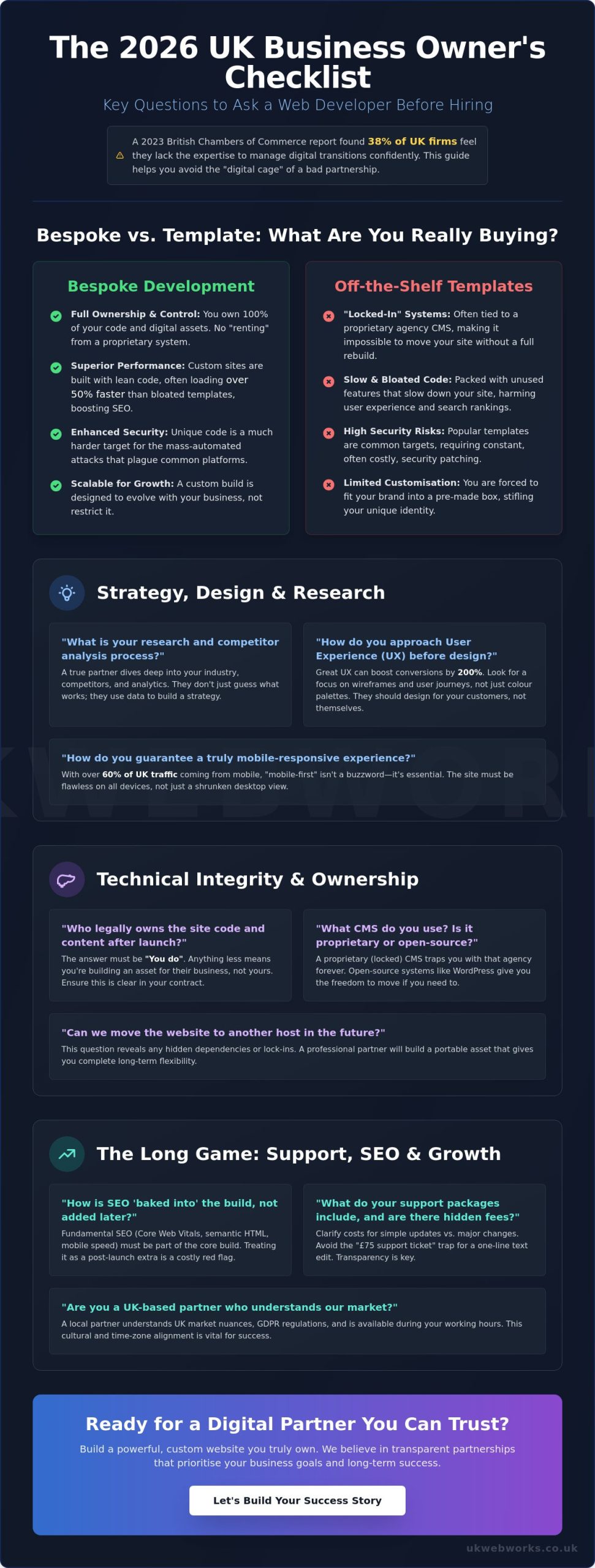
What if the sleekest portfolio you’ve seen today is actually a “digital cage” that locks your business into a proprietary system you can never truly own? It’s a common worry for UK business owners, especially since a 2023 report from the British Chambers of Commerce highlighted that 38% of firms still feel they lack the expertise to manage digital transitions confidently. Knowing the right questions to ask a web developer before hiring is the only way to avoid hidden post-launch costs and ensure you retain full ownership of your digital assets.
We believe you should feel confident and in control, not confused by technical jargon or anxious about “locked-in” contracts. You’re looking for a high-quality bespoke website and a partnership built on honesty rather than high-pressure sales. This 2026 checklist provides a straightforward, jargon-free framework to help you vet potential partners effectively. We’ll walk through the essential queries regarding hosting, intellectual property rights, and long-term support to ensure your project is a genuine business success.
Key Takeaways
- Learn how to move beyond a simple digital brochure by ensuring your developer performs deep industry research and prioritises true mobile responsiveness.
- Protect your business assets by identifying who legally owns your site’s code and ensuring your Content Management System isn’t “locked” to a single agency.
- Discover the essential questions to ask a web developer before hiring to ensure SEO is baked into the build rather than added as a costly after-thought.
- Understand how to vet long-term support packages and why a UK-based partner who shares your cultural values is vital for project success.
Why Vetting Your Web Developer is Your Most Critical Business Move
By 2026, your website isn’t just a digital brochure; it’s your primary storefront and most active salesperson. For many small to medium businesses in the UK, the website is the only point of contact a customer has with the brand. Choosing the wrong person to build it isn’t just a minor inconvenience. It’s a strategic risk that can stall your growth for years. Many owners fall for the allure of a “cheap” build, only to find that a £500 template ends up costing thousands in lost revenue and emergency repairs when it fails to perform.
You need to have the right questions to ask a web developer before hiring to separate the hobbyists from the professionals. There’s a massive gap between a “coder” who simply follows instructions and a “digital partner” who prioritises your ROI. While a coder might build exactly what you ask for, a partner will challenge your ideas if they don’t serve your business goals. This checklist serves as your shield against the “jargon trap.” Opaque agencies often use technical babble to hide a lack of strategy, but we believe in keeping things transparent and direct.
The Cost of a Misaligned Partnership
A poorly built site does more than just look bad. It actively damages your reputation. If your developer ignores Core Web Vitals or mobile responsiveness, your SEO rankings will plummet, making you invisible to the 81% of consumers who research products online before buying. We’ve seen countless businesses trapped by “hidden” fees, where a simple text update requires a £75 support ticket because the agency kept the keys to the CMS. For UK-based companies, geographic alignment is equally vital. You need a team that understands local market nuances and UK GDPR regulations, rather than a distant entity that’s unavailable during your working hours.
Bespoke vs. Template: What Are You Actually Buying?
Off-the-shelf templates are often bloated with “dirty” code that slows down your load speeds and limits your ability to scale. While they might look acceptable on day one, they’re difficult to customise as your business evolves. To truly compete, you must understand the web design process and why custom solutions offer a better long-term value proposition. Bespoke design is a tool tailored to specific business objectives. Unlike templates, custom builds are lean, fast, and designed around your specific customer journey. When considering your questions to ask a web developer before hiring, always probe into whether they are building for your specific needs or just shoehorning your brand into a pre-made box.
- Speed: Custom sites often load 50% faster than heavy, plugin-reliant templates.
- Security: Bespoke code is less vulnerable to the mass-targeted attacks that hit common templates.
- Ownership: You should own your assets, not rent them through proprietary agency software.
Essential Questions About Strategy, Design, and Research
Choosing a partner to build your online presence requires looking past the surface. The specific questions to ask a web developer before hiring will reveal if they are a genuine strategist or simply a digital decorator. You need a site that works as hard as you do, which starts with a solid foundation of research and user-focused logic.
The User-First Design Philosophy
Visual trends come and go, but user experience (UX) is what actually drives your bottom line. Research from Forrester indicates that a well-conceived user interface can increase your website conversion rate by up to 200%. Ask your developer how they approach wireframing and prototyping before they even touch a colour palette. A professional responsive web design company focuses on how a visitor moves through your site to complete a purchase or enquiry. If they can’t explain the logic behind their layout choices, they’re designing for themselves, not your customers.
Industry Research and Competitive Analysis
A bespoke build shouldn’t start with a blank canvas or a generic template. You should ask about their specific research process. A thorough phase includes:
- A deep dive into your top three local or national competitors.
- Analysis of your current site analytics to see where people drop off.
- Direct conversations to understand what your customers actually need from you.
Be wary of red flags. If a developer claims they “just know” what works for your industry without looking at your data, they’re guessing with your budget. In the UK market, where mobile traffic now accounts for over 60% of web visits according to 2023 Statista data, you must ensure their strategy covers every device. Ask for specific examples where their design choices led to a measurable increase in leads or sales. If you’re looking for a partner who prioritises these results, our team is ready to help you build something that actually performs.
This dedication to craftsmanship is a value shared by many top-tier British firms; for a look at how sustainable quality is prioritized in the property sector, you can visit Waterhead Projects.
Technical Integrity: Questions on Ownership, CMS, and Jargon
Technical details often feel like a barrier between you and your new website. Some developers use this complexity to hide restrictive contracts or inefficient processes. You need to pull back the curtain. These specific questions to ask a web developer before hiring will help you identify whether a partner is building an asset for your business or a trap that keeps you tied to their services indefinitely.
The “Ownership” Litmus Test
Ownership isn’t just about having your name on the invoice. It’s about your legal right to move the site to any host at any time. You must ask: “Who will legally own the website, the code, and the domain once it is finished?” If the answer isn’t a definitive “you,” walk away. Some agencies use proprietary CMS platforms. These are “closed” systems that only they can manage. If you decide to leave that agency, you can’t take the website with you; you’ll have to start from scratch. This is a common tactic to keep clients hostage. We recommend bespoke WordPress or Shopify builds because they offer the best balance of flexibility and control. These platforms allow you to hire any competent developer in the future, ensuring your business isn’t reliant on a single person or company.
Jargon-Free Technical Standards
You don’t need a computer science degree to ensure your site is built correctly. Focus on how the developer handles the fundamentals that impact your bottom line. Ask about their approach to site speed and mobile optimization. A site that takes longer than 3 seconds to load will lose 40 percent of its visitors immediately. You also need to know who is actually writing the code. Ask: “Do you outsource the development work or is it all handled by your UK-based team?” At UK Web Works, we believe in-house development is the only way to maintain quality control. Outsourced projects often suffer from communication gaps and “black box” coding that makes future updates a nightmare. If you are choosing the right ecommerce web design company, these technical standards become even more critical because security and payment processing are involved.
Finally, address the legalities of the UK market. Ask how they handle website security and GDPR compliance for UK users. This isn’t just about a privacy policy link. It involves:
- Implementing SSL certificates for encrypted connections.
- Ensuring data capture forms comply with the Data Protection Act 2018.
- Setting up secure, UK-based hosting to keep user data within local jurisdictions.
- Regular software updates to patch security vulnerabilities.
A transparent developer will explain these steps without using confusing terminology. They should treat security as a standard feature, not an expensive add-on.
The Long Game: Questions on Support, SEO, and Growth
Your website is a living asset. It isn’t a static brochure that sits on a shelf; it requires regular technical updates to stay secure and functional. One of the most vital questions to ask a web developer before hiring is how they handle the months following the launch. You don’t want to find yourself with a broken contact form or a security vulnerability because a plugin became outdated. In 2024, data from the UK government’s Cyber Security Breaches Survey found that 50% of UK businesses experienced a breach or attack in the preceding 12 months. Proactive support is your first line of defence.
Post-Launch Maintenance and Security
Maintenance and hosting are two different things. Hosting is just the digital space on a server where your files live. Managed maintenance involves active updates, backups, and security monitoring. For a UK business, your service level agreement (SLA) should specify clear response times. If your site goes down on a Tuesday morning, you need to know it’ll be fixed within hours. Ask these specific questions:
- Question 9: What is included in your monthly maintenance and support packages?
- Question 11: How do you handle hosting, and where are your servers located?
We recommend UK-based servers for local businesses. A server in London or Manchester provides faster load times for your British customers compared to one in the US. Speed is a direct ranking factor for Google, and every millisecond counts.
SEO and Digital Marketing Integration
SEO must be built into the foundation of your site. It’s much harder to fix a messy site structure after the project is finished. This is why you need to know if basic SEO is “baked in” or treated as an extra cost. A 2023 industry study showed that sites with correct schema markup can see a 20% increase in click-through rates from search results. When considering questions to ask a web developer before hiring, focus on the technical details that drive visibility.
- Question 10: Is basic SEO “baked in” to the build, or is it an additional service?
- Question 12: What happens if I want to add new features six months after launch?
A professional developer will explain how they handle site architecture, schema markup, and metadata from day one. They’ll also provide a clear path for growth. Your business will change, and your website needs to be flexible enough to add an e-commerce shop or a booking system without a total rebuild. We focus on building scalable sites that grow alongside your turnover.
Looking for a partner who prioritises your long-term growth? Explore our transparent maintenance and SEO packages today.
Beyond the Checklist: Choosing a Partner Who Speaks Your Language
The technical answers you get are only half the story. You’re looking for a partner, not just a one-off service provider. Building a website takes months of collaboration. Maintaining it takes years of support. You need to feel comfortable picking up the phone to the person on the other end. If the “vibe check” fails during the initial meeting, the project will likely struggle. It’s about trust. Can you see yourself working with this team long-term? A developer who listens is always better than one who just talks.
Choosing a UK-based team matters for more than just time zones. It’s about shared cultural values and a mutual understanding of the British market. When you discuss local SEO or consumer habits in your specific region, you want a developer who understands the nuances. UK Web Works provides that local reliability. We don’t hide behind support tickets or offshore our communication. You get direct access to experts who care about your business growth. We focus on bespoke results that put the business owner in control. This ensures your site reflects your brand accurately while meeting UK-specific regulations like GDPR.
The No-Nonsense Approach to Web Design
Transparency is the most valuable trait a developer can offer. Too many agencies use complex language to justify high costs or hide delays. We do the opposite. Our commitment to being a jargon-free agency means we explain everything in plain English. We believe that honesty is the best policy for long-term success. You don’t need a degree in computer science to understand your own website. We invite you to experience a direct, helpful consultation. We’ll talk about your business goals, not just code. This approach ensures your website is a tool for profit, not a source of frustration.
Your Next Steps to a Better Website
By now, you have a solid list of questions to ask a web developer before hiring. Your next move is to turn these points into a clear project brief. List your must-haves, your functional requirements, and your absolute deal-breakers. This clarity helps us provide an accurate, fixed-price quote. Budget certainty is vital for small and medium businesses. Knowing the total cost upfront prevents the “scope creep” that ruins many digital projects. To get started, follow these simple steps:
- Review your notes from this interview checklist.
- Identify the primary business goal for your new site.
- Compile your existing brand assets and content.
- Request a transparent, fixed-price project development fee.
We’re ready to help you build a site that actually works for your business. Let’s move away from technical confusion and toward digital growth.
Secure Your Business Growth for 2026 and Beyond
Selecting a partner for your next digital project shouldn’t feel like a gamble. You’ve now got the essential questions to ask a web developer before hiring, which ensures you maintain full control over your CMS, ownership rights, and long-term SEO strategy. Vetting for technical integrity and a clear roadmap for growth protects your investment. A successful website is a bespoke tool that works for your specific ROI, not a generic template that leaves you stuck with hidden fees later.
Our UK-based team at UK Web Works focuses on direct, local support and honest communication. We strip away the jargon and provide fixed-price development fees, so your budget stays on track from the first day. We don’t just build sites; we create reliable digital foundations that help British businesses thrive in local markets. It’s about craftsmanship and a no-nonsense approach that puts your commercial goals first. We’re ready to help you turn these questions into a finished product you’re proud of.
Download our jargon-free web design brief template or get a fixed-price quote today.
Take the first step toward a more professional online presence today; we’re here to support you every step of the way.
Frequently Asked Questions
How much does a bespoke website typically cost in the UK?
A bespoke website for a small to medium business in the UK typically costs between £2,500 and £10,000 depending on its complexity. This price reflects the craftsmanship involved in building a site from scratch rather than using a generic template. You’re paying for a unique digital asset that’s built specifically to convert your visitors into customers. It’s a long-term investment that avoids the technical limitations and performance issues of cheap, mass-produced site builders.
Do I really need to own my website code, or is renting a platform okay?
You should always aim for full ownership of your website code to avoid being locked into a single provider. Renting a platform might seem cheaper initially, but it leaves you vulnerable if that company raises prices or shuts down. When you own the code, you have the freedom to move your site to any host you choose. It’s a critical point to clarify when looking for questions to ask a web developer before hiring.
How long does the average web design project take from start to finish?
Most professional web design projects take between 8 and 12 weeks from the initial kickoff to the final launch. This timeline accounts for the planning, design, development, and testing phases required for a high-quality result. Simple sites might be ready in 6 weeks, while complex e-commerce platforms often require 16 weeks or more. We believe in setting realistic milestones so your business can plan its marketing activity around the specific launch date.
What is the difference between a web designer and a web developer?
A web designer focuses on the visuals and user experience, while a web developer builds the underlying structure. Think of the designer as the architect who draws the plans and the developer as the builder who lays the bricks. Most modern agencies provide both skills to ensure your site looks great and works perfectly. This is one of the vital questions to ask a web developer before hiring to ensure they have the necessary technical range.
Will I be able to update my own website content without calling you?
Yes, we build websites using Content Management Systems (CMS) that allow you to edit text and images without any technical knowledge. You’ll receive a login to a dashboard where you can make updates in real-time. This puts you in control of your daily content changes. We provide a training session at the end of the project to ensure you’re confident using the system. It’s about giving you independence rather than making you rely on us.
Is it better to hire a local UK agency or outsource abroad for a lower price?
Hiring a local UK agency is generally better for communication, legal protection, and shared cultural understanding. While overseas outsourcing can save 40% on initial costs, it often leads to delays due to time zone differences and language barriers. Working with a UK team means you’re protected by UK consumer laws and can pick up the phone during your normal working hours. We value the long-term relationships that come from being a local, reliable partner.
What happens if my website gets hacked or goes offline?
If your website goes offline, your hosting provider or maintenance team should respond within 4 hours to begin the recovery process. We recommend a proactive maintenance plan that includes daily backups and security monitoring to prevent issues before they start. Having a 99.9% uptime guarantee is a standard industry expectation you should look for. Rapid recovery ensures your business doesn’t lose revenue or reputation during a technical fault. It’s about keeping your digital shopfront open.
Do I need to provide all the images and text for the new website?
You can provide your own content, but most professional agencies offer copywriting and photography services to ensure the best results. Around 70% of project delays are caused by clients struggling to write their own text on time. If you’re busy running your business, it’s often more efficient to let experts handle the content creation. We can work with your existing materials or create fresh, SEO-friendly content from scratch to help your site rank better.