
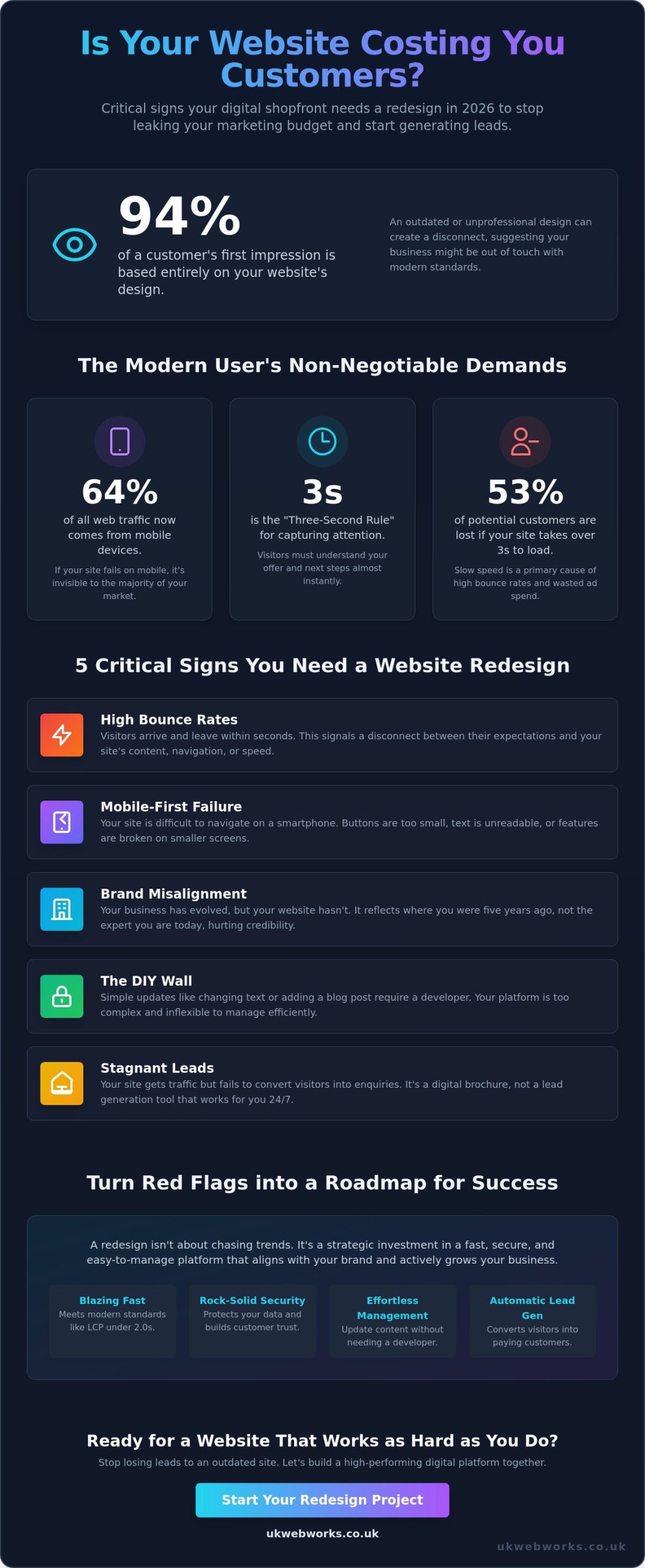
Did you know that 94% of a customer’s first impression of your business is based entirely on your website’s design? If you feel a twinge of embarrassment every time you send a link to a prospect, you are certainly not alone. Many UK business owners find themselves stuck with platforms that are difficult to update and frustratingly slow to load. Identifying the specific signs you need a website redesign is the first step toward stopping the silent leak in your marketing budget. In 2026, with over 64% of web traffic coming from mobile devices, a site that fails to load within three seconds will lose 53% of its potential customers before they even see your homepage.
We understand that the thought of a digital overhaul often brings a fear of technical headaches and complex jargon. You want a site that generates leads automatically and aligns with your brand, not a system that breaks every time you try to change a paragraph. This guide will help you identify the red flags costing you money and explain how to move toward a fast, secure platform that is easy to manage. We will explore how to meet modern standards, like the updated 2.0 second threshold for Largest Contentful Paint, while keeping the entire process straightforward and focused on your growth.
Key Takeaways
- Learn how to apply the “Three-Second Rule” to ensure your digital shopfront captures attention before visitors click away.
- Identify the five most common signs you need a website redesign that are currently causing your business to lose potential leads.
- Discover how to spot technical debt and stop it from draining your budget through poor SEO performance and high PPC costs.
- Use our jargon-free checklist to audit your current site, including the “Mum Test” for assessing real-world user experience.
- Understand the strategic advantage of building a bespoke, secure, and easy-to-manage platform that aligns with your brand.
Is Your Digital Shopfront Still Pulling Its Weight?
Think about your physical office or showroom in Hull or York. You wouldn’t let the signage fade until it was unreadable, or leave the front door stuck so customers had to shoulder it open to get inside. Your website is your digital shopfront. In 2026, it often provides the very first interaction a prospect has with your brand. It’s no longer enough for a site to simply exist online. A high-performing website must act as your most tireless employee, answering questions and capturing leads while you sleep. If it isn’t doing that, it’s a drain on your resources.
The “Three-Second Rule” has become the gold standard for digital success. Within three seconds of landing on your page, a visitor should know exactly what you offer and what they need to do next. If they are met with a wall of text or a confusing menu, they’ll click away. This lack of immediate clarity is one of the clearest signs you need a website redesign. A redesign isn’t just about chasing a “new look” for the sake of it; it’s about business growth and ensuring your site removes the friction that stops people from buying. By focusing on fundamental web design principles, you can ensure your site is built on a foundation of clarity and purpose.
The Evolution of User Expectations
How we use the internet has shifted dramatically over the last few years. In 2026, users expect “instant-answer” navigation. They are often arriving from AI-powered search engines that have already promised them a specific solution. If your site doesn’t deliver that answer immediately, they feel frustrated. “Good enough” has become a liability in our local market. When your competitors in Leeds or Scunthorpe are investing in seamless experiences, an outdated site makes your business look like it’s standing still. You need a platform that is ready for the future of search and user behaviour.
The “Silent Killer” of Conversions: Friction
Friction is the sum of all the small annoyances that drive customers away. It might be a mobile menu that’s hard to tap or a contact form that asks for too much information. These issues have a significant psychological impact. An outdated design suggests that you might be out of touch with modern standards in other areas of your business. Trust is hard to win but very easy to lose. To ensure your brand projects the right image, you might discover One Vision Photography | South Wales Wedding Photographer for inspiration on how high-quality media can elevate your professional standing. Businesses in Doncaster and Grimsby are already raising the bar, and your digital presence needs to match that level of professionalism to stay competitive in the region.
5 Critical Signs You Need a Website Redesign in 2026
While some issues are obvious, others act like a slow leak in a tyre. You might not notice the damage until you’re already stranded. If you’re seeing steady traffic but your inbox remains empty, you’re likely facing one of the most common signs you need a website redesign. Your site isn’t just a brochure; it’s a tool for conversion. When that tool stops working, your business growth stalls. Let’s look at the five red flags that suggest your platform is no longer fit for purpose.
- High Bounce Rates: If visitors leave your site within seconds, they aren’t finding what they need. This often points to poor navigation or slow load times.
- Mobile-First Failure: With over 64% of global web traffic coming from mobile devices in 2026, a site that doesn’t work perfectly on a smartphone is essentially invisible to half your market.
- Brand Misalignment: Your business has likely evolved since your site was last built. If your digital presence feels like a relic from five years ago, it’s hurting your credibility.
- The DIY Wall: You shouldn’t need a degree in computer science to change a phone number or add a blog post. If simple updates require a developer, your system is too complex.
- Stagnant Leads: A site that looks “fine” but doesn’t generate enquiries is a failed investment. Modern users expect a frictionless path to purchase.
When Your Brand Outgrows Your Code
Your business reputation in Yorkshire is built on hard work and reliability. If your website looks amateurish or outdated, it creates a disconnect. This is why a cohesive strategy from a brand identity agency is so vital. We often see clients who have scaled their services but are still using a site that reflects their very first year in business. Your digital voice must match the expert level of service you provide in person. If it doesn’t, you’re likely ignoring several signs it’s time for a website overhaul.
The Mobile Experience Reality Check
In 2026, “responsive” is just the baseline. Your site needs to be fully mobile-optimised for modern hardware like foldables and ultra-wide screens. A poor mobile experience doesn’t just frustrate users; it directly impacts your local footfall and bookings. If a potential customer can’t easily find your address or tap your phone number while walking down a street in Hull, they’ll simply move to the next result. If you’re unsure how your current site stacks up, you can always reach out for a straightforward chat about your options. We prefer a direct approach to solving these technical hurdles without the headache.
The Hidden Costs of Technical Debt
Technical debt is the digital equivalent of building a house on a crumbling foundation. You might not see the cracks from the street, but they make every future renovation twice as expensive. In the context of your business, this hidden mess is one of the most significant signs you need a website redesign. When your site is built on legacy code or outdated plugins, you aren’t just dealing with a slow interface; you’re paying a “laziness tax” on every marketing pound you spend. This is the cost of inaction, and it’s often higher than the investment of a new build.
Think about your Pay Per Click (PPC) campaigns. If you’re paying for clicks but 53% of mobile users abandon your site because it takes more than three seconds to load, you’re throwing half your budget away. Google’s algorithms now use Interaction to Next Paint (INP) as a primary ranking signal, requiring a response time of under 200ms. An old, clunky site simply cannot meet these standards. This means your competitors with faster sites will consistently pay less for better ad placements while you struggle to keep up.
There is also a massive security risk to consider. Outdated Content Management Systems (CMS) are the primary target for automated hacks. Beyond the risk of data breaches, an inefficient site wastes your team’s time every single day. If it takes your marketing manager an hour to change a banner because the backend is a labyrinth, that’s time they aren’t spending on actual growth. Investing in an intuitive user experience isn’t just for your customers; it’s for your internal efficiency too.
SEO and the Modern Search Landscape
Search has changed. Our seo agency hull team sees it daily: Google rewards sites that are fast, secure, and helpful. In 2026, AI-driven search results rely on clear site structures to pull information correctly. If your site’s code is a tangled web of legacy scripts, these bots will skip you in favour of a competitor whose site is easier to crawl and understand.
The Escalating Price of Maintenance
Many business owners fall into the trap of “patchwork” fixes. You pay a developer to fix a broken plugin, only for it to break something else. Over a year, these emergency repairs often cost more than a structured monthly plan. Our website maintenance packages are designed to be far more effective when applied to modern, clean code. A fresh build provides a secure, managed environment that stops you from constantly firefighting technical glitches and lets you focus on your business.
How to Audit Your Current Site (A Jargon-Free Checklist)
You don’t need a degree in computer science to know if your site is failing your business. While we have discussed the technical theory behind high-performing sites, it’s time for you to take the driver’s seat. Performing a simple, honest audit is the best way to confirm the signs you need a website redesign for your specific brand. This isn’t about looking for perfection; it’s about identifying the friction points that stop a local prospect from becoming a paying customer.
Start with a simple speed check. Use a free tool like Google PageSpeed Insights to see how your site actually performs on a mobile connection. If your score is in the red, you are likely part of the 47% to 53% of websites that fail modern Core Web Vitals thresholds. Beyond the numbers, you should also perform these practical tests:
- The “Mum Test”: Ask a non-technical friend to find a specific service or your price list. If they can’t do it within thirty seconds, your navigation is failing.
- Competitor Benchmarking: Open the websites of your three main rivals in Hull or York. If their digital shopfront looks more professional or is easier to use, your prospects will notice the difference immediately.
- Mobile Sanity Check: Don’t just use your own phone. Borrow three different devices with varying screen sizes and try to fill out your contact form. If the buttons are too small to tap, you’re losing leads.
- Analytics Review: Look for your “drop-off” points. If most visitors leave as soon as they hit your “About” page, your messaging isn’t resonating.
Analysing Your Conversion Funnel
Your website should act as a clear path to a sale. Are your calls to action prominent, or are they buried at the bottom of long paragraphs? A contact form that only works on certain browsers is a silent profit killer. Ensure your phone number and address are visible on every page. Local customers in East Yorkshire want to know you’re real and easily reachable. If they have to hunt for a way to contact you, they’ll simply move to the next result in the search listings.
The Content Integrity Check
Outdated content is a major trust killer. If your latest blog post is from three years ago, it suggests your business might be stagnant. Check for broken links and blurry images that look poor on modern high-resolution displays. Your services must reflect what you offer right now in 2026. If this audit reveals more red flags than you expected, you can book a professional site review with our team to get a clear, jargon-free plan for your next steps.
Turning Red Flags into a Roadmap for Success
Once your audit is complete, you likely have a list of areas that need urgent attention. Recognizing the signs you need a website redesign is a vital first step, but the real value comes from what you do next. It’s easy to view a new site as a painful expense that you’d rather put off. However, shifting to an investment mindset changes the perspective. A high-converting website isn’t just a cost; it’s a digital asset that works 24/7 to pay for itself by capturing the leads your old site is currently dropping.
Many business owners believe they need to hire a distant “big city” agency to get high-quality results. In reality, choosing a local web design hull specialist offers a distinct advantage. We understand the Yorkshire landscape and the specific expectations of customers in our region. There’s a level of accountability and shared values that you simply won’t find with a faceless national firm. You deserve a partner who is accessible and genuinely invested in the growth of the local economy.
Choosing Your Redesign Partner
When you’re ready to move forward, prioritise honesty and direct communication. You don’t need a partner who hides behind complex terminology or vague promises. Look for an agency that offers fixed-price project fees. This transparency is essential for avoiding the “budget creep” that often plagues technical projects. Whether your business is expanding in York, Leeds, or Hull, local expertise ensures your brand’s digital voice resonates with the people who matter most to your bottom line. We value hard work and long-term relationships, which is why we keep our process straightforward and our results measurable.
Ready for a Jargon-Free Consultation?
We pride ourselves on making the redesign process as smooth as possible for busy business owners. We don’t believe in using generic, bloated templates that slow down your site and make you look like everyone else. Instead, we focus on bespoke builds that are fast, secure, and incredibly easy for your team to manage without needing a developer on speed dial. We take the technical headache away so you can focus on running your business. If you’ve seen the warning signs and you’re ready for a change, contact our Hull team for a straightforward quote. We’ll help you turn your digital red flags into a roadmap for long-term success.
Build a Website That Works as Hard as You Do
Your website shouldn’t be a source of frustration or a silent drain on your marketing budget. By viewing your digital shopfront as a strategic investment rather than a cosmetic expense, you can remove the friction that stops your Yorkshire business from scaling. We’ve explored how technical debt and poor mobile performance act as barriers to your growth. Now that you can identify the signs you need a website redesign, you have the clarity needed to turn those red flags into a roadmap for success.
With over 10 years of experience in bespoke Yorkshire web development, our team focus on a no-jargon approach that keeps your business objectives front and centre. We provide fixed-price project fees with no hidden surprises; this ensures you can plan your growth with total confidence. It’s time to move away from clunky, outdated systems and toward a fast, secure platform that generates leads automatically. Get a fixed-price quote for your website redesign in Hull today. Your business deserves a digital presence that works just as hard as you do.
Frequently Asked Questions
How often should a business realistically redesign its website?
Most businesses should consider a redesign every three to five years to stay competitive. Technology and user expectations move fast; what was modern in 2022 often feels sluggish and outdated by 2026. If your site no longer reflects your current business model or fails to meet modern speed standards, you’re likely ignoring the signs you need a website redesign.
Will a redesign cause me to lose my current Google rankings?
A properly managed redesign should protect and eventually improve your search engine rankings. We use 301 redirects to tell Google exactly where your old pages have moved, ensuring you don’t lose your hard-earned authority. By improving your site speed and mobile experience, you’re actually meeting the specific ranking signals that Google prioritises for 2026.
How much does a professional website redesign cost in the UK?
The cost of a redesign depends entirely on the complexity of your site and the specific features you need. A bespoke business site requires a different level of investment than a large-scale e-commerce store with thousands of products. We always suggest looking for fixed-price quotes to avoid the “budget creep” that often comes with hourly rates or hidden fees.
How long does the average website redesign project take from start to finish?
A professional redesign typically takes between eight and twelve weeks from the initial planning stages to the final launch. This timeframe allows for deep research, bespoke design, and rigorous testing across all modern devices. More complex projects with extensive custom functionality may take longer to ensure every technical detail is perfect before going live.
Can we just refresh the design without rebuilding the whole backend?
You can refresh the visuals, but it’s often more cost-effective to rebuild the backend if your system is more than a few years old. Applying a new design to old, messy code won’t fix slow loading times or security vulnerabilities. A fresh build removes technical debt and ensures your site is easy for your team to manage internally.
What is the most important sign that a website needs a redesign?
The most critical sign is a consistent drop in conversion rates despite having steady traffic. If people are visiting your site but nobody is calling or filling out your contact forms, your digital shopfront is failing to build trust. This friction suggests that your user experience no longer meets the standards your customers expect in a modern market.
Should I choose WordPress or Shopify for my new website?
We generally recommend WordPress for service-based businesses and Shopify for dedicated online retailers. WordPress offers incredible flexibility for bespoke designs and is excellent for managing complex content. Shopify is a robust, secure choice if your primary goal is selling products and you want a system that handles payments and inventory with minimal fuss.
How do I explain the need for a redesign to my company director?
Focus your conversation on lost revenue and competitive disadvantage rather than just aesthetics. Show them data from your audit, such as high mobile bounce rates or how your local rivals in Hull look more professional. Explaining that the site is a lead-generation tool rather than a “marketing cost” helps align the project with the company’s growth objectives.