
What if the biggest barrier between you and a new customer isn’t your pricing or your competition, but the very words on your screen? Many business owners believe they need to use complex “marketing speak” to appear professional, yet this often has the opposite effect. If your website attracts traffic but fails to generate enquiries, the problem usually isn’t the visitor; it’s a lack of clarity. Learning how to write effective website copy is about more than just filling space. It is about building a bridge of trust between your expertise and your customer’s specific needs.
You probably know the feeling of staring at a blinking cursor, wondering how to explain your services without sounding like a corporate manual. It’s overwhelming to keep up with 2026’s digital shifts, from Google’s latest core updates to new accessibility standards. We promise to take the mystery out of the process with a practical, jargon-free framework. You’ll learn how to simplify complex ideas, speak directly to your audience’s pains, and create a professional voice that feels refreshingly human. This guide covers everything from structure to tone, ensuring your site finally works as hard as you do.
Key Takeaways
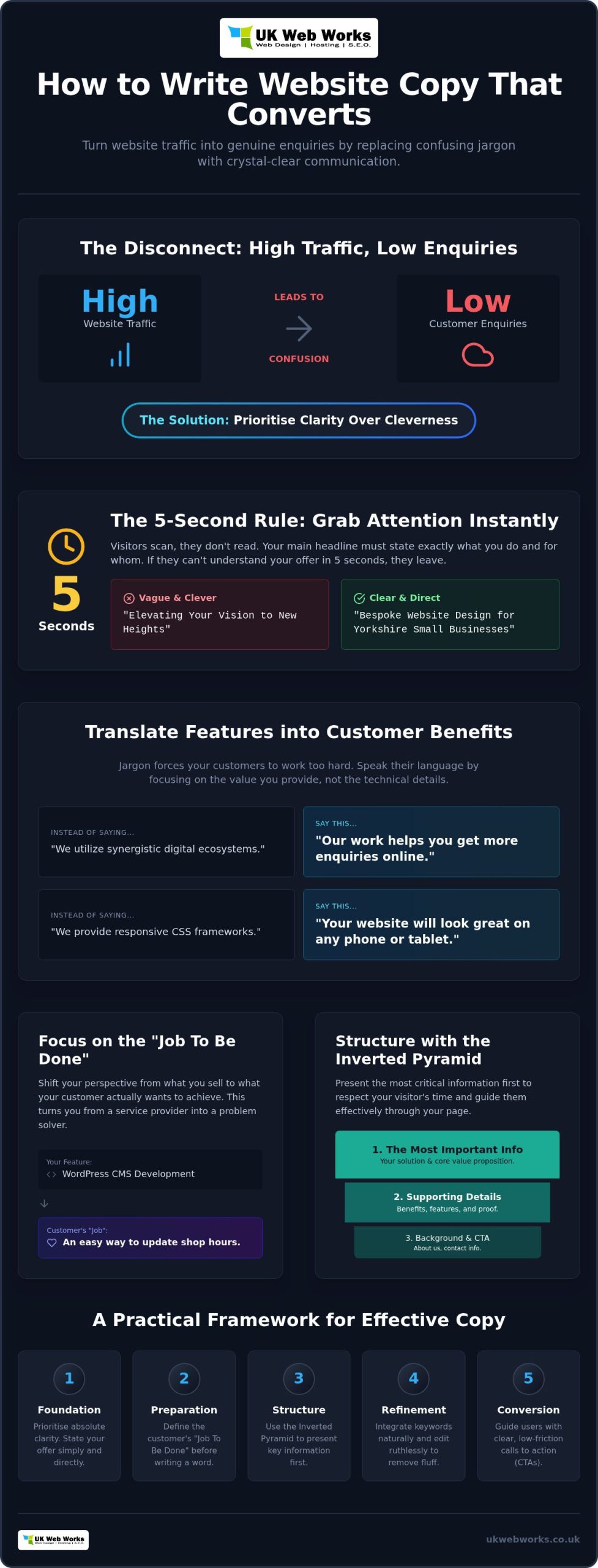
- Prioritise clarity over cleverness to ensure visitors understand your offer within five seconds of landing on your page.
- Use the “Job to be Done” framework to focus on what your customer actually wants to achieve rather than just listing technical features.
- Discover how to write effective website copy that integrates keywords and local Yorkshire locations naturally to improve your search visibility.
- Master the “Inverted Pyramid” structure to present your most important information first and guide users toward clear, low-friction calls to action.
- Learn how regular maintenance ensures your message remains accurate and continues to convert visitors as your business evolves.
The Foundation of Effective Website Copy: Clarity Over Cleverness
Website copy isn’t just decoration for your design; it’s the bridge that connects a visitor’s problem to your professional solution. While the historical definition of copywriting focuses on the act of writing text for advertising, modern digital copy must do more. It needs to guide, reassure, and persuade. If you are wondering how to write effective website copy, you have to start with a simple truth: clarity always beats cleverness. Many businesses in Hull and York try to sound sophisticated by using metaphors or industry buzzwords. This creates a barrier. You want your website to sound like a conversation with a trusted partner, not a riddle that needs solving.
The 5-Second Rule and User Psychology
Most visitors won’t read every word on your page. They scan. You have roughly five seconds to convince a visitor to stay before they hit the back button. This is why your H1 headline is the most important piece of real estate you own. If your main headline is vague or “clever”, such as “Elevating Your Vision to New Heights”, the user won’t know what you actually do. A clear headline, like “Bespoke Website Design for Yorkshire Small Businesses”, tells them exactly what’s on offer. Your sub-headlines should then support this claim by explaining how you deliver that value. This structure respects the user’s time and reduces the mental effort required to engage with your brand.
Avoiding the Jargon Trap
Jargon is a conversion killer. When you use “insider” language, you force your potential clients to work too hard. They shouldn’t need a dictionary to understand your services. Instead of talking about “synergistic digital ecosystems,” talk about how your work helps them get more enquiries. To master how to write effective website copy, you must translate every technical feature into a concrete customer benefit. For example, instead of saying “We provide responsive CSS frameworks,” try: “Your website will look great and work perfectly on every smartphone and tablet.” This approach builds immediate rapport because it shows you understand the client’s practical needs.
Let’s try a simple exercise. Define your primary service in one sentence without a single buzzword. For us, it looks like this: We build easy-to-use websites that help local businesses find more customers online. It’s direct, honest, and tells the reader exactly what they get. When you strip away the filler, your value proposition becomes impossible to ignore.
Preparation: What to Do Before Writing a Single Word
You wouldn’t start building a house without a blueprint, and you shouldn’t start writing your site without a solid plan. Understanding how to write effective website copy begins long before you open a blank document. It starts with research and a clear strategy. Many businesses fail because they write for themselves, using language that makes sense to their internal team but leaves their potential customers cold. If you want your words to work, you have to know exactly who you are talking to and what they need to hear.
The “Job to be Done” framework is a powerful tool for this stage. Instead of focusing on your product’s technical features, ask yourself what your customer is actually trying to achieve. They aren’t just looking for “WordPress CMS development”; they are looking for a reliable way to update their shop’s opening times without needing a degree in computer science. When you frame your copy around their goals, you move from being a service provider to a practical problem solver. This shift in perspective is the secret to creating a website that resonates.
Take a moment to look at your competitors across East Yorkshire. What are they saying? More importantly, what are they failing to mention? If every other business in Hull or Doncaster is talking about “innovation” and “synergy,” you will stand out by talking about “dependability” and “honest pricing.” Identifying these gaps allows you to position yourself as the unique solution your audience has been searching for. Defining one core message helps you maintain this consistency across every page of your site.
Profiling Your Local Audience
A business owner in Leeds has different pressures than a small shop owner in Whitby. In the North of England, trust is often earned through straight talking and a hands on work ethic. You can use this to your advantage by highlighting your geographic proximity and shared cultural values. Using social proof, such as testimonials from other Yorkshire based clients, builds immediate rapport. It signals that you aren’t a distant corporate entity, but a local partner who understands the regional market and its specific challenges.
Mapping the User Journey
Every page on your site needs a clear purpose. You must identify where your visitors are coming from, whether it’s through SEO, PPC, or social media. This allows you to align your message with their specific intent. Adhering to web writing best practices ensures that your content is scannable and easy to digest regardless of how a user found you. Your copy should work in tandem with a broader digital marketing agency hull strategy to ensure every word leads the visitor toward the next logical step. If you need help defining these goals, you can always reach out to our specialists for a direct, professional consultation.
Structuring Your Pages for Maximum Impact
A solid structure ensures your visitors don’t get lost in a sea of text. Most users look for answers within seconds, so you should adopt the “Inverted Pyramid” approach. This means leading with your most critical information at the top of the page. If you want to master how to write effective website copy, you have to stop burying your value proposition under paragraphs of introductory fluff. Start with the solution you provide, then offer the supporting details as the reader moves down the page. This keeps the user engaged and ensures they get the most important message even if they only skim the first few lines.
The Home Page Headline Formula
Your home page acts as a digital signpost. It needs to direct traffic without causing confusion. We use a three-step formula to create headlines that work: State what you do, state who it’s for, and state the core benefit. For example, a firm specialising in web design hull might use: “Bespoke Website Development for East Yorkshire Tradespeople that Turns Enquiries into Sales.” This uses active verbs to create momentum and tells the reader exactly why they should stay.
Writing Service Pages That Convert
Service pages should build authority without sounding like a high-pressure sales pitch. We recommend the Problem-Agitation-Solution (PAS) framework. First, identify the challenge your customer faces. Then, explain why that problem is costing them time or money. Finally, present your service as the straightforward fix. Use bullet points to make technical processes digestible:
- Clear timelines with no hidden delays.
- Fixed-price project fees for better budgeting.
- Direct communication with the specialist doing the work.
Every service page must conclude with a single, clear goal, such as a contact form or a direct phone number. This keeps the user focused on the next logical step.
The “About” page is often misunderstood. While it’s tempting to write a long history of your company, this page is actually about your customer. They want to know if you have the experience to solve their specific problems. Use this space to demonstrate your values and commitment to quality. Following the Plain Language Guidelines is particularly useful here. It helps you avoid the trap of sounding like a distant corporate entity. By keeping your language simple and human, you position yourself as a reliable local partner rather than just another faceless service provider.
Refinement: SEO Integration and the ‘No-Nonsense’ Edit
Refining your draft is where the real work happens. You’ve built the structure; now you need to ensure it’s found by the right people. Understanding how to write effective website copy means knowing how to weave keywords into your text without it feeling forced. Search engines are smarter than they used to be. They no longer reward “keyword stuffing” where you repeat phrases until the text becomes unreadable. Instead, focus on using your primary terms in headlines and naturally within the first few paragraphs. If your writing feels clunky, your visitors will leave, regardless of how high you rank.
For local businesses, geographic relevance is a powerful tool. Mentioning Hull, York, or Doncaster should feel like a natural part of your service description. Don’t just list cities at the bottom of the page. Instead, talk about your local focus or your experience working with clients in East Yorkshire. This builds immediate trust with both Google and your local customers. They want to know you are nearby and understand their specific market.
Most visitors are busy. They will skim your content to find what they need. You can make this easier by using specific formatting techniques:
- Use bold text to highlight key benefits.
- Break up long sections with descriptive H3 headings.
- Use bulleted lists for features or steps in a process.
- Keep paragraphs short, usually no more than three or four sentences.
Jargon-Free SEO Integration
Effective SEO is about matching search intent. You need to ask what your user is actually typing into Google. Are they looking for a “cheap website” or a “bespoke solution”? We find that “bespoke” and “professional” are much better markers of quality for businesses that value long-term relationships. Balancing these keywords with readability is a core part of any seo agency hull strategy. Your goal is to satisfy the algorithm while providing genuine value to the human reader. Once you’ve finished a section, try the “Read Aloud” test. If it sounds like a robot wrote it, start again.
The Final Polish: Accessibility and Tone
Accessibility is a requirement, not an option. Your copy should be easy for screen readers to interpret, which means using clear link text and logical heading structures. Consistency in your brand voice is also vital. If your home page is friendly but your service pages are cold and clinical, you’ll confuse your visitors. Trust is built on small details, including your choice of spelling. For UK-based businesses, using British English is essential for building rapport. Small details like using “optimisation” instead of “optimization” show your audience that you are local and pay attention to the details that matter to them.
If you find the technical side of SEO or tone consistency a challenge, contact our team for a direct SEO consultation. We can help you refine your message and ensure your site is built for both users and search engines.
Turning Your Copy into a Conversion Machine
The final step in learning how to write effective website copy is ensuring your words actually drive action. You’ve established clarity, structured your pages, and integrated local SEO for the Yorkshire market. Now, you need to turn that engagement into a conversion. A conversion isn’t always a direct sale; it might be a phone call, a newsletter signup, or a simple enquiry. To achieve this, your copy must work in perfect harmony with your design. Great words on a poor layout will go unread, while a beautiful design with confusing copy will fail to build trust. Your website should feel like a guided tour that leads naturally to a specific destination.
Effective Call to Action Strategies
Generic buttons like “Submit” or “Click Here” are often ignored because they don’t promise a specific outcome. You should replace these with descriptive, low-friction calls to action. Instead of “Contact Us,” try “Get My Free Quote” or “Book My Consultation.” This tells the user exactly what happens next. Placement is also critical. Most users scan in an “F-pattern,” looking across the top and then down the left side of the screen. You should place your primary CTA where their eyes naturally land. We also recommend using “micro-copy” nearby, such as “No credit card required” or “We’ll reply within 24 hours.” This reduces “click trigger” anxiety and reassures the visitor that they are making a safe choice.
When to Hire a Professional Agency
Writing your own copy is a great starting point, but there comes a time when DIY efforts can hold your business back. If you have traffic but no enquiries, or if you struggle to explain complex services simply, it might be time for an outside perspective. A professional agency doesn’t just write words; they look at your brand identity through the eyes of your local customer. They understand the synergy between copy, design, and search engine performance. This ensures every element of your site works toward the same goal.
When you choose a specialist team, you benefit from a craftsmanship-focused approach that integrates everything into one fixed-price project. This removes the stress of managing multiple freelancers and ensures your message remains consistent. Your copy shouldn’t be a one-time effort. Using professional website maintenance packages ensures that your content stays relevant as your business grows and digital standards change. In 2026, the most successful websites are those that use real user data to tweak their headlines and buttons, ensuring the message always stays sharp, honest, and effective.
Building Your Digital Future with Clarity
Your website is often the first point of contact between your business and a new customer. By prioritising clarity over cleverness and using a logical structure, you ensure that every visitor understands exactly how you can help them. Learning how to write effective website copy is a continuous process of refining your message to meet your audience’s needs. When you combine direct, honest language with a professional layout, your site becomes a powerful tool for growth and reliability.
If you’re ready to move beyond DIY efforts, our local Hull-based team of specialists is here to help. We provide fixed-price project development with expert SEO integration included as standard. We don’t believe in hidden fees or complex jargon; we just build high-quality digital experiences that work for your business. You can Get a No-Nonsense Bespoke Web Design Quote today to see how we can transform your online presence. We look forward to helping you reach more customers in East Yorkshire and beyond.
Frequently Asked Questions
How long should my website copy be?
Your copy should be exactly as long as it needs to be to solve the visitor’s problem. There is no magic word count, but clarity is always more valuable than length. For a home page, aim for concise headlines and punchy sections. Service pages might need more detail to build authority and explain your specific processes to potential clients.
Is SEO more important than good writing?
Neither is more important; they are equal partners in your digital strategy. SEO brings traffic to your site, but good writing turns that traffic into customers. If you focus only on search engines, your text will sound robotic and drive people away. Learning how to write effective website copy involves balancing keyword placement with a natural, human tone.
How often should I update my website copy?
You should review your copy at least once every six months to ensure it stays accurate. Digital trends and your own business services change over time. Keeping your content fresh ensures you stay relevant to both Google’s algorithms and your customers’ current needs. Regular updates also help you catch any outdated information before it causes confusion for your visitors.
Can I use AI to write my website copy?
You can use AI as a tool for generating ideas or outlines, but it shouldn’t be the final word. AI often lacks the specific local context and personal touch that builds trust with a Yorkshire audience. Always edit AI-generated text thoroughly. This ensures it matches your unique brand voice and provides the genuine expertise your customers expect from a professional partner.
What is the most important page on my website for copy?
Your Home Page is the most critical because it acts as your digital storefront. It sets the tone for the entire site and directs visitors to the information they need. If the copy here fails to explain what you do within a few seconds, most visitors won’t bother looking at your other pages. It is the foundation of your online presence.
How do I make my copy sound professional but not boring?
Focus on the benefits you provide rather than just listing your technical features. Use active verbs and address the reader directly as “you” to create a sense of collaboration. Professionalism comes from your expertise and honesty, not from using long, complex words. When you speak clearly about how you solve problems, you come across as a confident and reliable expert.
Should I write in the first person (I/We) or third person?
We recommend writing in the first and second person to create a direct connection with your audience. Using “we” and “you” makes your business feel approachable and helpful. Third-person writing often sounds distant and overly corporate. This can make it much harder to build the rapport and long-term relationships that are vital for growing a presence online.