
Have you ever looked at your latest social media post and realized the navy blue looks more like a dark purple compared to your website? It’s a common headache for local business owners who find themselves wasting hours explaining logo placements to printers or correcting off-brand graphics. Professional brand style guide creation isn’t just a task for global corporations; it’s a practical way to ensure your business looks consistent and trustworthy to every customer who finds you.
We understand that keeping your marketing materials uniform feels like a constant battle as you grow. You want a professional look that builds local recognition without the headache of learning complex design theory. This article provides the straightforward steps you need to build a set of rules that actually work for your team. We will walk through how to define your visual identity, set standards for new 2026 technologies like AI-generated content, and ensure your brand remains accessible and recognizable across every digital platform.
Key Takeaways
- Understand why a brand manual acts as a vital rulebook to build immediate trust with your customers in competitive local markets.
- Discover the core components of a professional identity that go far beyond simply having a logo file in your inbox.
- Learn our methodical 5-step process for brand style guide creation, beginning with a practical audit of what is currently working for your business.
- See why modern branding must be digital-first and responsive to ensure your logo looks sharp on small mobile headers.
- Find out how a collaborative, jargon-free approach helps you create a professional brand foundation that supports your long-term goals.
What is a Brand Style Guide and Why Does Consistency Matter?
Think of a brand style guide as the rulebook for your business. It is a practical document that defines exactly how your visual and verbal identity should appear to the world. Before diving into the details, it helps to understand what a brand is in a broader sense. It isn’t just a logo; it is the gut feeling a customer has when they see your name. A style guide protects that feeling by ensuring every interaction remains uniform.
In competitive markets like Hull and Leeds, standing out requires more than just a good product. It requires trust. If your website looks sleek but your social media graphics look cluttered and use different fonts, customers get confused. This confusion leads to “design drift,” where your marketing materials slowly start to look like they belong to several different companies. Investing time in brand style guide creation stops this drift before it starts, keeping your message clear and professional.
We treat a style guide as a living document. It shouldn’t be a static PDF that sits in a digital drawer for years. Instead, it grows alongside your business. As you launch new services or enter new platforms in 2026, your guide provides the foundation to ensure your identity stays sharp. It is the most effective way to turn a collection of individual graphics into a cohesive, recognizable brand.
The Practical Benefits of Brand Consistency
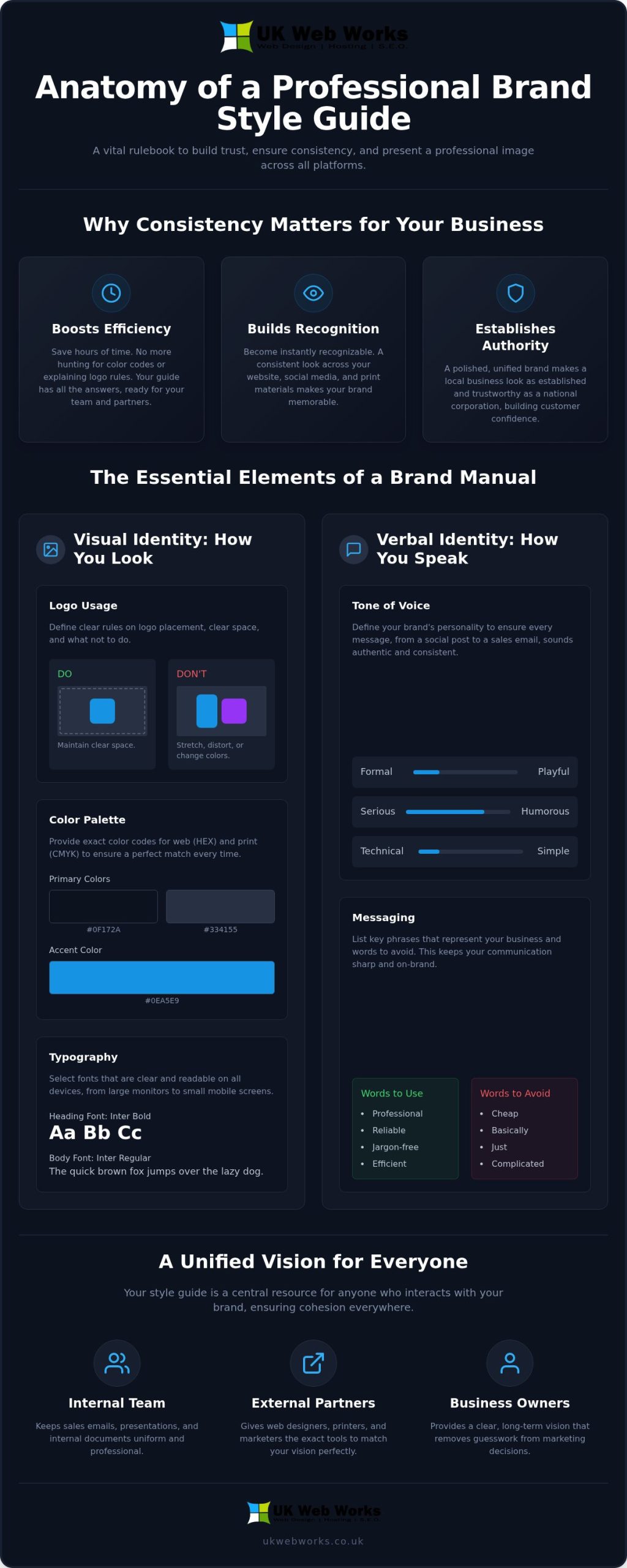
- Efficiency: You’ll save hours of time. You won’t have to dig for colour codes or explain logo margins to a printer because the rules are already written down.
- Recognition: It ensures your business is recognisable at a glance. Your customers should recognise your brand’s “feel” through its colours and layout even before they see your logo.
- Authority: A tight, consistent brand makes a small local business look as established and reliable as a national firm.
Who is the Style Guide For?
Everyone who interacts with your business needs access to these rules. Your internal team uses the guide to keep sales emails and internal decks uniform. Your external partners, such as your web design company, use these tools to build a website that perfectly matches your physical signage and stationery. For you, the business owner, brand style guide creation provides a clear, long-term vision. It removes the guesswork from marketing and lets you focus on running your business with confidence.
The Essential Elements of a Professional Brand Manual
A folder containing your logo is a good start, but it isn’t a brand identity. To be truly functional, your manual needs to provide a clear set of instructions for anyone using your assets. Without these rules, your brand will eventually lose its impact. This is why brand style guide creation focuses heavily on “usage rules,” the simple do’s and don’ts that keep your business looking professional across every medium. If you look at Adobe’s advice on How to Create a Brand Style Guide, you will find that the most effective manuals prioritize technical precision and ease of use.
Visual Identity: Logo, Colours, and Fonts
Your visual identity is the most immediate way people recognize you. Your guide should specify exactly how much “clear space” must surround your logo so it doesn’t look cramped. It should also forbid stretching or changing the logo colours. For your colour palette, providing HEX codes for web use and CMYK values for print ensures a perfect match every time. Typography is equally vital. We recommend choosing fonts that stay readable on a small mobile screen as easily as they do on a desktop monitor. These small details prevent your brand from looking amateur when you move between different platforms.
Verbal Identity: Tone of Voice and Messaging
How you speak is just as important as how you look. Your brand personality should reflect your values. For example, our own style is straight-talking and direct, while yours might be more formal or perhaps more playful. Defining this early helps you stay consistent in your messaging. List key phrases that represent your business and identify words your team should avoid. This ensures that a social media post feels like it came from the same person as a formal annual report. As an experienced brand identity agency, we know that a clear voice builds a stronger connection with your local audience.
Building these elements from scratch takes time and a methodical approach. If you are ready to move beyond just a logo and want to build a system that works for your business, you can reach out to our consultants for a chat about your goals. Getting these foundations right now will save you countless hours of frustration during future brand style guide creation updates as your business expands.
How to Create a Brand Style Guide: A 5-Step Process
Building a guide from scratch doesn’t have to be an overwhelming task. We recommend a methodical approach that starts with an honest look at your current materials. This “audit” phase is vital. Gather your recent flyers, check your social media headers, and look at your website side-by-side. You will likely spot where your colours have shifted or where your logo looks slightly distorted. Identifying these inconsistencies is the first step in successful brand style guide creation. It shows you exactly what needs fixing and what is already working well for your business.
You should adopt a digital-first mindset from the very beginning. Most of your customers in 2026 will find you through a smartphone screen or a social media feed. If your branding only looks good on a printed letterhead, it is failing half of its job. We suggest starting small. You don’t need a fifty-page document on day one. Focus on the essentials first, then expand the guide as your business grows and your marketing needs become more complex.
Phase 1: Research and Brand Discovery
Before you pick a single colour, you need to understand who you are talking to. Think about your target audience in Yorkshire. What do they value? Local customers often appreciate honesty, reliability, and a straightforward approach. Define your core values and what your business stands for. For a clear example of how to structure these identity pillars, you can study the University of Washington’s brand framework. It demonstrates how a large organization keeps its promise and tenets clear. Finally, look at your competitors in Hull or Leeds. Your goal is to ensure your identity remains distinct so you don’t get lost in the crowd.
Phase 2: Designing and Documenting the Rules
Once your research is solid, it is time to document the rules. Start with a “Logo Lockup.” This is a set of instructions showing how your logo should appear on both dark and light backgrounds. Next, select your colour palette. Ensure your primary and secondary colours meet web accessibility standards so everyone can read your content easily. Keep your instructions short and direct. Avoid using complex design terminology that might confuse your team. The goal of brand style guide creation is to make the rules so simple that anyone can follow them without needing a design degree. This clarity ensures your business remains professional and recognizable as you scale.
Digital-First Branding: Why Modern Guides Must Be Responsive
A brand manual designed only for brochures and business cards will inevitably fail on a modern website. In 2026, your digital presence is often the first point of contact for local customers. If your brand style guide creation process ignores how colours and layouts behave on a screen, you risk looking unprofessional. Screens use light (RGB) while paper uses ink (CMYK), and these differences can drastically change how your brand looks to a visitor. A digital-first approach ensures that your identity remains vibrant and clear, regardless of the device your customer uses.
Accessibility is no longer an afterthought; it is a core requirement. We use Web Content Accessibility Guidelines (WCAG) to ensure your brand colours have enough contrast for everyone to read. Choosing a pale grey font on a white background might look minimalist, but it makes your site unusable for many people. By building these standards into your guide from the start, you demonstrate that your business is inclusive and professional. Our website maintenance packages help you monitor these standards over time, ensuring your branding stays consistent as web technologies evolve.
Logo Versatility for the Web
Your logo needs to work in a variety of tight spaces. A complex, detailed crest might look great on a physical sign, but it will become an unrecognizable blur as a favicon, the tiny icon in a browser tab. Effective brand style guide creation includes simplified versions of your logo specifically for social media profile pictures and mobile headers. We focus on scalability. Your logo must remain legible even when it is shrunk down to fit the small header of a smartphone screen. This versatility prevents your brand from looking cluttered or messy on the platforms where your customers spend the most time.
Typography and Readability
Choosing the right fonts is about more than just aesthetics; it is about performance. We recommend using reliable Google Fonts or web-safe alternatives to ensure your text loads quickly and looks the same on every browser. Your guide should establish a clear hierarchy using H1, H2, and H3 tags. This structure helps users scan your content and find what they need. Clear, structured typography also supports your seo agency Hull efforts by improving on-page signals and keeping visitors engaged for longer. If you want to ensure your digital branding is built to last, contact our team today for a practical consultation.
Professional Brand Identity Design in Hull
We believe that a professional identity should be built on substance, not fluff. When you partner with us for brand style guide creation, you aren’t just getting a digital document; you are getting a blueprint for your business’s future. Our approach is collaborative and direct. We start by listening to your specific goals and understanding what makes your business unique. Since 2014, we have helped local firms in East Yorkshire turn their vision into a recognizable brand that commands respect in their industry.
Our background in bespoke website design and development gives us a unique perspective on branding. We don’t just design a logo and walk away. We consider how that logo will look on a responsive website, how your brand colours will appear in a social media feed, and how your tone of voice will resonate with your customers. This integrated thinking ensures that your brand identity works hard for you across every digital touchpoint. We invite you to have a no-obligation chat with our team about your branding needs. We are here to help you build a brand that lasts.
Why Work With a Local Yorkshire Agency?
Working with a team that understands the regional market makes a significant difference. We know the dynamics of Hull, York, and Leeds because we live and work here too. Local customers value honesty and a practical, hands-on work ethic, and we build those values into every brand we create. Face-to-face meetings allow us to develop a deeper understanding of your business vision than a distant agency could ever manage. You get a direct, straight-talking service where your success is our priority. We value long-term relationships and pride ourselves on being an ally to our clients as they grow.
Next Steps: From Brand Guide to Business Growth
A strong brand identity is the foundation for everything that follows. Once your rules are set, you can launch digital marketing agency Hull campaigns with total confidence. You will no longer wonder if your adverts look right or if your messaging is consistent. Your new guide becomes the tool you use to refresh your website, update your social media profiles, and even order new physical signage. It removes the guesswork and saves you money by preventing costly design mistakes. Contact us today to start your brand style guide creation process and take the first step toward a more professional, trustworthy business presence.
Building Your Brand for 2026 and Beyond
A professional brand isn’t built by accident. It’s the result of clear rules and a commitment to consistency across every platform your customers use. By focusing on a digital-first approach and establishing your visual and verbal identity now, you protect your business from the frustration of design drift. Brand style guide creation is the most practical investment you can make to ensure your company looks established and trustworthy to every local customer.
We have been serving businesses in Hull and the wider Yorkshire region since 2014. Our team provides direct, honest, and expert advice to help you simplify complex digital concepts. We focus on bespoke designs tailored specifically to your business goals, ensuring your brand identity works as hard as you do. If you’re ready to build a professional brand with a jargon-free quote, we’re here to help. Let’s start building a business presence that truly reflects your hard work and long-term vision.
Frequently Asked Questions
How much does it cost to have a brand style guide created?
The cost varies depending on the depth of the brand strategy and the number of elements included in the final manual. A basic document focusing on logo usage and colour palettes is a smaller investment than a comprehensive guide that includes tone of voice and digital accessibility standards. We focus on providing a clear, jargon-free service that delivers long-term value for your business rather than just a one-off document.
Can I create a brand style guide myself if I am not a designer?
You can certainly document your own basic rules using simple design tools, but a professional result requires a deeper understanding of technical requirements. Professional brand style guide creation ensures that your HEX codes are correct for the web and that your typography is legible on all screen sizes. If you aren’t a designer, you may find it difficult to create the responsive logo versions needed for modern mobile headers.
What is the difference between a brand style guide and a logo?
A logo is a single graphic mark used to identify your business, whereas a style guide is the set of rules that dictates how that logo is used. Think of the logo as your business’s face and the style guide as the dress code and personality. The guide ensures your logo is always shown in the best light by setting rules for spacing, background colours, and paired fonts.
How long does the brand style guide creation process take?
A typical brand style guide creation project takes between two and four weeks to complete. This timeframe allows us to conduct proper research into your market, develop design concepts, and refine the rules based on your feedback. Taking this time ensures the final document is a practical tool that your team can actually use to maintain consistency as you grow.
What happens if I need to change my branding later on?
Your style guide is a living document that should evolve alongside your business. If you launch a new service or decide to refresh your look, you simply update the guide to reflect these new standards. Having an existing guide makes this process much smoother because you already have a structured foundation to build upon rather than starting from zero.
Do I really need a style guide if I am only a small business in Hull?
Consistency is often the deciding factor that builds trust with local customers. In a competitive market like Hull, looking professional and uniform across your website and social media makes you stand out from less organized competitors. A style guide ensures that even a small team can produce marketing materials that look established, reliable, and high-quality.
What file formats should my brand style guide be delivered in?
Your guide should be delivered as a high-resolution PDF for easy sharing, accompanied by a library of logo files. These should include “vector” formats like SVG and EPS, which allow you to scale your logo to any size without losing quality. You should also receive PNG files with transparent backgrounds, which are perfect for use on social media and internal documents.
How often should a brand style guide be updated?
We recommend a quick review of your brand manual every twelve to eighteen months. You don’t necessarily need a full redesign, but you should check that your digital standards still meet the latest web accessibility requirements. Regular reviews help you spot “design drift” early and ensure your branding remains sharp and effective as new marketing platforms emerge.