
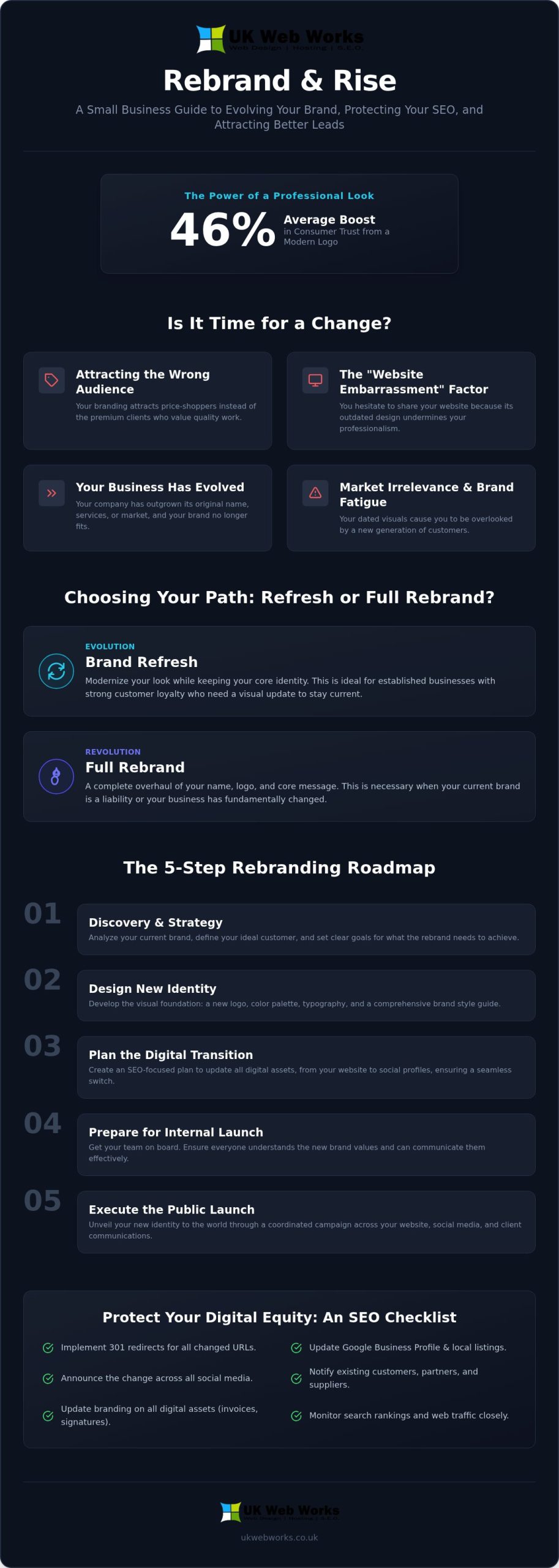
Did you know that a modern logo can boost consumer trust by an average of 46%? It’s a powerful figure, but for many local business owners, that potential is often overshadowed by the fear of losing what they’ve already built. You’ve likely felt that hesitation yourself. You know your current identity no longer reflects the high standard of your work, yet the thought of changing it feels like a massive risk to your search engine rankings and customer loyalty. Navigating the rebranding process for a small business shouldn’t feel like a gamble with your livelihood.
We understand that your reputation is your most valuable asset. That’s why we’ve put together this straight-talking guide to help you evolve your brand without the usual stress. You’ll learn how to distinguish a simple visual refresh from a strategic overhaul and see the actual 2026 costs involved in the UK market. We’ll provide a clear, step-by-step roadmap designed to protect your digital equity while positioning you to attract higher quality leads. It’s time to move your business forward with confidence, clarity, and a look that finally matches your expertise.
Key Takeaways
- Learn to identify the specific signs that your current brand is attracting the wrong customers and why a strategic shift is needed now.
- Discover the five-step rebranding process for a small business that protects your reputation while modernising your visual identity.
- Understand the difference between a brand refresh and a full rebrand to ensure you invest in the right level of change for your goals.
- Get a practical checklist for safeguarding your digital equity, focusing on how to maintain your SEO rankings during a transition.
- Develop a clear rollout strategy for the Yorkshire market, from internal team buy-in to a successful public launch.
Recognising the Signs: When Does Your Small Business Need a Rebrand?
Starting the rebranding process for a small business often begins with a moment of uncomfortable honesty. You look at your business card, your van livery, or your website and realise they no longer tell the true story of what you do. To put it simply, what rebranding is involves the strategic process of changing the corporate image of an organisation to better align with its current goals. It is not just a fresh coat of paint; it is a realignment of your reputation.
One of the most telling signs that you’ve outgrown your current identity is the quality of your leads. If you find yourself constantly fielding calls from customers who are only looking for the lowest possible price, your branding might be the culprit. A brand that looks “cheap” or outdated attracts people who value cost over quality. When you invest in professional Logo and Brand Identity Design, you signal to the market that you’re an expert worth a premium. If your visuals feel “homemade” compared to your competitors in Leeds or Hull, you are likely losing business before you even get a chance to quote.
Your business model might have also evolved beyond your original name or look. Many Yorkshire firms started as local service providers but have since expanded into ecommerce via Shopify or WooCommerce. This shift requires a more robust rebranding process for a small business to ensure your digital presence can handle the weight of national transactions. A brand built for a local handyman doesn’t always translate to a regional property maintenance firm.
The ‘Website Embarrassment’ Factor
We see this often: a business owner who is genuinely proud of their work but terrified to send people to their own website. It’s a growth killer. If you find yourself apologising for your site before a client even opens their laptop, you’re already starting the sales process from a position of weakness. An outdated design suggests a lack of investment in your own craft. When you have a Bespoke Website Design that you’re proud to share, that confidence naturally carries over into your sales pitches and client meetings.
Market Evolution and Relevance
The 2026 digital landscape moves quickly. Consumers now place a much higher value on transparency, local sourcing, and sustainability than they did even five years ago. If your brand still feels like it belongs in 2015, you risk “brand fatigue.” Brand fatigue occurs when a local service business uses the same tired visuals and messaging for so long that the community stops noticing their presence entirely. Refreshing your identity ensures you stay relevant to a new generation of buyers who expect a modern, professional experience from the companies they hire.
Brand Refresh vs. Full Rebrand: Choosing the Right Path
Deciding how far to go with your new look is a matter of balancing your future goals with your current reputation. The rebranding process for a small business doesn’t always require a total demolition of your past identity. Sometimes, a tactical update is all you need to stay competitive. Other times, the only way to move forward is to start from scratch. Understanding the difference between a refresh and a full rebrand will save you both time and money.
A brand refresh is an evolution. You keep your business name and your core mission but update your visual elements. This might involve modernising your colour palette, choosing more readable typography, or simplifying your logo. It is a practical choice for businesses that have a strong, positive reputation in Yorkshire and don’t want to confuse their loyal customers. It’s often the most cost-effective way to look current without losing the “digital equity” you’ve built up over the years.
A full rebrand is a revolution. This is a complete overhaul where you might change your name, your logo, and even your core business values. While this is a larger undertaking, it is sometimes the only logical step if your current brand is holding you back. If you’re unsure which path fits your current budget, we’re always happy to discuss your specific goals to see what makes the most sense for your situation.
When a Logo Tweak is Enough
You don’t need to reinvent the wheel to see results. We recently worked with a Hull-based trade business that had been using the same logo since the late 90s. Their reputation was excellent, but their look didn’t appeal to younger homeowners. By simply modernising the icon and choosing a more professional font, they saw an immediate shift in how they were perceived. Working with a professional brand identity agency allows you to keep the soul of your business while shedding the outdated baggage.
When a Total Overhaul is Mandatory
Sometimes the rebranding process for a small business must be more drastic. If your business name is geographically restrictive, it can cap your growth. For example, a company called “Hull Paving” might find it difficult to win high-value contracts in Leeds or York. Rebranding to “Yorkshire Exteriors” removes that barrier instantly. A total overhaul is also necessary following a merger or a legal dispute over a trademark. While starting with a blank slate is more work, it gives you the freedom to build a brand that is perfectly aligned with the 2026 market from day one.
The 5-Step Rebranding Process for Small Businesses
A successful transition requires more than just artistic flair; it demands a logical, step-by-step methodology. The rebranding process for a small business is a journey from internal reflection to public celebration. By following a structured path, you ensure that every decision you make is grounded in strategy rather than just personal preference. This methodical approach minimises risk and ensures your new identity has the staying power to last another decade.
- Phase 1: Internal Audit – Reviewing what you stand for in 2026 and identifying where your current image falls short.
- Phase 2: Market Research – Analysing what your competitors in Leeds or Doncaster are doing to find a gap you can own.
- Phase 3: Visual Identity – Developing the tangible elements like your logo, colour palette, and typography.
- Phase 4: Digital Implementation – Systematically updating your website, social media profiles, and email templates.
- Phase 5: The Rollout – Executing a planned announcement to your staff, existing clients, and the wider Yorkshire community.
Step 1: The Strategic Foundation
You must define your “Why” before you ever pick a brand colour. Your strategic foundation is the bedrock of the entire rebranding process for a small business. Start by identifying your ideal 2026 customer profile. Are they eco-conscious homeowners or time-poor local professionals? For a service-based business, brand purpose is the clear, singular promise of the specific problem you solve and the standard of integrity you bring to every job. Knowing this purpose allows you to build a brand that resonates on a deeper level than just a pretty picture.
Step 3: Visual Identity Design
Once the strategy is set, we move into the visual phase. Your logo is a tool, not just an ornament. It must be versatile enough to work on a tiny browser favicon, a social media profile picture, and a large-scale van wrap. In 2026, accessibility is a non-negotiable standard. Your chosen colour palette needs sufficient contrast to be readable by everyone, including those with visual impairments.
This is where the expertise of bespoke logo and web design companies becomes invaluable. You need a partner who understands the technical requirements of both high-quality print and modern digital displays. A logo that looks great on a designer’s screen but fails to reproduce clearly on your workwear is a waste of your investment. We focus on creating functional assets that maintain their integrity across every touchpoint of your business.
Phases four and five focus on the practical switch. Updating your digital presence is a technical task that requires precision to avoid broken links or lost data. Finally, your rollout should feel like an evolution. Whether you choose a “soft launch” to test the waters or a “big reveal” to make a splash, the goal is to communicate growth and renewed commitment to your local customers.
Protecting Your Digital Equity and SEO During a Rebrand
The most significant danger in the rebranding process for a small business isn’t a poorly designed logo. It’s the risk of losing years of hard-earned search engine authority overnight. If you change your business name or move to a new domain without a technical plan, your Google rankings can drop significantly. This loss of visibility often leads to a sudden decrease in leads, which is the last thing you want when launching a fresh identity.
Digital equity is the value your website has built with search engines over time. It includes your backlinks, your keyword rankings, and the trust Google has in your domain. When you alter these elements, you’re essentially telling the internet that you’ve changed. Without the right technical signals, search engines might treat you as a total stranger rather than an established local expert.
The Technical SEO Migration
If your rebrand involves a new URL, 301 redirects are your most vital tool. These redirects act like a “change of address” service for the internet, telling Google exactly where your old content now lives. Without them, any links pointing to your old site will lead to 404 errors, and your ranking power will vanish. Consulting an SEO agency Hull before you flip the switch ensures your transition is seamless. After the launch, you must monitor Google Search Console closely for any crawl errors or sudden drops in indexed pages.
Updating Your Local Presence
Your Google Business Profile (GBP) is often the first thing people see when searching for services in Hull or York. You must update your business name, logo, and website link here immediately to maintain your local standing. Consistency is key for local SEO. Search engines look for your Name, Address, and Phone number (NAP) across the web to verify your identity. Local Citations must match your new brand exactly because even small discrepancies can confuse search algorithms and hurt your local map rankings.
A successful rebranding process for a small business also requires a manual audit of your digital footprint. You need to update your brand across every touchpoint to maintain a professional image:
- Social Media: Change your handles on Facebook and Instagram. Announce the change with a post that explains the reason for the evolution to boost follower engagement.
- Directory Listings: Update your details on sites like Yell, Thompson Local, and any industry-specific directories.
- Email Signatures: Ensure every member of your team is using the new logo and the correct legal business name.
Managing this technical transition requires precision and a clear head. If you’re concerned about your search rankings during a name change, get in touch with our team to discuss a safe migration plan for your website.
Launching Your New Identity in Yorkshire: A Rollout Strategy
The final phase of the rebranding process for a small business is the most rewarding. It is the moment you stop planning and start showing the world your new identity. However, a launch isn’t just about changing a profile picture; it’s a strategic marketing opportunity to reconnect with your community. You need to get your internal team on board first. Even if you only have a couple of employees in your Hull office, they need to understand the ‘Why’ behind the change. If your staff can’t explain the new brand, your customers won’t understand it either.
You have two main choices for your launch: the ‘Soft Launch’ or the ‘Big Reveal’. A soft launch allows you to update assets like your email signatures and social banners over a week, which is often less stressful for tiny teams. A big reveal, where everything changes on a specific date, creates more impact. This is the better choice if you want to tie the rebrand to a specific milestone or anniversary. Whichever path you take, communicate the reasons for the change to your existing customers. Explain that you’re evolving to serve them better, which helps avoid any confusion or fear that the business has been sold.
Engaging the Local Community
In Yorkshire, your local reputation is everything. Use your rebrand as a reason to reach out to local business groups in Doncaster or share your story with the Hull press. This isn’t just about a new logo; it’s about your growth as a local company. Don’t forget the physical side of your identity. Ensure your signage, van wraps, and staff uniforms are updated to match your new look. Seeing your new brand out on the streets of East Yorkshire builds immediate trust. You might even host a small relaunch event or offer a ‘new look’ promotion to drive business during the transition week.
The Role of Your New Website
Your website is the heart of your new brand. It is where your new identity truly comes to life and where most of your leads will form their first impression. A rebrand is the perfect time to invest in bespoke website design that reflects your updated values. Your site needs to do more than just look good; it must function flawlessly and convert visitors into customers.
Finally, ensure your digital marketing agency Hull strategy aligns with your new identity. Your social media ads, email campaigns, and SEO efforts should all speak with the same voice and use the same visuals. When every part of your marketing works together, the rebranding process for a small business becomes a powerful catalyst for growth. Ready to start your journey? Get a no-nonsense quote for your rebranding and web project today.
Take the Next Step for Your Brand
Evolving your business identity is a significant milestone, but it doesn’t have to be a stressful one. By understanding the signs of brand fatigue and following a structured rebranding process for a small business, you can modernise your look while keeping your hard-earned reputation intact. We’ve looked at how to protect your SEO and why a local Yorkshire rollout strategy matters. Now, it’s about turning those plans into a reality that drives growth.
Our Hull-based team of no-nonsense experts is here to help you navigate this transition. We offer an integrated approach that combines visual design with technical SEO expertise, ensuring your new identity performs as well as it looks. With our fixed-price branding packages, you’ll always know exactly where you stand with your budget. Ready to evolve? Talk to our Hull-based brand experts for a jargon-free consultation.
Your business deserves an identity that reflects the quality of your work. Let’s build a brand that works as hard as you do.
Frequently Asked Questions
How much does the rebranding process for a small business cost?
The total cost depends entirely on the scope of the project and whether you choose a visual refresh or a full strategic overhaul. A simple update to your colours and typography is more affordable than a project that includes a name change and a new bespoke website. We always recommend choosing fixed-price project fees so you know exactly what your investment covers before the work begins.
How long does it take to rebrand a small business?
Most projects take between six and twelve weeks to move from the initial audit to the final public launch. A straightforward visual update can often be completed in about a month. If the rebranding process for a small business involves a complex website migration or extensive market research, the timeline will naturally extend to ensure every technical detail is handled correctly.
Do I need to change my business name to rebrand?
You don’t need to change your name to achieve a successful rebrand. Many of our clients keep their original name but update their logo, messaging, and website to better reflect their current expertise. You should only consider a name change if your current one is geographically restrictive, difficult to spell, or no longer represents the services you provide to the Yorkshire market.
Will rebranding my business affect my SEO or Google rankings?
It can affect your rankings if you change your domain name or website structure without a professional migration plan. However, with the right technical SEO approach, any impact is usually minimal and temporary. By using 301 redirects and updating your local citations, you can protect your digital equity while building a site that is more attractive to both users and search engines.
Should I tell my customers I am rebranding before I do it?
Involving your customers in the journey is a great way to build trust and excitement. Explaining that you are evolving to serve them better helps prevent confusion when your new identity launches. Use your social media channels or an email newsletter to share the “Why” behind the change, as this keeps your local reputation strong throughout the transition.
What is the difference between a brand and a logo?
A logo is a graphic symbol used to identify your business, but your brand is the sum of every experience a customer has with you. Your brand includes your reputation, your values, and the way you communicate. Think of the logo as the face of your business and the brand as its entire personality and professional standard.
Can I rebrand my business myself or do I need an agency?
While DIY design tools exist, they often lack the strategic depth needed for a long-term identity. The rebranding process for a small business requires a mix of visual design, technical SEO, and market strategy that is difficult to achieve alone. Working with an agency ensures your new look is functional across all platforms and designed to attract higher quality leads.
How do I know if my rebrand was successful?
Success is measured by an improvement in the quality of your enquiries and a boost in brand confidence. You should notice that you’re attracting more of your ideal customers and spending less time explaining what you do. Long-term success is also seen in your digital data, including higher engagement rates on your website and stable or improved search engine rankings.