
What if you could stop wondering whether your marketing budget is actually working? Most business owners we talk to feel like they are drowning in spreadsheets, yet they still can’t tell if their SEO or PPC agency is delivering real value. It’s frustrating to see vanity metrics rise while your profit stalls. To grow your business in 2026, you need to ignore the noise and focus on the specific digital marketing KPIs to track that lead directly to sales.
We believe in keeping things simple and honest. You don’t need a degree in data science to understand your ROI; you just need a practical system. In this guide, you’ll learn how to master the metrics that drive revenue, from understanding why the average email ROI currently sits between $36 and $42 to knowing if your social engagement is hitting the 3.5% benchmark. We’ll provide a no-nonsense checklist to help you monitor your growth every month and speak with confidence to your digital partners about what is actually happening with your budget.
Key Takeaways
- Focus on your “North Star” goal to prevent data fatigue and keep your marketing efforts aligned with your actual business objectives.
- Learn which digital marketing KPIs to track to ensure you’re measuring real profit rather than just vanity metrics like page views or likes.
- Discover why tracking your Customer Acquisition Cost (CAC) is vital for understanding the true price of winning a new client in the local Yorkshire market.
- Follow our practical checklist to audit your current tracking tools and identify three primary goals for the next quarter.
- Understand how a structured monthly retainer can simplify complex data and provide the jargon-free reporting you need to make informed decisions.
What are Digital Marketing KPIs and Why Do They Matter?
If you’ve ever looked at a marketing report and felt more confused than when you started, you’re not alone. Industry studies suggest that only 23% of marketers feel confident they’re watching the right numbers. To fix this, we need to define what we’re actually looking for. A Performance indicator (KPI) is a specific measurement that shows how well your business is achieving its main goals. It isn’t just any data point; it’s the data that actually matters to your bottom line.
It’s easy to get metrics and KPIs mixed up. Every KPI is a metric, but not every metric is a KPI. Think of it like a car dashboard. Your fuel gauge is a KPI because it tells you if you can keep driving. The clock on the dash is just a metric. It’s a number, but it doesn’t tell you anything about the car’s performance. When you’re deciding on the digital marketing KPIs to track, you should only pick the numbers that signal real growth.
We often advise our clients to find their “North Star.” This is one primary goal that keeps everything else in check. If your North Star is increasing online bookings, then a million likes on a Facebook post doesn’t mean much if the booking form stays empty. Focusing on the right data stops you from falling into the vanity metric trap, where high numbers look good on paper but don’t pay the bills. If you’re looking for financial flexibility to support your business or personal needs, I Need Cash can help you find suitable credit options.
The Role of KPIs in the Marketing Funnel
Top of Funnel (Awareness) involves tracking how many people in Hull and the surrounding areas are discovering your brand. Middle of Funnel (Consideration) measures trust. We look at whether people are spending time on your service pages or engaging with your content. Bottom of Funnel (Decision) focuses on the money metrics. These are the signals that a lead is finally ready to buy or book your services.
Setting SMART Objectives for 2026
Setting goals for the coming year requires a practical approach. Don’t just say you want more traffic. That’s too vague. A Specific goal would be increasing local leads by 20%. It must be Measurable, which means ensuring your Search Engine Optimization (SEO) and tracking tools are set up correctly to see the data. Finally, it must be Achievable. We help you set benchmarks based on your actual industry and regional competition so you aren’t chasing impossible numbers.
Essential Core KPIs: Measuring Real Business Value
Measuring the success of your online presence shouldn’t feel like a guessing game. While there are hundreds of data points available, the most Important Digital Marketing KPIs focus on one thing: profit. You need to know if the money you’re investing is coming back with a surplus. This is why we prioritise value over volume. A thousand visitors are useless if they don’t contribute to your bottom line.
In our experience working with businesses across Yorkshire, the two most overlooked numbers are Customer Acquisition Cost (CAC) and Customer Lifetime Value (LTV). CAC tells you exactly what you’re paying to win a new client in a competitive local market. LTV shows you how much that client is worth to you over the years. If your CAC is higher than your LTV, your business model isn’t sustainable. These are the critical digital marketing kpis to track if you want to grow without wasting your budget.
Calculating Your Marketing ROI
To find your Return on Investment, use this straightforward formula: (Revenue – Marketing Cost) / Marketing Cost. It sounds simple, but many businesses forget to include all their expenses. You must factor in your total ad spend alongside your agency fees to get an honest result. ROI is the primary indicator of campaign sustainability. If you’re spending £1,000 on ads and £500 on management to generate £3,000 in revenue, your ROI is 100%. Knowing this number gives you the confidence to scale up or pivot when needed.
Understanding Conversion Rates
A conversion rate is the percentage of visitors who take a specific action on your site. We categorise these into macro-conversions and micro-conversions. A macro-conversion is a direct sale or a confirmed booking. A micro-conversion might be a newsletter sign-up or a downloaded brochure. Both matter, but they serve different purposes in your growth strategy. Research from June 2026 shows that average e-commerce conversion rates typically sit between 1.70% and 2.96%.
Your bespoke website design plays a massive role here. If your site is slow or confusing, your conversion rate will suffer regardless of how much traffic you have. If your site falls below industry benchmarks, you likely have a bottleneck in your user journey. If you’re unsure where your budget is going, we can help you review your marketing performance to find those gaps and improve your results.
Channel-Specific KPIs: SEO, PPC, and Social Media
While core business metrics like ROI tell you if your marketing is profitable, channel-specific data helps you understand why. Each platform serves a different purpose in your strategy. Looking at these numbers allows you to spot where a campaign is thriving and where it might be leaking money. When deciding on the specific digital marketing kpis to track for each channel, we always recommend focusing on quality over sheer volume.
For example, high traffic is great, but it doesn’t pay the bills. You need to know if that traffic is actually doing what you want it to do. To help you understand the broader context of these measurements, Harvard Business School provides an excellent breakdown of 7 Marketing KPIs You Should Know & How to Measure Them. Using these as a foundation, let’s look at how they apply to the channels you likely use every day.
SEO Metrics for Local Visibility
In the world of Search Engine Optimisation, we’ve moved far beyond just tracking keyword rankings. While it’s nice to see your business at the top for “accountants in York,” the real value is in organic search traffic and the leads it generates. We look at how many people find you through Google without clicking an ad. We also monitor your backlink profile. A few high-quality links from reputable local sites are worth much more than hundreds of low-quality ones. For a deeper look at how we handle this, read our SEO Agency Hull Guide.
PPC and Paid Media Efficiency
When you’re paying for every click, efficiency is everything. We focus heavily on your Click-Through Rate (CTR) to see if your ad copy actually resonates with your audience. If your CTR is low, you’re likely targeting the wrong people or your message isn’t clear. We also track your Quality Score. This is Google’s way of measuring how relevant your ad and landing page are to the user. A higher score often leads to a lower cost per click, which protects your budget. Ultimately, your Cost Per Conversion is the most important number here. It tells you the exact price you’re paying for every lead generated through Google Ads.
Engagement and Email Performance
On social media, we ignore follower counts. For local brands, engagement rate is a much better indicator of success. It shows that people are actually paying attention to what you say. Similarly, with email marketing, we look at the balance between open rates and CTR. As of April 2026, the average email open rate is 21.33%, with a CTR of 2.62%. If your numbers are lower, it might be time to rethink your subject lines or the value you’re offering in the body of the email. These are the essential digital marketing kpis to track to ensure your messaging stays effective.
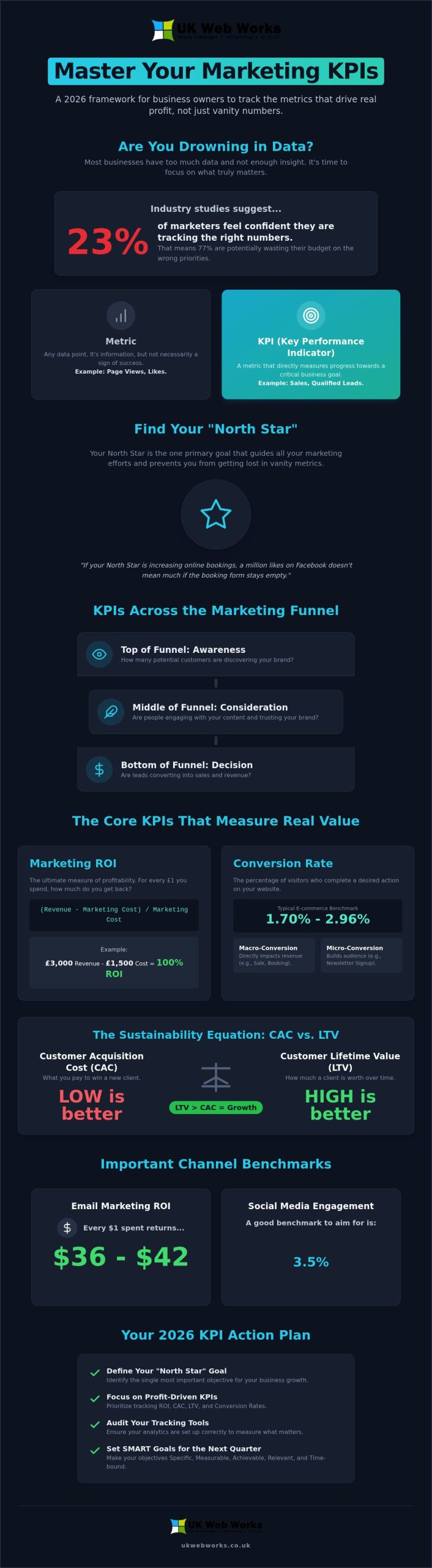
The Digital Marketing KPI Checklist: Your 2026 Framework
Knowing which numbers matter is only half the battle. The real challenge for most business owners is building a routine that makes this data useful. We’ve seen many companies collect mountains of information only for it to sit in a folder, unused and unread. To avoid this, you need a structured approach. This framework simplifies the process, ensuring that the digital marketing kpis to track actually inform your next business move.
Follow these five steps to get your tracking in order:
- Step 1: Audit your current tracking tools. Ensure your Google Analytics 4 (GA4) and Search Console are correctly configured. If you use a CRM, it should be linked to your website forms so you can see exactly where your leads originate.
- Step 2: Identify your top 3 business goals for the next quarter. Trying to improve everything at once often leads to improving nothing. Pick three priorities, such as increasing local lead volume or reducing your cost per acquisition.
- Step 3: Map specific KPIs to each of those goals. If your goal is growth in Hull, track your organic traffic from local search terms and your conversion rate for regional landing pages.
- Step 4: Establish a baseline. Record your current numbers today. You can’t measure progress if you don’t know where you started.
- Step 5: Set a monthly “Review Date.” Pick one day a month to sit down and look at the data. Avoid checking daily fluctuations; they are often just noise caused by seasonal shifts or temporary bot traffic.
Monthly Reporting Essentials
When you sit down for your monthly review, focus on the difference between total leads and Marketing-Qualified Leads (MQLs). A lead is anyone who fills out a form, but an MQL is someone who actually has the budget and intent to buy. Monitoring this helps you judge the quality of your traffic. We also recommend checking your website performance metrics, such as page load speeds and mobile responsiveness. Regular website maintenance is vital here; a slow site will cause your KPIs to drop regardless of how good your marketing is.
Analysing the Data: What to Look For
Look for patterns rather than isolated incidents. We prefer comparing Year-on-Year (YoY) growth rather than just Month-on-Month (MoM). This accounts for seasonal trends that might otherwise look like a success or failure. Be wary of sudden traffic spikes; these are often caused by bots and won’t result in sales. Data without context is just noise. Understanding the “why” behind a number is what allows you to make smart adjustments to your strategy. If you want a team to handle the technical side and provide clear, honest reports, get in touch with us today to discuss our monthly marketing retainers.
Moving from Tracking to Action with UK Web Works
Having a list of metrics is a great start, but numbers only provide value when they lead to better business decisions. We’ve seen many business owners feel overwhelmed by the sheer volume of data available. It’s one thing to know the digital marketing kpis to track, but it’s quite another to have the time and expertise to act on them. That’s where we come in. We bridge the gap between complex data and practical growth strategies.
Our approach is built on a foundation of honesty and linguistic simplicity. We don’t hide behind technical jargon or use complex dashboards to confuse you. Instead, we provide clear, straightforward reporting that focuses on what actually matters to your bottom line. Whether we’re managing your Search Engine Optimization or your PPC campaigns, our goal is to ensure you understand exactly how your budget is being used. We believe that transparency is the cornerstone of any successful partnership.
We’re convinced that a bespoke strategy always beats a cookie-cutter approach. Every business in Hull and East Yorkshire has different needs, and your marketing should reflect that. By choosing a monthly digital marketing retainer, you get more than just a service provider. You get a dedicated team of specialists who are genuinely invested in your long-term success and continuous optimisation. We act as an ally to your business, helping you navigate the technical side of growth with confidence.
The UK Web Works Approach to Growth
We don’t just show you a spreadsheet. We take the time to explain what the numbers mean for your specific business goals. Through regular consultations, we ensure our digital efforts are always aligned with your physical operations. Our local expertise means we understand the regional market dynamics in Yorkshire, allowing us to spot opportunities that a distant corporate agency might miss. We value hard work and long-term relationships, positioning ourselves as your trusted professional consultant rather than a distant service provider.
Ready to Scale Your Business?
If you’re tired of wasting budget on channels that don’t convert, it’s time for a change. We can start with a professional audit of your current digital presence to identify where your tracking might be failing. Having a single partner for your bespoke website design, development, and marketing ensures that your brand identity remains consistent and your tracking is seamless from the first click to the final sale. When you’re ready for a practical, results-driven approach, contact UK Web Works for a no-nonsense marketing consultation today.
Take Control of Your Marketing Growth
Tracking the right data is the difference between a marketing budget that feels like an expense and one that acts as an investment. By focusing on the essential digital marketing kpis to track, you move away from the frustration of irrelevant data and toward a clear understanding of your ROI. Remember to prioritise your “North Star” goal and use our monthly framework to keep your strategy on course. Consistency is what turns a spreadsheet into a tool for real business expansion.
At UK Web Works, our Hull-based team of specialists has been helping businesses grow since 2014. We believe in providing no-nonsense, honest reporting that cuts through the noise. You deserve to know exactly how your SEO and PPC are performing without having to decipher complex technical terms. We take pride in our craftsmanship and our commitment to building long-term relationships with our clients across Yorkshire.
If you’re ready for a clearer picture of your online performance, Request a Jargon-Free Marketing Audit from UK Web Works today. We’re here to help you turn your data into a practical plan for sustainable growth. It’s time to stop guessing and start growing with confidence.
Frequently Asked Questions
What is the most important digital marketing KPI for a small business?
The most important metric for any small business is Return on Investment (ROI). While other numbers tell a story, ROI confirms whether your marketing spend is actually generating profit. If you don’t know this number, you’re essentially flying blind. We focus on this above all else because it’s the only way to ensure your business remains sustainable and capable of growth in a competitive local market.
How often should I be checking my marketing KPIs?
You should check your digital marketing kpis to track once a month. Checking daily often leads to knee-jerk reactions based on minor fluctuations that don’t reflect long-term trends. A monthly review allows you to see the bigger picture and make informed adjustments. This steady approach helps you stay calm and methodical, rather than getting rattled by temporary dips in traffic or engagement.
What is a good conversion rate for a service-based website in the UK?
For a service-based website in the UK, a healthy conversion rate typically falls between 2% and 5%. However, this can vary depending on your specific industry and how niche your services are. If you provide a high-value, specialised service, your rate might be lower, but the lead quality will be higher. We always look at this number alongside your lead quality to ensure you’re attracting the right people.
For example, a specialist service provider like Expert Roofing & Guttering Ltd would focus more on high-intent lead quality than sheer volume to ensure a sustainable ROI.
Can I track my KPIs for free using Google tools?
Yes, you can track the majority of your essential data for free using Google Analytics 4 (GA4) and Google Search Console. These tools provide deep insights into how people find your site and what they do once they arrive. While they are powerful, they can be complex to set up correctly. We often help clients configure these tools as part of our maintenance plans to ensure their data is accurate and useful.
What are ‘vanity metrics’ and why should I avoid them?
Vanity metrics are numbers that look impressive on a report but don’t contribute to your business goals. Common examples include social media likes, raw page views, or follower counts. You should avoid focusing on these because they don’t pay the bills. Instead, look for metrics that signal intent, such as form submissions or phone calls. These provide a much more honest reflection of your marketing success.
How do I know if my SEO agency is actually doing a good job?
You’ll know your SEO agency is doing a good job if you see a steady increase in organic leads and relevant traffic over time. Don’t just settle for reports that show improved rankings for obscure keywords. A good partner will be transparent about their methods and show you how their work is impacting your bottom line. Look for honest communication and reports that link their efforts directly to your business growth.
What is the difference between a lead and a conversion?
A lead is a person who has shown interest in your business, perhaps by filling out a contact form. A conversion is a broader term that refers to any completed goal, which could be a lead or a final sale. When evaluating the digital marketing kpis to track, it’s vital to distinguish between the two. You want to ensure your leads are high-quality and actually converting into paying customers over time.
Why is my bounce rate so high and does it matter in 2026?
In 2026, the traditional bounce rate has been largely replaced by the Engagement Rate in GA4. This metric measures how many people actually interact with your site rather than just how many leave. A high bounce rate isn’t always bad; it might just mean a user found exactly what they needed quickly. We look at engagement time and scroll depth to get a clearer picture of your website’s actual performance.