
What if your new visual identity is actually driving customers away instead of drawing them in? It’s a sobering thought, but many UK business owners find that a flashy logo doesn’t always translate to more enquiries. You’ve likely experienced the frustration of a website that looks great on a laptop but fails to convert visitors into paying customers. Research from Marq suggests that consistent branding can increase revenue by 23%, yet many SMEs still struggle with fragmented digital identities. Finding the right brand and design agency shouldn’t feel like learning a second language just to understand a simple project update.
Cheap templates are tempting, but they carry significant hidden costs. Research from 2024 indicated that nearly 40% of small business websites using generic themes suffered from security vulnerabilities due to unmaintained plugins. Custom-built WordPress or Shopify sites outperform off-the-shelf themes because they are streamlined, faster, and built specifically for your business requirements. Bespoke design is an investment in long-term technical stability, and it can be helpful to explore Custom Web Design options from award-winning agencies like ImageWorks Creative to see how these high standards are implemented.
We agree that you deserve a partner who speaks plain English and focuses on your bottom line rather than winning design awards. This guide provides a straightforward, jargon-free roadmap for 2026 to help you secure a partner that blends bespoke creative strategy with technical web excellence. We’ll show you how to avoid the “pretty but useless” trap, ensure your branding stays consistent across all platforms, and manage the design process with total transparency. It’s time to move past the confusion and build a digital presence that actually works for your business.
Key Takeaways
- Learn why your brand strategy must inform every pixel of your website to avoid the common pitfalls of siloed design and development.
- Follow our straightforward 5-step checklist to audit your current digital assets and set measurable business objectives before you begin.
- Discover how a bespoke brand and design agency bridges the gap between high-end aesthetics and technical web excellence.
- Navigate the pros and cons of different agency models to find a reliable, UK-based partner that fits your specific growth goals.
- Understand why a website is never truly “finished” and how to use ongoing SEO and maintenance to scale your digital presence.
Understanding the Role of a Modern Brand and Design Agency
A brand and design agency is a partner that bridges the gap between visual storytelling and functional technology. Many business owners in the UK still view these as two separate tasks, often hiring a graphic designer for a logo and a separate developer for their website. This siloed approach is a common pitfall that leads to a disjointed customer experience. When your strategy and your pixels aren’t aligned, your business identity loses its impact before a customer even clicks a button.
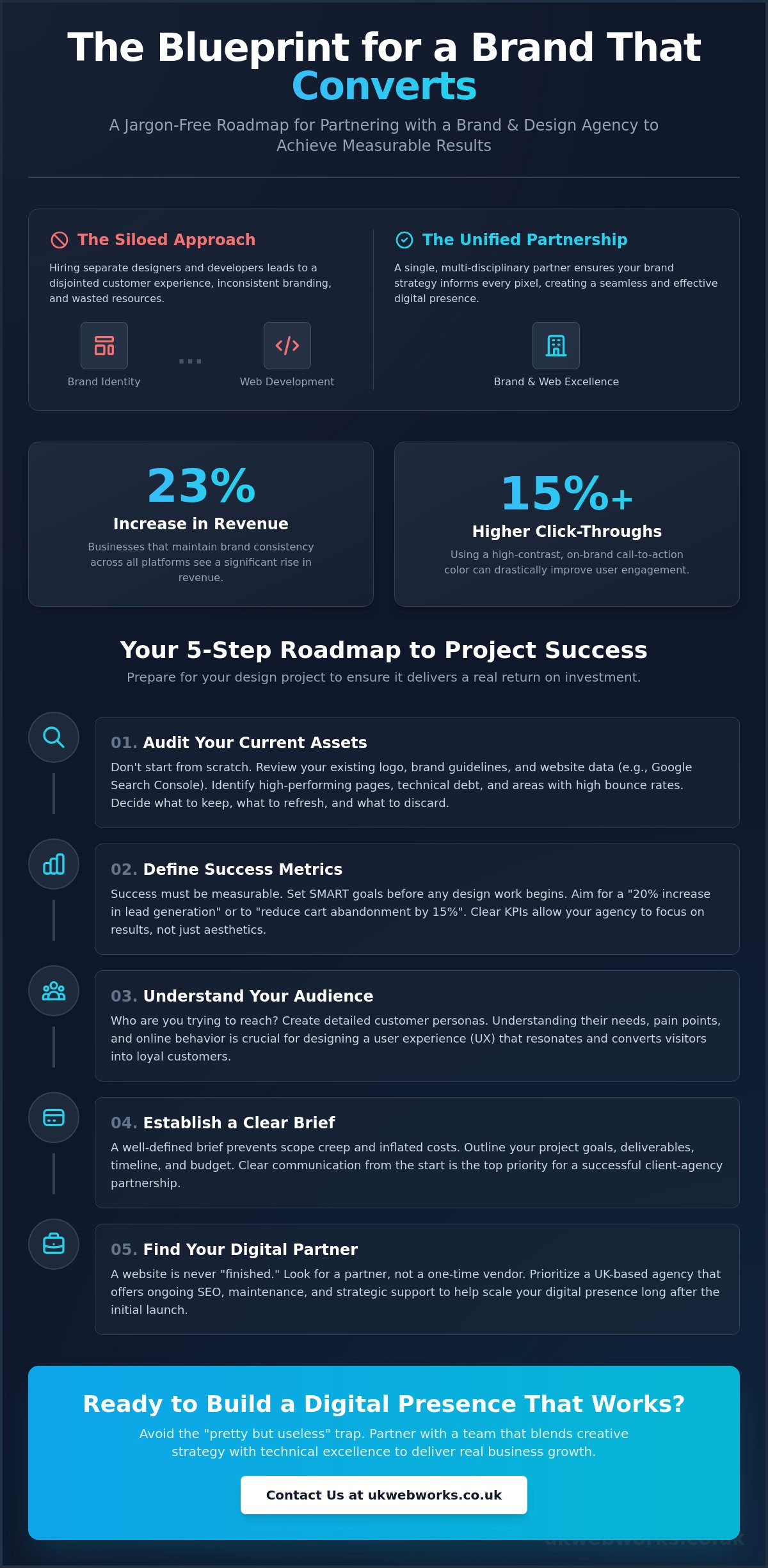
The “and” in and design agency is the most important part of the title. It signifies that every design choice, from the layout of a contact form to the speed of a page load, is rooted in brand strategy. According to a 2021 study on brand consistency by Lucidpress, businesses that maintain a consistent brand across all platforms see an average revenue increase of 23%. By choosing a unified partner, you protect your business identity and ensure that your digital presence feels reliable and professional. A branding agency focuses on your reputation and market position, but a design-led partner ensures those values are baked into the code of your website.
Brand Identity vs. Web Design: The Critical Connection
Your visual identity shouldn’t just look good on a business card; it must dictate your user experience (UX) patterns. A “pretty” website often fails because it lacks a foundational strategy. If your brand is built on being “efficient and direct,” but your website uses slow animations and complex navigation, you’ve already lost user trust. Typography and colour theory also play a massive role in website conversion rates. For instance, using a high-contrast colour for your primary call-to-action can increase click-through rates by over 15% when it aligns with the established brand palette. We don’t just pick colours because they look nice; we pick them because they guide your customers to the checkout.
The Benefits of a Multi-Disciplinary Digital Partner
Choosing a single team to handle both your brand and your digital build offers several practical advantages for small and medium businesses:
- Streamlined communication: You have one point of contact. You won’t find yourself acting as a middleman between a confused designer and an annoyed developer.
- Cost-efficiency: You avoid paying for multiple onboarding processes. A unified and design agency already understands your business goals, so they don’t need to be briefed twice.
This approach isn’t about following trends; it’s about digital craftsmanship. It ensures that your investment in a new website actually supports your long-term growth by building a brand that people recognise and trust. For businesses requiring high-level technical integration, NarvalDreams serves as a specialized growth partner focusing on enterprise web development and digital automation.
How to Prepare for Your Design Project: A 5-Step Checklist
Preparation is the difference between a project that delivers a return and one that simply looks nice. Before you approach a brand and design agency, you need to understand your starting line. Walking into a meeting without a clear brief leads to scope creep and inflated costs. It’s better to spend a week gathering your thoughts now than three months fixing a project that went off track.
Step 1: Audit Your Current Assets
Don’t start with a blank slate if you have existing data. Review your current logo, brand guidelines, and website performance. Use tools like Google Search Console to identify your top-performing pages. If your bounce rate is over 70%, your current design likely isn’t connecting with your visitors. You should also identify technical debt; this includes outdated plugins or slow-loading images that hinder your current site. The annual ‘What Clients Think’ report highlights that clear communication regarding existing business challenges is a top priority for successful client-agency partnerships. Decide what stays, what needs a refresh, and what belongs in the bin.
Step 2: Defining Success Metrics
Success isn’t a feeling; it’s a number. You need to set SMART goals before the first wireframe is drawn. Are you looking for a 20% increase in lead generation by December 2026? Or perhaps you want to reduce your cart abandonment rate by 15%? Defining these KPIs early allows your and design agency to build a strategy that focuses on results rather than just aesthetics. We often see businesses skip this step, only to wonder six months later if the investment was worth it. If you’re unsure how to track these figures, we can help you assess your current digital performance to set realistic targets.
Step 3: Identify Your Target Audience
Stop trying to appeal to everyone. Create three specific user personas. If you’re a B2B firm in Manchester, your audience might be “Decision-Maker David,” who values technical whitepapers and quick loading times. Give these personas names and habits. This helps the designers understand the “why” behind every button and colour choice.
Step 4: Set a Realistic Timeline and Budget
In the UK market, there’s a significant difference between a template-based site and a bespoke build. A bespoke project offers unique functionality and better SEO potential but requires a larger investment. Be transparent about your budget. It’s better to know if your £5,000 budget aligns with your expectations before the work starts. A realistic project timeline for a full rebrand and website usually spans 8 to 12 weeks.
Step 5: Gather Inspiration
You don’t need to be a designer to have a vision. Collect examples of websites or branding that you admire. Focus on the functionality you like, such as a specific navigation style or a clear checkout process. Avoid jargon and use simple terms to describe what you see. This provides a visual shorthand that helps the agency understand your aesthetic preferences without the guesswork.
The Anatomy of a Bespoke Web and Design Process
A successful project isn’t about luck. It’s the result of a methodical, step-by-step approach that removes guesswork from the equation. When you partner with a professional and design agency, you’re paying for a proven framework that turns your business goals into a functional digital tool. We break this down into clear stages so you always know what’s happening and why it matters for your bottom line. This structured path ensures that the final product isn’t just a website, but a reliable asset for your company.
Phase 1: Discovery & Research
We start by looking under the hood of your business. This begins with a jargon-free consultation where we talk about your goals in plain English. We don’t use technical fluff to impress you; we listen to what you need to achieve. During this phase, we conduct a deep dive into your competitors to find the gaps they’ve missed. According to 2023 industry data, 88% of online consumers are less likely to return to a site after a bad experience. We use research to ensure your site isn’t part of that statistic.
- Information Architecture: We map out a logical journey for your visitors. This ensures they find what they need quickly and easily.
- Competitor Analysis: We identify what others in your sector are doing well and where they are failing.
- User Mapping: We define the exact steps a customer takes from landing on your page to making an enquiry.
Phase 2: Creative Execution
This is where your brand starts to breathe. We move from research into visual concepts using mood boards. These boards help us align on the visual direction before we spend hours on detailed designs. It’s a transparent way for you to give constructive feedback without feeling overwhelmed. We then transition these static brand assets into interactive web elements. This process ensures that your visual identity remains consistent across every digital touchpoint.
Mobile responsiveness is baked into the process from the very first sketch. With mobile devices accounting for over 50% of web traffic in the UK, we ensure your site looks and performs perfectly on every screen size. Once the designs are approved, we move into development and testing. Our team turns the visual concepts into a responsive, secure digital reality. We test every link and form to ensure the site is robust and ready for work. Choosing the right and design agency means you get a partner who values this level of craftsmanship and attention to detail.
Comparing Agency Models: Finding the Right Fit
Choosing the right partner for your business depends on your specific goals and the complexity of your project. Freelance designers are often the go-to for small, one-off tasks like a single brochure or a social media graphic. While they offer lower overheads, they often lack the technical depth required for a full-scale brand rollout or complex web development. You might find yourself managing multiple freelancers just to get one website live.
Niche creative studios focus heavily on high-end aesthetics. They produce stunning visual work, but many outsource the technical build to third-party developers. This can lead to a disconnect between the design and the final performance of your site. A full-service and design agency provides holistic support, managing everything from your initial logo concepts to secure UK-based hosting. This joined-up approach ensures your brand identity works perfectly across every digital touchpoint. The same principle applies across all sectors; for example, effective charity web design requires this same unified approach to build digital trust and drive donations without wasting limited resources.
You should stay alert for red flags during the consultation process. Agencies that use “black box” pricing, where costs are lumped into one vague figure, often hide high margins or future hidden fees. A reliable partner will provide a transparent breakdown of where your budget goes. If an agency cannot explain their process without relying on buzzwords, it is usually a sign they are masking a lack of technical substance.
Why “Bespoke” Matters in 2026
Cheap templates are tempting, but they carry significant hidden costs. Research from 2024 indicated that nearly 40% of small business websites using generic themes suffered from security vulnerabilities due to unmaintained plugins. Custom-built WordPress or Shopify sites outperform off-the-shelf themes because they are streamlined, faster, and built specifically for your business requirements. Bespoke design is an investment in long-term technical stability.
- Scalability: Custom sites grow with you, whereas templates often break when you try to add new features.
- SEO Performance: Clean, bespoke code helps your site rank higher on search engines by improving load speeds.
- Security: Reducing reliance on third-party “bloatware” makes your site a harder target for cyber threats.
Transparency and Communication
Working with a UK-based team provides immediate value through real-time support and shared cultural alignment. You don’t have to wait for time zones to sync up to get an answer to an urgent question. We believe that jargon-free reporting is a sign of a high-quality agency partner. If a team can’t explain a technical concept in plain English, they likely don’t have a firm grasp of how it affects your bottom line.
Understanding billing models is equally important for your 2026 planning. Fixed-price models offer budget certainty for specific projects, while hourly billing is better suited for ongoing, reactive support. We prefer a direct approach that ensures you always know what you are paying for and why. If you want a partner who values honesty over high-pressure sales, view our transparent service options to see how we can support your growth.
Beyond the Launch: Scaling with Your Digital Partner
Launching your website isn’t the final step of your digital journey. It’s the first day of your brand’s new life. Many business owners fall into the trap of thinking a website is a “set and forget” project. In reality, the digital world moves too fast for that approach. A site that isn’t updated regularly will see its performance drop by as much as 20% within the first year as browser standards and security protocols change. You wouldn’t buy a new van and never service it; your digital assets require the same level of care.
Working with a long-term brand and design agency partner ensures your business doesn’t just exist online, it grows. We use real-world data to see how people interact with your pages. If the numbers show that users are getting stuck at the checkout or missing your contact form, we fix it. This iterative process turns a simple website into a high-performance business tool that evolves alongside your customer’s needs. A partnership built on trust and data is what separates a static brochure from a lead-generation machine.
Maintenance and Security
Security isn’t a one-time setup. New vulnerabilities emerge every day, and out-of-date software is the primary entry point for 90% of website security breaches. Managed hosting and frequent updates are non-negotiable if you want to maintain your site speed and reputation. We provide comprehensive website maintenance packages to give you peace of mind. This means we handle the technical background noise while you focus on running your business. It protects your investment and ensures your site remains fast and accessible for every visitor.
Marketing Integration
Your design needs to work in harmony with your marketing strategy. A bespoke web design provides a cleaner, faster foundation that search engines prefer. It’s much easier to rank on page one when your site isn’t weighed down by the “bloat” found in cheap, off-the-shelf templates. Once this foundation is solid, you can scale through social media and targeted email campaigns. Your brand and design agency should be there to ensure your visual identity remains consistent across every single touchpoint. Consistency builds trust, and trust is the primary driver for long-term customer loyalty.
Ready to build something that lasts? Contact UK Web Works for a jargon-free consultation and let’s discuss how we can support your business growth through 2026 and beyond.
Take the Next Step Toward a Stronger Digital Presence
Finding the right brand and design agency isn’t just about looking at a portfolio; it’s about finding a team that aligns with your business goals and offers a transparent, bespoke process. You now have a checklist to prepare your project and a roadmap for what a professional web and design journey looks like in 2026. Success comes from clear communication, a fixed-price approach to avoid budget surprises, and a partner who stays with you long after the site goes live.
At UK Web Works, we’ve been refining our digital craftsmanship since 2014. Our 100% UK-based team provides direct, reliable support without the confusing technical talk that often slows things down. We’ve spent over a decade helping small to medium businesses grow through honest service. We believe in hard work and total budget transparency, ensuring you know exactly what you’re getting from the start. We’re ready to help you navigate these choices and build something that actually works for your business.
Book a free, jargon-free consultation with our design team to discuss your next project. Let’s get to work on your future.
Frequently Asked Questions
What is the difference between a graphic designer and a design agency?
A graphic designer is usually a solo freelancer who focuses on specific visual tasks, whereas a brand and design agency provides a full team of strategists, developers, and project managers. An agency offers a broader range of expertise to handle complex, end to end projects. You get a collective pool of talent rather than a single point of failure. This ensures your project stays on track even if one person is away.
How much does a full brand and design project typically cost in the UK?
A full brand and design project in the UK typically starts from £5,000 for small businesses and can exceed £50,000 for mid market firms. According to the 2023 Design Council report, design led firms see a 5% increase in turnover for every £1 spent on design. We provide transparent, fixed fee quotes so you know exactly what you’re paying. There are no hidden costs or surprise invoices at the end.
How long does it take to complete a bespoke website and branding project?
A bespoke website and branding project usually takes between 8 and 14 weeks to complete. This timeframe allows for a 2 week discovery phase, 4 weeks for brand identity design, and 6 to 8 weeks for web development and testing. We follow a methodical schedule to ensure every detail is polished. Rushing this process often leads to technical debt that costs more to fix later.
Do I own the intellectual property of the designs once the project is finished?
You own 100% of the intellectual property rights once the final invoice is paid in full. We transfer all copyrights for logos, brand guidelines, and website code directly to your business. It’s vital to have this in writing to avoid legal issues in the future. We believe that since you paid for the work, you should own it without any ongoing licensing fees.
Will I be able to update the website myself after the agency launches it?
Yes, you’ll have full control to update your website content through a user friendly Content Management System. We provide a 60 minute training session and a jargon free manual to show you how to edit text and swap images. You won’t need to call us for every minor change. This keeps your site fresh and reduces your long term maintenance costs.
What happens if I already have a logo but need a new website?
We can build a new website using your existing logo, provided you have the high resolution vector files. Our team will audit your current branding to ensure the new site layout complements your established visual identity. If your logo looks dated, we might suggest subtle refinements to ensure it works on modern mobile screens. This approach maintains your brand equity while modernising your digital presence.
Why should I choose a UK-based agency over an offshore provider?
Choosing a UK-based and design agency ensures you benefit from shared time zones, local market knowledge, and enforceable legal contracts under English law. Communication is clearer when you can pick up the phone or meet in person. Offshore providers often struggle with cultural nuances that affect how British customers perceive your brand. Working locally provides a level of accountability and reliability that overseas teams can’t match.