Why are you still paying an average of $5.26 per click for keywords that you already rank for organically? It is a frustrating reality for many businesses in Leeds and Hull, where marketing budgets are often wasted on redundant traffic due to siloed reporting. If you feel like your search efforts are competing against each other rather than working together, you aren’t alone. Implementing a cohesive integrated seo and ppc strategy is the most effective way to stop the bleed and start capturing leads more efficiently.
I’m going to show you how to transform these two channels into a unified force that lowers your overall acquisition costs. With AI Overviews now appearing in more than 27% of search results, the old way of managing search in isolation simply doesn’t work in 2026. This guide provides a straightforward framework for sharing data between your paid and organic efforts. You will learn how to use PPC as a laboratory to de-risk your long-term SEO investments and ensure your brand dominates the first page of Google for your core services.
Key Takeaways
- Learn how to stop wasting your budget on redundant clicks by identifying where your organic and paid efforts are unnecessarily overlapping.
- Discover how to use paid search data as a “laboratory” to test high-value keywords before committing to a long-term SEO campaign.
- Master a practical integrated seo and ppc strategy that helps you dominate more screen space and push competitors off the first page.
- Follow a clear, five-step framework to audit your current search presence and create a shared master-list of high-performing keywords.
- Understand the value of a “one-team” approach that removes reporting silos and simplifies your digital marketing into a single, cohesive plan.
Why Siloed Search Marketing Fails in 2026
Many business owners treat SEO and PPC like two separate departments that never speak. In the 2026 search landscape, this rigid separation is a recipe for wasted spend. When your organic team and your paid team work in isolation, they often end up in a “War of the SERPs.” You might find yourself paying for a top-tier ad spot for a keyword where you already hold the number one organic position. While some visibility is good, paying for clicks you could get for free is simply poor management of your online advertising budget.
Data blindness is another major risk. If you are a business in Hull or York, you need to see exactly how your local customers are behaving across the board. Siloed reporting means you might miss the fact that a user clicked your ad, left, and then came back via an organic search to convert. Without an integrated seo and ppc strategy, you see two separate, disconnected interactions instead of one successful customer journey. Google now favors brands that show up in multiple places, and users are more likely to trust a company they see in both the sponsored and organic sections.
The High Cost of Independent Strategies
The “double-dipping” problem isn’t just about paying twice. It’s about the inefficiency of having two separate teams doing the same work. Keyword research is often duplicated, which wastes hours of billable time that could be spent on strategy. Messaging also becomes inconsistent. If your ad promises a specific discount but your organic snippet mentions an outdated offer, you confuse the customer and erode trust. Users in 2026 are savvy. They bounce between listings. If your brand doesn’t look cohesive, they’ll move on to a competitor who looks more professional.
Breaking Down the Digital Silos
To fix this, you need to stop thinking about separate pots of money for different channels. Think about a unified search budget. This approach ensures your web design and marketing are technically aligned from the start. For instance, if your PPC data shows a specific landing page is converting at a high rate, your SEO efforts should focus on that page immediately. This is how we work as an SEO Agency Hull businesses can rely on for actual growth. We look at the big picture because your customers don’t care which link they click. They just want a solution that works for them without any fuss.
The PPC Laboratory: Using Paid Data to Future-Proof SEO
SEO is a long game. It often takes months to see significant movement in organic rankings, especially in competitive local markets. Instead of guessing which keywords will actually bring in business, you can use Google Ads as a high-speed testing ground. This “PPC Laboratory” approach lets you validate “Money Keywords” in days rather than months. If a keyword converts well in a paid campaign, it’s a safe bet for a long-term SEO investment. If it doesn’t, you’ve saved yourself a year of effort ranking for a term that doesn’t pay the bills.
You can also use Search Term Reports to find high-converting long-tail phrases that your initial research might have missed. These are the specific, often longer questions your customers are typing into Google. While you wait for your organic presence to climb, an “SEO Bridge” strategy keeps your business visible. This bridge acts as a safety net. If you stop bidding on a keyword before your organic ranking has reached the first page, you create a visibility gap that your competitors will happily fill. By keeping the ads running until you hit that top-three organic spot, you maintain a steady flow of leads without interruption.
A/B Testing Headlines for Better Organic CTR
Google Ads is the perfect place to run experiments on your messaging. You can test multiple headlines simultaneously to see which one gets the most clicks from your target audience. Once you find a winner, you should apply that ad copy to your organic Title Tags and Meta Descriptions. This helps you get more “free” traffic from the same ranking position. It’s a simple mathematical win; a 1% increase in organic CTR can be worth thousands in additional revenue for a growing business without spending a penny more on ads.
Identifying “Content Gaps” Through Paid Data
Your paid data reveals exactly what your Yorkshire customers are asking. By analyzing the queries that trigger your ads, you can spot high-intent keywords that your competitors are completely ignoring. There are many smart ways to integrate SEO and PPC marketing strategies, but feeding these “winner” keywords back into your content plan is one of the most effective. This isn’t just about keywords; it’s about intent. If you see a high volume of “how-to” searches in your PPC reports, it’s a clear signal that you need an educational blog post or a dedicated FAQ section on your site.
This data-driven approach allows you to build a content strategy based on facts, not assumptions. When we design a website or plan a marketing retainer, we use this intelligence to ensure every page serves a purpose. It ensures your bespoke web design isn’t just pretty, but functional and profitable. If you want to see how this integrated seo and ppc strategy could work for your business, feel free to get in touch for a chat about your goals.
Maximising SERP Real Estate and Brand Authority
Occupying more space on the search results page is a simple but powerful way to increase your market share. When you have an integrated seo and ppc strategy, you create what we call the “1+1=3” effect. Data shows that when a brand appears in both the paid and organic results, the total click-through rate is often higher than if the two listings were added together. It sends a clear signal to the user that your business is a prominent, trusted leader in your field. This dual presence builds immediate authority before a customer even clicks through to your site.
Dominating the “fold” is another practical benefit. The “fold” is the part of the screen a user sees before they have to scroll. By running ads alongside high-ranking organic content, you effectively push your competitors off the first screen. This is especially important on mobile devices, where space is limited. If you control the top ad spot and the first organic result, you own the most valuable digital real estate available. It makes it much harder for a potential lead to find anyone else but you.
You also need to consider brand protection. It is common for competitors in busy areas like Leeds or Doncaster to “ad-snipe” by bidding on your business name. If you only rely on SEO, a competitor’s ad could appear above your organic website link. By running a low-cost brand campaign in PPC, you ensure your name stays at the very top. This keeps your acquisition costs low while defending your hard-earned reputation. There is a lot of value in seeing PPC and SEO working together to protect your brand from aggressive local competition.
Local Search Dominance in Yorkshire
For businesses targeting specific regions, integrating your Google Business Profile with Local Search Ads is a game-changer. This allows your business to appear in the “Map Pack” and at the very top of the sponsored results simultaneously. When a customer in Hull searches for a service, seeing your business twice in the local results creates a sense of reliability. However, this visibility only works if your landing pages are up to the task. High-quality Web Design Hull businesses can trust is essential for turning that local search dominance into actual enquiries. If the page doesn’t load quickly or look professional, you’ve wasted the effort of getting found.
The Psychology of Dual Visibility
Seeing a brand twice creates a psychological layer of social proof. It suggests that your company is established enough to invest in advertising and skilled enough to rank naturally. You can also use PPC to “retarget” users who first found you through an organic search. If someone reads an informational blog post on your site but doesn’t buy right away, a well-timed ad can remind them of your services later. This consistent messaging across both channels helps reduce “buyer remorse” and keeps your business at the front of their mind when they are finally ready to commit.
A 5-Step Framework for a Unified Search Strategy
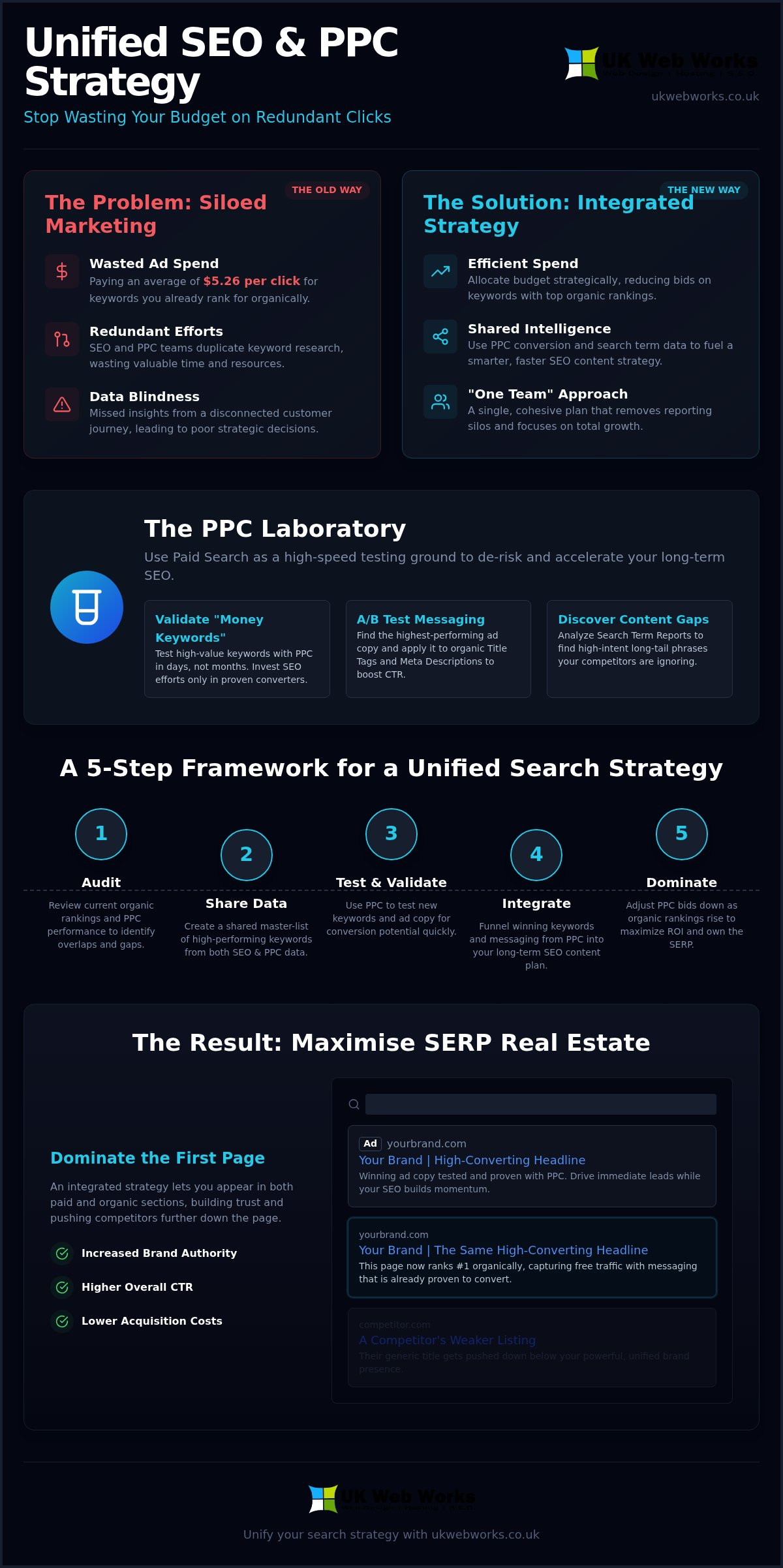
Successful search dominance doesn’t happen by accident. It requires a repeatable process that your team can follow daily. This five-step framework turns the concept of an integrated seo and ppc strategy into a practical workflow for your business. By following these steps, you move away from guesswork and toward a data-driven system that protects your margins.
Your first step is to audit your current “Double Coverage.” This means identifying every keyword where you are currently paying for an ad while also ranking in the top organic spot. In competitive local markets like Hull, you might find that 15% of your ad spend is going toward clicks you would likely get for free. Identifying this wasted spend allows you to immediately tighten your budget without losing traffic.
Next, create a shared keyword master-list. This should be a single source of truth accessible by everyone involved in your marketing. It ensures that your PPC team isn’t bidding on terms that your SEO team has already secured, and vice versa. It also helps you identify “SEO Probing” opportunities. You can launch short-term PPC campaigns to test the viability of a new service or location before you commit months of effort to an organic campaign.
Once the list is active, align your landing page UX. A page that works for SEO must also work for your Google Ads Quality Score. Finally, implement unified reporting. Stop looking at “SEO Leads” and “PPC Leads” separately. Instead, focus on your total Cost Per Lead (CPL). With the current cross-industry average CPL sitting at $70.11, knowing your true combined cost is the only way to ensure your growth remains profitable.
Landing Page Optimisation for Dual Channels
A Bespoke Web Design is always more effective for your bottom line than a generic template. Templates often come with “bloat” that slows down your site, hurting both your organic rankings and your Google Ads Quality Score. To win on both fronts, you must balance keyword density for search engines with punchy, conversion-focused copy for your paid visitors. Technical speed is also non-negotiable. Google’s algorithms for both paid and organic search reward pages that load instantly, ensuring you don’t pay a “slow site tax” on your ad bids.
Budget Reallocation Tactics
Knowing when to “turn off” the tap is just as important as knowing where to spend. If you hold the number one organic position for a specific term and your competitors aren’t bidding on it, you can often pause your PPC spend for that keyword. You can then reinvest that saved budget into high-competition SEO terms where you haven’t yet reached the first page. Using “Target CPA” bidding strategies, which now manage 78% of all Google Ads spend, helps you stay profitable while you wait for your organic authority to build. If you are ready to stop wasting budget and start dominating, contact us to discuss a unified search plan for your business.
The UK Web Works Approach: Integrated, Direct, and Local
We believe that digital marketing shouldn’t be a mystery. At UK Web Works, we take a direct approach to your search presence. Instead of dealing with multiple agencies or separate internal teams that don’t talk, you work with a single group of specialists. This ensures your integrated seo and ppc strategy is executed as one cohesive plan. We remove the jargon and focus on what actually matters to your business: growth and clarity.
Our Marketing & SEO services are designed to bridge the gap between technical web design and high-performance advertising. Because we handle your website design and development alongside your search marketing, we ensure every technical detail is aligned. There’s no back and forth between a designer and a marketer. We make sure your site is fast, responsive, and ready to convert the traffic we send to it. This alignment is what allows us to lower your acquisition costs while dominating the search results.
Transparency is a cornerstone of how we work. We pride ourselves on offering fixed-price projects and retainers. In a search world where costs can fluctuate wildly, having a clear and predictable budget is a significant advantage. You’ll always know exactly what you are paying for and what we are working on. We support businesses across Hull, York, Leeds, and the wider East Yorkshire area, providing the kind of reliable partnership that larger, more distant agencies often lack.
Why a Local Partner Matters
Understanding the local landscape is vital for search dominance. We know the Yorkshire business environment because we live and work here too. We understand the regional competition in Leeds and the specific needs of customers in Hull. This local expertise allows us to create campaigns that resonate with your audience. We speak your language, not marketing-speak. Our focus remains on real-world results, like phone calls and sales, rather than just clicks or vanity metrics. You need a partner who understands that a lead in York might behave differently than one in London.
Ready to Unify Your Search Strategy?
Starting a unified search plan doesn’t have to be a daunting process. During an initial strategy consultation, we’ll take a look at your current goals and challenges. We start by auditing your existing accounts to find immediate savings, often identifying wasted spend in the first few hours. This is about making your money work harder for you. If you want to learn more about our approach to online growth, our Marketing & SEO services provide a comprehensive foundation for any local business looking to grow. We work as an ally to your business, ensuring your digital presence is built on a foundation of honesty and hard work.
Take Control of Your Search Presence Today
Dominating the search results in 2026 requires more than just showing up. It’s about ensuring your paid and organic efforts work as one. By using PPC data to de-risk your SEO and claiming more space on the first page, you protect your brand and lower your lead costs. We’ve shown how a unified framework removes the guesswork and stops you from paying for clicks you could get for free.
Since 2014, we’ve helped Yorkshire businesses grow by providing bespoke strategies and jargon-free reporting. We don’t hide behind complex technical terms; we provide clear, direct advice that helps you win. If you’re ready to stop treating these channels as rivals and start using an integrated seo and ppc strategy, we are here to help.
Get a No-Nonsense Integrated Search Audit
Your digital growth should be built on a foundation of honesty and hard work. Let’s get started on building a search presence that truly works for your business.
Frequently Asked Questions
What is the main difference between SEO and PPC in 2026?
The main difference is speed and ownership. PPC gives you immediate visibility at a cost per click, while SEO builds a long-term digital asset that you own. In the 2026 landscape, SEO is also vital for appearing in AI Overviews, which now show up in 27.4% of tracked search queries. While PPC buys you a seat at the table today, SEO ensures you have a permanent place there tomorrow.
Should I stop PPC if I already rank #1 on Google organically?
Not necessarily. Holding both the top ad spot and the first organic result creates a dual presence that often increases your total click-through rate. It also pushes your competitors further down the screen, which is especially important on mobile devices. We only suggest pausing ads for top-ranking keywords if your competitors aren’t bidding on your brand name and you can safely reinvest that budget elsewhere.
How long does it take for an integrated strategy to show results?
PPC results are almost instant, but a full integrated seo and ppc strategy usually shows significant efficiency gains within the first 90 days. This is the period where we identify wasted spend and begin sharing keyword data between channels. While full organic growth can take six months or more, the cost savings from stopping redundant clicks happen much faster.
Can PPC data really help my SEO rankings?
Yes, it’s the most effective way to de-risk your SEO investment. PPC acts as a laboratory where you can test which keywords actually lead to phone calls and sales in a matter of days. Once we know which terms convert at a high rate, we can focus your SEO efforts on those specific phrases. This ensures you don’t spend months ranking for a keyword that doesn’t actually grow your business.
Is an integrated strategy more expensive than doing them separately?
It’s actually more efficient and often lowers your overall marketing costs. When you manage search in silos, you often end up “double-dipping” by paying for clicks you could have had for free. By unifying your budget and your team, you eliminate this waste. You’re investing in a single, cohesive plan that focuses on your total cost per lead rather than two separate, competing budgets.
How do I track the success of an integrated search campaign?
You should focus on your blended cost per lead and your total search engine real estate. Instead of looking at siloed reports, we track how many total enquiries your business gets from search as a whole. We also monitor your brand authority and how often you appear in both the paid and organic sections simultaneously. This gives you a much clearer picture of your actual return on investment.
Why is local SEO important for businesses in Hull and Yorkshire?
Local SEO is how you win against national giants who have massive budgets but no local presence. By appearing in the “Map Pack” and local search results, you reach customers in Hull or Leeds at the exact moment they need your services. It’s about being visible in your own backyard. When combined with local ads, it ensures your business is the first one people see in the Yorkshire region.
Do I need a new website to start an integrated SEO and PPC strategy?
You don’t always need a completely new site, but your current one must be technically sound. If your website is slow or difficult to use on a phone, you’ll pay more for your ads and struggle to rank organically. We start with a technical audit to see if your site can handle the traffic. If it’s holding you back, we’ll explain exactly what needs to change to ensure your marketing spend isn’t wasted.