
Choosing the wrong platform isn’t just a technical hiccup; it’s the difference between renting your business’s future and actually owning the digital roof over your head. When you’re weighing up wordpress vs shopify for ecommerce uk, you’re likely staring at a mountain of conflicting advice and hidden transaction fees. You want a store that works, ranks well in local UK searches, and doesn’t eat your margins with every sale. It’s frustrating when simple questions about costs turn into a maze of “it depends” and complex technical jargon that causes decision paralysis.
We understand that you need a high-performing site without the fear of being locked into a proprietary system you can’t control. This guide provides a direct, jargon-free breakdown of which platform actually grows your UK business without the hidden headaches. We’ll compare Shopify’s £19 monthly entry point and its 2.0% transaction fees against the full ownership and flexibility of a bespoke WordPress build. From navigating the £90,000 VAT threshold to securing local SEO dominance, here is the honest truth about where to invest your budget in 2026.
Key Takeaways
- Understand the fundamental difference between renting your store on a hosted platform and owning your digital asset entirely with a self-hosted solution.
- Learn how to calculate the true total cost of ownership by comparing monthly subscriptions and transaction fees against the long-term value of a bespoke build.
- Get a clear framework for deciding between wordpress vs shopify for ecommerce uk based on your specific growth goals and technical comfort level.
- Discover why site speed and bespoke design are the primary drivers for ranking higher in local UK searches and converting more visitors in 2026.
- See how partnering with a local UK team can remove the technical jargon that causes decision paralysis while ensuring your store is built for your unique market.
Choosing Your UK eCommerce Platform: The WordPress vs. Shopify Dilemma
The UK ecommerce market is projected to reach $317.33 billion in 2026. This massive growth means more competition for your shop in Hull, York, or East Yorkshire. Choosing between wordpress vs shopify for ecommerce uk is the first major hurdle you’ll face as a business owner. These two platforms dominate the landscape because they offer distinct paths to success; one prioritizes speed and convenience while the other focuses on long-term ownership and flexibility. When evaluating wordpress vs shopify for ecommerce uk, the technical trade-offs become clear once you look past the marketing gloss.
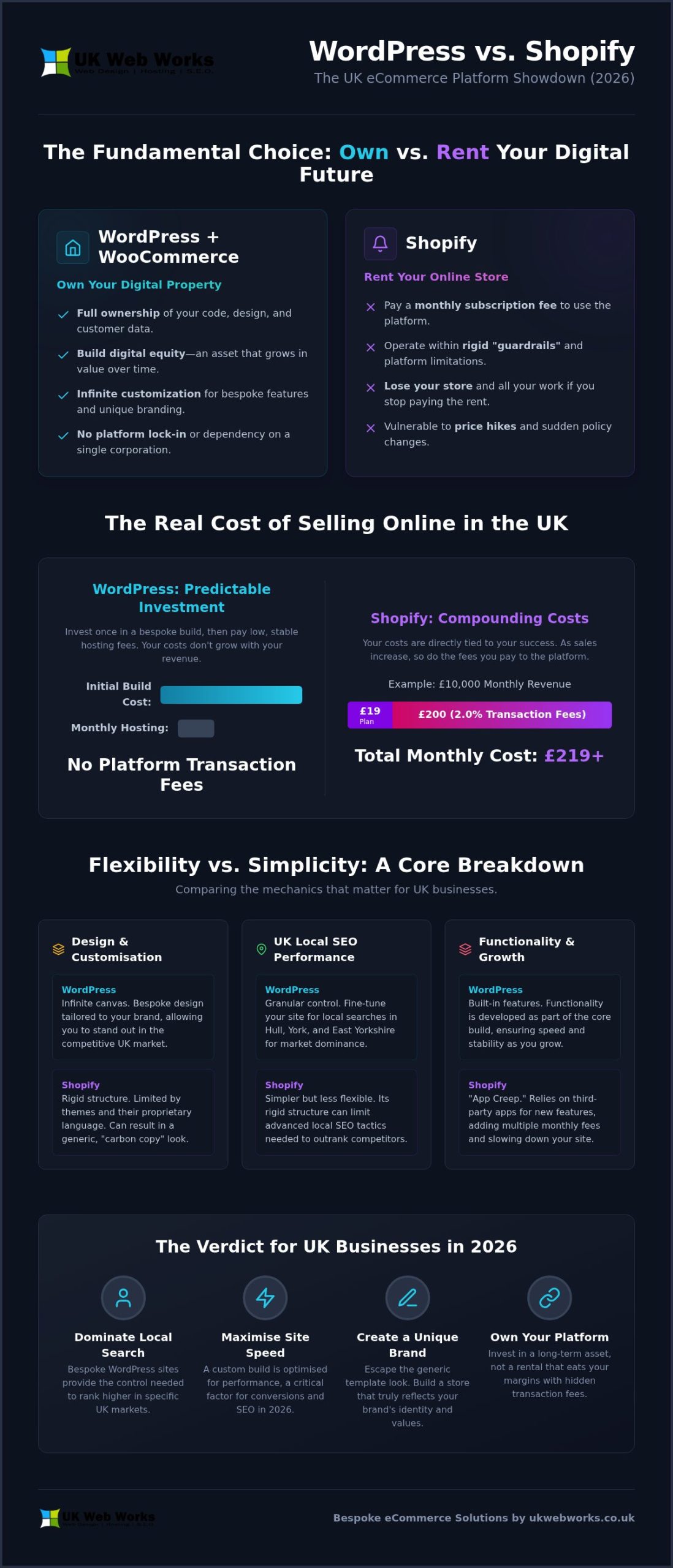
Understanding what e-commerce is from a technical standpoint helps you see that these aren’t just website builders. They are the engines of your business. The fundamental choice is between a hosted Software-as-a-Service (SaaS) model and a self-hosted open-source system. Think of it like the difference between renting a shop on a high street and buying a commercial property with a mortgage. With a rental, you pay a monthly fee for the space. You can’t knock down walls or change the storefront without permission. If you stop paying, you lose the shop. With a mortgage, you own the asset. You have the freedom to renovate and you’re building equity in your own digital property.
If you’re targeting customers in a specific region, your platform choice affects how well you rank in local searches. WordPress often provides more granular control over local SEO settings, allowing you to fine-tune your presence for local shoppers. Shopify is simpler to start, but its rigid structure can sometimes limit your ability to stand out. Having a local partner who understands the regional market ensures your site isn’t just a generic template. It should be a bespoke tool designed for your specific goals.
What is WordPress (and WooCommerce)?
WordPress is a Content Management System (CMS) that powers a significant portion of the web. By itself, it’s used for blogs and business websites. You use a plugin called WooCommerce to turn it into a fully functional online store. Because it’s open source, you own the code and your data entirely. You’ll need to arrange your own hosting, which typically costs between £5 and £30 per month in the UK. This setup gives you an infinite canvas for bespoke design and unique functionality.
What is Shopify?
Shopify is a “closed shop” SaaS platform. You don’t buy the software; you subscribe to it. The Basic plan currently costs £19 per month when billed annually or £25 per month on a rolling basis. In exchange for this fee, Shopify handles the technical hosting, security updates, and core maintenance for you. It’s designed for speed and ease of use, though you are limited to the features and layout options they provide within their ecosystem.
Flexibility vs. Simplicity: Comparing the Core Mechanics
Efficiency is the ultimate goal for any online retailer, but “easy” can sometimes be a trap. When you’re deciding on wordpress vs shopify for ecommerce uk, you have to look at what happens six months after your launch. Shopify is often praised for its simplicity, which is true for the initial setup. It provides a polished, guided experience that gets you selling quickly. However, this simplicity comes from a rigid structure. You are operating within Shopify’s guardrails. If your business model requires a unique feature that isn’t part of their core system, you’ll likely end up with “app creep.” This is where you install multiple third-party apps, each adding a new monthly subscription fee to your bill.
WordPress offers an infinite canvas. It’s built for those who want their store to adapt to their business, rather than the other way around. Because the UK eCommerce market is so competitive, a generic storefront can be a liability. Standing out in Hull or York requires a site that looks and feels like your brand, not a carbon copy of a thousand other shops. WordPress allows for deep, structural customisation that Shopify simply cannot match without extremely expensive enterprise-level plans.
Design, Themes, and Customisation
Shopify uses a proprietary language called Liquid. While it’s powerful, it limits you to what their themes allow. Many “off-the-shelf” themes are designed for a global audience and can feel impersonal for a local UK business. With bespoke web design on WordPress, we can build specific functionality tailored to your exact workflow. This might include custom trade portals, complex product builders, or unique delivery scheduling that fits your local logistics. You aren’t fighting a template; you’re building a tool. If you’re feeling stuck between these two worlds, we can help you explore your options with a direct conversation.
Managing Your Store Day-to-Day
The daily experience of running your shop is where the choice between wordpress vs shopify for ecommerce uk becomes most visible.
- Shopify Dashboard: Extremely clean and focused entirely on commerce. It’s excellent for staff who have never managed a website before.
- WordPress/WooCommerce Admin: Integrated directly into your website’s content area. It’s ideal if you’re also producing a lot of content, like blogs or guides, to drive traffic.
- Inventory & Orders: Both platforms handle standard shipping and tax remarkably well for the UK market, though WordPress offers more flexibility for complex VAT requirements.
A user-friendly interface is vital for non-technical staff. Shopify wins on pure out-of-the-box intuition, but a well-configured WordPress site, set up by a professional team, can be just as simple to manage while offering far more power under the hood.
The Real Cost of Selling Online in the UK (2026)
Numbers don’t lie, but they can be presented in ways that mask the true cost of doing business. When you’re comparing wordpress vs shopify for ecommerce uk, looking only at the monthly subscription is a mistake. You have to consider the Total Cost of Ownership (TCO) over three to five years. While one platform might seem cheaper to start, the other might offer better long-term value by letting you keep more of your hard-earned revenue. Understanding website design prices uk involves looking at both the initial build and the ongoing operational drain on your margins.
A fixed-price project fee for a bespoke build often delivers better value than a low monthly “rental” that scales its costs as you grow. If your business is successful, you don’t want to be penalized for that success through escalating fees. By owning your digital asset from day one, you avoid the trap of being locked into a pricing structure that you can’t negotiate or escape without a complete rebuild.
Monthly Fees and Transaction Charges
Shopify’s pricing is tiered to encourage you to spend more as your volume increases. The Basic Plan starts at £19 per month when billed annually, but the real cost lies in the transaction fees. On this plan, you’ll pay 2.0% plus 25p per online transaction. If you choose to use a third-party gateway like Opayo or Worldpay instead of Shopify Payments, they add an extra fee ranging from 0.5% to 2.0%.
In contrast, WooCommerce doesn’t charge its own transaction fees. You’re free to choose any UK payment gateway, such as Stripe or Klarna, and you only pay their standard rates. For a shop turning over £10,000 per month, Shopify’s 2.0% fee alone costs you £200 monthly. Once your business approaches the £90,000 VAT registration threshold, these compounding costs can become a significant burden compared to the flat hosting costs of a WordPress site.
Hosting, Security, and Maintenance
Shopify includes hosting and security in its monthly fee, which is convenient for those who want a “set and forget” approach. However, this convenience means you have no control over your server environment or performance optimisations. With WordPress, you’ll need to arrange your own hosting, which typically ranges from £5 to £30 per month for high-quality UK providers.
To keep a WordPress site as hands-off as Shopify, many business owners invest in website maintenance packages. These plans handle security updates, backups, and technical support, ensuring your store remains secure and performant. When you weigh the cost of wordpress vs shopify for ecommerce uk, remember that professional maintenance is an investment in your business’s security and uptime, not just an overhead. It provides the same peace of mind as a hosted platform while allowing you to retain full ownership of your store’s code and data.
SEO, Performance, and UK Market Nuances
Site speed is the silent killer of online sales. In 2026, UK consumers have zero patience for sluggish pages, especially with mobile commerce exceeding £100 billion. Google rewards stores that load instantly. When comparing wordpress vs shopify for ecommerce uk, you’ll notice Shopify provides a decent baseline speed. However, its heavy reliance on third-party apps can bloat your code. WordPress, when built with a bespoke approach, allows us to strip away the fluff. This results in a leaner, faster site that smashes Core Web Vitals and keeps your Yorkshire customers from bouncing to a competitor.
Ranking for local searches in Hull, Leeds, or York requires more than just a few keywords. You need control over your site’s architecture. Shopify is good for general SEO but can be restrictive when you want to customise URL structures or deep-link specific categories. WordPress offers complete freedom. You can implement advanced schema markup and local landing pages that tell Google exactly where you are and who you serve. This level of detail is often what separates a page-one result from a page-five ghost town. When debating wordpress vs shopify for ecommerce uk, consider how much control you need over your local visibility.
Getting Found on Google UK
Shopify’s native SEO tools are user-friendly but basic. They handle the essentials like meta titles and descriptions well. WordPress users have access to powerful plugins like Yoast or RankMath, which offer much deeper analysis. The real advantage comes from bespoke code. Instead of using a mass-produced theme that carries thousands of lines of unnecessary CSS, a custom WordPress site is built for performance. Working with an SEO agency Hull can help you leverage this technical flexibility to outrank larger, slower national brands.
UK Shipping and Payment Integrations
Operating in the UK market means navigating specific regulations like “Making Tax Digital” (MTD). Both platforms integrate with accounting software like Xero or QuickBooks, but WordPress often handles complex VAT scenarios more gracefully. This is vital if you’re approaching the £90,000 VAT registration threshold. For physical logistics, integrating with Royal Mail or DPD is straightforward on both, though WordPress allows for more bespoke shipping rules for local East Yorkshire deliveries. This ensures your shipping costs are accurate and your customers stay happy.
If something goes wrong, you want to talk to someone who understands your business environment. Relying on a US-based help centre in a different time zone can be a nightmare when your checkout is down on a Tuesday morning. Choosing a platform that allows for local support ensures you have an ally who knows the UK market nuances. If you’re ready to build a store that truly performs, you should contact our team in Hull for a direct, honest conversation about your goals.
Bespoke eCommerce: Why a Local Partner Makes the Difference
The debate over wordpress vs shopify for ecommerce uk often focuses purely on features and monthly costs. While those details matter, the success of your online store depends more on the strategy behind the software. A platform is just a tool; it’s how that tool is configured to meet your specific business goals that determines your profit margins. We’ve been building digital solutions since 2014, and we’ve seen that the most successful shops aren’t just “launched.” They are crafted by a partner who understands the local market in Hull, York, and across East Yorkshire.
Our approach is grounded in transparency and integrity. We don’t hide behind complex technical terminology or high-pressure sales tactics. Instead, we offer a professional consultation that simplifies these concepts so you can make an informed choice. We’re an ally to your business, helping you transition from “just having a website” to owning a high-performing digital asset that you actually control. When you work with a local team, you get accountability and a shared understanding of the regional economy that a distant corporate entity simply cannot provide.
Moving Beyond Templates in East Yorkshire
Many businesses start with “Do It Yourself” builders, only to find they’ve hit a ceiling within a year. Off-the-shelf templates often lead to a generic look that fails to build trust with a discerning UK audience. Bespoke design is about more than just aesthetics; it’s about conversion. By tailoring the user journey to your specific customers, we can remove the friction that leads to abandoned baskets. Our craftsmanship-focused approach ensures that your store reflects the quality of your brand, providing a unique experience that helps you stand out in a crowded marketplace.
Your Next Steps to a Profitable Online Shop
Deciding on wordpress vs shopify for ecommerce uk becomes much easier when you ask the right questions. We recommend using this short checklist to help clarify your direction:
- Do you want to own your code and data entirely without being “locked in”?
- Is your product range complex or does it require custom functionality?
- Will your projected turnover make percentage-based transaction fees too expensive?
- Do you value having a local partner for ongoing maintenance and support?
- Are you looking for a fixed-price project fee to keep your budgeting transparent?
If you’re ready to move past the decision paralysis and start building, we’re here to help. A long-term digital partner doesn’t just build a site; they help you navigate marketing, security, and growth as your business evolves. We invite you to a direct, jargon-free consultation to discuss your project and see which path fits your vision. You can contact our team in Hull today to get an honest assessment of your needs and a clear plan for your future online shop.
Building a Profitable Future for Your UK Store
Choosing between wordpress vs shopify for ecommerce uk isn’t just about picking a software. It’s about deciding whether you want to rent your business space or own the digital roof over your head. The right choice depends on your turnover goals, your need for bespoke functionality, and how much you value local SEO control. Whether you’re looking for the flexibility of WordPress or the managed simplicity of Shopify, your platform should serve your business, not the other way around. We’ve seen that the most successful retailers are those who prioritize long-term asset ownership and clear, predictable costs.
We’ve been crafting high-quality online shops since 2014. With over 10 years of eCommerce expertise, our team provides fixed-price, no-nonsense quotes that keep your budget transparent from the start. Based in Hull and serving the whole UK, we’re dedicated to building stores that help you outpace the competition without the hidden headaches of “app creep” or scaling transaction fees.
Get a Jargon-Free Quote for Your Bespoke eCommerce Store
Your next big step in the UK market starts with a simple, honest conversation. We’re ready to help you build something remarkable that truly belongs to you.
Frequently Asked Questions
Is Shopify better than WordPress for SEO in the UK?
Neither platform is inherently better, but they offer different levels of control. Shopify provides a solid foundation with simple tools for beginners. WordPress offers much deeper technical control, allowing you to fine-tune every element of your site architecture. This granular approach is often more effective for ranking in competitive local searches across Hull and East Yorkshire where technical performance is a primary ranking factor.
Which platform is cheaper for a small UK startup?
Shopify has lower upfront costs with its £19 monthly Basic plan, but WordPress is often more cost-effective as you grow. When weighing wordpress vs shopify for ecommerce uk, you must consider Shopify’s 2.0% transaction fees and monthly app subscriptions. WordPress allows you to avoid these recurring percentage-based costs, which means you keep a larger portion of your revenue once your shop begins to scale.
Can I move my shop from Shopify to WordPress later?
You can migrate your store, but it is a complex technical process that involves moving product data, customer records, and order histories. Migrations often carry risks to your search engine rankings if not handled correctly. It’s usually more efficient to choose the platform that fits your long-term goals from the start to avoid the expense and downtime associated with a complete platform rebuild.
Do I need a developer to manage a WordPress/WooCommerce site?
You don’t need a developer for day-to-day tasks like adding products or changing prices. The modern WordPress dashboard is intuitive for non-technical staff. However, having a professional partner for the initial build and ongoing security updates is a wise investment. A maintenance plan ensures your site stays fast and secure, providing the same “hands-off” experience as a hosted platform while you retain full ownership.
Which platform handles UK VAT and shipping better?
Both platforms handle UK VAT and “Making Tax Digital” compliance effectively through integrations with accounting software like Xero or QuickBooks. WordPress offers slightly more flexibility for businesses with complex requirements, such as specific shipping rates for local postcodes or weight-based Royal Mail tiers. This is particularly useful for shops approaching the £90,000 VAT registration threshold that need precise financial reporting and custom logic.
Is Shopify or WordPress more secure for my customers?
Both platforms are highly secure when they are managed correctly. Shopify handles all core security updates and PCI compliance for you as part of your monthly subscription. WordPress requires you to manage your own updates and backups. By using high-quality UK hosting and a professional maintenance plan, you can ensure your WordPress store is just as secure as any proprietary platform while maintaining control over your data.
How long does it take to build a bespoke eCommerce site in the UK?
A bespoke build typically takes between 6 to 12 weeks depending on the complexity of your product range and specific features. This timeframe allows for a methodical approach to design, development, and testing. We focus on getting the foundation right so your store is fully optimized for performance and conversion before it goes live to customers in the competitive UK market.
Do I own my website if I use Shopify?
You own your products and customer data, but you do not own the website software or the code. You are renting a service from Shopify. If you decide to leave their platform, you cannot take the website with you and must build a new one from scratch. WordPress is open-source, meaning you own the entire digital asset and can move it to any host whenever you like.