Did you know that while 53% of all web traffic comes from organic search, the average SEO conversion rate of 2.4% is nearly double that of PPC? It’s a startling figure when you consider the average UK business spends between £1,000 and £10,000 every month on Google Ads. When weighing up seo vs ppc, you might feel stuck between paying an average cost per click of £2.69 or navigating the fallout of the March 2026 Google Core Update. If you’re tired of wasting money on ads that don’t convert or waiting months for search results that never arrive, you’re not alone.
We believe you deserve a clear roadmap for your marketing spend rather than a sea of conflicting agency advice. This guide provides a straightforward, jargon-free comparison to help you decide exactly where your money works hardest for your business. We’ll look at the real ROI of both channels and explain how to build a sustainable lead generation strategy that fits your specific financial breathing room. By the end, you’ll understand whether to rent your visibility for immediate results or invest in a bespoke digital asset for the long term.
Key Takeaways
- Discover the fundamental difference between renting short term visibility and building long term digital equity for your brand.
- Use our straightforward framework to decide if your current business goals require immediate cash flow or sustainable, organic growth.
- Get a transparent breakdown of the real costs involved in seo vs ppc to ensure you’re investing your marketing budget wisely.
- Learn how to protect your traffic from 2026 algorithm shifts and the rise of AI-powered search results on Google.
- Understand why a bespoke website foundation is the essential bridge that turns your search traffic into paying customers.
SEO vs PPC: The No-Nonsense Breakdown of Search Marketing
Choosing the right path for your digital growth starts with understanding Search Engine Marketing (SEM). While they both aim to put your business in front of potential customers, they work in fundamentally different ways. The debate of seo vs ppc is not about which one is better in a vacuum. It is about which one fits your current business stage and financial goals. SEO is the process of earning your way to the top of organic search results through merit and authority. PPC is an auction-based system where you pay for a prominent spot at the very moment a user searches for your services.
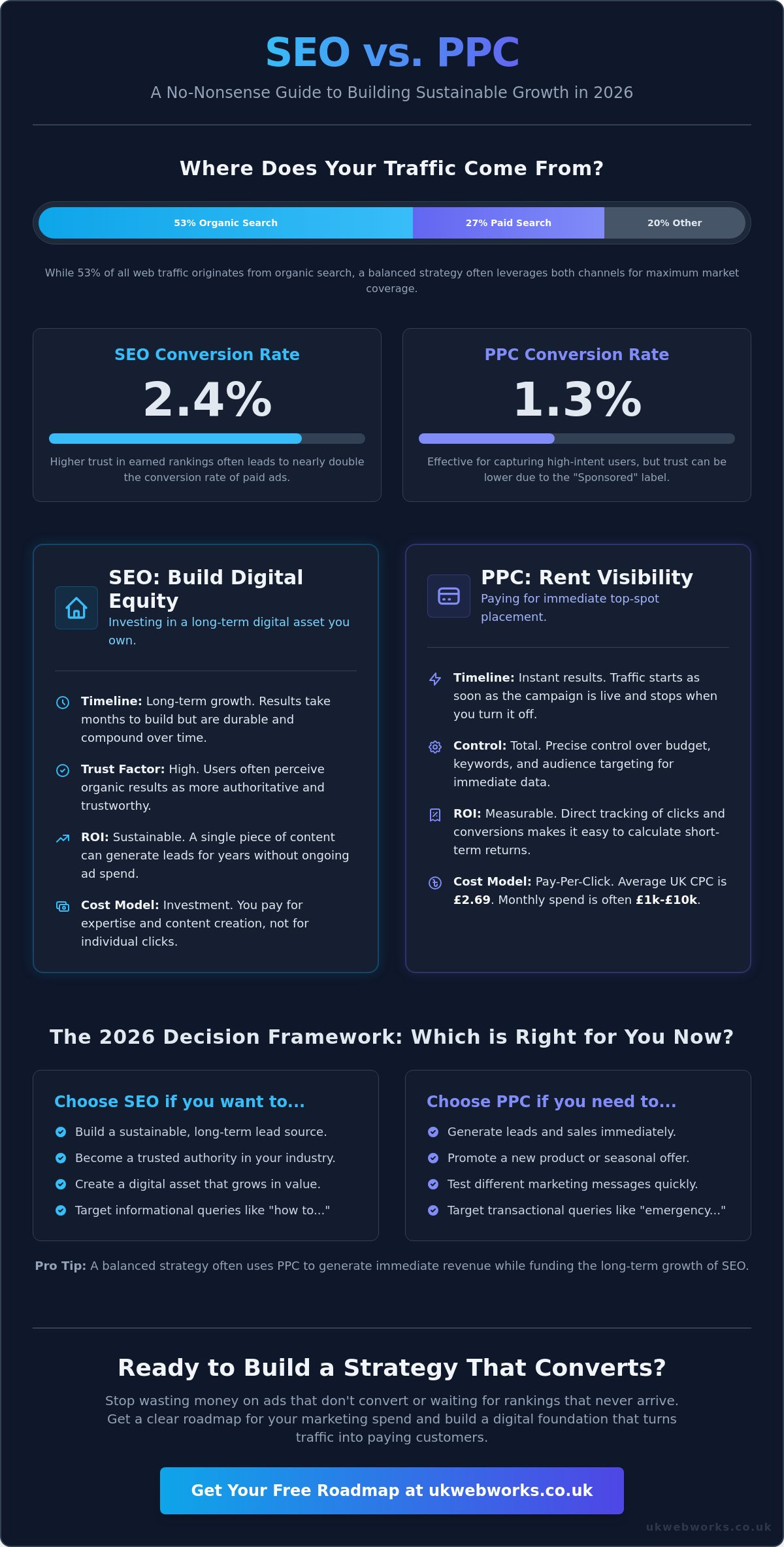
The core difference is simple: SEO is about building long-term authority, while PPC is about buying immediate speed. Many business owners believe they must pick only one to be successful, but that is a common misconception. In fact, 53% of all web traffic comes from organic search, while 27% is driven by paid search. Ignoring one often means leaving a significant portion of the market to your competitors. A balanced strategy uses the quick wins of paid ads to fund the long-term growth of organic rankings.
What is Search Engine Optimisation (SEO)?
We often describe SEO as building a house on land you actually own. It relies on three main pillars: technical health, content quality, and backlink authority. Following the Google Core Update in March 2026, the search engine has become even stricter about favoring authoritative, brand-owned domains over low-quality aggregators. This means your website needs to prove it is a reliable source of information. While it takes time to see progress, the results are durable. Savvy UK searchers often trust organic results more because they know these positions are earned rather than bought. Once you rank well, you don’t pay for every individual click, making it a highly cost-effective asset for your business.
What is Pay-Per-Click (PPC) Advertising?
If SEO is building a house, PPC is like renting a high-street shopfront for immediate footfall. You use platforms like Google Ads to bid on specific keywords that your customers are typing in. With an average cost per click in the UK sitting at £2.69 in 2026, you only pay when someone actually clicks your link. This provides instant visibility, which is perfect for new product launches or seasonal promotions. It gives you total control over your budget and allows you to see data on what works within hours. However, the moment you stop paying the “rent,” your visibility disappears. It is a powerful tool for generating leads today while you wait for your long-term organic foundation to settle.
Building Equity vs. Buying Visibility: How SEO and PPC Work in 2026
Search has changed drastically in 2026. With Google’s AI-generated overviews now appearing at the top of most results pages, the “zero-click” search is no longer a theory; it’s a reality for millions of users. This shift means your seo vs ppc strategy must be more precise than ever. If you’re just chasing simple answers, AI will likely steal that traffic. You need to target queries that require deep expertise or high-intent actions. This is where the expertise of a professional organic seo agency becomes vital. They help you navigate algorithm shifts by focusing on brand-owned authority that AI cannot easily replicate.
Think of PPC as an on-off switch. The moment you stop your budget, your traffic dies. SEO, by contrast, acts like compounding interest. While it takes longer to gain momentum, the work you do today builds a foundation that pays dividends for years. As noted in Google’s guide to SEO vs. PPC, both channels serve different parts of the customer journey. Understanding “Search Intent” is the secret to winning. A user looking for “how to fix a tap” (informational) is a great target for SEO. A user searching for “emergency plumber in Leeds” (transactional) is someone you should bid on with PPC to ensure you’re seen immediately.
The Long-Term Value of Organic Traffic
High-quality organic content doesn’t expire. A well-written guide published in 2024 can still generate leads in 2026 without any additional ad spend. There’s also a significant psychological benefit; users often perceive organic results as more authoritative and trustworthy than “sponsored” labels. For complex services where the “Trust Factor” is high, organic traffic often sees a 2.4% conversion rate, which is nearly double the 1.3% average seen in paid search. If you want to grow sustainably, you need to build this digital equity. If you’re unsure where to start, we can help you build a solid foundation for your search presence.
The Immediate Impact of Paid Search
PPC remains the fastest way to jump the queue. If you have a seasonal promotion or a new product launch, you can’t wait six months for SEO to kick in. Paid search allows you to target specific demographics, postcodes, and even times of day with surgical precision. It is an invaluable tool for testing. You can run a small ad campaign to see which headlines or offers resonate with your audience before committing to a full-scale organic content strategy. This speed allows you to generate cash flow today, providing the budget you need to invest in long-term organic growth.
Comparing Costs, Timelines, and ROI for UK Businesses
Let’s be honest about the numbers. A common myth we hear from business owners is that organic search is free. It isn’t. While you don’t pay Google for the click, you pay for the craftsmanship, technical expertise, and content quality required to rank. In 2026, the average UK small-to-medium business spends between £500 and £1,500 per month on SEO retainers. When weighing up seo vs ppc, you have to look at the different ways they consume your budget. PPC requires a direct ad spend, which for most UK firms ranges from £1,000 to £10,000 monthly. On top of that, agencies typically charge a management fee between 12% and 30% of that total spend.
The timeline for results is where these two strategies diverge most sharply. You can set up a PPC campaign and see traffic hitting your site within 24 hours. SEO is a much slower burn. It typically takes 6 to 12 months of consistent work to see a significant return on your investment. However, the cost per lead follows a very different path for each. With PPC, your cost per lead stays relatively flat; if you want more leads, you must pay for more clicks. With SEO, your initial costs are higher relative to the results, but as your authority grows, your cost per lead decreases over time. You’re building an asset that works for you even when you aren’t actively spending.
The Investment Curve: What to Expect
Think of the first 12 months as a transition. PPC provides the early wins you need to keep the lights on and prove your offers work. SEO provides the late-stage scaling that makes your business truly profitable. We define ROI simply: it is the total lifetime value of a customer minus what it cost you to acquire them. In competitive UK markets, relying solely on ads is becoming riskier. The average cost per click is now £2.69, but for legal services, it can hit £6.75. This “Ad Fatigue” and rising price pressure mean that businesses without an organic foundation often find their profit margins squeezed as the years go by. For businesses across the north of England, our guide to SEO Yorkshire explains how local companies can build organic visibility without being held hostage by rising ad costs.
Hidden Costs You Might Miss
Sending expensive traffic to a poor website is the fastest way to waste money. Whether it’s a slow-loading page or a confusing layout, a bad user experience ruins both SEO and PPC performance. You also need to account for ongoing maintenance. Digital assets aren’t “set and forget”; they require regular updates to stay secure and relevant. For local businesses, this includes professional google my business business management. Keeping your local profile accurate and active is a cost-effective way to boost visibility without the high price tag of national search terms. We focus on these practical details to ensure every pound you spend actually moves the needle.
The Decision Framework: Choosing Your Growth Path
Deciding between seo vs ppc isn’t a coin flip. It’s a strategic choice based on your current cash flow and long-term goals. If you need sales by Friday to pay the bills, SEO won’t help you. If you’re tired of being held hostage by Google’s rising ad prices, PPC isn’t the final answer. Most successful UK businesses eventually land on a hybrid Search Engine Marketing (SEM) model. This allows you to harvest immediate leads while planting seeds for the future. The right choice depends on your financial “breathing room” and how quickly you need to see a return.
When PPC is the Right Priority
Paid search is your best tool when speed is the only metric that matters. It’s particularly effective for the launch of a new bespoke ecommerce shop or a time-sensitive promotion. You can’t wait months for organic rankings when you have stock sitting in a warehouse. It also works well when you have a high-margin product that can comfortably absorb an average UK CPC of £2.69. Finally, PPC is the only way to directly compete with massive brands on high-intent keywords where they have held the top organic spots for years. It allows you to “jump the queue” and get your offer in front of customers today—a strategy that helps shoppers discover World of Cosmetics and other UK retailers precisely when they are ready to buy.
When SEO Should Take the Lead
The gold standard is a gradual transition. You start with a heavy PPC budget to find out which keywords actually convert into money. Once you have that data, you build bespoke content around those winning terms. As your organic rankings climb, you can slowly dial back your ad spend on those specific keywords and move that budget into testing new areas. This prevents you from ever being entirely dependent on a single channel or a single algorithm update. If you’re ready to stop guessing and start growing, let’s discuss a search strategy that fits your business.
Beyond the Jargon: Crafting a Search Strategy That Actually Converts
Your search strategy is only as strong as the website it leads to. In the ongoing debate of seo vs ppc, the winner doesn’t matter if your site acts like a leaky bucket. We’ve seen businesses waste thousands of pounds sending high-quality visitors to pages that take five seconds to load or look broken on a mobile phone. A high-performing bespoke website development foundation is the only way to ensure your marketing investment actually turns into revenue. Traffic is just a number; conversions are what pay the bills.
The “Trust Factor” is the invisible bridge between a click and a lead. When a UK customer lands on your site, they make a judgment about your business in less than a second. Professional branding and a clear user experience (UX) signal that you are a reliable partner. We focus on jargon-free reporting so you always understand how these elements are performing. You shouldn’t need a technical manual to see your ROI. Our approach is to start with your end goal, such as a specific number of monthly enquiries, and work backwards to choose the right channel for the job.
The Role of Bespoke Design in Search Success
Site speed and mobile responsiveness are no longer optional. They are core components of Google’s ranking systems and directly impact your PPC Quality Scores. A higher Quality Score means you pay less for every click, which stretches your ad budget significantly further. Many “off-the-shelf” templates are bloated with unnecessary code that slows down your site and frustrates users. Custom builds allow us to strip away the fluff and focus on a clean, fast experience. This ensures that whether a visitor arrives via a blog post or a paid ad, their journey toward contacting you is smooth and natural.
Next Steps: Your Growth Consultation
Before you commit a single penny to an ad budget or a long-term SEO contract, you need to know where you stand. A technical audit is the first step in identifying the bottlenecks that are currently costing you money. We help UK businesses find the “sweet spot” between paid and organic growth, ensuring you aren’t overspending on one at the expense of the other. We don’t believe in high-pressure sales tactics or confusing technical talk. If you want honest, straightforward advice on how to grow your brand in 2026, let’s have a conversation about your digital strategy.
Take Control of Your Digital Growth Today
Navigating the choice between seo vs ppc doesn’t have to be a gamble for your business. You’ve seen how paid ads provide the speed required for immediate testing, while organic search builds the long-term equity that protects your margins. In 2026, the most successful brands are those that combine these tools on a solid, bespoke website foundation. Since 2014, our UK-based team of specialists has focused on helping business owners grow through clear, honest advice.
We offer transparent, fixed-price project options so you never have to guess where your marketing budget is going. Our goal is to replace complex technical talk with a straightforward plan that prioritises your actual lead generation. We’re ready to roll up our sleeves and help you build a search presence that lasts. Get a jargon-free digital strategy review from UK Web Works today. You’ve got this, and we’re here to help you make it happen.
Frequently Asked Questions
Is SEO better than PPC for small businesses?
Neither is better in a vacuum; the right choice depends on your timeline and cash flow. SEO builds a permanent asset with an average conversion rate of 2.4%, while PPC provides the instant footfall needed for immediate sales. If you have the financial breathing room, starting both simultaneously is the most reliable way to grow a sustainable brand.
How long does it take for SEO to start working compared to PPC?
PPC can deliver traffic to your website within 24 hours of launching a campaign. SEO is a slower process that usually requires 6 to 12 months of consistent work before you see a significant return on your investment. We recommend using the immediate data from your paid ads to inform your long-term organic content strategy while you wait for your rankings to settle.
Can I do SEO and PPC at the same time?
Running both together is the gold standard for a modern search strategy. It ensures your brand appears in both the sponsored and organic sections, capturing a larger share of the traffic. This hybrid approach allows you to dominate the results page for your most profitable keywords while using paid data to find new organic opportunities.
Does running PPC ads help my organic SEO rankings?
Running ads does not directly boost your organic rankings. Google keeps these two systems strictly separate to maintain the integrity of their search results. However, the insights you gain from your paid campaigns regarding high-converting headlines can help you write better titles for your organic pages, which may improve your click-through rates over time.
Why is my PPC campaign so expensive with no results?
High costs without results often stem from a poor website foundation or targeting keywords that are too broad. If your site is slow or confusing, you’re paying an average UK cost per click of £2.69 just for people to leave immediately. A technical audit usually identifies these leaks in your user journey before they drain your entire marketing budget.
How much should I spend on SEO vs PPC in 2026?
In 2026, most small-to-medium UK businesses allocate between £500 and £1,500 monthly for a professional SEO retainer. For paid ads, the average spend ranges from £1,000 to £10,000 per month plus management fees. Your specific split should reflect whether you need leads today or a sustainable foundation for the coming years.
What is the difference between organic and paid search?
Organic search involves earning a spot through authority and relevance, while paid search involves winning an auction for a specific keyword. When comparing seo vs ppc, remember that organic search drives 53% of all web traffic. Paid search accounts for 27% of traffic but allows you to bypass the competition instantly for a fee.
Do I need an agency to manage my SEO and PPC?
You can manage these yourself, but professional oversight often pays for itself by reducing wasted spend on clicks that don’t convert. Most UK agencies charge between 12% and 30% of your monthly ad spend as a management fee. This ensures your campaigns are technically sound and stay ahead of continuous algorithm updates like the one seen in March 2026.