
The most expensive website you’ll ever buy isn’t the one with the highest quote; it’s the one that has to be rebuilt because the first version didn’t actually solve your business problems. We know the fear of a project drifting off course. It often starts with a few “small” changes and ends with a budget that’s doubled and a launch date that’s months behind schedule. If you’ve ever felt overwhelmed by technical jargon or disappointed by a site that looks good but doesn’t convert, you aren’t alone.
By implementing a formal website project discovery phase, you can strip away the confusion and replace it with a clear, fixed-price roadmap you can actually trust. We’re going to show you how this structured approach eliminates scope creep and ensures your project stays aligned with your specific business goals from day one. We’ll explore the essential steps of a modern discovery process and explain why this blueprint is the secret to a successful, stress-free build in 2026.
Key Takeaways
- Learn how to bridge the gap between your business vision and the final technical build so nothing gets lost in translation.
- Discover how a structured website project discovery phase protects your budget by identifying hidden technical requirements before coding begins.
- Identify the core research steps, including stakeholder interviews and user data, that align your new site with your actual business goals.
- Find out exactly which data points and competitor insights you should gather to prepare for a productive first session.
- Understand why a jargon-free approach focused on your local market helps ensure your website delivers a genuine return on investment.
What is a Website Project Discovery Phase?
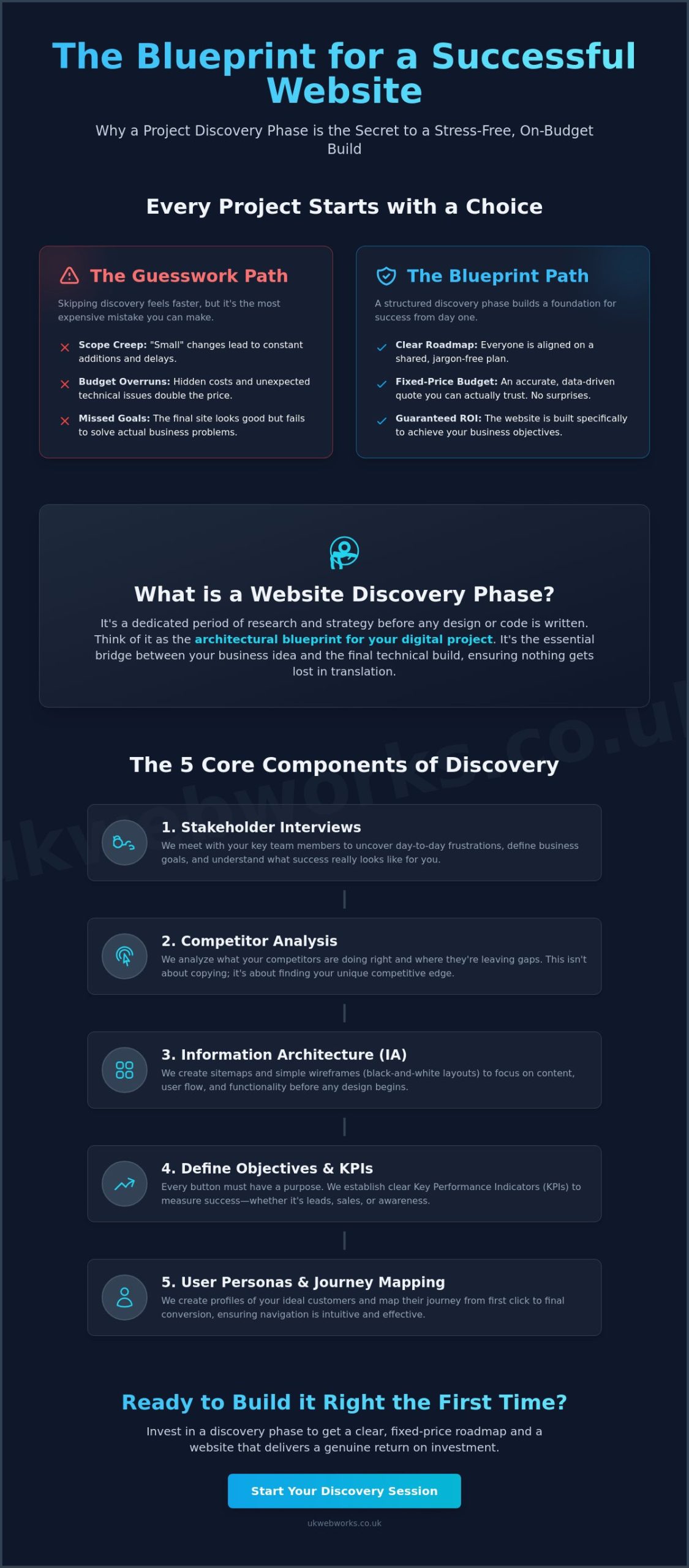
A website project discovery phase is a dedicated period of research and strategy that happens before a single line of code is written. Think of it as the architectural blueprint for your digital home. You wouldn’t ask a builder to start pouring concrete before you’ve decided how many rooms you need or how the plumbing should flow. Similarly, this phase acts as the essential bridge between your initial business idea and the final technical specification.
During this time, we work together to align everyone involved in the project. We define exactly who your users are, what they need to achieve, and how the sitemap should be structured to guide them there. This process is often referred to in the industry as a requirements analysis. By identifying potential technical roadblocks early, we prevent them from becoming expensive problems halfway through the build.
Stripping Away the Technical Jargon
We’ve seen many business owners get lost in a sea of “tech-speak” like back-end integrations or server-side rendering. That’s why we deliberately avoid jargon. We believe you should understand every part of your plan without needing a degree in computer science. Our focus stays on your business outcomes. Instead of debating technical features for the sake of it, we discuss how a specific function will save you time or help you close more sales. This ensures we’re all speaking the same language from the very first meeting.
The Difference Between a Quote and a Discovery
It’s tempting to want a price immediately. However, a “quick quote” given over the phone is often a red flag. Without a deep dive into your requirements, any figure is just a guess. These guesses usually lead to hidden costs and “scope creep” later on. A thorough website project discovery phase provides the hard data needed for an accurate, fixed-price project. It moves the conversation from guesswork to a data-driven roadmap. When we finish discovery, you aren’t left with a vague estimate; you have a clear plan that outlines exactly what will be built, how much it will cost, and how it will deliver results for your business.
The Core Components of a Successful Discovery Phase
A successful website project discovery phase is built on a foundation of evidence rather than assumptions. We don’t just ask what you want the site to look like; we ask what you need it to achieve. This starts with stakeholder interviews. We sit down with your key team members to uncover the day-to-day frustrations they face with your current site. We want to know about the missed enquiries, the hard-to-update pages, and the specific goals they have for the new one. It’s about finding out what success looks like for your business specifically.
We also look outward. A thorough competitor analysis helps us understand what other businesses in Hull and East Yorkshire are doing. We identify where they are succeeding and where they are leaving gaps that you can fill. This isn’t about copying. It’s about finding your competitive edge. Once we have this context, we move into the technical heart of the website project discovery phase: Information Architecture (IA). This involves creating sitemaps and initial wireframe concepts. These are simple, black-and-white layouts. They focus on content placement and functionality before we even think about colours or fonts. It’s a practical way to ensure the site’s skeleton is strong.
Defining Your Business Objectives
Every button and page on your site should have a purpose. Is the primary job to generate new leads, drive online sales, or simply build brand awareness? We help you set clear Key Performance Indicators (KPIs) to measure this success after the launch. This ensures your website strategy stays perfectly aligned with your wider digital marketing agency Hull goals. If you don’t know what you’re measuring, you won’t know if your investment is actually working. We focus on the numbers that matter to your bottom line.
User Personas and Journey Mapping
We create realistic user personas to represent your ideal customers. We look at their motivations and the specific problems they’re trying to solve. From there, we map the user journey. This is the path a visitor takes from their first click on a search result to their final enquiry. By mapping this out, we ensure the navigation is intuitive for everyone. If you’re ready to start planning your next build, you can reach out to our team to discuss your project. We’re here to help you build something that works.
Why Skipping Discovery is a Costly Mistake
Skipping the planning stage is like starting a car journey across the country without a map or a fuel gauge. You might feel like you’re making progress because the wheels are turning, but you’re likely headed for a dead end. In our experience, bypassing a formal website project discovery phase is the single biggest reason projects fail to meet their commercial objectives. It’s not just about a few delays; it’s about the financial risk of building something that doesn’t actually work for your business.
One of the most common issues is “scope creep.” Without a defined plan, “just one more button” or a “simple layout change” can quickly snowball. These small requests add up to dozens of extra hours. In 2026, with senior development rates often ranging between $100 and $400 per hour, these unplanned changes can decimate your budget. You also risk accumulating “technical debt.” This is the cost of fixing features that were built in a hurry without proper planning. It’s always more expensive to unpick a mistake after the site is live than it is to build it correctly the first time. Without clarity, you’ll face:
- Missed deadlines: Projects stall when developers have to stop and ask for clarification on basic functions.
- Budget overruns: Unexpected technical hurdles usually mean unexpected invoices.
- Poor conversion: You might end up with a beautiful site that fails to reach your target audience because the user path wasn’t tested.
Protecting Your Digital Investment
Think of discovery as an insurance policy for your business. It ensures that every penny you spend has a documented purpose. During this stage, we also look at the long-term health of your site. Research shows that the total cost of ownership for a professional website can double over a three-year period when you account for hosting, security, and iterative updates. That’s why planning your website maintenance package during the discovery phase is vital. It prevents you from being caught off guard by the ongoing costs of keeping a professional site running smoothly.
Addressing the “I already know what I want” Objection
We often hear clients say they don’t need discovery because they’ve already visualized the site. While your vision is the starting point, what you want might not be what your users actually need. A professional website project discovery phase provides an external perspective. It uses data to verify your ideas. We take your vision and translate it into a technically viable reality that converts visitors into customers. It’s the difference between a vanity project and a business tool that pays for itself.
How to Prepare for Your Discovery Session
Preparation is the key to getting the most value out of your website project discovery phase. You don’t need to be a technical expert to prepare. In fact, we prefer it if you focus on what you know best: your business. Before our first meeting, take some time to gather any existing data you have. If you use Google Analytics, look at your most visited pages. If you don’t have analytics, talk to your front-line staff. They’ll know exactly which questions customers ask most frequently and which parts of your current site are causing the most frustration.
We also suggest identifying your top three competitors. Take a look at their websites. Write down what you admire about them and, more importantly, what you dislike. This gives us a clear benchmark for the standards in your industry. Finally, start thinking about your features. Create two lists: “must-haves” and “nice-to-haves.” A “must-have” might be a specific booking system or a Shopify integration. A “nice-to-have” could be an interactive map or an advanced blog filter. Separating these early helps us manage your budget effectively without sacrificing the core functionality of your new site.
Gathering Your Internal Team
Don’t make the mistake of only involving your IT department. For a successful kick-off, we need the voices of the people who actually use the site to drive growth. This usually includes representatives from sales, marketing, and customer service. Sales teams understand the common objections that a website needs to overcome. Customer service teams know which information is missing from your current site. To keep the project on track, we recommend appointing a single point of contact. This person will be responsible for making final decisions and keeping the communication lines open between your business and our team.
Preparing Your Brand Assets
Your website is the digital face of your company. It needs to look the part. We’ll need to review your current logo and any existing guidelines from your brand identity agency. If your brand guidelines are outdated or non-existent, it’s better to address that now rather than halfway through the design process. We’ll also need high-quality imagery. If you don’t have professional photos of your team, products, or your Hull-based premises, now is the time to plan a shoot. Authentic photos build much more trust than generic stock imagery. If you’re ready to get started, you can book your discovery session with us today.
The UK Web Works Approach to Discovery
Our method at UK Web Works is built on transparency. We don’t hide behind complex terminology or vague promises. Instead, we’ve made a jargon-free commitment to every client. When we make a recommendation during your website project discovery phase, we explain the “why” behind it in plain English. We want you to feel confident that every decision is backed by logic and business value. You shouldn’t need a technical background to understand how your own website functions.
This approach is particularly effective for our work in web design Hull. Because we focus on the regional Yorkshire market, we understand the specific challenges local businesses face. Our discovery process leads directly to a fixed-price, no-surprises quote. You’ll know exactly what you’re paying for before the design work begins. We don’t see ourselves as just developers; we act as your strategic partners throughout the entire build. We are here to help you make informed decisions that benefit your bottom line.
Local Expertise for Hull and Yorkshire Businesses
We believe there’s a massive advantage to working with a team that knows your area. We understand the local competitive landscape in East Yorkshire and how to make your brand stand out. There’s also the simple benefit of working with a team you can meet face-to-face in Hull or York. We’ve built a strong track record of helping local brands grow through smart discovery and practical digital solutions. We value the long-term relationships we build with our neighbours and take pride in seeing local businesses thrive online.
Your Next Steps to a Better Website
Starting your project shouldn’t feel intimidating. Your first step is a “no-nonsense” consultation with our team. We’ll discuss your goals, your frustrations, and your vision for the future. Once the website project discovery phase is complete, the transition into the design and build phases is seamless. You’ll have a clear roadmap and a technical specification that serves as our guide. We take the guesswork out of web development so you can focus on running your business. Book your discovery session with UK Web Works today and let’s build something that actually delivers results.
Build Your Digital Future on Solid Ground
A website shouldn’t be a gamble. By committing to a structured website project discovery phase, you move away from vague estimates and toward a data-driven roadmap that protects your budget. You’ve seen how this process identifies technical hurdles early, aligns your team, and ensures every feature serves a commercial purpose. It’s about building a tool that works as hard as you do.
Since 2014, we’ve focused on delivering integrity and clarity to businesses across Hull and East Yorkshire. We specialize in bespoke design that prioritizes your goals over technical trends. Our thorough discovery process allows us to provide fixed-price project fees you can trust, with no hidden surprises halfway through the build. We’re here to be the reliable partner your business deserves.
Ready to turn your vision into a high-performing reality? Book Your Jargon-Free Website Consultation today. Let’s start planning a website that truly delivers for your brand.
Common Questions About Website Discovery
How long does a typical website discovery phase take?
A standard discovery process usually takes between two and four weeks. The exact timeframe depends on the size of your organization and the complexity of your requirements. For a straightforward business site, we can often complete the research in a week. Larger e-commerce projects require more time for user journey mapping and technical planning to ensure every detail is covered before the build begins.
Is the discovery phase a separate cost from the website build?
Yes, we treat discovery as a standalone service. This approach gives you the flexibility to plan your project without committing to a full development contract upfront. By separating these costs, you receive a detailed roadmap and a fixed-price quote for the build. It ensures that you only pay for the design and development work once the full scope is clearly defined and agreed upon.
What is the final output of the discovery phase?
The final result is a comprehensive project blueprint. You will receive a documented sitemap, user journey maps, and initial wireframe concepts that outline the site’s layout. We also provide a technical specification that describes how every feature will work. This document serves as the master plan for the build, ensuring there is no confusion between your team and our developers during the project.
Do I really need discovery for a small brochure website?
Even a simple site benefits from a website project discovery phase. Without this planning, you might end up with a site that looks professional but fails to speak to your ideal customers. Discovery helps us identify your most profitable services and ensures the navigation guides visitors toward an enquiry. It’s a small investment that prevents you from wasting money on a site that doesn’t convert.
Can I use the discovery findings with a different agency if I choose?
You absolutely can. Because you pay for the discovery phase as a separate project, you own all the research, wireframes, and specifications we produce. While we aim to build long-term relationships with our clients, you are free to take our blueprint to any other agency. We make sure our documentation is clear and professional so that any competent development team can follow it easily.
Who from my company needs to be involved in discovery?
We recommend involving a small group of people who understand your business goals and your customers. This usually includes the business owner or a marketing lead, plus someone from sales or customer service. You don’t need a large committee. A focused team of two or three people is usually best for making quick decisions and providing the practical insights we need to build a successful site.
What happens if we find out the project is too expensive during discovery?
This is one of the main reasons we conduct a website project discovery phase. If the initial plan exceeds your budget, we help you prioritize. We can identify which features are essential for launch and which can be added in a second phase. This allows you to manage your cash flow effectively while still building a high-quality website that meets your most urgent business needs.
How does discovery help with my SEO strategy?
We use the discovery phase to build your SEO strategy into the site’s architecture. Instead of trying to add keywords later, we research what your local customers in Hull and Yorkshire are actually searching for. We then use this data to plan your sitemap and page hierarchy. This ensures your website is technically optimized and relevant to your target audience from the moment it goes live.