
Why are you paying for a premium SEO strategy, a separate social media plan, and a monthly PPC budget if these channels aren’t actually talking to each other? With global digital ad spend projected to exceed $1.02 trillion in 2026, it’s easy to feel like you’re throwing money into a black hole of disconnected tactics. We know how frustrating it is to deal with inconsistent messaging and confusing data from different platforms. It’s often overwhelming to manage so many channels while your ROI stays flat.
This is where a truly integrated digital marketing strategy makes the difference. We believe that integration isn’t about being everywhere; it’s about making every platform you use work toward the same goal. In this guide, you’ll learn how to join up your digital efforts to stop wasting budget and start seeing the consistent growth your hard work deserves. We’re providing a clear roadmap for digital efficiency, helping you build a consistent brand voice and a better ROI through a practical, no-nonsense approach.
Key Takeaways
- Learn how to avoid the “multi-channel trap” where being on every platform without a joined-up plan leads to significant budget leakage.
- Understand why your website must serve as the central hub for all digital activity to ensure a consistent experience for every visitor.
- Discover how an integrated digital marketing strategy builds the trust needed for conversions by making every brand touchpoint count.
- Get a practical 5-step roadmap for defining your “North Star” goal and mapping a local customer journey that leads to consistent growth.
- Find out why a jargon-free partnership with a local expert can simplify your digital efforts and deliver better ROI through improved efficiency.
What is an Integrated Digital Marketing Strategy?
An integrated digital marketing strategy is a unified plan where every channel you use, from your website to your social media, works together to deliver a single, clear message. It is the opposite of a fragmented approach where different departments or agencies work in silos. Instead of hoping for the best, you ensure your SEO, PPC, and email marketing are all pulling in the same direction. This concept is closely tied to the broader academic principle of Integrated Marketing Communications (IMC), which emphasizes the need for consistency across all promotional tools.
Many businesses fall into the “multi-channel” trap. They think that being present on TikTok, LinkedIn, and Google Search is enough. However, being everywhere without a plan often leads to budget leakage. If your Facebook ads promise one thing and your website delivers another, you’re paying for clicks that won’t convert. In 2026, user attention is more fragmented than ever. With the rise of AI-powered search overviews and “zero-click” results, your brand needs to be recognizable and reliable across every touchpoint to win a customer’s trust.
The Difference Between Multi-Channel and Integrated
Multi-channel is about presence; integration is about performance. You can have a presence on ten platforms and still fail if they don’t connect. Imagine seeing a sleek, professional ad on Instagram that promises a high-end service. You click through, but you land on a slow, dated website that isn’t mobile-responsive. The disconnect is immediate. You lose trust, and the business loses a lead. An integrated approach ensures your brand identity remains consistent from that first social post all the way to your checkout page.
Why “Joined-Up” Thinking Saves Money
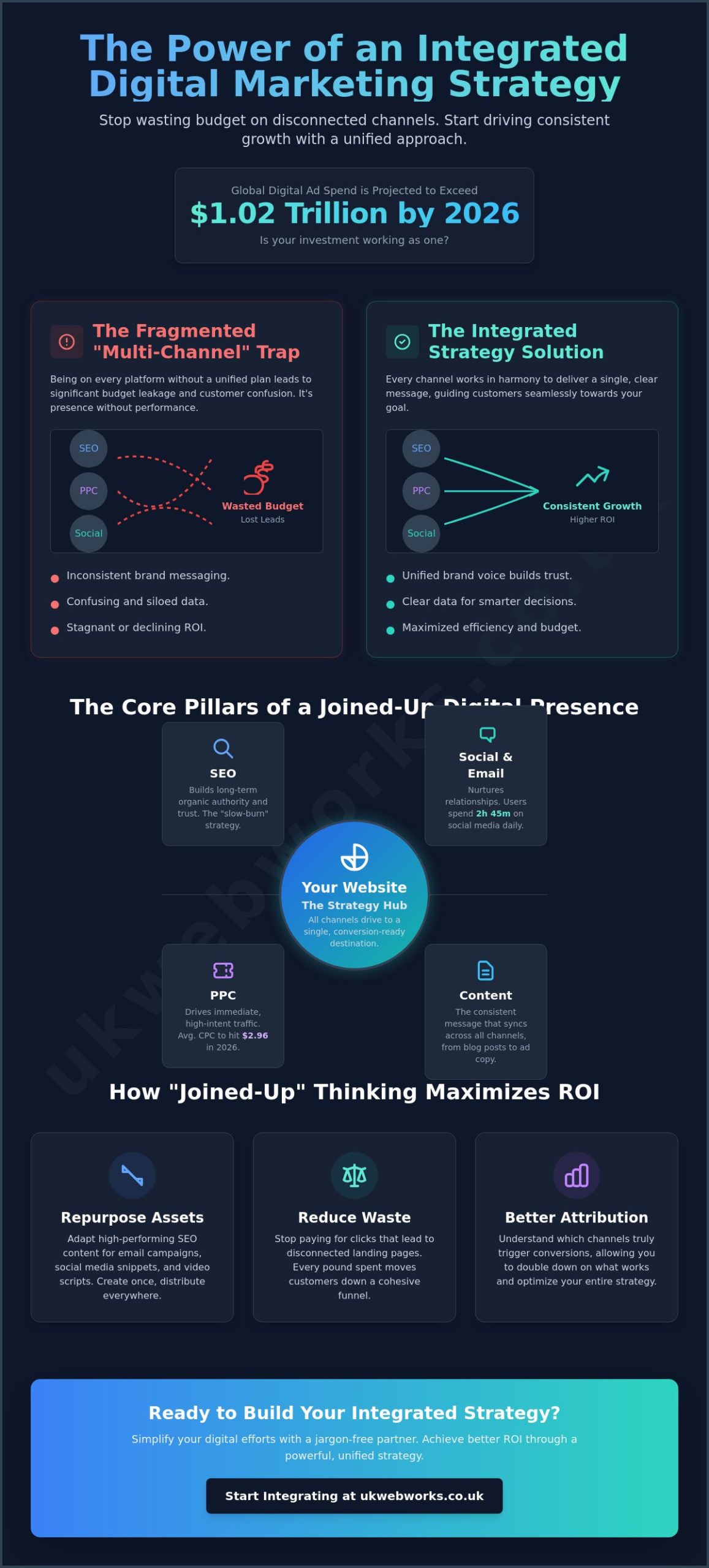
Efficiency is the biggest win here. When your strategy is joined up, you stop wasting money on redundant creative work. You can use your data to make smarter decisions rather than guessing. This approach saves money in several ways:
- Repurposing assets: High-performing SEO content can be adapted for email campaigns or social media snippets.
- Reduced waste: You stop paying for clicks that lead to disconnected or irrelevant landing pages.
- Better attribution: You understand which channel actually triggered the final sale, allowing you to invest where it matters.
An integrated digital marketing strategy is the connective tissue of your business growth.
The Core Pillars of a Joined-Up Digital Presence
To make an integrated digital marketing strategy work, you need a solid foundation. Many businesses treat their website as just another checkbox, but it’s actually the central hub where all your traffic should lead. A strategic approach to integrating communications starts with ensuring your “owned” media, like your site, is ready to handle the visitors your “paid” and “earned” media bring in. If your hub is broken, the rest of your marketing spend is wasted.
SEO builds long-term organic authority and trust. It’s the slow-burn strategy that ensures you’re found when people search for solutions. PPC, on the other hand, drives immediate, high-intent traffic to specific landing pages. With the average Google Search CPC rising to $2.96 in 2026, you can’t afford to send paid traffic to a page that doesn’t convert. By using PPC to test which headlines work, you can apply those lessons to your organic SEO strategy to improve performance across the board.
Social media and email marketing nurture the relationships you’ve built. Since the average user spends 2 hours and 45 minutes on social platforms every day, staying top-of-mind is essential. These channels keep your brand relevant between purchases. They shouldn’t just be about broadcasting; they should be about starting conversations that lead people back to your website.
Your Website as the Strategy Hub
Successful growth begins with bespoke website design. A generic template won’t cut it when you need to guide a visitor from a specific LinkedIn ad to a tailored checkout page. Your site must be conversion-ready before you spend a penny on advertising. Once it’s live, website maintenance plans ensure your hub stays fast and secure, preventing potential customers from bouncing due to technical errors.
Syncing Content Across Channels
Your content shouldn’t live in a vacuum. A professional SEO agency in Hull will use data from your PPC campaigns to identify which keywords actually lead to sales, not just clicks. This data then shapes your social media topics and blog posts. Throughout this process, a consistent brand identity agency ensures your visual style and voice look identical whether a user sees a Google Ad or a LinkedIn post. This level of detail is what makes an integrated digital marketing strategy so effective.
If you’re ready to stop guessing and start joining up your digital efforts, let’s have a chat about your project.
Why Integration Outperforms Fragmented Marketing
Fragmentation is the silent killer of marketing budgets. Most businesses operate in silos where the person managing social media rarely speaks to the person running Google Ads. This lack of communication creates a “trust gap” that drives potential customers away. When your messaging is inconsistent, you’re essentially starting from scratch with every new interaction. An integrated digital marketing strategy solves this by ensuring your brand speaks with one voice, regardless of where a customer finds you.
Trust isn’t built overnight. Research consistently shows that users need 7-10 “touches” with a brand before they feel comfortable making a purchase. In a fragmented setup, those touches are often disjointed and confusing. Integration makes those touches count. By aligning your message across every platform, you reinforce your value proposition every time a user sees your name. This consistency transforms casual browsers into confident buyers.
Efficiency is another major advantage. Instead of having different departments competing for individual channel “wins,” your entire team works toward a single North Star goal. This collaborative mindset is a core pillar of successful integrated digital marketing efforts. It allows you to see the full “Customer Decision Journey” rather than relying on misleading last-click metrics. You begin to understand how a blog post might assist a later PPC conversion, giving you the data clarity needed to invest your budget where it actually moves the needle.
For small businesses in Yorkshire, this approach provides a genuine competitive edge. Many local firms are still stuck in a fragmented way of working, treating digital marketing as a series of separate chores. Adopting a joined-up strategy is your “unfair advantage” in the local market. It makes your business appear more professional, more established, and more reliable than competitors who are just shouting into the void.
The “Halo Effect” of Joined-Up Marketing
Integration creates a psychological “halo effect.” When a local customer sees your high-ranking SEO position, they naturally view your brand as a legitimate leader in your field. If that authority is then backed up by strong social proof on Instagram and a professional LinkedIn presence, your PPC click-through rates will naturally rise. People are more likely to click on an ad from a brand they already recognize and trust. This synergy ensures that the sum of your marketing efforts is always greater than its parts.
Improving Your Return on Investment (ROI)
A joined-up approach is the fastest way to lower your Customer Acquisition Cost (CAC). By looking at the whole journey, you can quickly identify “dead weight” channels that aren’t contributing to your ultimate goal. You stop wasting money on tactics that don’t talk to each other and start focusing on the pathways that actually lead to sales. ROI is a byproduct of strategy, not just luck.
5 Steps to Building Your 2026 Integrated Strategy
Building an integrated digital marketing strategy doesn’t have to be a corporate headache. It’s about taking practical steps to ensure your time and money work harder. You don’t need a massive team or a global budget to see results; you just need a clear, methodical plan that aligns your digital presence with your business goals.
Step 1: Define your North Star goal. Are you looking for more service leads, direct e-commerce sales, or better brand awareness? Pick one primary objective. Trying to chase every metric at once usually leads to a diluted message and confused data.
Mapping the Local Journey
Step 2: Map the local customer journey. This is where you identify exactly how your specific audience moves from a search to a sale. Customers in Leeds or Doncaster often search differently than those in London. They might value local reliability and face-to-face accountability more than a generic global brand. You need to identify the pain points specific to your regional industry. If you’re a manufacturer in East Yorkshire, your content should speak to the logistical and technical needs of businesses in that area. Understanding these nuances allows you to create content that feels personal and relevant.
Step 3: Audit your current assets. Review your website, SEO rankings, social channels, and brand identity. Look for gaps where the messaging falls apart. If your LinkedIn profile is professional but your website is hard to use on a phone, you have a leak in your strategy.
Step 4: Align your messaging. Create one core offer and use one clear voice. Whether someone sees your PPC ad or reads an email, the value proposition should be unmistakable and identical.
Unified Reporting and Measurement
Step 5: Set up unified reporting. You must move beyond “vanity metrics” like likes and follows. These numbers look nice on a spreadsheet but don’t pay the bills. Setting up Google Analytics 4 (GA4) correctly is essential for tracking cross-channel conversions. It helps you see how a user might first find you through SEO and eventually convert via a direct search. A monthly report from a professional digital marketing agency in Hull should always focus on business growth and lead quality, not just clicks or impressions.
Ready to build a plan that actually delivers? Contact us today for a straightforward strategy review.
Partnering for Integrated Growth in Yorkshire
Success in digital marketing isn’t just about using the right tools; it’s about finding the right partner. When you work with a local agency that understands the Hull and East Yorkshire market, you gain a partner who knows your audience as well as you do. We believe that jargon-free communication is the only way to build a successful strategy partnership. You deserve to know exactly how your budget is being spent without having to navigate a sea of technical buzzwords. Our role is to act as a professional consultant, simplifying complex digital concepts so you can make informed decisions for your business.
At UK Web Works, we specialize in bringing every element of your digital presence together. We combine bespoke website design, technical SEO, and targeted PPC into one cohesive plan. This approach ensures that your integrated digital marketing strategy isn’t just a collection of ideas but a functional roadmap for growth. We don’t position ourselves as a distant corporate entity. We are a dedicated team of specialists who are genuinely invested in your long-term success. We value hard work and the craftsmanship-focused approach that regional businesses expect.
Why Proximity Matters in Digital Marketing
There is immense value in being able to meet your team in Hull or York to discuss strategy. Face-to-face conversations allow for a level of clarity and collaboration that emails simply can’t provide. Our local knowledge helps us identify the right geographic SEO and PPC keywords that matter to your specific location. We understand the unique challenges of growing a presence in the Yorkshire region, from the manufacturing hubs to the specialized engineering firms. This proximity helps us build a partnership based on integrity and direct, honest communication. You aren’t just another account number to us; you’re a local business we want to see thrive.
Ready to Join Up Your Digital Marketing?
It’s time to stop treating your website and your marketing as two separate worlds. They are two halves of the same whole. If they aren’t working together, you’re likely experiencing the budget leakage and inconsistent messaging we discussed earlier. Our bespoke approach ensures that your integrated digital marketing strategy fits your specific business objectives, whether that’s generating more local leads or expanding your e-commerce reach across the UK.
Every successful project starts with an initial digital audit. This helps us identify where your current efforts are falling short and where the biggest opportunities for growth lie. We take a practical, hands-on approach to simplify your digital presence and get your business moving in the right direction. Speak to our team about a no-nonsense integrated strategy today and let’s start building a digital presence that actually works for you.
Take Control of Your Digital Growth
Digital marketing shouldn’t feel like a series of expensive experiments. By treating your website as your central hub and ensuring your SEO, PPC, and social efforts speak with one voice, you eliminate the budget leakage that holds many Yorkshire businesses back. You’ve seen how consistency builds the trust needed for conversions and how unified data allows you to make decisions based on facts rather than feelings.
Adopting an integrated digital marketing strategy is about moving from a collection of scattered tactics to a high-performance system. Our Hull-based team of specialists focuses on delivering proven results for Yorkshire SMEs through jargon-free, direct communication. We don’t hide behind complex reports or technical filler; we provide the clear, actionable insights your business needs to thrive in a competitive landscape.
The first step toward a more efficient and profitable 2026 is understanding where you stand right now. We’re here to help you join up the dots, simplify your digital presence, and stop the feeling of being overwhelmed by too many channels. It’s time to start seeing the consistent growth your hard work deserves.
Get a No-Nonsense Digital Marketing Audit
Frequently Asked Questions
What is the first step in an integrated digital marketing strategy?
The first step is defining your primary business goal, often called your “North Star.” You need to decide whether you’re chasing leads, direct sales, or brand awareness before you spend a penny on ads or content. Without this clarity, your efforts will stay fragmented. Once your goal is set, you can audit your existing assets to see what’s working and where your messaging is currently falling apart.
How much does an integrated marketing strategy cost for a small business?
Costs depend entirely on your industry competition and the scale of your objectives. Instead of looking at a single price tag, it’s better to view it as an investment in efficiency that reduces wasted ad spend. Many small businesses find that joining up their efforts actually lowers their overall marketing costs over time. We recommend starting with a clear audit to identify where your current budget is being lost to disconnected tactics.
Do I need to be on every social media platform for an integrated strategy to work?
You don’t need to be everywhere. In fact, trying to manage every platform often leads to the “multi-channel trap” where your message becomes thin and inconsistent. It’s far better to master two or three channels where your specific audience actually spends their time. An integrated digital marketing strategy focuses on making the platforms you do use work together seamlessly rather than simply increasing your headcount on social media.
How long does it take to see results from an integrated digital approach?
You can often see immediate improvements in lead quality and ad performance within the first few weeks as messaging is aligned. However, the full benefits of long-term organic authority and brand trust usually take six to twelve months to mature. Strategy is a marathon, not a sprint. By joining up your efforts, you ensure that your short-term wins from PPC are supporting your long-term growth in search engines.
What is the difference between integrated marketing and omnichannel marketing?
Integrated marketing focuses on ensuring your brand message and voice are consistent across all digital channels. Omnichannel marketing is more about the technical side of the user experience, ensuring a customer can move from a mobile app to a desktop site without friction. While they overlap, integration is the “connective tissue” that makes sure your story makes sense to the customer, regardless of which device or platform they use to find you.
Can I implement an integrated strategy myself or do I need an agency?
You can certainly start the process yourself by aligning your social media posts with your website content. However, as your business grows, managing the technical links between SEO, PPC data, and web development becomes a complex task. Most Yorkshire SMEs find that partnering with a specialist team saves them time and prevents costly mistakes. It allows you to focus on running your business while experts handle the day-to-day integration of your digital channels.
How do I measure if my digital marketing is actually “integrated”?
You’ll know your marketing is integrated when your data stops being confusing and starts telling a single story. Look at your conversion paths in Google Analytics 4 to see if users are interacting with multiple channels before buying. If your social media traffic is assisting your search conversions, and your brand voice feels identical across all touchpoints, you’ve successfully implemented an integrated digital marketing strategy. Consistent ROI and lower acquisition costs are the ultimate proof.