
What if you could stop guessing which button colour or headline works and actually see what makes your customers click? It’s incredibly frustrating to invest your hard-earned budget into a beautiful new website only to find that your enquiries haven’t moved an inch. You likely already know that a/b testing for websites is the most honest way to respect your customers’ preferences. With roughly 77% of companies now using these tests to improve their results, it’s no longer just a luxury for the tech giants.
We believe you shouldn’t have to be a data scientist to grow your online presence. This guide will show you how to turn more of your existing visitors into loyal customers by making small, evidence-based changes. We’ll walk through a clear framework for refining your digital presence and show you how to start testing without a full redesign, even if you’re worried about your current traffic levels.
Key Takeaways
- Stop relying on guesswork and learn how to use real customer data to guide your website’s growth and design decisions.
- Discover the specific high-impact elements, such as call-to-action buttons, where a/b testing for websites can lead to immediate improvements in conversion rates.
- Master a logical 5-step process for identifying performance bottlenecks and creating simple hypotheses that lead to meaningful results.
- Learn the essential technical best practices to ensure your experiments don’t harm your SEO or search engine rankings.
- Understand how professional implementation ensures your data is accurate, allowing you to focus on growing your business instead of managing code.
What is A/B Testing for Websites and Why Does Your Business Need It?
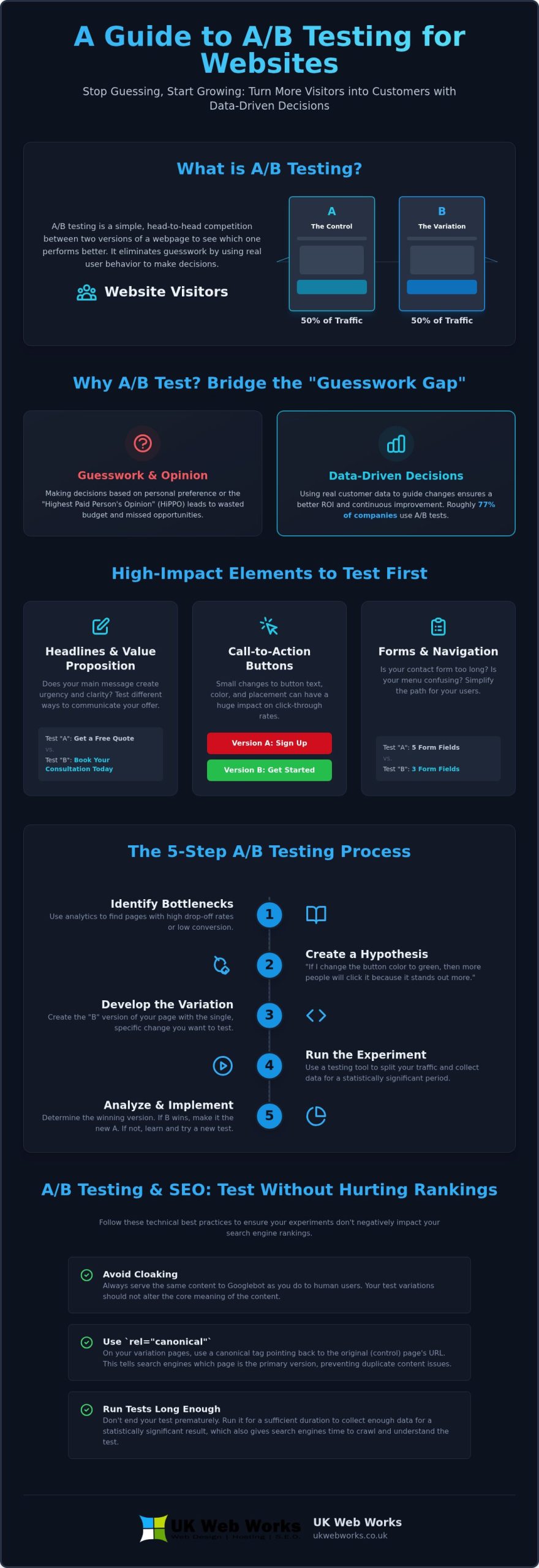
Think of A/B testing as a simple, head-to-head competition between two versions of the same webpage. One version is your current site; the other includes a single change, such as a different headline or a new button colour. You show both versions to real visitors and let their actions tell you which one is more effective. It’s a straightforward way to see what actually resonates with your audience without having to guess.
Many business owners fall into what we call the “Guesswork Gap.” This happens when you make design decisions based on what you think looks good rather than what your customers actually use. You might personally love a minimalist layout, but if your customers in Hull or York can’t find your phone number quickly, they’ll simply leave. A/B testing for websites bridges this gap by providing objective data that proves which version drives more enquiries.
A full website redesign is a significant investment and, frankly, a bit of a gamble. You’re changing everything at once and hoping the new version performs better than the old one. Iterative testing is different. It allows you to make small, controlled improvements over time. This approach is much more cost-effective because you’re refining your existing digital presence rather than throwing it all away and starting from scratch. You can see exactly which headline or call-to-action button is doing the heavy lifting.
The Difference Between “A” and “B”
To run a successful test, you need to understand three core components:
- The Control (A): This is your current, live website version. It serves as the baseline for the experiment.
- The Variation (B): This is the modified version of your page. It should ideally contain only one specific change so you can pinpoint what caused a shift in behaviour.
- The Split: This is the process where traffic is automatically divided. Half of your visitors see version A, while the other half see version B.
Why Guessing is Costing You Money
In many businesses, the “HiPPO” (Highest Paid Person’s Opinion) often dictates website changes. While experience is valuable, it isn’t always a perfect predictor of how a user will navigate a site. Relying on opinions rather than facts can lead to wasted budget and missed opportunities. By making data-driven decisions, you ensure a much better ROI on your digital marketing agency Hull spend. A/B testing is a practical method that removes ego from the design process and replaces it with evidence.
What Should You Test? High-Impact Elements That Drive Conversions
Starting your journey with a/b testing for websites doesn’t require a total overhaul of your digital strategy. We suggest focusing on the “low hanging fruit” first. These are the elements that take minutes to change but can significantly increase your conversion rates. Your Call to Action (CTA) buttons are the most obvious starting point. Does a green button work better than a red one? Does “Sign Up” get more clicks than “Get Started”? Small changes here often lead to the biggest wins.
Speak your customer’s language. If you’re targeting local Yorkshire clients, they often respond better to straight-talking headlines and authentic imagery. Testing whether a photo of your actual team in Hull performs better than a polished stock image is a great way to build trust. This data-driven approach is explored in A Refresher on A/B Testing, which highlights how evidence beats intuition every time. By testing your value proposition, you ensure you aren’t just using industry jargon that confuses your audience.
The “Big Three” Elements to Optimise First
There are three areas where a/b testing for websites typically yields the fastest results. First, look at your primary headlines. Try comparing “Get a Free Quote” against “Book Your Consultation Today” to see which creates more urgency. Second, examine your contact forms. If a five-field form scares people off, try reducing it to three fields and measure the increase in lead volume. Finally, look at your navigation menu. Simplifying the path to your most profitable services can prevent visitors from getting lost and leaving your site.
Ecommerce Specific Tests for Yorkshire Shops
For local Yorkshire-based online shops, small regional nuances matter. Testing a “Free Delivery” banner against a “10% Off First Order” offer can reveal what your local customers value most. As an ecommerce web design company, we frequently find that product page layouts are a goldmine for improvements. Try moving your “Add to Basket” button above the fold or testing different product image angles to see what drives more sales. If you want to see how these changes could work for your specific business, feel free to get in touch with us for a professional perspective.
The 5-Step A/B Testing Process: From Idea to Implementation
Moving from theory to action doesn’t have to be complicated. We use a logical, five-step cycle to ensure every change on your site is backed by evidence rather than guesswork. This methodical approach helps you avoid the common mistake of making changes for the sake of “freshening things up” without knowing if they actually help your bottom line.
The first step is to identify your bottleneck. We look at where people are leaving your site using tools like Google Analytics or heatmaps. Once you find a page with a high drop-off rate, you move to step two: forming a simple hypothesis. For example, you might say, “If I make the phone number bigger and bolder, more people will call us.” This gives your test a clear purpose.
Step three involves creating your variation. It is vital to keep this simple and focus on just one change at a time so you know exactly what caused the result. In step four, you run the test. For businesses with local traffic levels in Yorkshire, we typically recommend running a test for two to four weeks to gather enough data. Finally, step five is to analyse the results and implement the winner. The successful version becomes your new “Control,” and the process begins again with a new idea.
Setting Realistic Goals
Before you start a/b testing for websites, you need to define what a “win” looks like for your specific business. For most of our clients, this means more clicks on a contact button or a higher volume of completed enquiry forms. You don’t need a maths degree to understand statistical significance; it simply means having enough data to be confident that the result wasn’t just a fluke. If your site has lower traffic, we focus on “macro” changes, such as testing an entirely different offer, rather than tiny tweaks like changing a button shade.
Tools of the Trade
You have access to several powerful tools to manage this process. While Google Optimize was discontinued in 2023, modern alternatives like VWO or PostHog have stepped in to fill the gap. These platforms handle the heavy lifting of splitting your traffic and tracking the results. Because the technical setup can be daunting, our website maintenance packages often include the management of these tools as standard. This ensures your tests are configured correctly from day one, allowing you to focus on the insights rather than the code.
A/B Testing and SEO: How to Test Without Hurting Your Rankings
One of the most common concerns we hear from business owners is whether running multiple versions of a page will damage their search engine rankings. It is a valid worry. You don’t want to risk your hard-earned visibility just to test a new headline. However, when done correctly, a/b testing for websites is perfectly safe. In fact, Google and other search engines actually encourage it as a way to improve the user experience.
The most important rule to follow is “No Cloaking.” This simply means you should never show Googlebot something different than what your human users see. If you try to trick the search engine by showing it a version of the page that is strictly optimised for keywords while users see something else, you’ll likely face a penalty. To keep things transparent, we use the rel="canonical" tag. This small piece of code tells Google which page is the original and should be the one that appears in search results. Similarly, we use 302 (temporary) redirects rather than 301 (permanent) ones during the experiment. This signals to search engines that the change is only for a short period while you gather data.
Google’s Stance on Testing
Google wants to see websites that provide value to their visitors. When you use a/b testing for websites to make your pages more helpful and easier to navigate, you’re aligning your goals with theirs. A better-converting site often leads to better seo agency hull results because of improved user signals. When people find what they need and stay on your site longer, it tells search engines that your content is high quality, which can naturally boost your rankings over time.
When to Stop the Test
While testing is beneficial, you shouldn’t leave an experiment running indefinitely. As of July 2026, Google’s John Mueller has noted that while long tests don’t trigger direct penalties, they can create uncertainty about which version of a page should be indexed. We follow a simple “Winner Stays On” rule. As soon as you have a clear result, you should update your main site with the winning version and end the test. This keeps your site architecture clean and ensures your rankings remain stable. If you’re nervous about the technical side of experimentation, we can manage the entire process for you to ensure your visibility is protected. Speak to our team today to learn how we can help.
Maximising Your Results with a Professional Digital Partner
Setting up an experiment is one thing, but interpreting the data correctly is quite another. Many business owners attempt DIY testing only to find that their results are skewed by bot traffic or a broken tracking setup. It’s incredibly easy to misread a “winning” result that doesn’t actually lead to more money in the bank. This is where having a professional partner makes a real difference. We handle the technical heavy lifting, ensuring your a/b testing for websites is accurate, meaningful, and safe for your site’s performance.
For businesses seeking specialised custom software and experience design, Webtonic Solutions offers a great example of how technical expertise can be used to enhance user experience and site performance.
One of the biggest advantages of working with a local expert is the ability to understand the “why” behind the numbers. A test might fail not because your idea was bad, but because the execution didn’t resonate with your specific audience. We understand the Yorkshire market and know that customers in Hull and York often value reliability and straightforward communication over flashy, complex designs. We don’t just tell you which version won; we help you understand what that tells us about your customers’ preferences.
Our goal is to help you move away from one-off tests and towards a culture of continuous improvement. Your website shouldn’t be a static brochure that you “set and forget” for five years. Instead, it should be a living asset that evolves based on real-world evidence. By constantly refining your digital presence, you stay ahead of the competition and ensure your marketing spend is always working as hard as possible. A/B testing for websites is the engine that drives this long-term growth.
Bespoke Design Meets Data
We believe that great design and hard data go hand in hand. We use the results from our testing to inform every decision in our web design hull process. This craftsmanship-focused approach ensures that your bespoke site isn’t just beautiful, but also highly functional. You’ll enjoy the peace of mind that comes with our fixed-price project management and our commitment to jargon-free reporting. You’ll always know exactly what we’re testing and, more importantly, how it’s helping your business grow.
Your Next Steps to a Better Website
If you’re tired of guessing what makes your customers click, it’s time to start using data to your advantage. We’re a straight-talking team with a local presence across Hull, York, Leeds, and Doncaster. We’d love to sit down with you for a no-obligation chat about your current conversion rates and your goals for the future. We can review your existing site and identify the “low hanging fruit” that could be your first big win. Contact UK Web Works for a jargon-free website review today and let’s start growing your business together.
Start Growing Your Business with Data-Driven Decisions
Your website is your most valuable digital asset, and it should be working as hard as you do. By embracing a/b testing for websites, you move away from subjective opinions and towards a strategy rooted in real customer behaviour. You’ve seen how small, evidence-based changes to your headlines, buttons, and forms can lead to significant improvements in your enquiry rates without the risk or expense of a complete site overhaul. Plus, you now know that you can experiment safely without putting your search engine rankings at risk.
We’ve been helping businesses across Hull, York, and Leeds grow online since 2014. Our team provides direct access to local experts who prefer straight talk over technical jargon. We offer fixed-price, no-nonsense quotes so you always know where you stand. It’s time to stop wondering why visitors aren’t converting and start using data to find the answers. We’re here to help you interpret the results and turn those insights into revenue.
Ready to stop guessing? Book your jargon-free website consultation with UK Web Works
Frequently Asked Questions
How long should I run an A/B test for on my website?
You should typically run a test for 2 to 4 weeks to account for variations in weekly traffic patterns. This timeframe ensures you capture enough data to make a confident, evidence-based decision for your site. If you stop an experiment too early, you might act on a temporary spike in traffic rather than a genuine trend that reflects your customers’ true preferences.
Do I need a lot of traffic to start A/B testing?
You don’t need thousands of daily visitors to benefit from a/b testing for websites. While higher traffic levels lead to faster results, smaller sites can still test “macro” changes, such as entirely different offers or page layouts. We focus on big shifts that create a noticeable impact even with fewer users, ensuring your marketing budget isn’t wasted on guesswork.
Is A/B testing the same as multivariate testing?
A/B testing compares two versions of a page with one specific difference, whereas multivariate testing looks at several variables simultaneously. For most local businesses, the A/B approach is much more practical and easier to manage. It provides clearer, more direct answers without requiring the massive traffic levels needed to accurately measure multiple overlapping changes at the same time.
Can A/B testing negatively affect my Google rankings?
Testing won’t hurt your rankings as long as you follow search engine guidelines like using 302 redirects and canonical tags. We ensure Googlebot sees the same content as your users to avoid any penalties. Since a/b testing for websites helps improve the overall user experience, it often leads to better long-term search performance and higher quality signals for your site.
What is the most important thing to test first?
Start with your primary call-to-action (CTA) buttons or your main headline, as these elements drive the most conversions. These “low hanging fruit” changes are quick to implement and often yield the most significant results. Changing a button’s text from “Submit” to “Get My Free Quote” is a simple experiment that can immediately tell you more about what your Yorkshire customers want.
How much does it cost to start A/B testing?
The cost to start testing depends on the tools you choose and the technical complexity of your experiments. Some platforms like PostHog offer generous free tiers for smaller volumes, while professional tools like VWO or Convert Experiences have monthly fees for higher traffic. We often include the technical setup and management within our maintenance plans to provide a fixed-price solution that avoids hidden costs.
Can I run multiple A/B tests at the same time?
You can run multiple tests at the same time, provided they are located on different pages or sections of your site. Running two separate experiments on the same landing page can “pollute” your data, making it impossible to know which change actually influenced the visitor. It is best to keep your experiments isolated so you can be 100% confident in the results.
What happens if my A/B test shows no clear winner?
An inconclusive result is still valuable information because it tells you that the specific change you made didn’t influence your customers’ behaviour. This “neutral” outcome is a clear sign to stop that test and move on to a different hypothesis. It prevents you from wasting time and resources on design changes that don’t actually help you grow your business or revenue.