
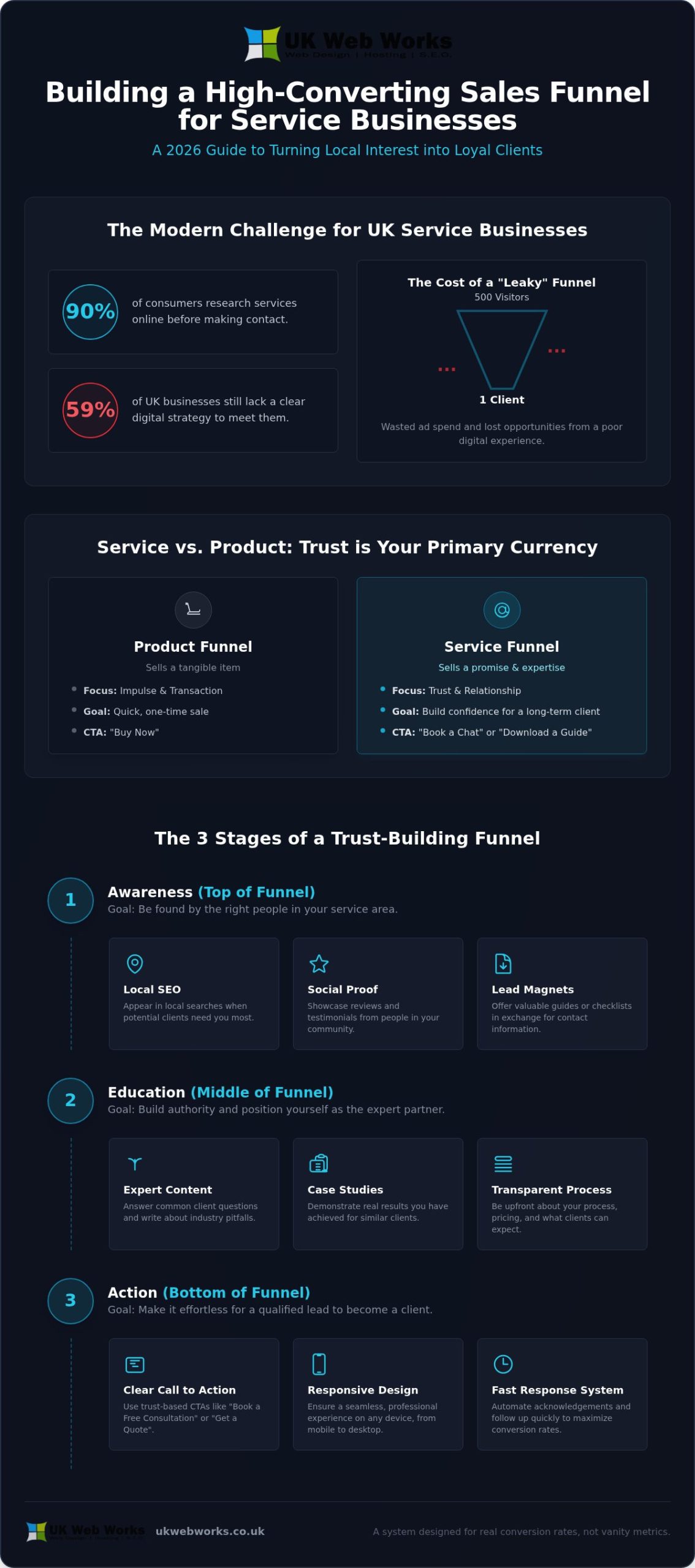
Over 90% of consumers research services online before they ever pick up the phone, yet 59% of UK businesses still don’t have a clear strategy to meet them there. If you’re tired of watching your marketing budget disappear into ads that don’t convert, you aren’t alone. Most service providers feel overwhelmed by technical jargon while their websites sit idle like digital business cards that don’t actually sell. We believe building a sales funnel for a service business should be about creating a trust-building architecture, not a series of high-pressure tactics or confusing software setups.
You deserve a professional online presence that works as hard as you do. In this 2026 guide, we’ll show you how to construct a high-converting system that turns local interest into loyal clients without the usual technical headaches. We’ll move past the hype to provide a clear, manageable roadmap for your growth. You’ll learn how to stabilize your lead flow and build a predictable monthly revenue stream using practical tools and honest communication. Let’s look at how you can simplify your digital strategy and start seeing real results from your hard work.
Key Takeaways
- Understand the fundamental difference between service-based trust and e-commerce impulse to create a journey that feels natural for your clients.
- Learn how to map your funnel using awareness and education to solve small problems for your prospects before they even hire you.
- Discover the role of local SEO and branding in building a sales funnel for a service business that attracts the right people in your area.
- Identify why bespoke, responsive web design is the necessary skeleton for a funnel that converts visitors into leads on any device.
- Gain a clear roadmap for launching your system using a fixed-price approach that focuses on real conversion rates rather than vanity metrics.
Understanding the Sales Funnel for Service-Based Businesses
A sales funnel isn’t just a piece of software. For a local plumber, a consultant, or a web designer, it’s the process of turning a total stranger into a paying client. Most people think of the traditional purchase funnel as a linear path, but in 2026, the journey is often more like a conversation. You’re moving someone from the initial “Who are you?” stage through to the final “When can you start?” phase. Building a sales funnel for a service business requires a different mindset than selling physical products. You aren’t selling a pair of shoes that someone buys on impulse. You’re selling your time, your expertise, and your reputation.
In 2026, personal authority and local reputation have become the most powerful lead magnets. With the UK digital advertising market projected to grow at a CAGR of 14.5% through 2033, standing out isn’t about spending more on ads. It’s about being the most trusted voice in your area. Before you touch a single line of code or set up an email sequence, you must identify your “service-market fit.” This means knowing exactly who you help and why they should choose you over a national competitor.
The Cost of a “Leaky” Funnel
If your website gets 500 visitors a month but only generates one phone call, you have a “leaky” funnel. You might be wasting money on SEO or PPC only to have prospects leave because they can’t find your pricing or they’re put off by a slow-loading page. In the service industry, response times are everything. If a lead fills out a form and doesn’t hear back within an hour, the chances of conversion drop significantly. A simple website isn’t enough anymore; you need a system that captures interest and starts the relationship immediately.
Service vs Product: Why Trust is Your Primary Currency
Selling a service is selling a promise. Because your clients can’t hold your product in their hands before they pay, they need more touchpoints to feel secure. This is why service funnels are often longer and more consultative. Instead of “Buy Now” buttons, your funnel should offer “Book a Chat” or “Download a Guide.” By being transparent about your process and addressing common objections upfront, you build a “trust engine.” For instance, when you learn more about Grabex Windows Ltd, you can see how they use educational heritage guides to build confidence in their bespoke timber and aluminium products. This approach avoids high-pressure sales tactics and focuses on demonstrating value, which is far more effective for long-term growth in the UK market. Building a sales funnel for a service business is about proving you can solve a problem before you ever send an invoice.
Mapping Your Funnel: Awareness, Education, and Action
Mapping out the customer journey isn’t just a theoretical exercise. It’s the blueprint for your growth. Building a sales funnel for a service business requires you to think about how a local prospect feels at every step of their journey. They start with a nagging problem, look for a guide they can trust, and eventually decide if you’re the right fit for their specific needs. In 2026, this journey is rarely linear. It’s often a mix of social media discovery, search engine research, and word-of-mouth validation.
TOFU: Capturing Local Interest
At the top of the funnel (TOFU), your goal is to be found by the right people. Since over 90% of consumers research online before making a purchase, you need to be visible exactly where they’re looking. Working with an SEO Agency Hull ensures you’re showing up for the local searches that matter most to your bottom line. Use social proof early in this phase. Reviews from people across Yorkshire carry more weight than anonymous testimonials. Lead magnets, such as a local pricing guide or a service checklist, give people a reason to trust you with their contact details while providing them with immediate value.
MOFU: Building Authority Through Content
The middle of the funnel (MOFU) is where you educate your prospects. They’ve identified their problem, and now they’re comparing different solutions. You can help them by answering the questions you hear from your clients every single day. If you’re a specialist contractor, write about how to avoid common pitfalls in your industry. This builds authority and positions you as a partner rather than just another vendor. Use case studies to show the actual results you’ve achieved for local businesses. This is a core part of a solid marketing and sales plan that treats the prospect with respect and transparency.
BOFU: Removing Friction from the Close
When someone reaches the bottom of the funnel (BOFU), they’re ready to act. Don’t make them work for it. Your call to action (CTA) should be clear and direct, like “Book Your Free Consultation” or “Request a Site Visit.” Keep your contact forms short; every extra field is a reason for someone to walk away. Frame your pricing as an investment in a solution rather than just an expense. When building a sales funnel for a service business, the goal is to make the final booking feel like the most logical next step. If you’re unsure how to structure these high-conversion pages, we’re always happy to discuss your specific project requirements.
The journey doesn’t end once the first invoice is paid. Turning a one-off client into a long-term partner is the most efficient way to grow your revenue. Consider offering maintenance contracts or follow-up services to keep that relationship alive. It’s much easier to keep a client who already knows your work than it is to find a new one from scratch. This creates a sustainable cycle where happy clients fuel your future growth through advocacy and recurring work.
The Trust Engine: Driving Traffic with Local SEO and Branding
Traffic is the lifeblood of any digital system, but when you’re building a sales funnel for a service business, you don’t just need numbers. You need neighbors. High-volume traffic from another continent won’t help a plumber in Hull or a consultant in York. This is where local SEO acts as the high-octane fuel for your conversion engine. While general Sales Funnel Template and Examples often focus on broad global reach, your success depends on winning the local map pack and appearing when it matters most.
Dominating Local Search in 2026
Local SEO in 2026 is a proximity-based trust signal that connects your expertise with a prospect’s immediate need. Optimising for “near me” searches in East Yorkshire isn’t just about keywords anymore; it’s about proving to search engines that you’re a legitimate, active member of the community. Your Google Business Profile serves as the “front door” to your funnel. It’s often the first thing a prospect sees before they ever reach your website. By gathering and showcasing authentic local reviews from clients in Hull, York, and Leeds, you provide the social proof necessary to move someone from the awareness stage into a genuine conversation. Local backlinks from regional directories and community sites further cement your position as a reliable local authority.
Branding That Breeds Confidence
Your brand is the silent ambassador that speaks for you when you’re not in the room. A strong Brand Identity tells a prospect that you’re reliable, professional, and here for the long haul. Consistency is vital. If your social media looks different from your website, or if your logo looks like it was made with a generic template, you’re creating “brand friction” that makes people hesitate. Professional logo design directly impacts your conversion rates because it signals quality and attention to detail before a single word is read.
Choosing a bespoke approach over a generic template is a strategic move for your funnel’s health. Templates often feel thin and lack the personality required to build a real human connection. When you use a consistent, grounded voice across all your platforms, you’re reinforcing the message that you’re a trusted professional. For example, Finest Furniture Studio uses a distinct brand voice to communicate the quality of their bespoke fitted furniture, which helps build the trust needed to turn a casual visitor into a warm lead. Building a sales funnel for a service business isn’t just about the mechanics of the site; it’s about the integrity of the brand behind it. We’ve seen that businesses with a unified local presence and a clear, professional identity convert at a much higher rate than those trying to be everything to everyone.
Technical Foundations: Bespoke Design and Automation
A reliable sales funnel needs a solid foundation. Think of your website as the skeleton of your digital presence. While generic templates might seem like a quick fix, they often lack the flexibility needed to truly represent your expertise. Choosing Bespoke Web Design ensures your site is built around your specific workflow rather than forcing your business into a pre-made box. Building a sales funnel for a service business requires this level of precision to ensure that every button, form, and page serves a clear purpose.
Responsive design is a critical part of this foundation. In 2026, your prospects are moving between devices constantly. Your funnel must work perfectly whether a client is browsing your services in a Leeds cafe on their phone or reviewing a detailed proposal in a York office on a desktop. If your site is difficult to navigate or the contact form doesn’t work on mobile, you lose that hard-earned trust instantly. We focus on creating seamless experiences that feel professional on any screen.
High-Converting Landing Pages
A landing page should have one goal and one goal only. For a service provider, this usually means getting a prospect to request a quote or book a call. The anatomy of a successful page is straightforward: a headline that solves a problem, proof that you can do the job, and a clear action to take. Speed is a vital factor here. If your page takes more than a couple of seconds to load, visitors will leave. Regular Website Maintenance keeps your funnel fast and secure, which also helps your search engine rankings. Small, logical tweaks to your layout can often lead to better results without needing to increase your marketing budget.
Automation Without Losing the Personal Touch
You don’t need enterprise-level software to run an efficient funnel. Simple CRM tools can track your leads and remind you to follow up without the technical headache. The aim is to use technology to support your human relationships, not replace them. You can set up automated “Thank You” emails that feel genuine and reassure the client that you’ve received their inquiry.
Online booking systems are another practical tool that can save you hours of administrative back-and-forth. When your funnel handles the scheduling, you can focus on delivering your service. Automated reporting also allows you to see exactly which marketing channels are driving the most value, so you aren’t guessing where your next lead is coming from. If you want to build a system that manages your inquiries while you’re busy on-site, get in touch to discuss your bespoke funnel project.
Launching and Refining Your Funnel: The UK Web Works Way
Launching your funnel is a significant milestone, but it’s just the beginning of your growth journey. Building a sales funnel for a service business isn’t a “set and forget” task. It requires consistent attention and a willingness to refine your approach based on how people actually interact with your site. We recommend starting small with a “Fixed-Price” approach. This allows you to get your foundations right without a massive initial investment, ensuring your system is stable before you try to scale. It’s about manageable progress rather than taking unnecessary risks with your capital.
Focus on the numbers that actually impact your bank account. Vanity metrics like social media likes or general website hits can be misleading. In 2026, 62% of UK businesses report that increasing sales revenue is their top priority, so your funnel should be judged on its ability to generate qualified leads. By prioritizing conversion rates over surface-level popularity, you ensure that every pound spent on marketing is working toward a predictable monthly income. A funnel is never truly finished; it’s a living part of your business that grows with you.
Measuring Your Success in 2026
To understand if your funnel is working, you need to track specific Key Performance Indicators (KPIs). Look at your Cost Per Lead (CPL) compared to your Customer Lifetime Value (CLV). If it costs you a reasonable amount to acquire a lead but that client stays with you for years, your funnel is a success. We also use heatmaps to see exactly where local users might be getting stuck or losing interest. This data, combined with real feedback from your Yorkshire customers, allows us to make logical adjustments to your messaging. It’s about being methodical and using facts rather than guesswork.
Why a Local Partnership Beats a Faceless Agency
There’s a distinct advantage to working with a team that understands the regional market nuances in East Yorkshire. A faceless, national agency won’t understand the specific needs of a business owner in Hull or the expectations of a client in Leeds. Having a local partner means you can meet your web team in person to discuss your goals. We value these long-term relationships and take a craftsmanship-focused approach to every project. We don’t position ourselves as a distant corporate entity, but as a dedicated team of specialists who are genuinely invested in your success.
Integrity and openness are the cornerstones of how we work. We don’t hide behind complex terminology or push services you don’t need. Building a sales funnel for a service business is a continuous process of improvement. As market trends shift and your business grows, your funnel should evolve too. We’re here to ensure your online presence remains a reliable asset that builds trust and delivers value every single day. Ready to build a funnel that actually works? Let’s chat.
Secure Your Business Growth for 2026
Building a sales funnel for a service business is about more than just technology; it’s about creating a reliable system that reflects your professional integrity. You now have the roadmap to move from inconsistent lead flow to a predictable, high-converting presence. By focusing on trust-building content, local SEO, and a bespoke technical foundation, you’re setting your business up for long-term success. You don’t need to be a technical expert to have a website that actually sells.
We’ve spent over 10 years helping professionals in Hull and across Yorkshire grow their digital presence. Our approach is simple: we provide bespoke designs that prioritise real conversions over unnecessary fluff. You won’t find any hidden surprises here. We work on a fixed-price basis to give you total peace of mind. We’re here to be your partner, not just another faceless service provider.
If you’re ready to stop guessing and start growing, we’d love to help you build a system that works as hard as you do. Book a Jargon-Free Funnel Consultation today. Your future clients are already looking for you. Let’s make sure they can find you.
Frequently Asked Questions
How long does it take to see results from a sales funnel?
You’ll usually start seeing initial data within 30 days if you’re using paid advertising, but organic results from SEO often take three to six months to fully mature. This timeline depends on your local competition and the current state of your online presence. We focus on steady, sustainable growth rather than overnight miracles that don’t last.
Do I need a big budget to build a sales funnel for my service business?
You don’t need a massive corporate budget to start building a sales funnel for a service business. It’s better to invest in a high-quality foundation, like bespoke web design, and then scale your marketing spend as you see a return on your investment. We prefer a fixed-price approach so you can manage your cash flow without worrying about hidden costs.
What is the most important part of a service-based funnel?
Trust is the most critical element of any service-based funnel. Unlike e-commerce, where a product speaks for itself, your clients are buying your expertise and reliability. Every part of your funnel, from the initial headline to the final booking form, must work together to prove you’re a safe and professional choice for their specific project.
Can I build a sales funnel on a WordPress website?
WordPress is an excellent platform for building a sales funnel for a service business because of its flexibility and SEO-friendly structure. It allows you to integrate CRM tools, booking systems, and landing pages without needing to start from scratch. Our WordPress CMS development ensures your funnel is easy for you to manage while remaining fast and secure for your visitors.
How much automation is too much for a professional service?
Automation is too much when it starts to feel robotic or prevents a client from reaching a real person when they need help. Use it for repetitive tasks like sending appointment reminders or “thank you” emails after a form is submitted. Keep your actual consultations and advice personal, as this human connection is what sets local service providers apart from competitors.
What is the difference between a sales funnel and a website?
A website is a collection of pages that provide general information, while a funnel is a specific path designed to lead a visitor toward a single action. Think of your website as your digital office and the funnel as the guided conversation you have with a prospect. Both are important, but the funnel is the system that actively drives your revenue.
Do I need to be on every social media platform to feed my funnel?
You don’t need to be on every platform to feed your funnel successfully. It’s much more effective to pick one or two channels where your Yorkshire audience actually spends their time, such as LinkedIn or Facebook. Focus on providing high-quality value on those specific platforms rather than spreading your efforts too thin with generic posts that don’t land.
How do I know if my current website is a “leaky” funnel?
You’ll know your funnel is “leaky” if you have plenty of website visitors but very few inquiries or phone calls. High bounce rates on your service pages or a lot of abandoned contact forms are clear signs that something is wrong. We use data to find these gaps so we can refine your messaging and make the path to booking much smoother.