
What if that “unlimited” hosting plan you’re considering is actually the biggest bottleneck holding your business back? It’s a common trap. You sign up for a low introductory rate only to find your site crawling during peak hours or crashing when you need it most. When you’re choosing the right web hosting for my business, it’s easy to get lost in a sea of technical terms like VPS, SSL, and Bandwidth. You deserve a website that loads instantly for your local customers and a provider that speaks plain English when you have a question.
We understand the frustration of dealing with slow support from massive corporations that treat you like a ticket number. You need peace of mind regarding security and backups without overpaying for features you’ll never use. In this 2026 guide, we’ll show you how to select a reliable hosting foundation that fits your specific needs. We’ll skip the jargon and focus on what actually matters: speed, security, and a partner you can actually reach when it counts.
Key Takeaways
- Understand why your hosting is the foundation of your digital presence and how to avoid the hidden costs of “cheap” entry-level plans.
- Navigate the differences between shared, VPS, and managed services to simplify choosing the right web hosting for my business.
- Learn which security and performance features, such as SSL certificates and modern storage, are essential for maintaining a fast, secure site in 2026.
- Spot the fine print in hosting contracts to avoid the “unlimited” bandwidth trap and unexpected renewal price increases.
- Discover the benefits of managed UK hosting that lets you offload technical maintenance to local experts who understand your market.
What is Web Hosting and Why Does Your Choice Matter?
Think of your website as a physical house. You have spent time designing the rooms, painting the walls, and making it look perfect for visitors. But even the most beautiful home needs a solid foundation and a plot of land to sit on. In the digital world, web hosting is that plot of land. Web hosting is the service that stores your website files and makes them accessible to the world via the internet. If you want to understand the technical foundations better, you might ask what is a web hosting service? to see how different server types function, but for most owners, it’s about reliability and speed.
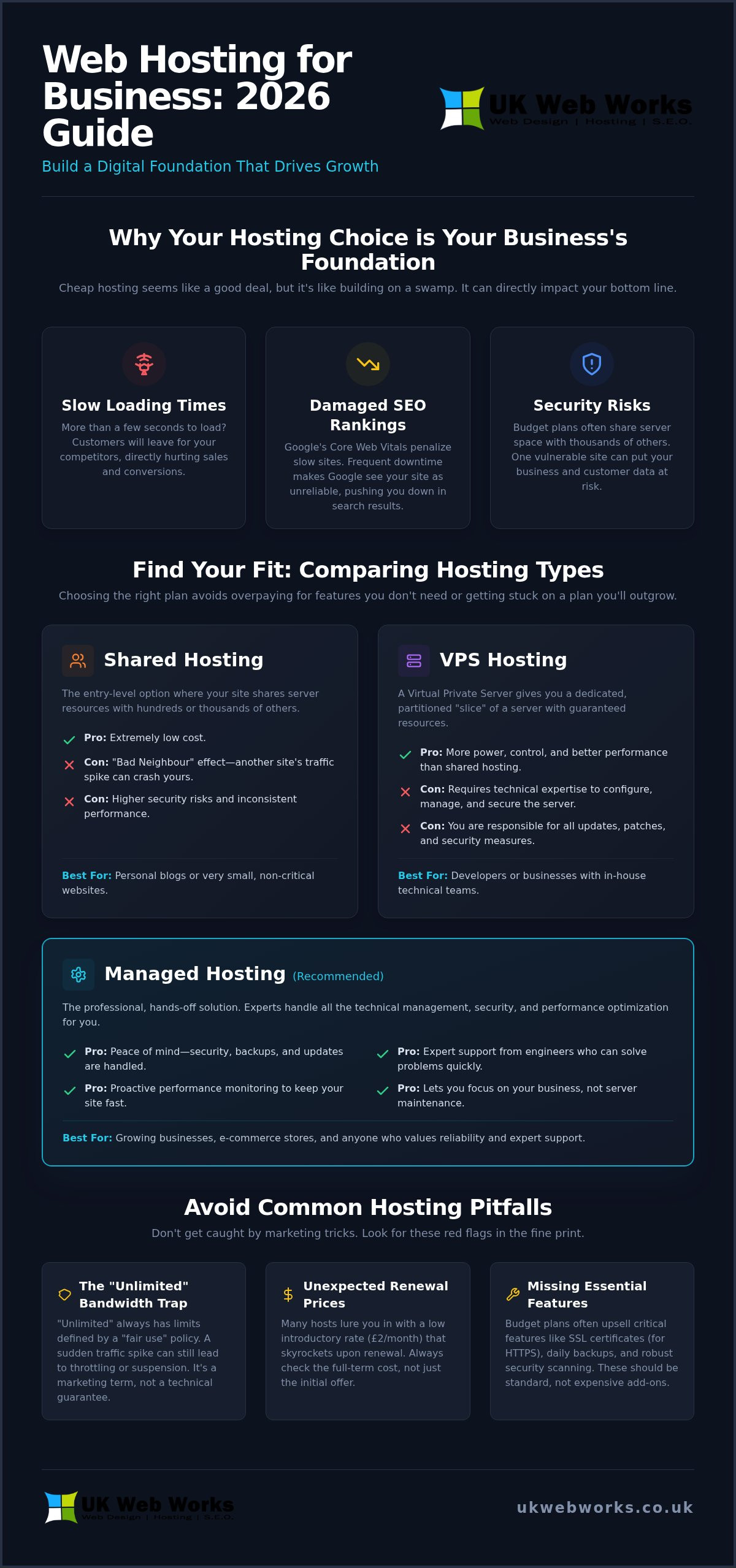
When you start thinking about choosing the right web hosting for my business, the quality of that “land” determines how your visitors experience your brand. Cheap hosting often feels like building a skyscraper on a swamp. It might look fine at first, but eventually, the cracks start to show. Slow loading times and frequent downtime aren’t just minor inconveniences; they are direct threats to your conversion rates. If a customer has to wait more than a few seconds for your site to load, they’ll likely go to a competitor. Your hosting is the engine under the hood, and a budget engine won’t win the race.
The Impact of Hosting on Your Google Rankings
Google cares deeply about how fast your site responds. This is measured through Core Web Vitals, which are specific metrics that judge the user experience. If your server takes too long to deliver data, your rankings will suffer. Reliability is also key. If your site is down when Google tries to “crawl” it, the search engine will assume your site is unreliable and push you down the results page. For local firms, regional server proximity matters too. If you’re targeting customers in Yorkshire, having your data stored on a local server reduces the physical distance data has to travel, resulting in a snappier experience for your neighbors.
Reliability vs. Price: Finding the Sweet Spot
It’s tempting to grab a plan for £2 a month. However, these budget options usually mean you’re sharing a single server with thousands of other websites. If one of those sites gets a sudden spike in traffic, your site could slow to a crawl or crash entirely. The hidden costs of budget hosting include lost sales and a damaged reputation that’s hard to rebuild. Choosing the right web hosting for my business means viewing it as an investment rather than a cost. Business-grade hosting ensures you have the resources you need to stay online and keep your brand identity intact, even during your busiest hours.
Shared, VPS, or Managed? Comparing Hosting Types
Picking a hosting type is often the most confusing part of choosing the right web hosting for my business. You’ll see several options with varying price points, and it’s not always clear which one fits your specific needs. Let’s break down the four main categories you’ll encounter in 2026. Understanding these differences helps you avoid paying for power you don’t need or getting stuck with a plan that can’t handle your growth.
Shared hosting is the entry-level choice. It’s affordable because you share server resources with hundreds of other websites. While it’s fine for a small personal blog, it’s often too restrictive for a growing business that needs consistent performance. A Virtual Private Server (VPS) gives you a dedicated slice of a server. You get more power and control, but you also need the technical skills to manage it. If you aren’t comfortable with server configurations, a VPS can quickly become a headache. Cloud hosting uses a network of servers to host your site. It’s incredibly scalable. If your ecommerce shop suddenly goes viral, the cloud can handle the traffic spike without breaking a sweat.
Managed hosting is the professional solution. It’s a “hands-off” approach where experts handle the technical heavy lifting. You focus on your business while we ensure the server stays fast and secure. Before making a final decision, it’s helpful to review professional tips for choosing a web host to ensure your provider aligns with your long-term goals.
Shared Hosting: The Pros and Cons for Small Firms
The primary draw of shared hosting is the low monthly cost. However, the security risks are notably higher because you’re tied to the safety practices of everyone else on that server. We often talk about the “Bad Neighbour” effect. If another site on your server gets hacked or uses too much bandwidth, your site pays the price. This leads to slow speeds or even total downtime. When your business starts to grow and you need a reliable presence, it’s time to leave these crowded environments behind.
Why Managed Hosting is the Standard for Professional Businesses
Managed hosting has become the standard for professional firms that value their time. It includes automatic updates, security patches, and daily backups as standard. You also get support that actually understands your bespoke website design. Instead of spending hours troubleshooting a server error, you can rely on specialists to keep things running. This service saves you from technical headaches and ensures your site is always ready for customers. If you’re feeling overwhelmed by the technicalities, you can always reach out to us for a chat about your options.
5 Crucial Factors for Evaluating Hosting Providers in 2026
Once you’ve decided on the type of service you need, the next step is filtering through the thousands of companies vying for your attention. Choosing the right web hosting for my business requires looking past the flashy marketing and checking the actual hardware and support structures in place. In 2026, entry-level specs have improved, but the gap between “budget” and “business-grade” is wider than ever. You need a foundation that doesn’t just work, but actively helps your site perform.
Speed is your first priority. Don’t settle for standard hard drives; ensure your provider uses NVMe SSD storage. This technology is significantly faster than traditional SSDs, allowing your database and files to load almost instantly. You should also check for global Content Delivery Network (CDN) integration. While many lists of the best web hosting for small businesses highlight these features, you must verify they’re included in your specific tier rather than offered as a paid add-on. Performance isn’t just about the server; it’s about how that server communicates with your customers’ browsers.
To complement your high-performance hosting, having a reliable fibre internet connection at your office is essential; you can learn more about high-speed options for UK businesses.
Reliability comes down to backups and scalability. A professional host should take daily off-site backups as a standard practice. If something goes wrong, you shouldn’t have to worry if your data from yesterday is safe. Additionally, your host must be able to grow with you. If your marketing takes off and your traffic doubles overnight, your hosting environment should scale without requiring a manual migration that causes downtime.
The Importance of UK Data Centre Locations
Physical distance still dictates speed. If your business serves customers in Hull or across Yorkshire, a server located in London or Manchester will always outperform one in New York or Singapore. This reduced latency provides a snappier experience for your visitors and supports your SEO agency Hull efforts by improving your site’s technical health scores. Beyond speed, keeping your customer data on UK soil simplifies GDPR compliance and provides legal peace of mind.
Security Beyond Just an SSL Certificate
In 2026, an SSL certificate is the bare minimum. You need proactive protection. This includes a Web Application Firewall (WAF) to block malicious traffic before it reaches your site and robust DDoS protection to keep you online during an attack. We include these layers within our website maintenance packages because security isn’t a one-time setup. It’s a continuous process of monitoring and patching that keeps your digital investment safe from evolving threats.
Avoiding Common Hosting Pitfalls: What to Look for in the Small Print
Choosing the right web hosting for my business often feels like a game of spot the difference, but the real traps are usually hidden deep within the terms and conditions. Many “big box” providers use clever marketing to make their services look like a bargain, only for you to discover hidden limitations later. Integrity in hosting means being upfront about what you are actually getting. If a deal looks too good to be true, it’s usually because the provider is cutting corners on support or hardware.
The biggest red flag is the “unlimited” promise. In reality, unlimited storage and bandwidth do not exist. Every server has physical limits. Most providers hide a cap on “Inodes” in their small print. An Inode is simply a single file or folder. If your business site uses a lot of images or emails, you can hit this file limit long before you run out of disk space. When you hit that limit, your site might stop receiving emails or crash entirely. You should also look closely at renewal rates. That £1.99 monthly introductory offer often triples or quadruples after the first year, locking you into a much more expensive contract once your site is already established.
Control panels matter more than you might think. Stick to industry standards like cPanel or Plesk. Some hosts use proprietary, custom-built panels that make it incredibly difficult to move your website to a different provider later. This is a form of “vendor lock-in” that limits your freedom. Finally, always test a host’s support before you pay. Send them a technical question on a Tuesday afternoon and see how long it takes for a real person to give you a direct, jargon-free answer.
Understanding Bandwidth and Storage Limits
Most small business websites don’t actually need much space. A typical five-page site might only use 500MB of storage. However, you need to understand your traffic. Bandwidth is the amount of data transferred between your site and its visitors. If you host large PDF brochures or high-resolution videos directly on your server, your bandwidth usage will spike. It’s often better to host videos on dedicated platforms to keep your site lean and fast.
The Problem with “Free” Hosting and Site Builders
Free hosting and “all-in-one” proprietary builders often seem like a shortcut, but they come with significant risks. You often do not truly own your site on these platforms. If the provider changes their terms or shuts down, your data could vanish. Moving away from these builders is notoriously difficult because their code isn’t designed to work anywhere else. For a professional brand, the lack of ownership and the difficulty of migration make these “free” options a poor long-term choice. If you want a foundation you actually control, contact our team for an honest talk about managed hosting.
Why Managed UK Hosting is the Right Choice for Growing Firms
Managed hosting is more than just a place to store files. It’s a partnership. When you reach the point where choosing the right web hosting for my business becomes a priority, you’re likely looking for more than just a server. You’re looking for time. Managed services allow you to focus on your day-to-day operations while a team of specialists handles the technical maintenance, security patches, and server optimisations. It’s the difference between being an IT manager and being a business owner. You gain the peace of mind that comes with knowing your foundation is solid.
One of the biggest advantages is the seamless integration between your website design, SEO, and hosting environments. When these elements are handled under one roof, your site performs better. We understand the digital marketing Hull landscape and how to align your server settings with your marketing goals. If a technical issue arises, you won’t be caught in the middle of a finger-pointing match between a developer and a hosting company. Because we handle both, we find and fix problems faster, often before you even notice them. It’s a streamlined approach to digital growth.
Tailored Solutions for Hull and Yorkshire Businesses
Working with a local agency provides a personal touch that “big box” hosting companies simply cannot match. We provide tailored solutions for firms across Hull and Yorkshire, ensuring your site is optimised for your specific audience. Our approach is built on integrity. We don’t believe in jargon-heavy contracts or hidden fees that appear after the first year. We simplify the technical side so you always know exactly what you’re paying for and why it matters for your growth. We act as your digital ally, providing a reliable foundation that scales as your reputation grows. Choosing the right web hosting for my business should be about building a long-term relationship, not just buying a subscription.
How to Get Started with Professional Hosting
Moving to a professional environment doesn’t have to be stressful. We handle the entire migration process for you, ensuring your existing site moves over without downtime or data loss. We also help you set up professional business email addresses linked to your domain. This is essential for building trust with your clients. A professional email address looks far better on a business card than a generic free account. If you’re ready to stop worrying about your server and start focusing on your customers, contact UK Web Works today for a jargon-free consultation on your hosting needs.
Build Your Business on a Reliable Digital Foundation
Your website deserves a home that’s as professional as your brand. We’ve explored why avoiding the “unlimited” trap and watching for renewal price hikes is essential for your long-term budget. By prioritising speed through UK-based data centres and choosing a managed service, you can stop worrying about technical maintenance and get back to what you do best. Choosing the right web hosting for my business is a decision that sets the pace for your entire digital growth strategy.
We believe in straightforward service without the jargon. Our managed hosting comes with 99.9% uptime and the speed of local servers. You’ll have dedicated support from our Hull-based team whenever you need a hand. You don’t need to be a technical expert to have a fast, secure website that your customers love. If you’re ready for a simpler approach to your online presence, contact UK Web Works for a jargon-free hosting consultation today. Let’s build something reliable together.
Frequently Asked Questions
Is web hosting the same as a domain name?
Web hosting and domain names are two separate services that work together to keep your site online. Your domain name is your digital address, like a street name; your hosting is the physical space where your website’s files actually live. You need both to have a functioning site. While you can buy them from different companies, they must be linked so visitors can find your content when they type in your address.
Can I change my hosting provider later if I make the wrong choice?
You can certainly move your website to a new provider at any time through a process called migration. This involves moving your files, databases, and email accounts to the new server. Most professional providers offer migration services to make the transition seamless and stress-free. It’s much easier to switch if you’ve used standard platforms like WordPress rather than a proprietary “all-in-one” website builder that locks your data in.
How much storage space does a typical business website need?
A typical business website usually needs between 1GB and 5GB of storage space. Most small sites are much smaller than owners expect, often taking up less than 500MB in total. You only need significantly more space if you’re hosting high-resolution videos or thousands of large images directly on your server. For most firms, the quality of the storage is more important than the quantity.
Does it matter where my hosting server is physically located?
Server location is a critical factor for your website’s speed and user experience. If your customers are primarily in the UK, your server should be in a UK data centre to reduce the physical distance data has to travel. This lower latency results in faster loading times for your visitors. It also helps with local search visibility, as search engines prefer delivering fast results to regional users.
What is an SSL certificate and do I really need one?
An SSL certificate encrypts the connection between your website and your visitors, showing a padlock icon in the browser address bar. You absolutely need one. Beyond keeping customer data safe, search engines now penalise sites without SSL certificates by marking them as “Not Secure.” It’s a standard security requirement in 2026, and most reputable hosting plans now include it as a basic feature.
What happens if my website gets more traffic than my hosting plan allows?
If your traffic exceeds your plan’s limits, your website will likely slow down or become unavailable to new visitors. Budget providers often suspend accounts that use too many resources without any prior warning. When choosing the right web hosting for my business, look for a provider that offers easy scalability. This ensures your site stays online during busy periods or successful marketing campaigns.
Is managed hosting worth the extra cost for a small business?
Managed hosting is worth the investment for any business that values its time and digital security. It removes the burden of technical maintenance, such as software updates and daily backups, from your busy schedule. This allows you to focus on running your firm while experts ensure your site remains fast and secure. It’s often much cheaper than the cost of fixing a hacked or broken website.