
Did you know that just a one second delay in your page load time can slash your conversion rates by up to 7%? In a competitive market, that tiny lag is often the difference between a completed sale and a lost customer. You’ve likely spent hours looking at healthy traffic numbers while wondering why your checkout remains quiet. It’s a common frustration, especially when you’re faced with high cart abandonment or confusing jargon from agencies that seems designed to complicate rather than clarify.
We believe your online store should work as hard as you do. This guide focuses on practical ecommerce website design to increase conversions uk businesses can implement right now to see real results. You’ll discover the exact design strategies and technical features that turn UK browsers into buyers without the headache of technical jargon. We’ll provide a clear roadmap for your site, covering everything from platform selection to handling the new €3 EU customs duty on low-value parcels arriving in July 2026.
Key Takeaways
- Learn why standard “digital brochures” fail and how to identify the micro-frictions that drive UK customers away.
- Discover how ecommerce website design to increase conversions uk relies on technical pillars like site speed and data-driven CRO services.
- Get a clear comparison between Shopify and WooCommerce to decide which platform best fits your growth plans for 2026.
- Find out how to vet an ecommerce agency by focusing on their ability to deliver measurable sales growth rather than just award-winning visuals.
- Understand why a craftsmanship-focused approach and clear, jargon-free communication are essential for building a reliable online store.
Why Most UK Ecommerce Websites Fail to Convert (The ‘Pretty but Passive’ Trap)
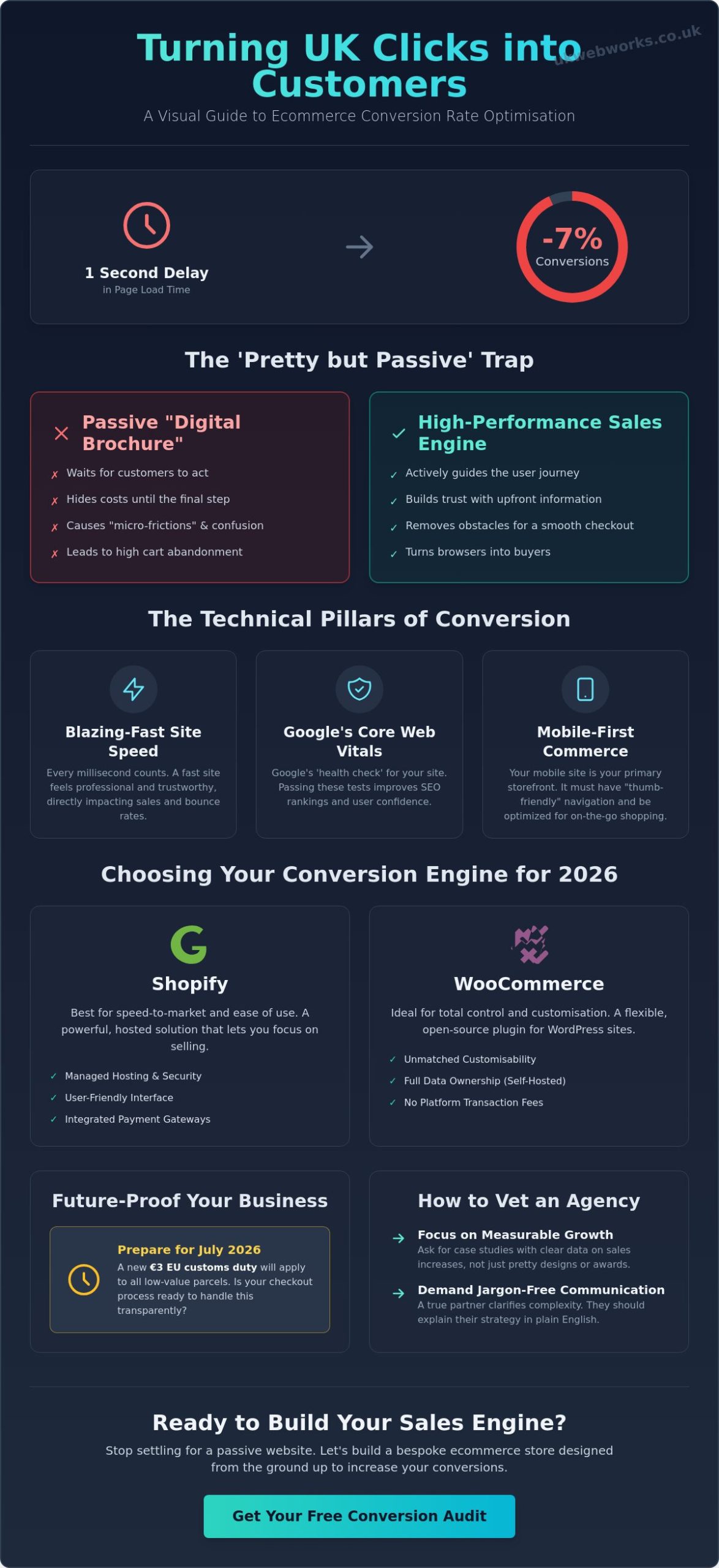
Many business owners in the UK fall into the trap of commissioning a site that looks stunning but acts like a digital brochure. It sits there, looking pretty, but it doesn’t actually drive sales. This is what we call “Passive Design.” A high-performance sales engine doesn’t just wait for customers to buy; it actively guides them through a logical journey. In 2026, visual aesthetics are just the entry fee. They aren’t the closing argument that secures a transaction.
When we talk about ecommerce website design to increase conversions uk shoppers expect, we’re talking about removing micro-frictions. These are tiny obstacles, like a button that’s hard to click on mobile or a shipping cost that only appears at the very last second. For the modern UK consumer, these small annoyances signal a lack of professionalism. They create a psychological barrier that leads straight to cart abandonment. If your site feels like hard work, your customers will find someone else who makes it easy.
The Trust Deficit in Modern Online Shopping
British shoppers are notoriously skeptical. They can spot a generic, low-effort template from a mile away. Honest design signals reliability. This means being upfront about everything from the start. If your pricing is hidden or your delivery times are vague, you’ve already lost the sale before the customer even reaches the checkout. We’ve found that using plain, jargon-free language doesn’t just make your site easier to read; it builds a bridge of trust. When you speak clearly, you show that you’re a partner who values the customer’s time and money.
Beyond the Surface: Technical Integrity as a Sales Driver
Technical craftsmanship is the foundation of every successful store. If your site architecture is messy, your conversion rate will suffer, even if your product photos are professional. This is where Conversion rate optimization (CRO) comes into play. It isn’t just about changing button colors. It’s about the data-driven logic of how a user moves from a landing page to a thank-you screen.
A well-structured site helps with technical SEO, but it also gives the user confidence. When a page loads instantly and the navigation feels intuitive, the customer feels safe. They trust that if you’ve put this much care into your website, you’ll put the same care into fulfilling their order. Building a site with ecommerce website design to increase conversions uk businesses can rely on means looking past the surface and focusing on the high-performance engine underneath.
The Technical Pillars of Ecommerce Conversion Rate Optimisation Services
Conversion Rate Optimisation (CRO) sounds complex, but the core concept is straightforward. It involves making data-driven design changes to ensure a higher percentage of your visitors actually complete a purchase. Instead of guessing what might work, we look at how people use your site and remove the hurdles in their way. Effective ecommerce website design to increase conversions uk businesses need in 2026 is built on this foundation of technical excellence rather than just artistic flair.
Site speed is perhaps the most critical technical pillar. Research shows that a 1 second delay in page load time can reduce conversions by 4% to 7% and significantly increase your bounce rates. In the UK market, where consumers expect instant results, every millisecond matters. If your site is slow, you aren’t just losing a lead; you’re actively handing revenue to your competitors. A fast site feels reliable, and reliability is the cornerstone of a successful online shop.
Google measures this reliability through “Core Web Vitals.” Think of these as a health check for your website. They look at how quickly the main content loads, how fast the site responds when someone clicks a button, and whether the layout jumps around while loading. If your site fails these tests, Google is less likely to show you in search results, and customers are less likely to stay. Keeping your site healthy often requires a professional website maintenance plan to ensure performance doesn’t dip over time.
Mobile Commerce: The Primary UK Storefront
Mobile-first design is no longer optional. In 2026, your mobile site is your primary storefront. This means designing specifically for “thumb-friendly” navigation. Buttons should be easy to tap with one hand, and menus must be simple to navigate on a small screen. Speed is even more vital here, as many customers shop while on 4G or 5G connections. Integrating seamless payment options like Apple Pay, Google Pay, and Klarna is essential. These tools allow customers to buy in seconds without having to dig out a physical bank card.
Streamlined Navigation and Search Functionality
You might have heard of the “Three-Click Rule,” which suggests a user should find any product within three clicks. While it’s more of a guideline than a strict law, the goal remains the same: speed and simplicity. Predictive search is a powerful tool here. As a customer types, your site should suggest relevant products immediately. Using logical hierarchies and breadcrumbs also helps. These small design choices reduce user frustration by showing customers exactly where they are and how to get back to a previous category without hitting the “back” button repeatedly.
Shopify vs WooCommerce: Choosing Your Conversion Engine
Deciding between Shopify and WooCommerce is one of the most important choices you’ll make for your business. It isn’t just a matter of personal preference; it’s about which platform provides the most reliable engine for your specific sales goals. Both options are capable of delivering high-quality ecommerce website design to increase conversions uk shoppers expect, but they approach the task differently. One offers a streamlined, managed experience, while the other provides near-limitless flexibility for those with more complex requirements.
Shopify has become a powerhouse in the British market, accounting for 24% of the UK’s ecommerce software market as of March 2026. It’s built for rapid growth and reliability. WooCommerce, a plugin for WordPress, offers a different path. It allows for deep customisation and is often the preferred choice for established brands that need their shop to function in a very specific way. However, you should be wary of the “cheap” platform trap. Saving money on monthly fees by using an underpowered platform often leads to technical friction, slow load times, and ultimately, a lower conversion rate that costs you far more in lost sales than you saved on software.
Shopify: Speed and Security as Conversion Drivers
The biggest advantage of Shopify is its hosted checkout. Because Shopify manages the payment process, it’s incredibly secure and fast, which builds immediate trust with your customers. It also simplifies complex features like abandoned cart recovery and multi-currency selling. We often help clients integrate bespoke website design into the Shopify framework. This gives you a unique, brand-focused look while keeping the rock-solid technical foundation that Shopify provides. With the Basic plan starting at £19 per month when billed annually, it’s an accessible entry point for many growing businesses.
WooCommerce: Total Control Over the Sales Funnel
If your business model requires a highly specific checkout flow or unique product configurations, WooCommerce is often the better fit. It gives you total control over every step of the sales funnel. However, this flexibility comes with more responsibility. You’ll need to manage your own hosting and security. We recommend high-quality hosting to ensure your site remains fast, as basic plans can struggle with heavy traffic. Because WooCommerce requires regular updates to stay secure and performant, many of our clients opt for website maintenance packages. This ensures that your conversion engine is always tuned and protected against digital threats.
Buying Guide: How to Vet an Ecommerce Agency for Conversion Expertise
Choosing the right team to build your store is just as critical as choosing the platform itself. You aren’t just buying a layout or a set of features; you’re investing in a sales tool that needs to perform under pressure. Many agencies lead their sales pitches with “award-winning” visuals, but a beautiful site that fails to convert is a failed project. When looking for ecommerce website design to increase conversions uk businesses should prioritize partners who speak the language of business objectives rather than just artistic trends.
Ask for evidence of growth. A reliable partner will be happy to show you how their design choices led to measurable improvements in sales or lead generation for previous clients. They should be able to explain the logic behind their work without hiding behind a curtain of mystery. Trust is built on transparency, which is why we believe it’s essential to find a partner who provides a fixed-price web design quote. This approach removes the fear of “scope creep” and ensures that both parties are aligned on the project goals from the very first day.
Essential Questions to Ask Your Potential Partner
- How do you measure and report on conversion rate improvements? Look for a focus on data, such as bounce rates and checkout completion, rather than vague “engagement” metrics.
- What is your approach to mobile-first user experience (UX)? They should explain how they prioritize the mobile journey, especially for customers on the move.
- Do you provide ongoing support after the initial build is complete? A website isn’t a “set and forget” asset. You need to know who to call when you need updates or maintenance.
Red Flags to Avoid in the UK Web Design Market
Watch out for agencies that hide behind complex technical terminology and jargon. If they can’t explain a concept simply, they probably don’t understand its practical impact on your bottom line. High-pressure sales tactics that promise “overnight success” are another major warning sign. Real growth in the UK market comes from methodical craftsmanship and a deep understanding of your specific audience. Vague pricing structures are the final red flag; they often lead to unexpected extra costs that can derail your budget. If you want a partner who values integrity and delivers clear results, reach out to our specialist team to discuss your growth plans.
The UK Web Works Approach: Bespoke Builds with Conversion Baked In
We believe that technical excellence shouldn’t be a mystery. Our approach to ecommerce website design to increase conversions uk brands rely on is simple: we build for results, not just for show. While other agencies might focus solely on the latest design trends, we prioritize a craftsmanship mindset. This means every button, every line of code, and every layout choice serves a specific purpose. We don’t just want your site to look good; we want it to be the most effective sales tool in your arsenal. We act as a dedicated ally, translating complex digital concepts into plain English so you always know exactly where your investment is going.
Visibility is the first step toward a sale. Because of this, we integrate professional SEO agency services into every ecommerce build we undertake. It’s a waste of resources to build a high-converting store if your target audience can’t find it. By baking search engine optimization into the foundation of your site, we ensure that your shop is structured correctly for Google from day one. This proactive strategy saves you from expensive technical fixes later and sets a solid path for long-term growth.
From Strategy to Sale: Our Collaborative Process
We never touch a line of code until we’ve identified your unique business challenges. Every project starts with a conversation where we listen to your goals and understand your customers. From there, we develop a conversion-led site map and wireframe. This acts as the blueprint for your success, ensuring the user journey is logical and frictionless. Before we launch, we perform a final check to ensure your brand identity resonates perfectly with your target audience. A consistent, professional brand builds the trust necessary to turn a casual browser into a loyal customer.
Your Next Step Toward Better Conversions
The digital market moves quickly. Every day your site remains unoptimized is a day you’re potentially losing revenue to faster, more intuitive competitors. Waiting to improve your online presence often costs more in lost opportunities than the price of the upgrade itself. We’re here to help you navigate these changes with integrity and openness. If you’re ready to move past the jargon and start building a store that actually performs, a professional consultation is the best place to start. We’ll audit your current site, identify the friction points, and show you a clear roadmap for growth. Let’s have a straight-talking conversation about your project and how we can help you scale your UK business with confidence.
Building Your Future-Proof Ecommerce Store
Increasing sales in 2026 isn’t about chasing every new trend. It’s about getting the fundamentals right through technical craftsmanship and a deep understanding of your customers. We’ve explored how moving away from passive design and focusing on speed can stop revenue leaks. Whether you choose the streamlined power of Shopify or the bespoke flexibility of WooCommerce, your platform must align with your specific growth goals.
Achieving effective ecommerce website design to increase conversions uk businesses need requires a partner who values honesty over hype. Since 2014, we’ve focused on building long-term relationships through integrity and straight-talking advice. We provide bespoke designs tailored specifically to UK consumer habits, ensuring your store feels local and reliable. You don’t need to navigate complex jargon to get results.
If you’re ready to transform your site into a high-performance sales engine, let’s have a jargon-free, professional consultation. Get a straightforward, fixed-price quote for your ecommerce project today and take the guesswork out of your digital investment. We’re here to help you scale with confidence and clarity.
Frequently Asked Questions
What is a good conversion rate for a UK ecommerce website in 2026?
How much does professional ecommerce website design cost in the UK?
The cost of a professional build varies based on the complexity of your product range and the specific technical features you need. A bespoke Shopify store for a growing brand has different requirements than a complex, multi-vendor WooCommerce site. We always recommend seeking a fixed-price quote. This ensures your project remains within budget and prevents the unexpected costs often associated with vague agency estimates.
Can I improve my conversion rate without a full website redesign?
Yes, you can often achieve significant sales gains by making targeted, data-driven changes to your existing site. This process involves identifying micro-frictions, such as a confusing checkout or slow page loads. Small refinements to ecommerce website design to increase conversions uk shoppers expect can lead to better results. You don’t always need to start from scratch to see a meaningful lift in your bottom line.
How long does it take to see results from conversion rate optimisation?
You can often see measurable improvements within a few weeks of implementing technical changes or layout updates. While speed optimizations often yield immediate results, changes to user experience require enough traffic to provide a clear picture of success. We typically recommend monitoring your performance data over a 30 to 90 day period. This timeframe allows for a more accurate assessment of how new designs affect customer behavior.
Does site speed really affect my sales that much?
Site speed is one of the most critical factors in determining whether a visitor completes a purchase. Research indicates that even a one second delay can reduce your conversions by up to 7%. UK consumers shopping on mobile devices have very little patience for slow-loading pages. Investing in efficient code and reliable hosting isn’t just a technical task; it is a direct investment in your sales engine.
Should I choose Shopify or WooCommerce for a new UK online shop?
The right choice depends on your technical requirements and how much control you need over the sales funnel. Shopify is an excellent, managed solution that accounts for 24% of the UK market. WooCommerce offers near-limitless flexibility for bespoke builds but requires more active maintenance. We help you evaluate both platforms based on your growth plans to ensure you choose the engine that fits your business best.
What are the most important trust signals for UK online shoppers?
Clear contact information, transparent delivery costs, and recognizable payment icons are essential for building immediate rapport. UK shoppers are often skeptical of sites with hidden fees or vague “About Us” pages. Displaying honest customer reviews and offering familiar payment methods like Apple Pay or PayPal signals that you are a reliable business. Consistency in your ecommerce website design to increase conversions uk helps reassure visitors that they are in safe hands.
How do I know if my current web agency is doing a good job with CRO?
A reliable agency will provide regular reports that show growth in sales and checkout completion rather than just vanity metrics like traffic. They should be able to explain their design choices using clear, jargon-free language. If your partner cannot show a direct link between their work and your business objectives, it may be time to reconsider the relationship. Look for an ally who prioritizes transparency and results.