
A budget hosting plan is only a bargain until your website goes offline during your busiest sales week. It is a common trap; you sign up for a low-cost deal to keep overheads down, only to find your pages crawling or your checkout failing exactly when a customer is ready to buy. This comparison of managed vs shared hosting uk cuts through the marketing fluff to show you where your money really goes. We understand that you need a website that stays fast and secure without requiring you to become a part-time server technician.
You likely already believe that your digital presence should be a reliable asset, not a constant source of technical anxiety or security fears. We promise to clarify the real-world differences between these two hosting paths so you can ensure your UK business remains fast, reliable, and fully compliant with the 2026 Data Use and Access Act. We will look at everything from the performance benefits of PHP 8.5 to the critical importance of UK-based server locations for local latency. By the end of this guide, you will know exactly which setup fits your current budget and your long-term growth ambitions.
Key Takeaways
- Learn the practical difference between sharing resources in a digital “flatshare” and having a dedicated team manage your site like a professional hotel.
- Understand how “noisy neighbours” and resource limits on budget servers can lead to unexpected downtime and security risks for your business.
- Evaluate the performance benefits of managed vs shared hosting uk to see how expert server tuning directly impacts your site’s speed and reliability.
- Discover why keeping your data on UK soil is essential for local search engine rankings and meeting the latest 2026 data sovereignty requirements.
- Use our decision framework to determine if the transition to managed hosting will deliver a better return on investment through saved time and improved customer trust.
Managed vs Shared Hosting UK: Breaking Down the Jargon for 2026
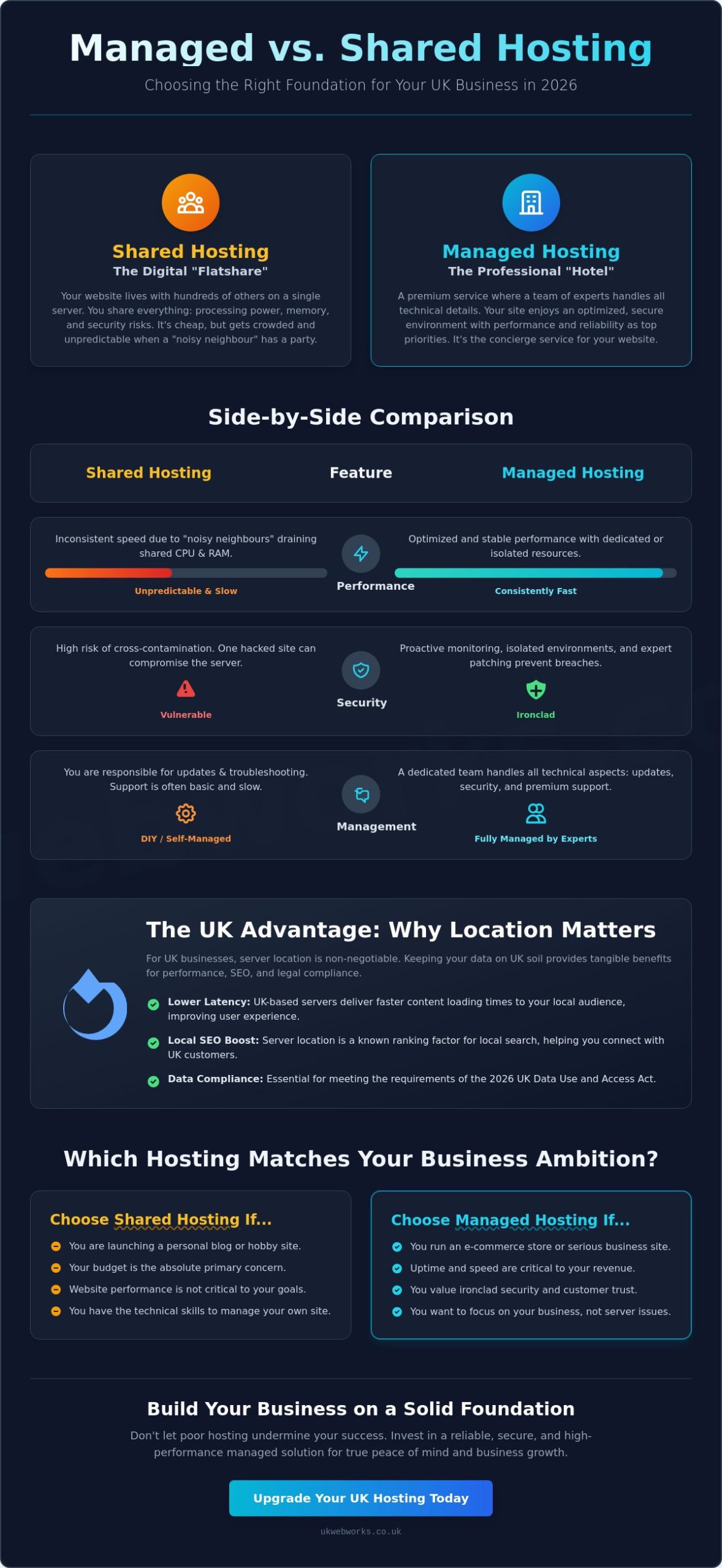
Your website is the digital storefront of your business. If the foundation is shaky, everything else, from your SEO rankings to your customer trust, will eventually suffer. When comparing managed vs shared hosting uk, it helps to think of the choice as a property decision. Shared hosting is like a student flatshare. You have your own room, but you share the kitchen, bathroom, and Wi-Fi with dozens of other people. If your flatmate decides to host a party, your internet speed drops and the whole place becomes sluggish. Managed hosting, by contrast, is more like staying in a professionally managed hotel where a concierge handles the details and the infrastructure is built for your specific comfort.
The UK market in 2026 is more competitive than ever. With the rollout of PHP 8.5 and the latest cPanel version 136, technical standards have shifted. Customers expect instant loading times, and search engines penalise anything less. A Web hosting service might offer you space on a server for a few pounds, but the “cheapest” option rarely represents the best value for a professional site. If your server fails during a busy Tuesday morning, the money you saved on monthly fees is quickly eclipsed by the revenue lost while your site is offline.
What is Shared Hosting?
In a shared environment, your website lives on a single server alongside hundreds, or sometimes thousands, of other sites. This multi-tenant setup is why providers can offer such low prices. However, it introduces the “noisy neighbour” effect. If another website on your server experiences a massive traffic spike or gets hit by a security breach, your site’s performance can plummet. While many budget hosts market “unlimited” bandwidth or storage, these claims are often governed by strict “fair use” policies in the small print. If your site starts to grow, you might find your account suspended just when you need it most.
What is Managed Hosting?
Managed hosting moves away from the “do-it-yourself” model. Instead of just renting space, you are hiring a team of specialists to look after the technical health of your site. This includes proactive updates, performance tuning, and constant security monitoring. Managed hosting is a professional service focused on delivering peak performance and ironclad security through proactive technical oversight. It differs from a standard VPS because the provider doesn’t just give you the keys to a virtual box; they actively manage the software, the patches, and the optimisations required to keep a modern business site running at its best in the managed vs shared hosting uk landscape.
Shared Hosting: The True Cost of the Budget Option
Shared hosting often appears as the most cost-effective way to get online. For a few pounds a month, you get a spot on a server. However, this bargain comes with a hidden price tag that many UK business owners only discover when things go wrong. When comparing managed vs shared hosting uk, it’s vital to look past the initial price tag. The most common issue is the “noisy neighbour” problem. Because you are sharing resources with hundreds of other websites, a sudden surge in traffic for one can drain the CPU and RAM available to you. Your site doesn’t just slow down; it can become completely unresponsive during your own peak hours.
Security is another significant concern. On a shared server, websites often share the same IP address. If a neighbour site is compromised or used for spam, your own site’s reputation can suffer. This “cross-contamination” can lead to your business emails being flagged as spam or your site being blacklisted by search engines. When researching the different Types of Web Hosting, it becomes clear that shared environments lack the isolated security layers required for modern data protection. This is a risk that growing businesses simply cannot afford to take.
From an SEO perspective, shared hosting is a gamble. Google’s Core Web Vitals are a direct ranking factor. If your server takes too long to respond because it is busy processing someone else’s data, your rankings will drop. You can spend thousands on marketing, but if the foundation is weak, your conversion rates will never reach their potential. A slow site frustrates customers and sends them straight to your competitors.
When Shared Hosting Makes Sense
Budget plans aren’t inherently bad; they just have a very specific use case. If you are running a personal blog, a small hobby site, or a temporary project that doesn’t generate revenue, shared hosting is a sensible choice. However, for any business that relies on its website for leads or sales, the limitations are clear. Most ambitious UK start-ups find they outgrow these entry-level plans within the first six months. As soon as you have consistent traffic, the trade-off between managed vs shared hosting uk becomes a matter of business survival.
The Hidden Time Sink
The real cost of budget hosting is often measured in hours, not pounds. When a WordPress update breaks your site or a plugin conflicts with your server settings, you are on your own. You might spend hours in a support queue only to be told the issue is with your code, not the server. If you have invested in bespoke web design, it deserves a foundation that supports its complexity rather than hindering it.
Instead of fighting with server configurations, your time is better spent growing your business. If you want to ensure your site remains a high-performing asset without the technical stress, you might find it helpful to speak with a trusted professional consultant about your options.
Managed Hosting: Why Your Business Site Needs a Professional Caretaker
Choosing between managed vs shared hosting uk is often a choice between managing your own server or letting experts handle the heavy lifting. Managed hosting provides a layer of professional oversight that shared plans simply cannot match. Instead of just giving you server space, a managed provider optimises the environment specifically for your site’s code. This performance tuning ensures that your database queries and scripts run as efficiently as possible. It is critical for maintaining fast load times as your content grows and you move toward the standards of PHP 8.5.
Security in a managed environment goes far beyond a standard firewall. While shared hosts might offer basic automated scans, managed services include constant monitoring and proactive malware removal. If a vulnerability is discovered in a common plugin, your provider often patches it before you even know there’s a problem. This level of care is essential for meeting the data protection standards expected in 2026. It helps you stay aligned with the requirements of the Data Use and Access Act without needing to hire an in-house security team.
Data recovery is another area where managed hosting proves its worth. Most budget hosts offer automated backups, but they rarely verify if those files are actually usable. Managed hosting typically includes verified backups and a dedicated staging environment. This allows you to test new features or updates in a safe, private area before pushing them live. It removes the anxiety that often accompanies site updates, ensuring your public-facing site remains stable and professional at all times.
Expert Support: A Direct Line to Specialists
When something goes wrong, you don’t want to deal with a generic call centre script. Managed hosting gives you access to senior developers who understand the nuances of your specific setup. This direct line is particularly vital for an ecommerce shop where every minute of instability results in lost revenue. You aren’t just paying for a server; you’re paying for the peace of mind that a specialist is always watching your back and can resolve complex issues quickly.
Scalability Without the Stress
Traffic surges should be a cause for celebration, not a reason for your site to crash. Managed providers can scale your resources seamlessly to handle spikes from a national PR campaign or a seasonal sale. This flexibility is a core component of comprehensive website maintenance packages. It ensures that your digital infrastructure grows alongside your business ambition. You won’t have to worry about migrating servers every time your visitor numbers hit a new milestone.
The UK Advantage: Why Server Location and Local Support Are Non-Negotiable
When you are weighing up managed vs shared hosting uk, it is easy to get lost in technical specifications like RAM and CPU cores. However, the physical location of your server is just as critical as the hardware inside it. If your business serves a UK audience, having your data stored in a UK-based data centre provides a distinct performance edge. While some global providers suggest that Content Delivery Networks (CDNs) make server location irrelevant, the “Time to First Byte” still depends heavily on the distance between the origin server and the user. A UK-based server significantly reduces the physical journey data must travel to reach your customers’ devices.
Beyond speed, there is the matter of support. Many budget hosting providers operate on a global scale, which often means their primary support teams are based in different time zones. If your site has a critical issue at 9:00 AM on a Monday, you don’t want to wait six hours for a support desk operating in a distant time zone to respond. Working with a team that shares your working hours and understands the UK digital landscape ensures that problems are resolved when they actually matter to your business. This cultural alignment means you aren’t just a ticket number; you are a local partner with shared professional values.
Speed and Search Rankings in the UK
Google and other search engines prioritise user experience. A faster site leads to better Core Web Vitals, which directly influences your search rankings. Using a UK-based IP address signals to search engines that your content is highly relevant to local users. This is particularly important for mobile users across the country who may be browsing on 4G or 5G connections where every millisecond of latency is noticeable. Keeping your server local ensures your site feels snappy and responsive, regardless of where your customer is located across the country.
Security and Compliance
The legal landscape for data protection is becoming increasingly complex. By June 19, 2026, UK organisations must be fully compliant with the new requirements of the Data Use and Access (DUA) Act. Keeping your data on UK soil simplifies your GDPR obligations and provides peace of mind regarding data sovereignty. This is often a mandatory requirement for government contracts or high-security professional services. Local accountability means that if a data issue arises, you are dealing with an entity that operates under the same legal jurisdiction as your own business. It removes the need for complex legal workarounds and ensures your customer data remains protected within the UK’s robust regulatory framework.
If you want to ensure your website is built on a foundation of speed and local reliability, we can help you set up a high-performance managed hosting solution tailored for the UK market.
Making the Right Choice: Matching Your Hosting to Your Business Ambition
Deciding between managed vs shared hosting uk often comes down to how much you value your own time and the reliability of your revenue streams. If your website is a primary source of leads or sales, the “extra cost” of managed hosting is quickly offset by the return on investment. You aren’t just paying for a faster server; you are buying back the hours you would otherwise spend troubleshooting updates or waiting in support queues. When your hosting is handled by specialists, you can focus on high-level strategy rather than technical maintenance.
Your hosting choice should never be made in a vacuum. It is a critical component of your broader growth strategy. We often see businesses invest heavily in a digital marketing agency to drive traffic, only for that traffic to bounce because the shared server couldn’t handle the load. A high-performing site is the foundation upon which all your marketing efforts are built. If the foundation is weak, your ad spend and social media efforts will never reach their full potential.
When to Invest in Managed Hosting
For some, a budget shared plan is a reasonable starting point. If you run a static brochure website that rarely changes and receives minimal traffic, the limitations of shared hosting might not impact you immediately. However, you should consider moving to a managed environment if your business fits any of the following criteria:
- Your site processes online payments or handles sensitive customer data.
- You rely on consistent organic traffic and work with an SEO agency to improve rankings.
- Your business runs seasonal promotions or PR campaigns that cause traffic spikes.
- You don’t have an in-house technical team to manage server security and updates.
Final Recommendation
At UK Web Works, we prioritises managed environments for all our bespoke builds. We believe that professional web development deserves a professional home. The “peace of mind” factor is the ultimate benefit; knowing that your site is fast, secure, and backed up by experts allows you to run your business with confidence. If you are unsure where your current setup stands, we recommend a hosting audit to identify potential speed or security gaps. We invite you to contact us for a jargon-free consultation to find the right hosting path for your UK business.
Secure Your Site’s Future with the Right UK Hosting
Your choice of hosting determines whether your website is a reliable business asset or a constant source of technical anxiety. We have explored how budget shared hosting introduces risks like the noisy neighbour effect and security vulnerabilities that can derail your progress. By contrast, managed services provide the proactive monitoring and performance tuning necessary to meet 2026 standards. When evaluating managed vs shared hosting uk, the real value lies in reclaiming your time and ensuring your data stays on UK soil for maximum speed and GDPR compliance.
Our team specialises in bespoke WordPress and Ecommerce hosting, backed by UK-based servers and experts who monitor your site’s health around the clock. We understand the local market and the specific challenges you face when growing an online presence. Don’t let a budget server hold back your business growth or drive away customers with frustratingly slow loading speeds. Take the first step toward a more reliable digital storefront today.
Get a Jargon-Free Hosting Audit from UK Web Works to see how we can strengthen your digital foundation. We are here to help you build a fast, secure presence that works as hard as you do.
Frequently Asked Questions
Is managed hosting worth the extra cost for a small UK business?
Yes, because it saves you time and protects your revenue. For a small business, the hours spent fixing server errors or recovering from downtime are hours not spent billing clients. While the monthly fee is higher, the proactive security and performance tuning mean you don’t need to hire a technical specialist. It is an investment in reliability that prevents the high costs of a broken digital storefront.
Does shared hosting affect my Google rankings in the UK?
It can negatively impact your rankings if the server is slow or unreliable. Google uses Core Web Vitals as a ranking signal, and shared servers often struggle with “Time to First Byte” during busy periods. If your site takes too long to respond because of other users on the server, your SEO performance will suffer. High-quality hosting is a foundational part of any modern UK search strategy.
Can I migrate from shared hosting to managed hosting easily?
Yes, most managed providers handle the entire migration process for you to ensure zero downtime. They move your files, databases, and emails while checking for compatibility with modern standards like PHP 8.5. This removes the technical risk of losing data or breaking your site during the move. We recommend planning a migration during a quiet period to ensure a seamless transition for your customers.
What happens if my website on a shared server gets hacked?
You are usually responsible for fixing the breach yourself on a shared plan. Budget providers often suspend your account immediately to protect other users, leaving your site offline until you can prove it is clean. This often requires hiring an external developer to manually remove malware. In contrast, managed hosting includes proactive monitoring and malware removal as part of the service, keeping your site online and protected.
Do I need to be a developer to use managed hosting?
No, you actually need fewer technical skills for managed hosting than for shared hosting. The “managed” part means the provider handles the server configuration, security patches, and performance optimisations for you. You can focus on updating your content or managing your shop through a simple dashboard. It is designed specifically for business owners who want a high-performing site without needing to learn server administration.
Is a CDN the same as having a UK-based server?
No, a CDN is a secondary layer that caches content, but the original data still lives on your primary server. While a CDN helps global speed, the initial request always goes back to the origin server. If that server is in the US while your customers are in London, you will still experience higher latency. For the best UK performance and GDPR compliance, your primary server should be physically located in a UK data centre.
How much faster is managed hosting compared to shared hosting?
What is the ‘noisy neighbour’ effect in web hosting?
The noisy neighbour effect occurs when one website on a shared server uses excessive resources, slowing down every other site on that same machine. If a site sharing your server experiences a traffic spike or a DDoS attack, your website’s performance will plummet. Managed hosting eliminates this risk by providing isolated resources. You don’t have to worry about someone else’s technical issues or popularity crashing your business website.