
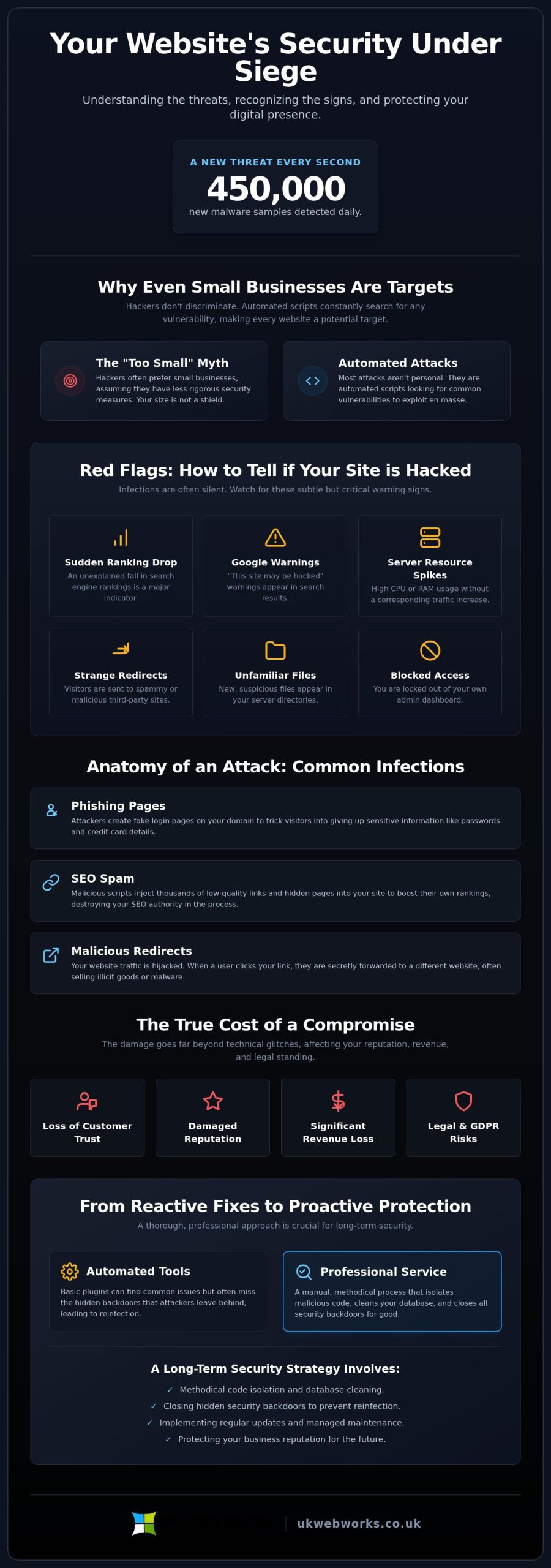
With roughly 450,000 new malware samples detected every single day, the threat to your online presence is more than just a theoretical risk. It’s a genuine challenge that can lead to Google blacklisting and a sudden drop in your search engine rankings. If you’ve discovered a security warning on your dashboard, you’re likely feeling the weight of potential data breaches and the confusion of technical jargon. Finding a reliable malware removal service for websites shouldn’t add to that stress.
We understand how much you’ve invested in your business reputation. It’s common to feel overwhelmed when your hosting provider sends a list of complex errors you don’t recognize. You want your site back, your customers protected, and your peace of mind restored. We’re here to help you cut through the noise and get your digital storefront clean and functional again.
This guide will show you exactly how to identify an infection and the specific steps required to remove it for good. You’ll learn how to restore your access to search results and implement a practical strategy to prevent future attacks. We’ll keep things simple and direct so you can focus on running your business while we handle the security.
Key Takeaways
- Learn to spot the subtle warning signs of an infection, such as sudden drops in search rankings or unfamiliar files appearing in your server folders.
- Understand why a professional malware removal service for websites offers a more thorough solution than basic automated plugins by manually closing hidden security backdoors.
- Discover our methodical restoration process that isolates malicious code and cleans your database without disrupting your website’s design or functionality.
- Shift from reactive repairs to a long-term security strategy that protects your business reputation through regular updates and managed maintenance.
What is Website Malware and Why is Your Site a Target?
Understanding What is Website Malware is the first step in reclaiming your online presence. Simply put, it’s malicious code that someone has injected into your server or content management system (CMS) without your permission. It isn’t just a simple “virus” like you might find on an old desktop computer. It’s a sophisticated set of instructions designed to exploit your website’s resources, storage, and reputation for someone else’s gain.
Many business owners in Hull and East Yorkshire assume they aren’t targets because they aren’t global corporations. This is a dangerous misconception. Hackers often prefer small, local businesses because their security measures are sometimes less rigorous. These attacks are rarely personal; they are often automated scripts looking for any vulnerable door left ajar. Modern infections are frequently “silent,” hiding deep within your database or server files. They work quietly in the background while your site looks perfectly normal to you. This is why a professional malware removal service for websites is so vital; it uncovers the threats you can’t see before they do permanent damage.
Common Types of Website Infections
Malware comes in many forms, each with a specific goal. We see everything from resource theft to identity fraud. Some of the most common issues we encounter include:
- Phishing pages: Attackers use your reputable domain to host fake login pages. They trick people into entering passwords or credit card details, making it look like your business is the one stealing information.
- SEO Spammers: These scripts inject thousands of low-quality links into your blog or create hidden pages. This helps their dodgy sites rank better while destroying your own standing with search engines.
- Malicious Redirects: Your hard-earned traffic is hijacked and sent elsewhere. When a customer clicks your link, they are automatically sent to a third-party site selling counterfeit goods or malicious software.
The Real Cost of a Compromised Website
The damage of an infection goes far beyond technical errors. The immediate loss of customer trust can take years to rebuild. If a visitor sees the dreaded “This site may be hacked” warning in search results, they will likely never return to your pages. Beyond reputation, there are serious regulatory risks to consider. If you handle customer data, a breach could lead to legal implications under UK GDPR. A compromised site is a liability that threatens your rankings, your revenue, and your legal standing. Investing in a reliable malware removal service for websites ensures that these risks are managed quickly and professionally. Protecting your business means treating security as a practical, ongoing priority rather than an afterthought.
Red Flags: How to Tell if Your Website Has Been Hacked
Detecting a hack isn’t always as obvious as a defaced homepage. Sometimes the signs are subtle; other times, they arrive as a blunt notification from Google. If you notice a sudden, unexplained drop in your search engine rankings, it’s time to investigate. Google’s primary goal is to protect its users, so if its crawlers detect malicious patterns, they won’t hesitate to demote your site or slap a “This site may be hacked” warning next to your listing. When this happens, seeking a malware removal service for websites is the fastest way to stop the bleeding and begin the recovery process.
Keep a close eye on your server’s vitals. A sudden spike in CPU or RAM usage without a matching increase in visitor traffic is a major red flag. This often happens because hackers are using your server’s power to mine cryptocurrency or send out thousands of spam emails. You might also hear from customers who report strange redirects to gambling sites or receive antivirus warnings when they try to browse your shop. For a broader perspective on protecting your company from these threats, the FTC cybersecurity guide for businesses offers excellent foundational advice on the risks small firms face.
Technical Warning Signs for Site Owners
Your Google Search Console is your best friend here. It often provides specific security notifications before you even notice a problem. Look for “ghost pages” in your index; these are URLs you never created, often filled with pharmaceutical or gambling keywords designed to hijack your SEO. You should also check your core server files. Unexplained changes to your .htaccess or wp-config.php files are classic indicators that someone has altered your site’s fundamental instructions to create a backdoor for themselves.
User Experience Indicators
Don’t ignore a sluggish website. If your pages feel slow or time out frequently for no apparent reason, malicious scripts could be hogging your resources. Keep an eye out for rogue pop-ups that aren’t part of your marketing strategy. These are often injected via compromised plugins to trick your visitors into downloading malware. Finally, check your admin logs. If you see failed login attempts from unfamiliar geographic locations, someone is likely trying to brute-force their way into your dashboard. If these signs feel familiar and you want a professional opinion, reach out for a straightforward assessment of your site’s health. A professional malware removal service for websites can identify these hidden issues before they become permanent disasters.
Automated Tools vs. Professional Malware Removal Services
It’s tempting to think a single “one-click” plugin can solve every security headache. These tools have their place as a first line of defense, but they often act as a basic smoke alarm rather than a full fire brigade. For a thorough cleanup, a professional malware removal service for websites provides a level of scrutiny that software simply cannot match. Automated scanners look for known patterns, but hackers are constantly evolving their methods to bypass these digital gatekeepers. If an infection is new or custom-made for your site, a standard scanner will likely walk right past it.
This in-depth guide to website malware highlights how complex these infections can be, often requiring more than a simple scan to resolve. While software relies on a database of historical threats, a human expert uses logic and experience to find anomalies. We look for the “why” and the “how” behind a breach, not just the symptoms appearing on your homepage. This distinction is vital for business owners who need to ensure their site stays clean long after the initial repair is finished.
When Automated Scanners Fail
Scanners often struggle with “obfuscated” code. This is malicious script hidden within what looks like legitimate, standard code. If a scanner doesn’t recognize the specific signature of a virus, it won’t flag it, leading to a dangerous false negative. Data from 2025 shows that 82% of cyberattack detections were actually malware-free, relying instead on stolen credentials and legitimate tools. A plugin won’t tell you if a hacker has compromised an admin account and is simply logging in as you. Furthermore, automated tools rarely fix the underlying vulnerability, meaning you could be reinfected within minutes of a “successful” scan.
The Value of a Professional UK-Based Expert
Working with a dedicated specialist means you’re collaborating with someone who understands the architecture of your specific build. Whether you have a WordPress site or a bespoke responsive design, a human expert performs a comprehensive database cleanup that most plugins ignore. We don’t just delete the infected files; we find the backdoor that let the attacker in. Closing these entry points is the only way to prevent immediate reinfection. You get direct communication and a partner who values the long-term health of your Hull or East Yorkshire business. We treat your website with the craftsmanship it deserves, ensuring every line of code is exactly where it should be.
Our Straightforward Process for Cleaning and Restoring Your Website
Many hosting providers suggest restoring your site from a recent backup as the primary fix for an infection. While this sounds like a simple solution, it’s often a temporary one. If the vulnerability existed when that backup was created, you are simply restoring the hacker’s entry point along with your files. A professional malware removal service for websites involves a much more methodical, manual cleanup that addresses the root cause. We don’t just roll back the clock; we fix the underlying issues to ensure your site stays secure for the long term.
Our process is designed to be thorough yet minimally disruptive. We understand that your website is a vital tool for your business in Hull or East Yorkshire, and downtime costs money. We work quietly in the background to isolate threats without damaging your site’s functionality or design. By the time we are finished, your code will be cleaner and your site more resilient than it was before the attack. This isn’t about a quick patch; it’s about a complete restoration of your digital integrity.
Step 1: The Deep-Clean Phase
We begin by auditing your entire environment, including all files, databases, and server logs. We manually review your file structure to identify suspicious modifications that automated scanners frequently miss. For businesses using WordPress CMS development or Shopify ecommerce stores, the database is a common hiding spot for malicious scripts. We meticulously clean your SQL database, removing injected code and any unauthorized admin users. To finish this phase, we reset every password and security key across your hosting and CMS to lock out the intruders for good.
Step 2: Hardening and Verification
Once the site is clean, we focus on “hardening” your defenses. This means patching vulnerabilities in your CMS core, themes, and third-party plugins that allowed the breach in the first place. We implement server-level firewalls and security headers to block future attacks. Before we consider the job done, we test your site’s core functions. We check that your contact forms, checkout processes, and login areas are working exactly as they should. Finally, we handle the technical submission to Google and Bing to clear any security warnings and restore your search engine rankings.
If your site is currently displaying warnings or behaving strangely, don’t wait for the damage to spread. Contact us today for a professional site restoration and get your business back on track with a clean, secure website.
Beyond the Clean-up: Protecting Your Site with Managed Maintenance
Cleaning your site is a huge relief, but it isn’t the end of the story. Think of it like repairing a broken window after a burglary; the repair is essential, but you also need to look at why the window was easy to break in the first place. A one-time malware removal service for websites gets you back on your feet, but managed maintenance keeps you there. Without a plan for regular updates and constant monitoring, most sites remain vulnerable to reinfection within a matter of weeks. A professional malware removal service for websites provides a clean slate, but long-term security requires a proactive mindset.
In the same way that you might check out EFW Plastering & Rendering to ensure your building’s exterior is professionally rendered and protected, your digital storefront requires specialized care to remain secure and professional.
We believe in building a digital environment where security is a standard feature rather than an emergency response. This means shifting your focus from reactive repairs to preventative care. When you treat your website as a living asset that requires regular attention, you significantly reduce the risk of future downtime. It’s about protecting your hard-earned reputation and ensuring your customers always have a safe place to interact with your brand.
The Role of Ongoing Website Maintenance
Preventative patching is your best defense against modern threats. Hackers often rely on known vulnerabilities in WordPress plugins, Shopify apps, or bespoke code libraries. When developers release an update, they’re frequently closing a security hole that has already been discovered. If you don’t apply that update immediately, you’re leaving a door wide open for automated scripts. We also prioritize regular off-site backups. If a worst-case scenario occurs, having a “clean” version of your site stored safely away from your main server is a lifesaver. This ensures we can restore your business operations in hours rather than days. Continuous monitoring for uptime and suspicious login attempts adds that final layer of protection you need for peace of mind.
Local Support for Hull and Yorkshire Businesses
There is a massive advantage to having a local expert you can actually call when things go wrong. We don’t hide behind a faceless support ticket system or a distant corporate office. We understand the specific market in Hull and East Yorkshire, and we value the long-term relationships we build with our clients. We see ourselves as an extension of your team, someone who is genuinely invested in your success.
Security isn’t just a technical hurdle; it’s a vital part of your SEO strategy. A secure site is a fast, reliable site that search engines trust to show to their users. To ensure your digital investment stays protected, you can explore our website maintenance packages. These plans are designed to take the technical weight off your shoulders. We handle the updates, the monitoring, and the security hardening so you can focus on running your business. We’re here to be your ongoing digital partner, providing the honest, practical support you need to grow online safely.
Secure Your Digital Reputation Today
A compromised website is a stressful challenge, but it doesn’t have to be a permanent setback for your business. We’ve explored how identifying red flags early and choosing a professional malware removal service for websites over basic automated tools can save your search rankings and customer trust. Remember that a thorough cleanup is about more than just deleting files; it’s about closing the security gaps that let attackers in for good.
By choosing an expert partner who understands the local Hull and Yorkshire market, you get a no-nonsense approach to complex technical problems. We provide fixed-price security audits and direct support to ensure your site stays clean and functional. You don’t have to navigate these digital threats alone. We’re here to act as your ally, making sure your digital storefront remains a safe and reliable place for your customers.
Ready to restore your peace of mind? Get a jargon-free quote for professional malware removal and let’s get your website back to its best. We’re here to help you build a secure, reliable presence online that you can be proud of.
Frequently Asked Questions
How long does it take to remove malware from a website?
A thorough cleanup usually takes between 24 and 48 hours to complete. While we can often get your site back online quickly, we take the extra time to manually inspect every file and database entry. This ensures that hidden backdoors are closed and your business is fully protected before the site is cleared for public use.
Will my website lose its Google rankings after being hacked?
Your search rankings will likely suffer if Google detects malicious activity and flags your domain. The good news is that these rankings can be restored once the threat is neutralized. A professional malware removal service for websites helps you navigate the recovery process by verifying the cleanup with search engines and requesting the removal of security blacklists.
Can I just restore a backup to fix a malware infection?
Restoring a backup is often a temporary fix that fails to address the root cause of the breach. If the vulnerability that allowed the hack existed when the backup was created, the attacker will simply use that same entry point to reinfect your site. You must patch the security hole and clean the current environment to ensure the problem doesn’t return immediately.
What is the “This site may be hacked” warning and how do I remove it?
This is a security notice Google displays in search results to warn users that your site might contain malicious code. To remove it, you need to perform a complete security audit and cleanup of your site files and database. Once the site is secure, you can submit a review request through Google Search Console to have the warning lifted.
Is it possible for malware to reinfect my site after it has been cleaned?
Reinfection is highly likely if you only remove the symptoms and ignore the underlying security flaws. True protection involves “hardening” your site by updating your CMS, patching plugins, and resetting all access credentials. Professional cleaning should always be followed by a managed maintenance plan to keep your defenses up to date against new threats.
Do I need to change my hosting provider if my site gets hacked?
You don’t always need to switch providers, but a hack is a good time to evaluate your current hosting environment. If your provider offers little support or lacks server-level firewalls, moving to managed web hosting can provide a much-needed layer of security. A host that understands the needs of local businesses can be a valuable ally in preventing future issues.
How much does a professional malware removal service cost?
The cost of a professional malware removal service for websites depends on the depth of the infection and the complexity of your site architecture. We avoid hidden fees by providing clear, direct quotes based on your specific situation. Choosing a professional service is a practical investment in protecting your business reputation and securing your long-term revenue. To help manage your broader business finances and tax planning, you can visit Qalqlet to access their comprehensive suite of online calculators.