
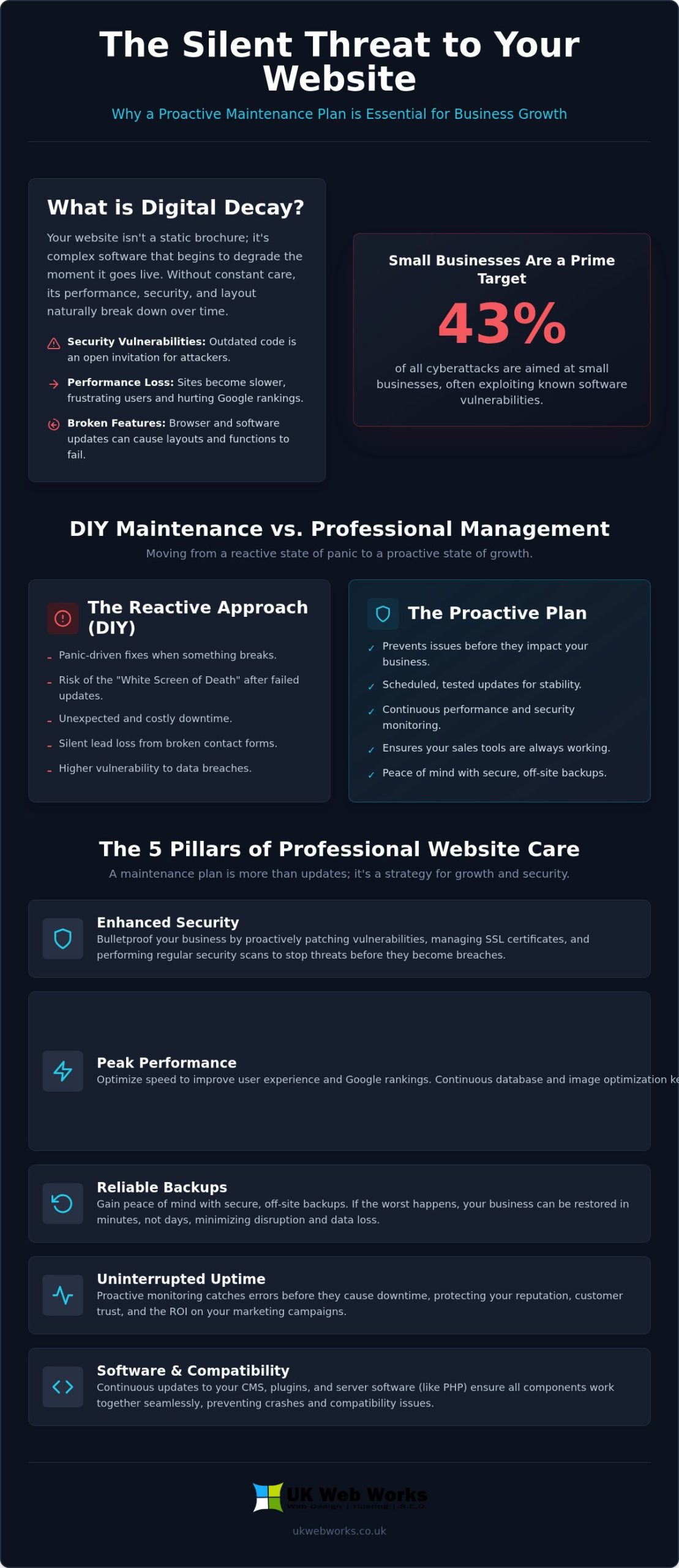
Your website isn’t a static digital brochure; it’s a complex piece of software that begins to decay the moment it goes live. If you’ve ever felt overwhelmed by technical talk about PHP versions or felt that familiar sting of worry about a potential data breach, you aren’t alone. In fact, research shows that 43% of cyberattacks now target small businesses. Understanding the real benefits of a website maintenance plan is the first step toward moving from a reactive state of panic to a proactive state of growth. It’s about more than just clicking an update button; it’s about ensuring your primary sales tool remains secure and efficient.
We agree that you shouldn’t have to be an IT expert to run a successful online business. You deserve the peace of mind that comes with knowing your site is in professional hands. This guide will show you how a dedicated maintenance strategy protects your hard-earned reputation while keeping your site fast enough to satisfy both Google and your customers. We’ll look at the latest WordPress 7.0 requirements, the truth about security patches, and how consistent care ensures you’re never left stranded when something goes wrong.
Key Takeaways
- Learn why modern websites aren’t “set and forget” assets and how to stop technical decay from hurting your brand.
- Discover the long-term benefits of a website maintenance plan for strengthening security and boosting your site’s performance.
- Understand the hidden costs of DIY management and how to avoid the “White Screen of Death” when updates go wrong.
- Identify the essential components of a professional care plan, including secure off-site backups and proactive software updates.
- Find out why a local, bespoke approach provides the accountability and tailored support your business needs to grow.
Understanding Digital Decay: Why Websites Are Not “Set and Forget” Assets
Many business owners believe that once their website is launched, the hard work is over. In reality, a website is more like a high-performance vehicle than a static brochure. It requires regular tuning to remain functional. We call the alternative “Digital Decay.” This is the natural degradation of your website’s performance, security, and layout that happens when software is left to age without intervention. Because modern websites are complex ecosystems of interconnected plugins, themes, and server software, a change in one area can easily break another.
If you’re running a business in Hull or East Yorkshire, your digital reputation is often your first point of contact with local customers. A broken layout or a slow-loading page doesn’t just look unprofessional; it tells your audience that you’ve stopped paying attention. One of the greatest benefits of a website maintenance plan is that it prevents this decay from taking root, ensuring your site remains a reliable asset rather than a liability.
The Myth of the “Finished” Website
The day your site goes live is actually the beginning of its lifecycle. The digital environment is constantly shifting. Web browsers like Chrome and Safari receive updates almost every month, and your site must adapt to these changes to display correctly. Without oversight, a site that looked perfect in January might look cluttered or broken by June. Software compatibility refers to the ability of your CMS, such as WordPress, to run smoothly alongside the latest PHP server versions and browser standards without functional errors. Professional Web development involves a continuous cycle of testing and refining to meet these evolving standards.
The High Price of Unplanned Downtime
While industry giants like IBM report that downtime can cost large enterprises upwards of $400,000 per hour, the impact on a local UK business is just as severe relative to its size. If your site goes down, you aren’t just losing visibility; you’re losing money in real-time. This is especially true if you are running a local marketing campaign. Imagine spending your hard-earned PPC budget to drive traffic to a site that won’t load or a contact form that fails silently. These “invisible” costs are often the most damaging because you don’t even know you’re losing leads. A proactive maintenance plan acts as an early warning system, catching these errors before they affect your bottom line or your Google rankings.
The Core Benefits of a Managed Website Maintenance Plan
A well-managed plan does more than just keep the lights on. It transforms your website from a passive digital address into a high-performing business tool. When we talk about the benefits of a website maintenance plan, we’re looking at five critical pillars: security, performance, search visibility, user experience, and legal compliance. Each of these factors directly influences how much trust your customers place in your brand and, ultimately, how many sales you make.
Bulletproofing Your Business Against Cyber Threats
Cybersecurity isn’t just for global corporations. In 2026, automated bots crawl every corner of the web looking for outdated software versions to exploit. Proactive maintenance moves you beyond simple “hacking” protection to a strategy of vulnerability patching. This includes managing your SSL certificates and performing regular security scans to identify risks before they become breaches. Following essential security practices ensures your site isn’t an easy target. The Cyber Essentials standards start with basic maintenance as a foundation for business safety. We also insist on secure, off-site backups. If the worst happens, you need to know you can restore your business in minutes, not days.
Speed as a Competitive Advantage
Google doesn’t just care about what you say; it cares about how fast you say it. Core Web Vitals are now a primary ranking factor for businesses in Leeds, Hull, and throughout Yorkshire. Research shows that 53% of mobile visitors will leave a page that takes longer than three seconds to load. Ongoing tasks like database optimisation and image compression keep your site lean. For ecommerce shop owners, every fraction of a second saved results in lower bounce rates and higher conversion. Speed isn’t a one-time fix. It’s an ongoing commitment to efficiency.
GDPR and Data Integrity
UK law is strict about data protection. Outdated plugins and CMS versions often create “backdoors” that hackers use to access customer information. Under the Data Protection Act 2018, you’re responsible for keeping user-facing forms secure. One of the overlooked benefits of a website maintenance plan is the “paper trail” it provides. If a compliance audit ever occurs, you can prove you’ve exercised due diligence by keeping your software current and your security protocols active. It’s about protecting your customers as much as your company. If you’re unsure if your current setup meets these standards, you can speak with a specialist about your site’s health to find a straightforward solution.
The Hidden Costs: DIY Maintenance vs. Professional Management
Many business owners start out by managing their own updates. It seems like a simple way to save money. However, this often leads to a “false economy” where the time you spend troubleshooting technical issues far exceeds the cost of professional help. When you handle things yourself, you’re essentially taking on a second job as a part-time web administrator. One of the clearest benefits of a website maintenance plan is that it hands those technical headaches to specialists, allowing you to focus on your actual trade.
The Time-Cost Analysis for Yorkshire Business Owners
Maintaining a modern site involves a repetitive cycle of tasks. You need to verify backups, check for security vulnerabilities, and test every update for compatibility. If you’re spending 5 to 10 hours a month in the back end of your site, you’re losing valuable time that could be spent on client work or strategy. Research from Pew Research on Digital Decay highlights how easily online content can become inaccessible or “broken” without consistent oversight. Investing in a professional website maintenance package isn’t just a cost; it’s a way to reclaim your schedule and ensure your digital presence doesn’t simply vanish or degrade over time.
When DIY Goes Wrong: The Emergency Repair Bill
The real trouble usually starts with a single click. We’ve seen many business owners encounter the “White Screen of Death” after a routine plugin update went wrong. When your site crashes, you’re suddenly facing emergency repair rates from developers who don’t know your history. These one-off fix costs are almost always higher than a steady monthly retainer. Professional management avoids this by using staging environments. We test every update in a safe, private copy of your site before it ever touches your live shop. This proactive approach includes access to premium monitoring software and specialist tools that would be too expensive for a single business to license individually. You gain a digital ally who understands your specific goals and stands ready to help when things get complicated.
What a Professional Maintenance Plan Should Include
Not all support plans are created equal. Some providers simply run an automated script once a month, while others act as a dedicated extension of your team. To truly realise the benefits of a website maintenance plan, the service must cover both technical stability and proactive growth. A comprehensive plan acts as a safety net that catches small errors before they become expensive failures.
At a minimum, your plan should include these five pillars:
- Regular Core and Plugin Updates: This is the foundation. It ensures your CMS and its various features remain compatible with the latest security standards.
- Secure Cloud Backups: We never store backups on the same server as your website. Daily or real-time copies are kept off-site so your data is always recoverable.
- Uptime Monitoring: Your provider should know your site is down before you do. Modern monitoring tools send alerts within minutes of any interruption.
- Content Support: A site that never changes feels abandoned. Good plans include time for small tweaks to text, swapping images, or uploading new blog posts.
- Monthly Reporting: You deserve to see where your money goes. These reports should be jargon-free summaries of updates performed and overall site performance.
The Technical Essentials Checklist
There are several non-negotiable items that separate a basic service from a professional one. This includes active SSL management, continuous malware scanning, and robust spam filtration for your contact forms. It is also where we distinguish “managed hosting” from “standard hosting.” Standard hosting simply gives you a space on a server. Managed hosting provides a fine-tuned environment specifically optimised for your site’s software. When your technical health is aligned with a specialist SEO agency hull, you ensure that every technical update also supports your search engine rankings.
Strategic Support and Consultation
A maintenance partner should be more than just a helpdesk. They should be a consultant who keeps you informed about new digital trends and features that could benefit your business. Regular “Health Checks” help identify potential bottlenecks in your user journey before they affect your sales. We value a straight-talking approach. If a new feature is useless or likely to slow down your site, your partner should have the integrity to tell you no. This honest collaboration is what builds long-term success. If you want to see how a tailored strategy can protect your business, you can enquire about our maintenance plans today for a straightforward, no-obligation chat.
Choosing a Maintenance Partner in Hull and East Yorkshire
When you’re looking for someone to look after your business’s most important digital asset, accountability is everything. It’s one thing to have a support email for a company on the other side of the world, but it’s another thing entirely to be able to pick up the phone and speak to a human in your own time zone. In Hull and East Yorkshire, we value directness and reliability. One of the main benefits of a website maintenance plan with a local partner is the knowledge that your site isn’t just another ticket in a generic system. You’re working with people who understand your local market and are genuinely invested in your success.
We believe in a bespoke approach. One-size-fits-all plans often force you to pay for features you don’t need or leave out the ones you do. At UK Web Works, we focus on expert craftsmanship and simplicity. Whether your site is currently “broken” after a bad update or has simply been neglected for a few years, the transition to a managed plan is straightforward. We start by stabilising your current setup, cleaning up any underlying errors, and then moving into a proactive rhythm of care. It’s about taking the weight off your shoulders so you can get back to running your business.
Questions to Ask a Potential Web Agency
Before you sign any contract, you need to know exactly how your site will be protected. Ask about their backup frequency and their “Time to Recovery” (TTR) guarantees. If the server fails, how quickly can they have you back online? You should also inquire if updates are automated or manually tested by a human developer. Automated updates are risky because they don’t account for visual “breaks” on the front end of your site. Finally, check if you’ll have a dedicated contact. You want a partner who knows your history, not a generic support ticket system that treats you like a stranger.
Building a Long-Term Digital Partnership
Maintenance is rarely an end in itself; it’s the first step toward a broader digital marketing agency hull strategy. Once your site is technically sound, secure, and fast, you have a solid foundation for growth. This is where the “Hull sensibility” comes in. We work with you to ensure that every technical tweak supports your long-term commercial goals. We’ve seen how the benefits of a website maintenance plan extend far beyond code; they provide the confidence you need to invest in SEO or PPC, knowing your site can handle the traffic and convert those visitors into customers.
If you’re tired of worrying about your site’s health or wondering if your plugins are out of date, let’s have a no-obligation chat. We can take a look at your current setup and give you a straight-talking assessment of what’s needed to keep your business moving forward. It’s a simple, honest way to protect your digital investment for the long term.
Securing Your Digital Future
Your website is the engine of your business. Leaving its health to chance is a risk you don’t need to take. We’ve explored how proactive care prevents digital decay and why local expertise is the most reliable way to maintain your online reputation. Understanding the real benefits of a website maintenance plan means moving away from the “set and forget” mindset. It’s about ensuring your site stays fast, secure, and compliant without you having to touch a single line of code.
Since 2014, our team has provided bespoke WordPress and ecommerce support for businesses across Hull and Yorkshire. We don’t hide behind technical jargon; we offer straight-talking advice that helps you grow. If you’re ready to stop worrying about updates and start focusing on your trade, we’re here to help. View our jargon-free Website Maintenance Packages to see how we can protect your digital investment. Let’s keep your business moving forward.
Frequently Asked Questions
Is website maintenance really necessary if my site is working fine?
Yes, maintenance is essential because software updates are released constantly to patch security holes you can’t see. Even if your site appears fine on the surface, outdated plugins or themes make it a target for automated bots. One of the greatest benefits of a website maintenance plan is that it prevents small, invisible issues from turning into a total site crash that costs thousands to repair.
Can I do my own website maintenance to save money?
You can handle your own updates, but it’s often a false economy for busy business owners. Spending several hours a month troubleshooting technical conflicts takes you away from your actual work. If an update goes wrong and breaks your layout, you’ll end up paying emergency rates for a developer to fix it. Professional management provides a safer, more cost-effective alternative.
How much does a website maintenance plan typically cost in the UK?
Costs for maintenance vary depending on the complexity of your site and the level of support you need. A simple brochure website requires less time than a busy WooCommerce shop with hundreds of products. Most plans are structured as a monthly investment that scales with your traffic and technical requirements. We focus on providing a bespoke service that ensures you only pay for the care your specific site needs.
What happens if my website gets hacked while on a maintenance plan?
If a security breach occurs, our priority is immediate restoration from a clean, off-site backup. We identify how the entry happened, patch the vulnerability, and get your business back online as quickly as possible. Having a professional team ready to act provides peace of mind that a hack won’t lead to permanent data loss or weeks of downtime for your brand.
Will a maintenance plan help my Google rankings (SEO)?
It certainly will. Google prioritises sites that are fast, secure, and reliable. By keeping your software updated and your database optimised, a maintenance plan ensures you meet the technical standards required for high rankings. Consistent uptime and the use of an SSL certificate are also critical factors that tell search engines your site is a safe place to send visitors.
How often should a website be updated and backed up?
Backups should happen at least once a day, though ecommerce stores often require real-time backups to protect customer order data. We typically review and apply software updates on a weekly or monthly basis. However, if a critical security patch is released for a major plugin or the WordPress core, we apply those changes immediately to keep your site bulletproof against new threats.
What is the difference between web hosting and website maintenance?
Think of web hosting as the digital plot of land where your site lives. It keeps your files accessible on the internet. Website maintenance is the ongoing care of the “building” on that land. While hosting keeps the lights on, maintenance ensures the plumbing and security are working, the windows aren’t broken, and the entire structure is safe for your customers to enter.
Can you maintain a website that was built by another agency?
We frequently take over the management of sites built by other developers. Our process begins with a comprehensive health check to understand how your site was put together and identify any immediate risks. Once we’ve stabilised the environment and cleaned up any legacy issues, we move you onto a managed plan that provides the long-term reliability you’ve been looking for.