
Did you know that 96% of UK businesses targeted by cyberattacks are small or medium sized firms? It’s a sobering reality in 2026, yet many owners still view digital upkeep as an optional extra. The true cost of not maintaining your website often stays hidden until a critical failure occurs, turning a small saving into a massive liability. You might feel that if the site looks fine today, it’ll be fine tomorrow, especially when technical jargon like PHP versions or SSL renewals feels like a different language.
We understand that frustration. It’s easy to see website care as just another bill, but neglecting your digital presence is a false economy that leads to reputational disasters and wasted marketing spend. In this guide, you’ll discover how to turn your site into a secure, fast asset that actually generates leads. We’ll break down the impact of the 2026 Cyber Security and Resilience Bill and show you how predictable digital overheads can provide the peace of mind you need to focus on your actual work.
Key Takeaways
- Learn why saving a small amount on monthly upkeep is a false economy that often leads to thousands in emergency repair bills.
- Understand how outdated plugins act as an entry point for automated attacks and what you need to do to stay compliant with new UK security laws.
- Discover the hidden cost of not maintaining your website, including how slow loading speeds can cause local customers to choose your competitors instead.
- See how predictable maintenance fees provide peace of mind by preventing the downtime that wastes your marketing budget and staff productivity.
Why Skipping Website Maintenance is a False Economy
Maintaining a website is the ongoing process of checking for performance issues, fixing software bugs, and applying security updates. It’s the engine room of your digital presence. Too often, business owners treat their site as a “set and forget” project. This mindset is dangerous in 2026 because the digital environment moves too fast for a static approach. A site that isn’t actively managed is a site that’s slowly breaking.
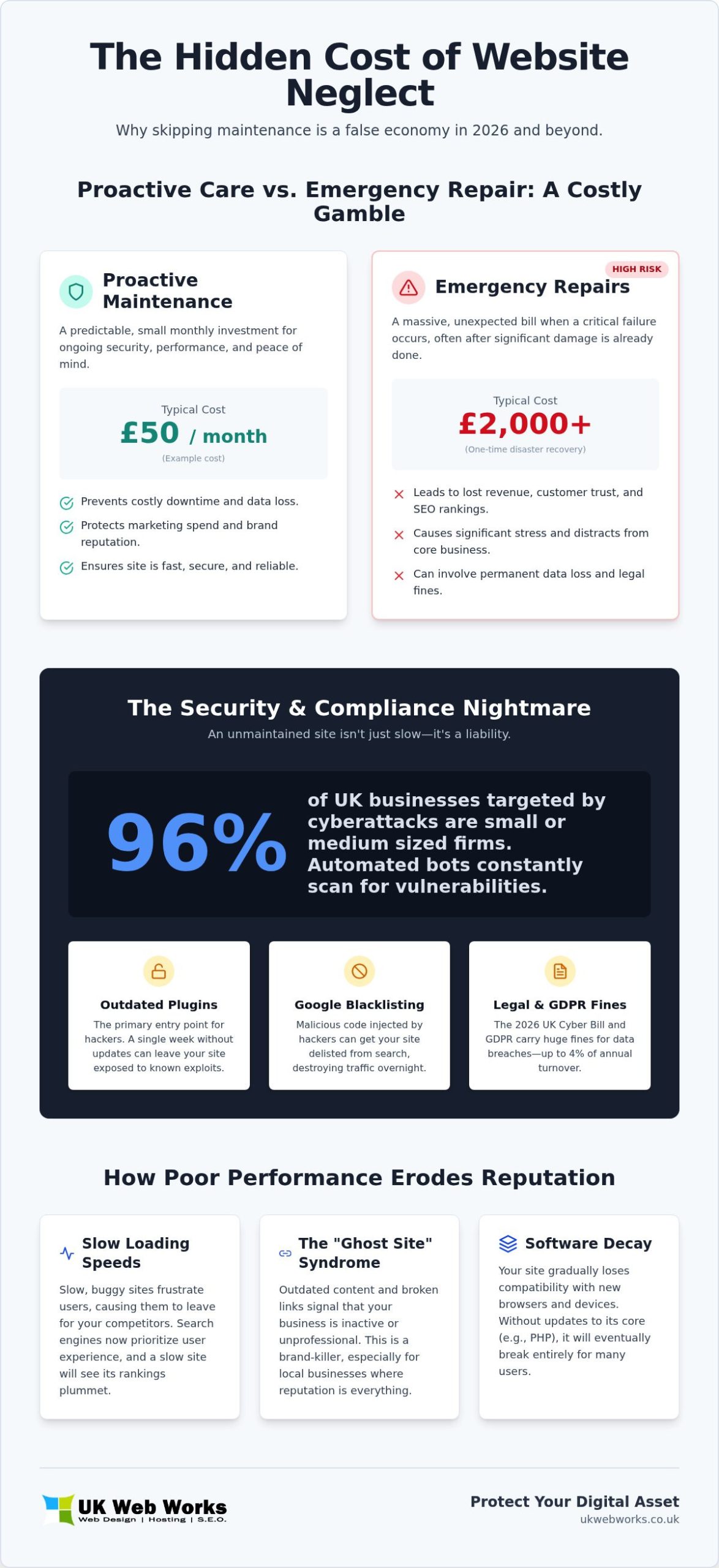
The cost of not maintaining your website becomes painfully clear when you look at the numbers. This is the definition of a false economy. You might save a small amount each month by opting out of a professional plan, but you’re effectively self-insuring against a disaster. Saving £50 today only to spend £2,000 on emergency repairs later isn’t a bargain. It’s a significant financial risk that also costs you sleep and peace of mind.
Search engines now prioritise user experience as a core ranking factor. If your site is slow, buggy, or insecure, your visibility will plummet. Proactive maintenance isn’t just a technical task; it’s a vital part of your marketing strategy. It ensures that every penny you spend on SEO or social media isn’t being poured into a leaky bucket. By choosing a proactive growth strategy over a “launch and forget” mindset, you protect your investment and your brand.
The “Ghost Site” Syndrome
Outdated content and broken links signal to potential customers that your business is inactive. In regions like Yorkshire, where local reputation is everything, a neglected site can be a brand killer. Customers expect a professional, responsive experience. If they encounter errors, they’ll assume your service is equally sloppy. A site that looks fine on the surface can still be failing in the background, quietly driving away leads because of hidden technical glitches that frustrate users.
Software Decay and the 2026 Tech Stack
Platforms like WordPress and Shopify require regular updates to stay secure. As these systems evolve, older versions become easy targets for automated attacks. Maintaining site stability also requires monitoring server-side updates, such as PHP and MySQL versions. Software decay is the gradual loss of compatibility between a website and modern web browsers. Without a clear web governance framework, your site will eventually lose its ability to function correctly on the devices your customers use every day.
The Security and Compliance Nightmare of a Neglected Site
Automated bot attacks don’t discriminate based on your turnover or industry. In fact, 96% of all UK businesses targeted by cyberattacks are small and medium sized firms. These bots constantly scan the web for vulnerabilities, and an unmaintained site is like leaving your front door wide open. When you ignore the cost of not maintaining your website, you aren’t just risking a slow page; you’re risking a total security collapse.
Outdated plugins remain the primary entry point for hackers. By 2026, the complexity of the modern tech stack means that even a single week without updates can leave you exposed to known exploits. Following Cybersecurity best practices is no longer optional. If a hacker gains access, they can inject malicious code that redirects your traffic or steals customer data. This leads to the “Blacklist” effect, where Google removes your site from search results overnight to protect users. Reclaiming your rankings after being blacklisted is a long, expensive process that can take months of technical work.
Legal compliance has also become more stringent. The UK’s Cyber Security and Resilience Bill, introduced in 2026, mandates much stricter incident reporting. If you suffer a breach, you may be required to notify authorities within 24 hours. Combined with UK GDPR, which carries fines of up to £17.5 million or 4% of annual turnover, the financial stakes of neglect are higher than they’ve ever been.
Beyond the Padlock: SSL and Encryption
An expired SSL certificate is a death sentence for user trust. In 2026, browsers have shifted toward even more aggressive warnings, often blocking access to unmaintained sites entirely with full-screen “Not Secure” alerts. This isn’t just about the padlock icon anymore; it’s about basic accessibility. Our managed hosting and maintenance services ensure these certificates never lapse, keeping your site open for business. If you’re worried about your current security status, you can always reach out to us for a direct assessment.
Data Backups: Your Digital Safety Net
Many business owners assume their host handles everything, but there’s a vital difference between host-level backups and dedicated maintenance backups. A host-level backup might be stored on the same server as your site; if the server fails, the backup goes with it. We recommend off-site, automated backups that are regularly tested for restoration. Having a file is useless if it doesn’t actually work when you need it. Our website maintenance packages provide this automated safety net, ensuring your data is secure and recoverable within minutes, not days.
Maintenance Fees vs. The Massive Bill for Emergency Repairs
When you look at your monthly outgoings, a maintenance plan might seem like a line item you can cut. However, the cost of not maintaining your website usually manifests as a sudden, massive financial shock rather than a slow drain. Think of it like a boiler service versus an emergency call-out on a freezing winter night. One is a manageable, scheduled expense; the other is a premium-rate crisis that demands immediate payment and causes total disruption.
Emergency repairs are expensive because they require a developer to drop their current projects and perform digital surgery. Most professional agencies in Hull and Leeds prioritise their maintenance clients first. If you’re an ad-hoc customer with a crashed site, you’ll likely face higher hourly rates and a longer wait for a fix. While your site is down, you aren’t just paying for the repair. You’re also losing potential sales and wasting money on Pay Per Click (PPC) advertising that’s sending traffic to a broken page. Your staff’s productivity also drops while they wait for the tools they need to do their jobs.
Cleaning up a malware infection is significantly more complex than applying a simple security patch. It involves scanning thousands of files, removing malicious code, and verifying that the site is clean before Google will lift its warning. This process can take hours or even days of specialist work. In contrast, a proactive maintenance plan prevents these infections from happening in the first place by keeping your software current and your firewalls active.
Predictable Overheads vs. Financial Shocks
A fixed-price maintenance plan makes annual business budgeting straightforward. You know exactly what’s going out each month. Without this, you’re vulnerable to what we call the Recovery Tax. Neglect introduces this tax because it often takes five times longer to repair a site that hasn’t been updated for a year compared to one that’s kept current. At UK Web Works, we provide jargon-free support so you aren’t surprised by hidden fees or technical excuses when you need help most.
The Longevity of Your Digital Asset
Regular care extends the life of your online presence. Technical neglect eventually leads to the Complete Rebuild trap, where the code becomes so outdated that it’s cheaper to start again than to fix the existing problems. Protecting your investment in bespoke web design hull requires consistent updates. Quality builds deserve quality care to remain functional and profitable for years to come. Ignoring the cost of not maintaining your website leads to this trap, where a simple update turns into a total system failure.
How Poor Performance Erodes Your Local Reputation
Your website is often the first point of contact for a customer in Hull or York. In a fast-paced digital market, patience is a rare commodity. Research shows that 53% of mobile users will leave a page if it takes longer than three seconds to load. This “3-Second Rule” is a harsh reality for local businesses. If your site is sluggish because of bloated code or unoptimised images, you’re effectively handing your customers to the competition. This hidden loss of business is a major part of the cost of not maintaining your website.
Local search results are now more competitive than ever. Google prioritises sites that offer a seamless experience, especially on mobile devices. If your site isn’t responsive or takes too long to respond, your rankings will inevitably slip. You might be investing in growth, but even the most talented SEO agency Hull can’t fix the damage caused by a fundamentally broken or slow website. Maintenance ensures that your technical foundation remains strong enough to support your marketing goals.
User Experience (UX) as a Competitive Advantage
Broken features are silent conversion killers. A contact form that doesn’t send or a checkout button that hangs doesn’t just lose you one sale; it loses you a customer’s lifetime value. Regular performance monitoring keeps these interactive elements working exactly as they should. It’s important to understand that in 2026, Google’s Core Web Vitals are a primary ranking factor for local businesses. If you don’t meet these speed and stability standards, you’re invisible to a large portion of your local market.
- Snappy Interactions: Fast-loading pages keep users engaged and reduce bounce rates.
- Functional Forms: Regular testing ensures your primary lead generation tools never fail.
- Mobile Excellence: 58% of all web traffic now comes from mobile devices; your site must be ready.
Local Trust and Digital Professionalism
In East Yorkshire, your reputation is your most valuable asset. A fast, functional site reflects the quality and reliability of your physical services. If a potential client visits your site and finds it “feels” broken or unsafe, they’ll naturally worry that your business is equally neglected. This psychological barrier is hard to overcome once it’s established. Any digital marketing agency hull will tell you that driving traffic is only half the battle. You need a maintained, professional site to convert that traffic into revenue and drive a real ROI. To ensure your site is representing your business correctly, book a performance review with our team today.
Choosing a No-Nonsense Maintenance Plan with UK Web Works
We believe that website maintenance should be straightforward and effective. Our approach is built on a foundation of local reliability and professional integrity. We don’t hide behind complex technical terminology or use high-pressure sales tactics. Instead, we act as a trusted consultant for your business. By now, it’s clear that the cost of not maintaining your website far outweighs the modest investment of a managed plan. We focus on the technical “heavy lifting” so you can focus on running your business.
When you partner with us, you get a dedicated team right here in Hull. You won’t be dealing with a distant corporate entity; you’ll be speaking with specialists who understand the Yorkshire market. Our maintenance plans are designed to integrate seamlessly with our bespoke web development and managed web hosting services. This creates a unified digital strategy where every update and security patch is handled with care. We provide a comprehensive service that includes:
- Security Patches: Immediate application of critical updates to close vulnerabilities before they can be exploited.
- Performance Monitoring: Constant checks to ensure your site stays fast and meets the 3-second loading rule.
- Regular Backups: Automated, off-site backups that are tested to ensure they actually work when needed.
- Software Updates: Managing the evolution of your CMS and server-side software to prevent software decay.
Our Jargon-Free Guarantee
One of the biggest barriers for business owners is the confusing language used in the tech industry. We’ve made it our mission to provide a jargon-free guarantee. We’ll always explain what we’re doing and, more importantly, why it matters to your bottom line. There are no hidden fees or complex technical barriers here. We provide honest, straightforward support to businesses across Hull, York, and Leeds. Our goal is to help you stay online, secure, and profitable without the headache of managing the technical details yourself.
Next Steps: Protecting Your Investment
Transitioning from a neglected site to a managed plan is simpler than you might think. We start by assessing your current setup and identifying any immediate risks or performance bottlenecks. From there, we move you onto a structured plan that provides immediate protection and long-term stability. This isn’t just about fixing bugs; it’s about professional digital stewardship. You’ll gain the peace of mind that comes with knowing your most important marketing asset is in safe hands. If you’re ready to stop worrying about hackers or slow load times, view our website maintenance packages today and take the first step toward a more secure digital future.
Secure Your Digital Future Today
Your website is much more than a digital business card; it’s the primary engine of your local growth. We’ve explored how easy it is to fall into the trap of neglect, but the financial and reputational cost of not maintaining your website is simply too high to ignore in 2026. By shifting from a reactive “break-fix” mindset to a proactive maintenance strategy, you protect your business from automated cyber threats and ensure your customers always find a fast, functional site that they can trust.
Since 2014, we’ve provided bespoke designs and straight-talking support for businesses across East Yorkshire. We believe in high-quality production without the technical fluff. Whether you’re worried about the latest security regulations or just want a site that stays snappy for your visitors, we’re here to do the heavy lifting for you. It’s about having a reliable partner who values your long-term success as much as you do.
Ready to trade technical headaches for predictable digital overheads and peace of mind? Get a jargon-free website maintenance quote from UK Web Works and let’s keep your business moving forward. We look forward to helping you grow.
Frequently Asked Questions
How much does website maintenance cost in the UK for 2026?
Industry rates for maintenance vary widely depending on the complexity of your site and its traffic levels. A basic brochure site requires less intensive care than a complex e-commerce shop processing thousands of transactions. Instead of focusing on a single number, consider that the cost of not maintaining your website often includes lost revenue and high emergency fees. Most businesses find that a managed plan is a small price to pay for consistent site health.
Can I maintain my own WordPress website to save money?
While it’s possible to handle your own WordPress updates, it often becomes a false economy for busy business owners. Technical conflicts between plugins can break your site’s design or functionality without warning. If you don’t have the time to test backups or monitor security logs daily, you might miss a critical issue until it’s too late. Professional maintenance ensures these tasks are handled correctly without taking you away from your actual work.
What happens if my website is hacked because I didn’t update it?
If your site is compromised, the immediate impact is often a total loss of search engine visibility. Google and other browsers will display a prominent warning to users, which destroys your brand’s credibility overnight. You’ll then face the high cost of emergency digital forensics and cleanup. Additionally, under the 2026 Cyber Security and Resilience Bill, you may have legal obligations to report the incident to authorities within a very tight timeframe.
Is website maintenance necessary for a small brochure site?
It’s a common misconception that small sites are under the radar for hackers. In reality, automated bots scan every corner of the web for outdated software to use in larger attacks. Even if your content rarely changes, your site’s underlying code must stay compatible with modern web browsers. Regular maintenance prevents your brochure site from becoming a ghost site that looks broken or neglected to your potential customers in East Yorkshire.
Does website maintenance include hosting and domain renewal?
Hosting and domain management are separate from the actual upkeep of your website’s software. Hosting is the service that keeps your site live on a server, while maintenance is the active work of updating plugins, monitoring speed, and fixing bugs. While they are different technical needs, we find it’s often more efficient for our clients to have a single partner handle everything. This ensures that your server and your site software are always perfectly in sync.
How often should a website be updated and checked for errors?
Security updates should be treated with urgency and applied as soon as they become available. For general health checks, performance monitoring, and broken link scans, a weekly or monthly routine is the standard for professional sites. This consistent schedule allows us to catch minor issues before they impact your visitors. If you only check your site once a year, you’re likely missing dozens of small errors that are quietly eroding your conversion rates.
Will skipping maintenance affect my Google search rankings?
Google rewards sites that provide a fast, secure, and reliable user experience. If your site slows down because of software decay or develops security vulnerabilities, your search engine rankings will suffer. Search engines are designed to send users to the best possible result; they won’t recommend a site that is buggy or potentially dangerous. The cost of not maintaining your website is often reflected in a steady decline in your local organic traffic.
What is the difference between web hosting and web maintenance?
The simplest way to understand the difference is to think of hosting as the rental of your digital office space. It’s the infrastructure that allows people to visit you online. Maintenance is the ongoing service that keeps that office clean, secure, and modern. You can have the best hosting in the world, but if you don’t maintain the site itself, your visitors will still encounter a slow, outdated, and potentially broken experience.