
A “pretty” website is a vanity project unless it’s actively putting money back into your bank account. You likely suspect your current site is holding you back, but spending £5,000 or more on a redesign feels risky without a guaranteed payoff. It’s frustrating to watch competitors launch sleek platforms while you’re stuck wondering if a fresh look will actually drive sales or just drain your budget. We understand that calculating website redesign roi often feels like trying to solve a puzzle where the pieces keep changing.
We’re here to strip away the technical fluff and provide a straightforward way to look at your numbers. You’ll learn how to accurately measure and forecast the financial impact of a new site using a simple, jargon-free framework. We’ll share a clear formula to calculate your potential returns and the specific metrics you need to track after launch. This guide gives you the confidence to choose a bespoke solution that works as hard as you do.
Key Takeaways
- Move beyond “vanity metrics” like site hits and learn how to define your redesign success through measurable profit and real business growth.
- Use our straightforward, jargon-free formula for calculating website redesign roi based on your current traffic and conversion benchmarks.
- Identify “hidden” financial gains, such as reducing your team’s operational overhead and lowering customer support costs through better self-service tools.
- Forecast your potential returns before spending a penny by using “What-If” scenarios to test the sensitivity of your financial projections.
- Avoid “ROI leakage” by understanding why bespoke design often outperforms cheap templates in delivering long-term value for UK businesses.
Understanding the Business Case for a Website Redesign
For most UK business owners, a website is no longer just a digital business card. It is a functional tool that should work as hard as any member of your staff. When we talk about Return on Investment (ROI), we are looking at the measurable profit your business generates relative to the total cost of the redesign. It’s a simple equation, but one that many agencies hide behind technical jargon.
As we move into 2026, the era of “vanity metrics” is over. High hit counts and page views don’t pay the bills if those visitors aren’t converting into customers. We want to help you move away from seeing your website as a “cost centre” like rent or electricity. Instead, your site should be a “revenue driver,” a platform specifically engineered to grow your bottom line. Whether your primary goal is lead generation, direct e-commerce sales, or building brand authority, calculating website redesign roi begins with clear objectives and honest numbers.
The Problem with Outdated Websites
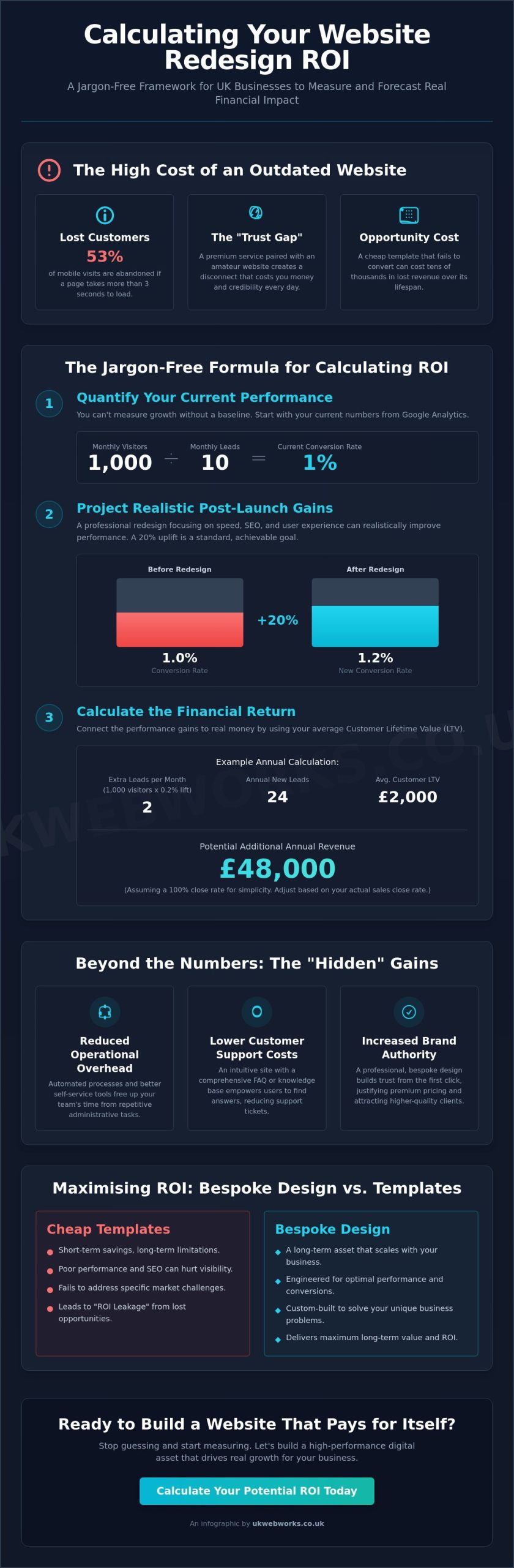
An outdated website is more than just an eyesore; it is a financial drain. Research from Google shows that 53% of mobile visits are abandoned if a page takes longer than three seconds to load. If your site is slow or difficult to use on a smartphone, you are literally sending potential customers to your competitors. This creates what we call the “Trust Gap.” We define the Trust Gap as the delta between your actual expertise and your digital presence. If you provide a premium service but your website looks amateur, that disconnect costs you money every single day.
Investment vs. Expense: A Mindset Shift
It is helpful to think of your website as a 24/7 salesperson who never takes a holiday, never sleeps, and can talk to hundreds of people at once. When you view it this way, the “cheapest” option often becomes the most expensive. A budget template site might save you £1,000 upfront, but if it fails to convert visitors, the lost opportunity cost over three years can reach tens of thousands of pounds.
Shifting your mindset toward bespoke web design ensures you are building a long-term asset. A custom-built platform scales with your business and addresses your specific market challenges. When calculating website redesign roi, you must factor in these saved opportunities and the increased value of a professional, high-performing asset that builds trust from the first click.
- Lead Generation: Turning passive browsers into qualified enquiries.
- Direct Sales: Reducing friction in the buying process to increase basket value.
- Brand Authority: Using professional design to justify premium pricing.
The Jargon-Free Formula for Calculating Your Return
Calculating website redesign roi doesn’t require a degree in accounting. It requires a clear look at your current numbers and a realistic view of where you want to be. We focus on three main pillars: what you have now, what’s possible, and the total cost of getting there. By stripping away the technical fluff, you can treat your website as a measurable business asset rather than a vague overhead cost.
Step 1: Quantify Your Current Performance
You can’t measure growth without a solid starting point. Log into Google Analytics and find your current conversion rate by dividing your monthly leads by your total visitors. If your site attracts 1,000 visitors and generates 10 enquiries, your conversion rate is 1%. You also need to know your customer Lifetime Value (LTV). If an average client spends £2,000 with you over three years, you can assign a concrete value to every lead based on your closing rate. A 1% increase in conversion can often double profits for a UK small business, making this the most vital metric to track during a rebuild.
Step 2: Projecting Post-Launch Gains
We avoid the “500% growth” promises often found in high-pressure sales pitches. Instead, we look at realistic industry benchmarks. A 20% increase in performance is a standard, achievable goal for a professional redesign. This growth comes from better technical foundations that improve your SEO rankings and faster loading speeds. When you invest in high-quality ecommerce web design, you also see improvements in average order value because the user experience is smoother. Beyond the immediate sales, you should consider the wider business value of a website redesign, which includes better brand trust and reduced customer support enquiries.
Step 3: The Final ROI Calculation
The math is straightforward. Use this formula: ((Gains – Investment) / Investment) x 100. When you calculate the “Investment” part, be honest about the total spend. Your calculation should include:
- Design and development fees.
- Professional content writing and SEO setup.
- Hosting and ongoing maintenance costs.
Calculating website redesign roi over a 36-month period provides a much clearer picture of the true value the project brings to your bottom line. A website is a long-term asset, not a one-off expense. By spreading the cost over three years, you can see how even a modest performance boost pays for itself many times over. If you’re unsure where to start with your own data, you can always reach out to our team for a transparent look at your current performance.
Measuring the ‘Hidden’ Gains of a Modern Website
When calculating website redesign roi, it’s easy to focus only on the checkout page. However, the most substantial financial wins often happen behind the scenes. These “hidden” gains relate to how much it costs to actually run your business day to day. A clunky site doesn’t just annoy customers; it drains your staff’s time and inflates your overheads.
Think about your customer support team. If your site lacks clear information, your phone rings constantly with the same basic questions. By building better FAQ sections and self-service portals, you can reduce these repetitive enquiries. If you handle 50 fewer “Where is my order?” calls each month, your team can focus on closing new deals instead. You should also consider your Cost of Customer Acquisition (CAC). A site with improved organic visibility reduces your reliance on expensive paid ads. According to a 2023 report by Lucidpress, consistent and professional branding can increase revenue by 23%. This “Brand Equity” allows you to command premium prices because you look the part. If you want to ensure your staff matches that professional digital image, check out The Staff Uniform Company for specialist workwear.
- Operational Efficiency: Reclaiming hours spent on manual data entry or site fixes.
- Support Savings: Lowering the volume of basic enquiries through better UX.
- Organic Growth: Reducing the need for high-cost PPC campaigns.
- Brand Trust: Building the authority needed to support higher margins.
Administrative Efficiency and CMS Savings
Managing an outdated site is a slow, frustrating process. We’ve seen clients move from rigid legacy systems to modern WordPress builds and cut their content update time by 70%. This efficiency means your marketing team spends less time fighting with code and more time creating value. Bespoke admin panels simplify the process even further, ensuring that new staff members require 50% less training time to manage the site. When you combine this with no-nonsense technical support and managed hosting, you remove the hidden costs of constant troubleshooting.
Technical Stability and Reduced Downtime
Every minute your site is offline, you’re losing money. For a UK business with a £500,000 annual turnover, an hour of downtime during a busy afternoon could cost over £250 in lost sales. Professional maintenance packages act as an insurance policy for your ROI, keeping your site patched and healthy before problems arise. Much like the tailored risk management solutions provided by Paterson Insurance Brokers, proactive site management mitigates the risk of unexpected financial loss. Security is equally vital. The UK Government’s Cyber Security Breaches Survey 2023 found that the average cost of a breach for small businesses was approximately £4,220. Modern security standards prevent these massive, unexpected expenses from wiping out your profits.
How to Forecast ROI Before You Spend a Penny
Forecasting isn’t about guesswork or pulling numbers out of thin air. It starts with looking at your current performance and comparing it to the competition. If a rival’s site loads in 1.8 seconds while yours takes 5.2, they’re likely capturing the 40% of users who abandon slow pages. You can’t improve what you don’t measure. We look at these gaps to see exactly where you’re losing money before we even open a design file.
We recommend using “What-If” scenarios to test the sensitivity of your projections. For example, if your current conversion rate is 1.2%, what happens to your bottom line if a redesign pushes it to 1.7%? By running these numbers, you can see the minimum performance jump required to make the project pay for itself. It turns a creative project into a logical business decision. Calculating website redesign roi becomes a matter of arithmetic rather than hope.
A professional audit is your best tool for finding “low-hanging fruit.” Often, small tweaks to a checkout flow or a clearer call-to-action can provide an immediate boost in revenue. These quick wins help the project reach its break-even point much faster. To get an accurate forecast, you also need total transparency in pricing. You can’t calculate a return if you’re worried about hidden fees or “extra” costs appearing halfway through the build. We believe in fixed, honest quotes so your budget stays predictable.
Setting Realistic Benchmarks
By 2026, industry data suggests Ecommerce conversion rates in the UK will average around 2.8%, while B2B lead generation sites should aim for 3.5%. These are the targets we use to keep your expectations grounded. Don’t trust any agency that offers a “guaranteed” ROI. They don’t control your market or your competitors. Instead, focus on the metrics that actually drive profit, such as your cost per acquisition and the lifetime value of a customer.
Identifying the Risks to Your Return
Even the most beautiful design will fail if your content is weak or your marketing spend disappears. Design is the engine, but content is the fuel. Another common risk is the “sign-off slump.” If internal approvals take weeks instead of days, it delays the launch and pushes back your return. Every month your old site stays live is a month of missed opportunities. Finally, ensure your hosting and SEO strategy are integrated. A shiny new site that crashes under traffic or disappears from Google won’t give you the return you’re looking for.
Want a straightforward look at your potential returns? Request a jargon-free audit and let’s look at the numbers together.
Maximising ROI with a Bespoke Design Strategy
Calculating website redesign roi involves more than just looking at the initial invoice. It requires a long-term view of how your digital presence performs over three to five years. Many UK businesses fall into the trap of “ROI Leakage” by choosing cheap, off-the-shelf templates. While the upfront cost is lower, these templates often result in poor performance that drains your potential profits. A one-second delay in mobile load times can impact conversion rates by up to 20%, according to industry data. For a business with an annual online turnover of £250,000, that represents a significant loss that far outweighs any initial savings on a template.
We take a different approach at UK Web Works. Our strategy is direct, honest, and focused entirely on your specific business goals. We don’t believe in adding features for the sake of it. Instead, we focus on digital craftsmanship that ensures every element of your site serves a purpose. By removing the “bloat” found in standard templates, we create faster, more reliable websites that provide a better foundation for your ROI calculations.
Bespoke vs. Template: The Financial Reality
Templates are often built to be “everything to everyone,” which means they come with heavy code that slows down your site. This negatively impacts your SEO and frustrates your visitors. In contrast, a bespoke site is built for your specific audience from day one. You get a lean, efficient tool that is easier to manage and cheaper to maintain in the long run. Working with a UK-based partner also means you have local experts who understand the British market and are available when you need them. This reliability is a key component in calculating website redesign roi, as it reduces the risk of costly downtime or communication breakdowns.
To keep your financial planning predictable, we operate on a fixed-price basis. You won’t face unexpected bills or “scope creep” that ruins your budget. This transparency allows you to calculate your break-even point with total confidence.
Starting Your Redesign Journey
The transition from calculation to implementation starts with a clear understanding of where you are now. We recommend the following steps to get started:
- Request a jargon-free audit: We’ll look at your current site performance and explain the findings in plain English.
- Prepare your data: Gather your current monthly traffic figures and average lead values to help us build a more accurate ROI forecast.
- Define your “Must-Haves”: Focus on the features that will directly drive revenue rather than “nice-to-have” extras.
When you are ready to move forward, contact us for a transparent, fixed-price quote. We pride ourselves on being a reliable partner for UK small to medium businesses, providing the technical expertise you need without the high-pressure sales tactics. Let’s build a website that doesn’t just look good but works hard for your bottom line.
Turn Your Website Into a Measurable Business Asset
Investing in a new digital presence shouldn’t feel like a gamble. By applying a clear formula to your conversion rates and average order values, you can turn vague hopes into predictable growth. Remember that 88% of online consumers are less likely to return to a site after a bad experience, according to research from Toptal. This means your return isn’t just about new sales; it’s about protecting the customers you’ve already worked hard to find.
When you’re calculating website redesign roi, look beyond the immediate checkout page. Consider how much time your team saves when they aren’t fixing old bugs or explaining confusing navigation to frustrated callers. We believe in keeping things simple and honest. Our UK-based expert team focuses on digital craftsmanship that delivers measurable results without the technical fluff. We provide fixed-price project fees so you know exactly what your investment is from day one, ensuring your path to profit is transparent and secure.
Get a transparent, fixed-price quote for your bespoke redesign
Your business deserves a site that works as hard as you do, and we’re ready to help you build it.
Frequently Asked Questions
What is a good ROI for a website redesign?
A successful redesign for a UK small business should aim for a 10% to 20% increase in conversion rates within the first year. According to data from Econsultancy, companies that prioritise user experience see an average 400% increase in conversion rates over time. We focus on these practical improvements rather than vanity metrics to ensure your investment translates into actual profit for your company.
How long does it take to see a return on investment for a new site?
You can typically expect to see a measurable return within 6 to 12 months after your new site goes live. This period allows search engines to re-index your updated pages and gives your marketing strategy time to settle. While technical fixes like faster loading speeds provide immediate benefits, the full impact on your bottom line usually becomes clear after two full fiscal quarters.
Can I calculate ROI if I don’t sell products directly on my site?
Yes, you calculate ROI by assigning a specific monetary value to lead generation actions like form completions or enquiry calls. If your data shows that 5% of leads become customers and an average customer is worth £500, then every lead is worth £25 to your business. This makes calculating website redesign roi a straightforward process of tracking how many additional leads the new site generates.
How much does a professional website redesign cost in 2026?
Industry benchmarks from the 2024 UK Digital Agency Report indicate that a professional redesign for a small to medium enterprise typically costs between £3,000 and £15,000. These figures depend on the complexity of your requirements and the number of bespoke features needed. We provide transparent, fixed quotes upfront so you don’t have to worry about hidden fees or unexpected costs during the build.
Will a redesign automatically improve my SEO and traffic?
A redesign only improves SEO if you specifically address technical performance and content quality during the process. If you change your URL structure without using 301 redirects, you could actually see a temporary 15% drop in traffic. However, improving mobile usability and site speed directly supports Google’s ranking factors. We ensure these technical foundations are solid so your visibility grows rather than shrinks.
What are the biggest mistakes that ruin website ROI?
The biggest mistake is choosing visual flair over user functionality, which often leads to high bounce rates. A study by Forrester found that 88% of online consumers are less likely to return to a site after a single bad experience. Other errors include failing to set up tracking software before launch or ignoring mobile users. Without accurate data from day one, you can’t measure your success.
Should I factor in my own time when calculating the investment cost?
You should definitely include the cost of your internal staff’s time to get an accurate ROI figure. If a member of your team spends 30 hours on content reviews at a rate of £25 per hour, that adds £750 to your total investment. We aim to be a reliable partner that handles the technical heavy lifting. This approach allows your team to focus on their daily roles without distraction.
Is it better to do small updates or a full redesign for the best ROI?
A full redesign usually offers a higher long-term ROI if your current site is more than 3 years old or lacks mobile responsiveness. Small updates are good for minor tweaks, but they won’t fix a broken user journey or outdated code. When you opt for a complete overhaul, you’re building on a modern, fast foundation. This makes calculating website redesign roi much easier as the performance gains are more significant.