
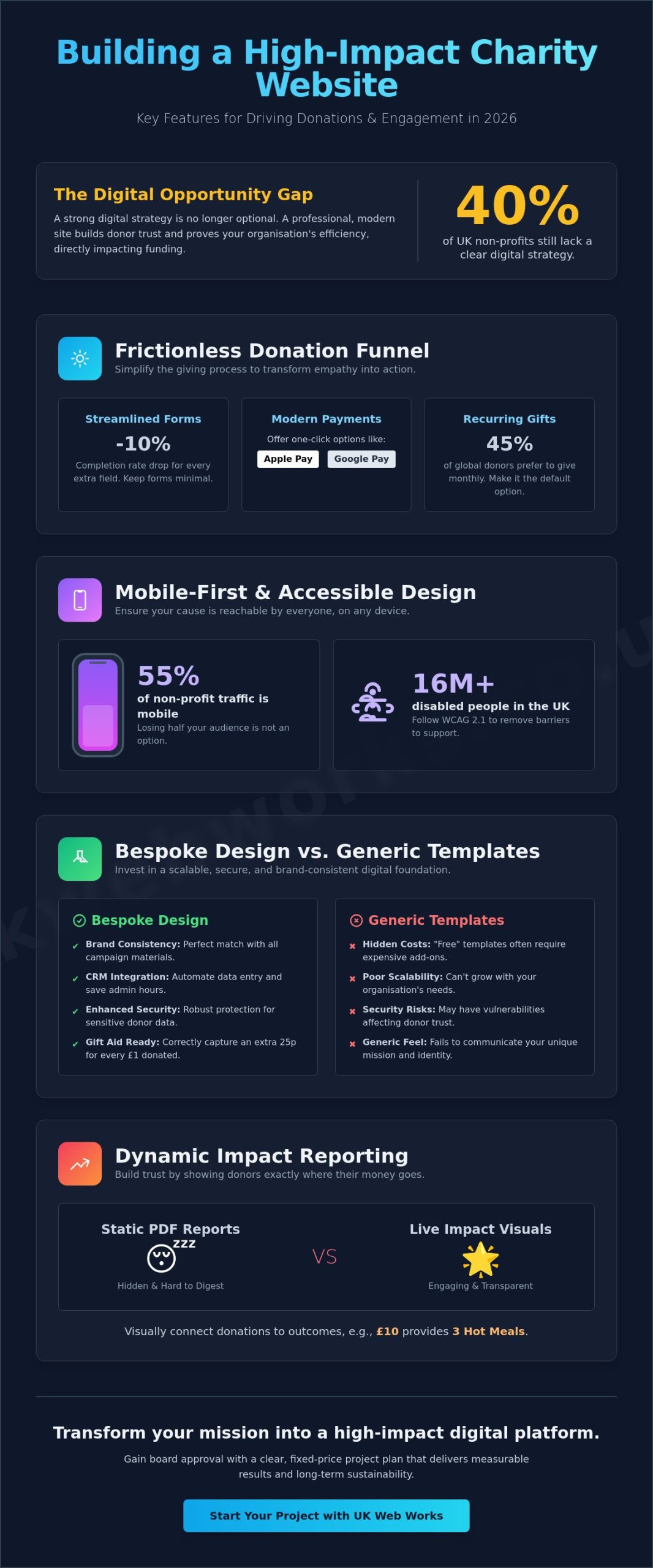
According to the 2023 Charity Digital Skills Report, 40% of UK non-profits still lack a clear digital strategy, which often leads to missed funding opportunities. You likely know that a strong online presence is essential, yet the fear of misusing donor funds on a failed project keeps many organisations stuck with outdated sites. It is frustrating when you want to focus on your mission, but instead, you are wrestling with complex systems that your limited staff do not have the time to manage.
We believe that charity web design should be straightforward and transparent. This guide will show you how to transform your mission into a high-impact digital platform that drives donations and engages supporters without any technical jargon. You will learn how to build digital trust for 2026 by automating your donation processes and creating a professional site that works as hard as your team does. We will cover everything from visibility to user experience, ensuring your cause gets the attention it deserves while keeping your data secure and your message clear.
Key Takeaways
- Understand why effective charity web design prioritises donor trust and unique user requirements over standard commercial sales tactics.
- Learn how to build a high-impact donation funnel that simplifies the giving process for supporters on mobile and desktop alike.
- Discover how to secure board approval by setting realistic budgets and defining clear objectives for your digital presence.
- See how a jargon-free, user-led approach can transform your site’s performance and significantly increase donor engagement levels.
- Gain insights into managing your project with fixed-price transparency to avoid budget creep and ensure long-term sustainability.
Why Charity Web Design Requires a Different Approach to Commercial Sites
Most commercial websites focus on a simple transaction: money for a product. In contrast, charity web design is about building a digital bridge between a problem and a solution. You aren’t selling a physical item; you’re asking for a contribution toward a shared goal. This requires a unique user experience that prioritises emotional connection and long-term trust over a quick sale.
The “Trust Deficit” is a real challenge for non-profits. The Charity Commission’s 2024 report on public trust highlights that donors are increasingly selective about where their money goes. A professional, modern site validates your organisation. If your website looks dated or is difficult to use, major donors may question your operational efficiency. We believe transparency is the antidote. Showcasing real-time impact data and clear financial accountability on your home page proves that every £1 donated is handled with care. To ensure your message reaches everyone, your site must also adhere to the Web Content Accessibility Guidelines (WCAG), making your cause inclusive to all supporters.
Balancing emotional storytelling with functional calls-to-action (CTAs) is a delicate art. You need to pull at the heartstrings without creating a confusing user journey. We use clear, bold buttons that stand out against compelling imagery. This ensures that when a visitor feels moved to help, they don’t have to search for the “Donate” button.
The Psychology of the Donor Journey
The transition from awareness to a “one-click” donation must be seamless. Friction kills donations. If a supporter has to fill out five pages of forms, they will likely give up. In 2026, frictionless giving through Apple Pay or Google Pay is the most important metric for non-profit success. The donor journey is a deliberate path that transforms raw empathy into a tangible act of support. We focus on making this path as short and reassuring as possible.
Bespoke Design vs. Generic Templates
Generic templates often come with hidden costs for growing charities. They might look “free” at first, but they rarely scale. A bespoke charity web design allows for custom integration with Gift Aid and your specific CRM system. This is vital. In the UK, failing to properly capture Gift Aid means losing 25p for every £1 donated. A template won’t always handle these UK-specific nuances correctly.
- Brand Consistency: Your digital presence should match your physical campaigning materials perfectly. Working with a brand identity agency ensures your charity’s visual language is cohesive and commands immediate trust from donors.
- CRM Integration: Automate your data entry to save hours of administrative work.
- Security: Custom builds offer robust protection for sensitive donor data, which is non-negotiable for maintaining trust.
Choosing a bespoke approach ensures your brand identity remains consistent across every digital touchpoint. It reflects a level of digital craftsmanship that signals your charity is here for the long term.
Essential Features of a High-Impact Charity Website
Your website acts as your digital storefront and your most persistent fundraiser. In 2026, effective charity web design must prioritise a frictionless “Donation Funnel” to ensure supporters don’t drop off before completing their gift. We recommend streamlined forms that ask for minimal information; research indicates that every extra field can reduce completion rates by up to 10%. Offering multiple payment gateways like Apple Pay, Google Pay, and PayPal alongside traditional card payments is now a baseline expectation. Since 45% of global donors prefer to give monthly, your site should make recurring gift options the prominent default choice.
Supporter habits have shifted significantly. Roughly 55% of traffic to non-profit sites now originates from mobile devices. If your site isn’t designed with a mobile-first approach, you’re likely losing half of your potential contributions. Beyond device compatibility, you must follow WCAG 2.1 accessibility standards. This ensures that the 16 million disabled people in the UK can interact with your cause without technical barriers. You can find expert tips to drive engagement by looking at how high-performing sites use these technical foundations to build long-term trust.
Impact reporting modules are another vital tool for modern non-profits. Instead of hiding your achievements in static PDF downloads, use dynamic graphics to show exactly where the money goes. Visualising that £10 provides three hot meals or £50 buys a complete school kit provides the transparency donors crave. This direct connection turns a vague request for money into a tangible, measurable result.
Integrating Donation Platforms and CRMs
Connecting your site to platforms like JustGiving or Stripe simplifies the giving process. Integrating these tools with bespoke CRM solutions ensures that every donor’s journey is tracked from their first click. Automated Gift Aid declarations are a non-negotiable feature for UK charities, as they increase the value of eligible donations by 25% at no extra cost to the supporter. By syncing these systems, you’ll find that CRM integration saves staff time by reducing manual data entry and preventing human error; for those seeking professional guidance on streamlining these digital processes, you can check out Wanas Apps to learn about their consultancy services.
Security and Data Protection for Donors
Trust is the primary currency of the non-profit sector. GDPR compliance is mandatory for handling sensitive supporter data, and failing to secure this information can lead to heavy fines and a damaged reputation. Every site needs an SSL certificate to encrypt data and secure hosting to prevent downtime. Because digital threats evolve daily, regular website maintenance packages are vital for non-profit security. They ensure your software is patched and your donor database remains protected against vulnerabilities. If you’re concerned about your site’s current security, we can help you audit your digital defences to ensure your supporters stay protected.
Case Study: Increasing Donor Engagement Through Bespoke Web Development
A national UK charity recently approached us with a common problem. Their bounce rate had climbed to 74%, and mobile donations had dropped by 16% over the previous year. They were struggling with a legacy system that felt slow, looked dated, and made it difficult for their team to update essential campaign information. We knew that a standard template wouldn’t solve their issues. They needed a strategic approach to charity web design that focused on the donor’s journey.
Our strategy moved them away from their clunky old platform to a bespoke WordPress CMS. This transition provided the speed and flexibility they were missing. We focused on a user-led design that prioritised clarity over complexity. By stripping back unnecessary features, we created a streamlined experience that works perfectly on any device.
Identifying the User Pain Points
We didn’t guess what was wrong; we used data. Heatmapping software revealed that 68% of visitors were getting lost in a complex, three-tier navigation menu. Potential donors were clicking away before they even found the support pages. We simplified the structure and moved the “Donate” button to a persistent header that remains visible as the user scrolls. This small change had a massive impact. A 2.3-second improvement in page load speed resulted in a 21% increase in conversion rates, proving that donors value their time as much as their money.
The Role of Visual Storytelling
Trust is built through transparency and authenticity. We advised the charity to ditch generic stock photos of people shaking hands. Instead, we integrated high-quality, authentic imagery showing their actual projects across the UK. We added a silent video header to the homepage to create an immediate emotional connection with visitors. The way we collaborated as their brand and design agency helped revitalise their entire digital identity. It wasn’t just a new website; it was a complete refresh of how they communicate their mission.
The results after six months were clear and measurable:
- 24% increase in monthly recurring donations.
- 32% rise in volunteer sign-up completions.
- 45% reduction in homepage bounce rate.
This case study demonstrates that effective charity web design is about more than just looking good. It is about removing the technical barriers that stand between a willing donor and a worthy cause. When you make it easy for people to help, they usually do.
Planning Your Project: Budgeting, Accessibility, and Board Approval
Start by defining what success looks like for your organisation. You need to decide if your primary goal is driving donations, increasing awareness, or recruiting new volunteers. A project that tries to do everything at once often fails to do anything well. We recommend picking one lead objective to anchor your charity web design strategy. This clarity helps your agency build a user journey that actually converts visitors into supporters.
Be realistic about your financial layout. A bespoke build requires a larger initial investment than a template, but it removes the limitations of “off-the-shelf” designs that often break as your charity grows. Budget for the initial build, but also set aside roughly 10% to 15% of the total project cost for annual maintenance and security updates. This prevents your site from becoming a technical liability two years down the line. It’s about long-term value, not just the lowest sticker price.
Navigating the Specification Process
Writing a brief shouldn’t feel like a chore. Focus on the outcomes you want rather than the technical features you think you need. Tell us who your audience is and what you want them to do. Discovery sessions are vital here. They allow your agency to dig into your mission and ensure the final product reflects your values. If you aren’t sure where to start, learning how to choose a web design agency in England that understands the non-profit sector will save you time and stress. We find that a collaborative approach always yields better results than a rigid list of demands.
Maximising Value with Google Grants and SEO
Most UK charities are eligible for the Google Ad Grant. This provides approximately £7,800 per month in free search advertising. It’s a massive resource that many organisations leave on the table. However, ads are temporary. SEO is your long-term engine for growth. Integrating SEO from the start of your charity web design project ensures that your site ranks for relevant terms without you having to pay for every click. Organic traffic from search engines provides a steady stream of supporters who are already looking for the specific causes you support.
When you present the project to your board of trustees, focus on the “Business Case.” Show them how a modern site reduces manual admin tasks and increases donor retention. Trustees value transparency and return on investment. Frame the website as a digital asset that works 24/7 to secure the charity’s future. By showing clear projections for engagement and donation growth, you turn a “cost” into a strategic investment. A strong brand identity agency partnership can further strengthen your case by demonstrating how a cohesive visual identity builds the donor trust that underpins long-term fundraising growth.
If you’re ready to plan your next digital project, talk to our team for a straightforward, jargon-free consultation.
The UK Web Works Approach to Charity Partnerships
UK Web Works understands that your mission matters more than technical buzzwords. We’ve built our reputation on a straightforward, “sleeves-rolled-up” approach to charity web design. We don’t hide behind “tech-speak” or use complex terminology to justify high costs. Instead, we speak your language. This ensures that every stakeholder, from your volunteers to your trustees, understands exactly what we’re building and why it works for your cause.
Budget creep is a major concern for non-profits. We address this directly with fixed-price project fees. You won’t find hidden surprises in our invoices. Once we agree on a scope, that’s the price your board can rely on. Whether you’re a small local community group or a national organisation, our bespoke solutions are designed to scale as your fundraising goals grow. We don’t just hand over the keys and disappear; we stay by your side with ongoing support to ensure your digital presence remains secure and effective for the long term.
Digital Craftsmanship for the Third Sector
Busy charity managers don’t have time to manage multiple vendors or decode confusing hosting packages. We take that weight off your shoulders. Our UK-based team shares your cultural values and understands the specific regulatory environment of the British third sector. We provide honest, transparent advice on security and hosting, ensuring your donors’ data is protected by robust, reliable systems. This isn’t just about code; it’s about craftsmanship. We focus on practical features that drive donations and volunteer sign-ups rather than flashy, unnecessary gimmicks that drain your resources.
Our team doesn’t just sit behind screens; we get stuck into the details of your user journeys. This hands-on work ethic ensures that the finished product isn’t just a generic template. It’s a bespoke tool built for your specific audience, whether they are looking to donate, seek help, or sign up for a fundraising event. By keeping everything in-house in the UK, we ensure communication is fast, clear, and reliable.
Next Steps for Your Charity Site
Getting started is simple and entirely risk-free. You can request a no-obligation, jargon-free consultation to discuss your specific goals for charity web design. During our first discovery call, our specialists will listen to your challenges rather than pitching a pre-packaged solution. We’ll look at your current site’s performance and identify clear, actionable improvements that can be made within your budget. It’s a chance for us to see if we’re the right fit for your organisation’s culture and long-term vision.
Future-Proof Your Charity’s Digital Impact
Building a successful platform in 2026 requires more than just a donation button. It demands a strategy centred on digital trust, where accessibility and transparent storytelling turn casual visitors into lifelong supporters. You’ve seen how bespoke features and clear navigation can solve the common friction points that often stall donor engagement. Effective charity web design isn’t about following the latest flashy trends; it’s about creating a reliable, high-performing tool that works as hard as your team does.
At UK Web Works, we help non-profits navigate these technical choices without the headache. Our UK-based team are specialists in WordPress and bespoke builds, providing a no-nonsense approach that prioritises your mission over complex terminology. We offer fixed-price development fees so your board can approve budgets with total confidence. We don’t believe in hidden costs or high-pressure sales, just honest craftsmanship that helps your organisation grow. Let’s build a site that reflects the integrity of your cause and delivers measurable results for your community.
Get a Jargon-Free Quote for Your Charity Website
Frequently Asked Questions
How much should a charity spend on a new website in 2026?
Small to medium UK charities typically budget between £5,000 and £15,000 for a professional redesign according to recent industry benchmarks. This range covers a secure, responsive site that meets modern accessibility standards. Costs can increase if you require complex features like a member portal or custom database integration. We recommend setting aside a 10% contingency fund to cover any unexpected technical requirements during the build.
Can we integrate our existing donation platform like JustGiving into a new design?
Yes, you can integrate JustGiving, Enthuse, or Donorfy seamlessly into your new charity web design. We use secure API connections or embed codes to ensure the donor journey feels consistent and professional. This approach keeps your transaction fees predictable while allowing you to track conversions accurately. It also simplifies your financial reporting by keeping your existing payment data streams intact.
What is the best CMS for a charity website?
WordPress is the most popular choice for 43% of all websites because it’s flexible and easy for non-technical teams to manage. It offers specific non-profit tools like GiveWP for donations and robust security plugins to protect donor data. Other options like Wagtail are excellent for larger organisations that need strict permission controls. We focus on platforms that give you full ownership of your content without monthly software lock-in fees.
Do charities need a bespoke website or is a template enough?
A bespoke website is usually the better investment for building long-term digital trust and credibility. While templates look cheaper upfront, they often include bloated code that slows down your site and hurts your search engine rankings. Custom builds ensure your site meets the WCAG 2.2 accessibility standards required for inclusivity. It also means your site is designed specifically around your supporters’ needs rather than a generic layout.
How can we ensure our charity website is GDPR compliant?
You must implement a clear privacy policy, an active cookie consent banner, and secure SSL encryption as a baseline. Ensure every contact form has an explicit opt-in checkbox for marketing rather than a pre-ticked box. Under UK GDPR rules, your organisation is responsible for how any third-party plugins handle supporter data. We provide a straightforward checklist to help you document your data processing and keep your trustees informed.
What is a Google Ad Grant and how does it help our web design strategy?
The Google Ad Grant provides eligible UK non-profits with up to £7,500 of free search advertising credit every month. To keep this grant, your website must meet strict performance standards, including fast loading speeds and high-quality content. We align your charity web design with these requirements from the start. This ensures your landing pages convert the free traffic into actual donations or volunteer sign-ups.
How long does a typical charity web design project take from start to finish?
Most professional charity projects take between 8 and 12 weeks to complete from the initial kickoff meeting. This timeline includes the discovery phase, design concepts, development, and a rigorous testing period. If your project involves complex CRM integrations or migrating thousands of legacy blog posts, it may take 16 weeks. We provide a clear project roadmap so your team can plan fundraising campaigns around the launch date.
Will we be able to update the website ourselves without technical knowledge?
Yes, we build every site with a user-friendly dashboard so your team can edit text, swap images, and post updates easily. You won’t need to know a single line of code to add new events or change your homepage banners. We provide recorded training sessions and jargon-free manuals for your staff and volunteers. This gives you total control over your digital presence without being reliant on an agency for daily tasks.