
A web design proposal isn’t just a price list for a new website. It’s a strategic roadmap that determines whether your digital presence will actually grow your business or simply sit there looking pretty. We know that reviewing these documents can feel overwhelming, especially when you’re trying to figure out what to look for in a web design proposal while dodging hidden costs and confusing jargon like CMS, SEO, or hosting. It’s frustrating when you can’t tell if you’re paying for a high-quality, bespoke build or just another recycled template.
You deserve a partner who speaks your language and values your bottom line as much as you do. In this guide, we’ll show you how to decode agency pitches, spot the red flags that lead to budget creep, and ensure your project stays aligned with your specific business goals for 2026. We’ve put together a clear framework to help you compare different offers with confidence. By the end, you’ll know exactly how to choose a partner who understands your local market and builds a site that generates real leads.
Key Takeaways
- Understand why a one-page quote is a significant risk and how a professional proposal acts as a strategic roadmap for your digital growth.
- Discover exactly what to look for in a web design proposal to ensure you receive a comprehensive blueprint with transparent, measurable outcomes.
- Learn how to spot hidden red flags in agency pitches that often lead to technical confusion or unexpected costs after the project begins.
- Find out how local expertise in Hull and East Yorkshire provides a competitive advantage through a better understanding of your specific regional market.
- See how a no-nonsense approach and fixed-price development fees can remove the stress from your transition from initial brief to a successful launch.
Why a Web Design Proposal is More Than Just a Price Quote
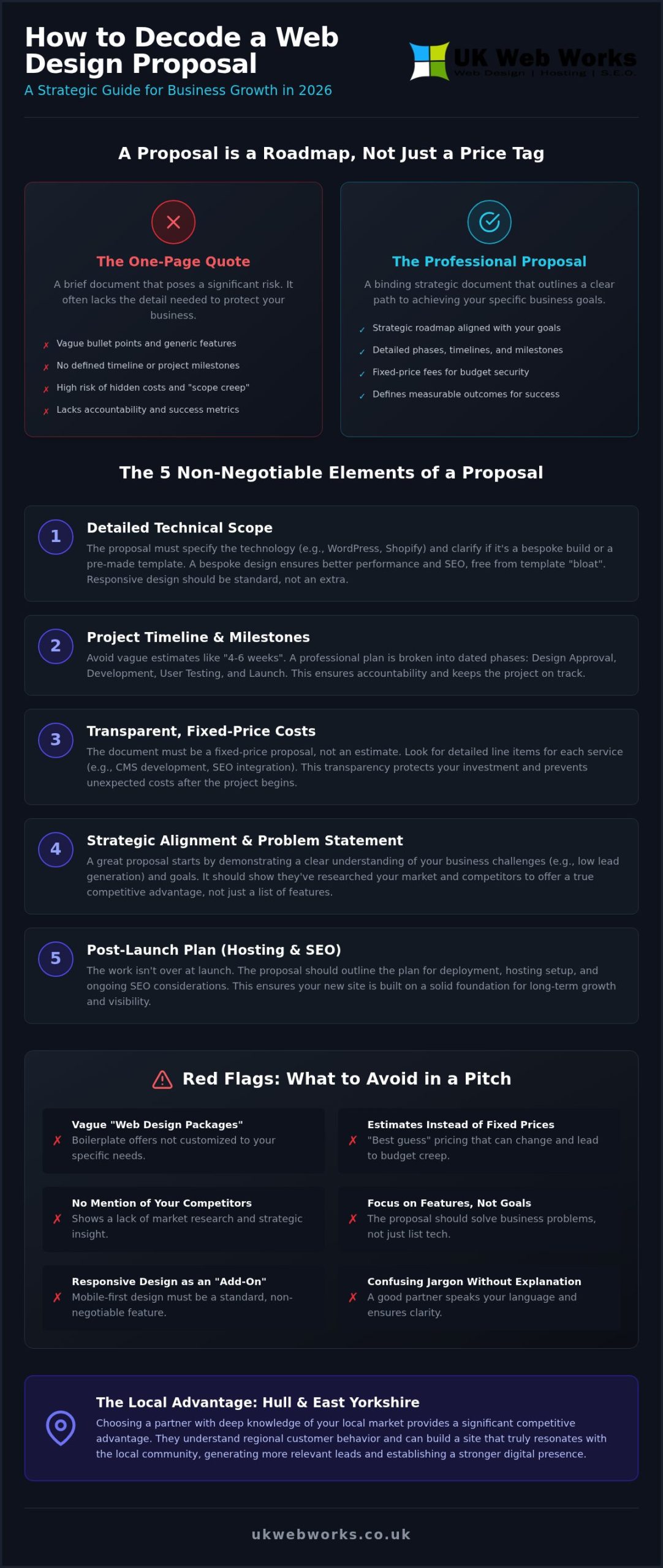
Think of a web design proposal as more than a simple bill. In 2026, a professional proposal serves as a binding strategic document. If you receive a one-page “quote” that only lists a price and a few bullet points, you’re looking at a major risk for your business. A brief quote doesn’t protect you from hidden costs or missed deadlines. It doesn’t define what success looks like for your specific company. When you are deciding what to look for in a web design proposal, you should be searching for a partner who treats your website as a digital platform, not just a static brochure. This document is the benchmark for accountability. It ensures everyone is on the same page before a single line of code is written.
Understanding the design process helps you see why detail matters. A proposal should outline every phase, from research to launch. Without this, you’re essentially buying a “black box.” You won’t know what’s happening behind the scenes until it’s too late to make changes. A thorough document turns a vague idea into a concrete project plan. It sets the stage for a collaborative relationship where your business goals remain the priority.
The Strategic Alignment Check
A great proposal starts with your business, not the agency’s portfolio. Look closely at the “Problem Statement.” This is often the most important part of the document. It should clearly explain the challenges you’re facing, such as low lead generation or a confusing user experience. If a website designer hasn’t researched your local competitors in East Yorkshire, they can’t build a site that truly stands out. You want to see they’ve looked at your specific market and identified how to give you an edge. They should focus on your goals, not just a list of technical features they happen to offer.
Proposal vs. Estimate: Knowing the Difference
It’s easy to confuse an estimate with a fixed-price proposal, but the difference is vital for your budget security. An estimate is often a “best guess” that can change as the project evolves. A fixed-price proposal provides a clear, set fee for the work described. This is why you need to see detailed line items. If you see a generic “Web Design Package,” be careful. These are often boilerplate documents that haven’t been customized for your needs. A bespoke proposal will break down exactly what you’re paying for, from WordPress CMS development to SEO integration. This transparency ensures there are no nasty surprises once the project starts. Knowing what to look for in a web design proposal means demanding this level of detail to protect your investment.
The 5 Non-Negotiable Elements of a Professional Proposal
A professional proposal acts as your project’s blueprint. It must provide clarity, transparency, and measurable outcomes from the very first page. One of the most critical parts of this document is the technical scoping. Scoping is the technical process of creating a detailed map for every individual page and function of your site to prevent project creep. Without this level of detail, your budget and timeline are likely to spiral as the project evolves. While you evaluate what to look for in a web design proposal, ensure the document covers the full lifecycle of your site, from the initial design concepts to final deployment and hosting setup.
Technical Scope and CMS Choice
Your proposal should name the specific technology used to build your site. Look for clear mentions of WordPress CMS for standard business sites, or Shopify and WooCommerce for ecommerce projects. If you’re planning a project to update an old site, this comprehensive guide to website redesigns explains why choosing the right platform is vital for long-term success. Responsive design must be listed as a standard requirement, not an optional extra. You also need to verify if the agency is creating a bespoke design tailored to your brand or simply installing a pre-made template. Bespoke builds offer better SEO performance and faster loading speeds because they don’t include the “bloat” found in many off-the-shelf themes.
The Project Timeline and Milestones
A professional agency won’t just give you a vague “4-6 weeks” estimate. That’s a red flag for project delays and poor management. Instead, expect the build to be broken into clear, dated phases. You should see specific milestones for design approval, development, and user testing. User testing is vital. It involves checking the site across different browsers and mobile devices to ensure a smooth experience for every visitor. These checkpoints keep the project on track and give you regular opportunities to provide feedback. It ensures accountability on both sides of the partnership.
Post-Launch Support and Maintenance
A website isn’t a “set and forget” asset. Your proposal needs to address what happens after the site goes live. Does it include ongoing security updates and software patches? You should look for a clear explanation of website maintenance packages to protect your investment. Having a clear path for technical support means you won’t be left stranded if a plugin breaks or you need a quick content update. This long-term view is a hallmark of a partner who is genuinely invested in your success. If you want to see how a transparent, detailed plan looks for your business, feel free to reach out to our team for a chat.
Red Flags: What to Avoid in a Web Design Pitch
Learning how to read between the lines of a slick sales pitch is a skill that can save your business thousands of pounds. A polished presentation doesn’t always translate to a high-performing website. When you are evaluating what to look for in a web design proposal, you need to look past the flashy mockups and focus on the fine print. Choosing the wrong partner based on a low price often leads to a site that breaks, doesn’t rank on Google, or costs double to fix later. We often hear the question: “Why is this other quote half the price?” The answer is usually found in what’s missing. A cheap site often uses a cookie-cutter template that limits your growth and slows down your page speeds. In the long run, the cheapest option usually costs the most in lost leads and missed sales opportunities.
Ownership and Intellectual Property
You must own your digital assets. Check that the proposal explicitly states you own the domain name and all website files upon final payment. Some agencies use proprietary CMS systems. These are traps. If you want to move to another agency later, you can’t take your site with you. You’re locked in. We believe in transparency and freedom. You should always demand full administrative access to your site from the moment it launches. This ensures you aren’t held hostage by a single provider if your business needs change in the future.
Vague Deliverables and “Hidden” Costs
Watch out for “danger words” like SEO-ready. This is often a hollow promise. Real SEO requires specific technical actions like schema markup, image optimization, and meta description writing. If these aren’t listed as line items, they probably aren’t happening. Knowing what to look for in a web design proposal also means checking for external costs. Does the quote include stock imagery, font licenses, or professional copywriting? Many cheap quotes leave these out. You might end up with a bill for hundreds of pounds in extra fees that you didn’t budget for. Finally, ensure the document mentions ongoing costs like managed hosting and domain renewals. A truly professional partner will give you the full picture of your total investment, not just the initial build cost.
Why Local Expertise Matters for Hull and Yorkshire Businesses
When you’re reviewing a digital document, it’s easy to forget that the people behind the screen matter as much as the code they write. Choosing a local website designer provides a layer of cultural insight that a distant agency simply cannot match. A designer in Hull or East Yorkshire understands the regional economy and the specific tone that resonates with local customers. They know the difference between a business targeting the industrial heritage of the Humber and a boutique firm in the York city centre. When considering what to look for in a web design proposal, you should check if the agency demonstrates a genuine understanding of your local market. This isn’t just about being polite; it’s about ensuring your website speaks the right language to the people who actually use your services.
Face-to-Face Accountability
There’s significant value in being able to sit across a desk from your design team. While video calls are useful for quick updates, a face-to-face meeting in Hull or Leeds often sparks better creative ideas and clearer communication. Local agencies are deeply invested in their regional reputation. They can’t hide behind a generic contact form if a project hits a snag. This accountability often leads to faster project speeds because misunderstandings are resolved quickly in person. On-the-ground knowledge also fuels your local SEO strategy. We understand the landmarks, the local search habits, and the specific phrases people in Yorkshire use when they’re ready to buy. This ensures your proposal isn’t just a generic template but a plan built for your specific community.
Understanding the UK Market
A proposal from a UK-based agency will automatically account for specific requirements that overseas providers often overlook. This includes clear explanations of VAT and adherence to UK consumer rights. GDPR compliance is another non-negotiable area that must be addressed in your project scope. Your proposal should specify exactly how your site will meet these data protection standards to keep your business legal and your customers safe. Proximity also affects your site’s technical performance. UK-based servers are essential for site speed when your primary audience is in Scunthorpe, Grimsby, or York. Faster loading times for local users lead to better search rankings and a more professional user experience. Knowing what to look for in a web design proposal means checking for these UK-specific technical details to ensure your site is built for the long term. If you want a partner who truly knows the local business landscape, get in touch with our Yorkshire-based team today.
Moving from Proposal to Launch with UK Web Works
You now have a clear understanding of what to look for in a web design proposal. You know that it isn’t just about the price tag; it’s about the strategic foundation of your future digital growth. At UK Web Works, we take this responsibility seriously. We recognize that the fear of hidden costs is a significant concern for many business owners. That’s why our approach is built on integrity, total clarity, and a commitment to your long-term success. We don’t just build a site and walk away. We act as a straight-talking ally for businesses across Yorkshire, ensuring your digital presence works as hard as you do.
We believe in a no-nonsense style of communication. We don’t hide behind complex terms or high-pressure sales tactics. Instead, we offer a grounded, professional partnership that simplifies the build process. When you review a document from us, you’ll find that it’s designed to be read and understood without a dictionary of tech jargon. This transparency is the cornerstone of our brand and the reason why so many local firms trust us with their online presence.
Our Jargon-Free Scoping Process
Our scoping process is where we translate your vision into a practical technical blueprint. We strip away the fluff and focus on what matters: your specific business goals. Whether you require WordPress CMS development or a Shopify ecommerce store, we explain the reasoning behind every technical choice. This detailed mapping leads directly to our fixed-price project development fees. You won’t face unexpected bills halfway through the build because we’ve already accounted for every page and function. Our proposals also include the essential groundwork to help you rank in Hull and the surrounding areas, making sure your site is seen by your local target audience.
Requesting Your Bespoke Proposal
Getting started is straightforward. Before our discovery call, think about your primary objectives. Do you need to generate more leads, or is your current site simply outdated and slow? Providing us with your current pain points and a few examples of local competitors helps us create a truly accurate strategic roadmap. This initial conversation is about listening to your needs and offering practical, honest solutions. We’re here to remove the confusion and help your business grow with a website that actually delivers results. Contact UK Web Works today for a transparent, professional web design proposal.
Ready to Build Your Digital Roadmap for 2026?
Choosing the right partner starts with knowing what to look for in a web design proposal to ensure your business is protected and positioned for growth. A professional document should do more than just list a price; it should act as a clear, strategic blueprint that defines your goals and eliminates the fear of hidden costs. By focusing on technical transparency, ownership rights, and clear milestones, you can avoid common pitfalls and invest in a platform that actually generates leads.
At UK Web Works, we bring over 10 years of local expertise to every project. We specialize in bespoke designs tailored specifically for the Hull and Yorkshire markets, delivered with a no-jargon communication style that keeps you in control. We’re here to help you move past the confusion of technical terms and into a collaborative relationship built on honesty and results. If you’re ready to see a transparent, strategic plan for your next project, you can get a fixed-price web design proposal from UK Web Works today. We look forward to helping your business succeed online.
Frequently Asked Questions
What is the difference between a quote and a web design proposal?
A quote is a simple price estimate while a web design proposal is a comprehensive strategic document. It outlines the full project scope, including specific business goals and technical deliverables. You want to see how the agency plans to solve your problems, not just what they charge for their time.
Should SEO be included in a web design proposal?
Foundational Search Engine Optimization (SEO) should always be a part of the build. Don’t settle for vague terms like “SEO-ready.” A professional proposal lists specific technical actions like schema markup, image compression, and keyword-focused meta descriptions to ensure your site can be found by local customers in Yorkshire.
Do I own my website once the project is finished?
You should have 100% ownership of your website, domain name, and files once the final invoice is paid. This is a critical point when deciding what to look for in a web design proposal. Avoid agencies that use proprietary systems, as these often prevent you from moving your site to a different host or provider in the future.
How long should a professional web design proposal be?
A professional document is typically between five and fifteen pages long. It needs to be long enough to cover the project blueprint, technical specifications, and maintenance plans in detail. If it’s only one or two pages, it likely lacks the depth required to protect your business from project creep and unexpected delays.
What are common hidden costs in web design pitches?
Stock imagery, font licenses, and professional copywriting are the most common hidden costs. You should also check if the proposal mentions ongoing expenses like managed web hosting and domain renewals. A transparent partner will list these clearly so you can budget for the total cost of ownership from the start.
Why do web design prices vary so much between agencies?
Prices vary based on the level of craftsmanship and the agency’s expertise. A freelancer using a basic template will always be cheaper than a local agency building a bespoke, high-performance site. Bespoke builds take more time and skill but offer better long-term value through higher lead generation and faster loading speeds.
Should I look for an agency that uses WordPress or a custom CMS?
We recommend using an open-source platform like WordPress CMS because it offers the most flexibility. A custom or proprietary CMS often locks you into a single agency’s ecosystem. With WordPress, you own the site and can easily find specialists to help you maintain or grow it as your business expands.
What happens if I want to change the scope after signing the proposal?
Scope changes are managed through a formal change request process. This ensures that any new features or pages are documented and priced separately to keep the original project on track. Understanding this process is an important part of what to look for in a web design proposal to avoid budget surprises later in the development cycle.