
Did you know that 48% of shoppers walk away from their purchase simply because they encounter unexpected costs at the final stage? In 2026, UK consumers have little patience for hidden fees, especially with the Digital Markets, Competition and Consumers Act now strictly enforced. If you’re struggling with high marketing spend but seeing low conversion, focusing on reducing shopping cart abandonment uk is the most direct way to protect your margins. It’s frustrating to pay for traffic only to watch it vanish because of a clunky Shopify or WooCommerce checkout that doesn’t meet local expectations.
We understand that standard templates often fail to address the specific nuances of the British market, from VAT transparency to mobile-first efficiency. You deserve a checkout process that works as hard as your brand does. This guide provides a practical roadmap to reclaim that lost revenue by implementing proven technical and design strategies. We’ll show you how to streamline your mobile performance, meet the latest PCI DSS v4.0 standards, and ultimately drive a higher average order value for your business.
Key Takeaways
- Understand why UK-specific delivery expectations, such as offering Royal Mail or DPD options, are critical for maintaining customer trust and completing sales.
- Explore why implementing guest checkout remains the single most effective technical change for reducing shopping cart abandonment uk in 2026.
- Learn to identify the specific security signals and payment icons that UK shoppers look for before they feel comfortable sharing their financial details.
- Discover how bespoke website development overcomes the limitations of standard templates by allowing for precise, logic-based shipping and tax calculations.
- Get a practical plan to transform your mobile checkout from a basic responsive layout into a high-performing, mobile-native experience.
What is Shopping Cart Abandonment and Why Does it Plague UK Retailers?
At its simplest level, shopping cart abandonment is the gap between a customer’s intent to buy and the completed transaction. When a visitor adds an item to their basket but leaves your site before paying, they contribute to your abandonment rate. For UK retailers, this isn’t just a missed opportunity. It represents a significant drain on resources. If you are investing heavily in Search Engine Optimization (SEO) or Pay Per Click (PPC) Advertising, every abandoned cart represents money spent on traffic that failed to convert. In 2026, reducing shopping cart abandonment uk has become a survival strategy rather than a luxury.
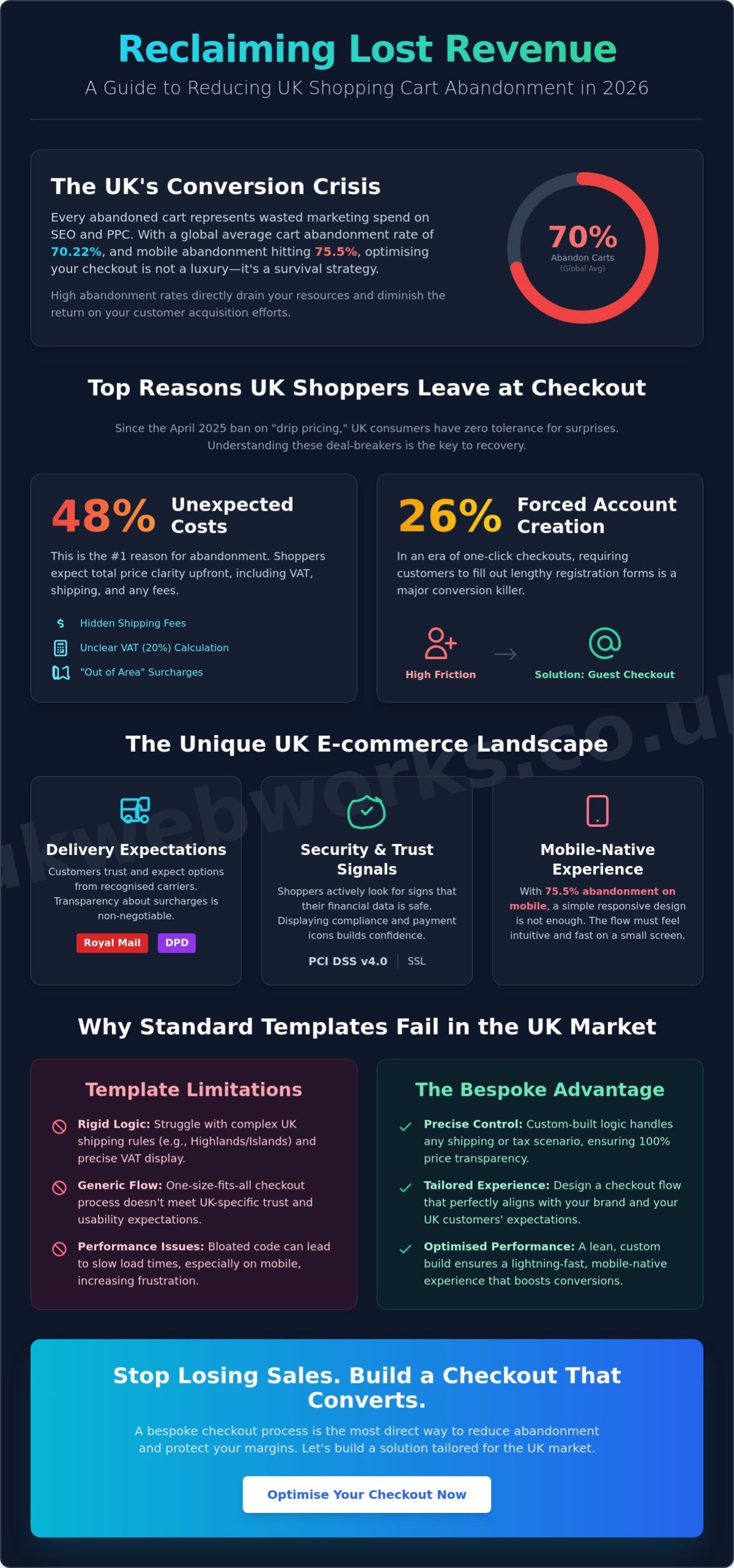
The global average abandonment rate currently sits at approximately 70.22%. However, UK businesses face a unique set of challenges. Research shows that 48% of shoppers abandon their carts because extra costs like shipping, taxes, and fees are too high. Between stricter consumer protection laws and high expectations for delivery speed, the “friction points” in a typical UK customer journey are more pronounced than in many other markets. If your checkout process feels slow or opaque, your customers will simply find a competitor who offers a smoother path.
The 2026 UK Ecommerce Landscape
UK consumer behaviour has shifted decisively toward mobile-first interactions. With mobile abandonment rates averaging 75.5%, businesses can’t afford to treat their mobile site as an afterthought. For brands aiming to optimize these touchpoints, Dulyfixed Small Business Solutions provides mobile-first design strategies that ensure a frictionless path to purchase. The ongoing cost-of-living crisis has also changed how people shop; many users now use the shopping cart as a temporary “wishlist” to compare total prices including VAT and shipping. Since the April 2025 ban on “drip pricing,” UK shoppers have zero tolerance for costs that appear only at the final step. The abandonment threshold for a modern UK site is reached the moment a customer encounters an unexpected fee or a mandatory account creation screen.
Calculating Your Store’s Abandonment Rate
To fix the problem, you first need to measure it accurately. You can calculate your rate by dividing the number of completed transactions by the number of initiated carts, subtracting that from one, and multiplying by 100. It’s vital to distinguish between “cart” abandonment (leaving after adding an item) and “checkout” abandonment (leaving after starting the payment process). If your dropout occurs mostly at the payment stage, your issue is likely technical or security-related. While a 0% rate is impossible in any retail environment, focusing on reducing shopping cart abandonment uk by even 20% can be transformative for your bottom line.
The Top Reasons for Abandonment in the UK Market
While global trends offer a broad overview, UK shoppers have specific expectations that can make or break a sale. If your conversion rates are stalling, it is likely because your checkout process contains “deal-breakers” that modern British consumers simply won’t tolerate. Understanding these local nuances is the first step toward reducing shopping cart abandonment uk and keeping your revenue on track. It isn’t just about the price of the product; it’s about the clarity and reliability of the entire transaction.
Unexpected costs remain the primary reason for dropout. Since the ban on “drip pricing” in April 2025, UK shoppers expect the total price, including the 20% VAT and mandatory fees, to be clear from the start. When a customer reaches the final stage only to see a shipping fee they weren’t prepared for, 48% of them will leave. Similarly, forced account creation acts as a digital wall. Research shows that 26% of people abandon their purchase when they are required to register. In a world of “one-click” expectations, making your customers fill out unnecessary forms is a relic of the past that costs you money.
Transparency in Pricing and Shipping
UK consumers value honesty over a low initial price that climbs during checkout. Displaying VAT and estimated delivery costs on the product page builds immediate trust. In our national market, the psychology of delivery is complex. While “Free Delivery” is a powerful incentive, many shoppers prefer “Fast and Tracked” options through recognized carriers like Royal Mail or DPD. If you ship to the Highlands or Islands, don’t hide the “out of area” surcharge until the final click. Addressing these costs early prevents the frustration that leads to a lost sale. If your current platform makes this level of transparency difficult, you might benefit from exploring bespoke website design to gain better control over your data display.
The User Experience (UX) of the Checkout
Technical performance and micro-frictions often go unnoticed by store owners but are painfully obvious to customers. Slow loading times or jargon-heavy error messages can make a site feel insecure. This is particularly true with the implementation of Strong Customer Authentication (SCA). While SCA is a legal necessity for UK payments, it adds an extra step to the flow. Following checkout design best practices ensures that these security hurdles feel like a helpful protection rather than a frustrating barrier. Use a reassuring and direct tone in your form labels and error messages. When a customer knows exactly what they need to fix to complete their purchase, they are far more likely to stay and finish the job.
Technical Strategies for Reducing Checkout Friction
While attractive design draws customers in, your site’s technical performance is what actually closes the deal. In 2026, the most effective technical change you can make for reducing shopping cart abandonment uk is implementing a guest checkout option. Forcing users to create an account is a primary cause of friction. By removing this barrier, you respect your customer’s time and simplify their path to purchase. We often see businesses struggle with the debate between one-page and multi-step checkouts. In the UK market, a multi-step process often performs better for complex orders, provided it includes a clear progress bar to manage expectations.
Your payment methods must also align with local preferences. UK shoppers increasingly rely on “Buy Now, Pay Later” (BNPL) services like Clearpay, alongside digital wallets such as Apple Pay and Google Pay. These “1-click” options bypass traditional form-filling, which is critical since many UK delivery issues and payment frustrations stem from tedious data entry. Integrating these methods directly into your product or cart pages can significantly streamline the transaction. If you want to see a measurable difference in reducing shopping cart abandonment uk, you must look beyond standard templates and focus on site speed and logic.
Mobile-First Checkout Design
With mobile abandonment rates averaging 75.5%, your checkout must be designed for “thumb-friendly” interactions. This means placing buttons within easy reach and ensuring that form fields are large enough to tap without error. We focus on reducing form fields to the absolute minimum required for UK shipping, such as using postcode lookup tools to auto-fill addresses. If your current template-based store feels restrictive, a more tailored approach through Bespoke Web Design can provide the specific mobile-native functionality your customers expect.
Payment Gateway Optimisation
Security is non-negotiable for British shoppers. Since March 31, 2025, PCI DSS v4.0 compliance has been mandatory for all businesses handling card data. Your payment gateway should handle this complexity in the background so it doesn’t interrupt the user experience. High-growth stores now treat 1-click payment options as a standard requirement rather than a bonus. By reducing the number of clicks between “Add to Basket” and “Order Confirmed,” you directly address the technical friction that leads to dropped sales and lost revenue.
Building Trust: Social Proof and Security Signals
The moment a customer reaches the payment page is often when anxiety peaks. This is the “reassurance phase.” UK shoppers are particularly cautious about where they share their financial details, especially with the increased focus on digital security in 2026. If your site feels anonymous or lacks clear security signals, you’ll struggle with reducing shopping cart abandonment uk. Trust isn’t built with a single badge; it’s the result of consistent, professional cues provided throughout the checkout journey.
Displaying recognized UK security badges and payment icons, such as Verified by Visa or Mastercard ID Check, provides immediate visual confirmation that the transaction is safe. Beyond technical security, your returns policy plays a vital role in the decision-making process. A jargon-free, clear policy reduces the “buyer’s remorse” that often leads to a cancelled session. Keep this information accessible but concise; a simple link to a pop-up window can answer questions without pulling the customer away from the checkout flow.
Trust Indicators That Actually Work
UK consumers value transparency and local accountability. Showing a Trustpilot or Google Review widget near the checkout can be effective, but it shouldn’t distract from the final payment task. A visible UK phone number or a Live Chat option signals that there’s a real team behind the screen ready to help if something goes wrong. Including your physical business address in the footer or on the contact page adds a layer of integrity that many digital-only brands lack. It proves you’re a legitimate entity operating within the UK, which is a powerful motivator for local shoppers.
Leveraging Scarcity and Urgency (The Right Way)
Urgency can be a double-edged sword for ecommerce brands. While “low stock” alerts are helpful and honest, fake countdown timers are widely recognized as a manipulative tactic and will destroy trust instantly. Instead, consider using “reserved basket” timers for high-demand items. This tells the customer their choice is secure for a limited time, which encourages completion without feeling predatory. If you’re looking to implement these features effectively, choosing the right ecommerce web design company is essential to ensure your site balances conversion with credibility.
Building a trustworthy online presence requires a methodical approach to every design element. If your current store feels like it’s lacking that professional polish, we can help you create a more reliable experience for your customers. Focusing on these trust signals is a cornerstone of reducing shopping cart abandonment uk. To discuss how we can improve your site’s credibility, take a look at our bespoke website design services.
The Bespoke Advantage: Why Custom Builds Beat Templates
Many businesses start their journey with “off-the-shelf” platforms like Shopify or WooCommerce. These are excellent tools for getting started, but they often come with a hidden cost: inflexibility. When you rely on standard templates, you are forced to work within their specific limitations. This often leads to a “plugin-heavy” store where each new feature requires another third-party app. This bloat slows down your site and creates technical friction, which is a major hurdle in reducing shopping cart abandonment uk. We believe your software should adapt to your business, not the other way around.
Custom Functionality for UK Logistics
UK logistics can be surprisingly complex. Whether you are offering click-and-collect services or managing specific shipping surcharges for the Highlands and Islands, a template often struggles to keep up without causing errors. We develop bespoke postcode lookup tools that are tailored for the latest UK developments, ensuring your customers don’t get stuck at the address entry stage. Our approach to Bespoke Website Design eliminates the friction found in generic templates by creating a flow that feels natural to your local audience.
Long-Term Growth and Maintenance
Your website is a growing part of your business that requires regular attention to stay secure and efficient. A custom-built site is much easier to iterate and A/B test because you have full control over every element. You don’t have to wait for a template provider to release an update. To keep your checkout running at peak performance and ensure you remain compliant with the latest security standards, we provide comprehensive Website Maintenance Packages. This proactive care protects your digital investment and helps in consistently reducing shopping cart abandonment uk over the long term.
We position ourselves as a dedicated partner rather than just a service provider. We understand the regional market and the specific challenges you face when growing an online presence. Ready to see how a more tailored approach can transform your conversion rates and reclaim lost revenue? Contact UK Web Works for a jargon-free ecommerce audit today and let’s discuss a roadmap for your success.
Transform Your Checkout into a Growth Engine
We’ve explored how reducing shopping cart abandonment uk requires a mix of honest pricing, technical speed, and local trust signals. By removing forced account creation and streamlining your mobile experience, you respect your customer’s time and protect your marketing investment. Standard templates often fall short when handling complex UK logistics; a more tailored approach is often the only way to reach your full potential.
Our team focuses on bespoke ecommerce builds that convert. We provide jargon-free, professional consultancy to help you navigate the specific nuances of UK consumer UX. You deserve a partner who understands the local market and prioritizes high-quality, practical results over technical filler. It’s time to move beyond ‘out of the box’ limitations and build a store that truly performs for your business.
Ready to reclaim your lost sales? Talk to our ecommerce experts today
We’re here to help you turn those abandoned baskets into loyal customers and long-term revenue.
Frequently Asked Questions
What is the average cart abandonment rate for UK ecommerce stores?
The global average abandonment rate is approximately 70.22%, and UK stores typically follow this trend. However, the dropout rate for mobile users is significantly higher, averaging 75.5% across most sectors. Monitoring your specific data is vital, as even a small reduction in these numbers can lead to a substantial increase in your monthly revenue without needing extra traffic.
Does offering free delivery really reduce cart abandonment?
Yes, free delivery is a powerful motivator because high extra costs are the primary reason for 48% of abandoned baskets. Since the 2025 ban on drip pricing, UK shoppers expect to see all mandatory fees upfront. If you can’t offer free shipping, being transparent about costs on the product page prevents the frustration that causes customers to leave at the final stage.
Should I use a one-page or multi-step checkout for my UK shop?
Multi-step checkouts often perform better for UK brands, provided they include a clear progress bar to reassure the customer. While one-page checkouts seem faster, they can appear cluttered and confusing on mobile devices. A clean, logical flow that separates shipping from payment helps users focus on one task at a time, which generally leads to higher completion rates.
How does mobile speed affect my checkout abandonment rate?
Mobile speed is a major factor in conversion, as users on smartphones expect instant interactions. With mobile abandonment rates at 75.5%, even a two-second delay in page loading can cause a customer to lose interest. Optimising your code and removing unnecessary third-party scripts is essential for reducing shopping cart abandonment uk and ensuring a smooth experience for your mobile audience.
Is guest checkout better than forced account creation?
Offering a guest checkout is almost always better than forced registration. Research shows that 26% of shoppers will walk away if they’re required to create an account before buying. By removing this barrier, you respect the customer’s time and simplify their journey. You can always offer the option to save their details for next time after they’ve completed their purchase.
What are the best payment methods to offer UK customers in 2026?
UK shoppers in 2026 prefer a mix of traditional card payments and digital wallets like Apple Pay or Google Pay. “Buy Now, Pay Later” options such as Clearpay have also become a standard expectation for many demographics. Providing these one-click payment methods reduces the friction of manual data entry, which is a common reason for dropout during the final payment phase.
How can I track where people are dropping out of my checkout?
You can track dropout points by setting up conversion funnels in your analytics software. This allows you to see exactly which page or form field is causing the most friction for your visitors. Identifying these specific technical hurdles is a methodical first step toward reducing shopping cart abandonment uk and improving the overall efficiency of your online store.
Can a bespoke website design actually lower my abandonment rate?
A bespoke website design lowers abandonment by eliminating the technical bloat and rigid layouts found in standard templates. Custom builds allow for logic-based shipping calculations and postcode lookup tools that work seamlessly for the UK market. Because the code is lean and fast, your site provides a more professional and reassuring experience that keeps customers engaged through to the final confirmation.